At a Glance
Key differences that define each motorcycle
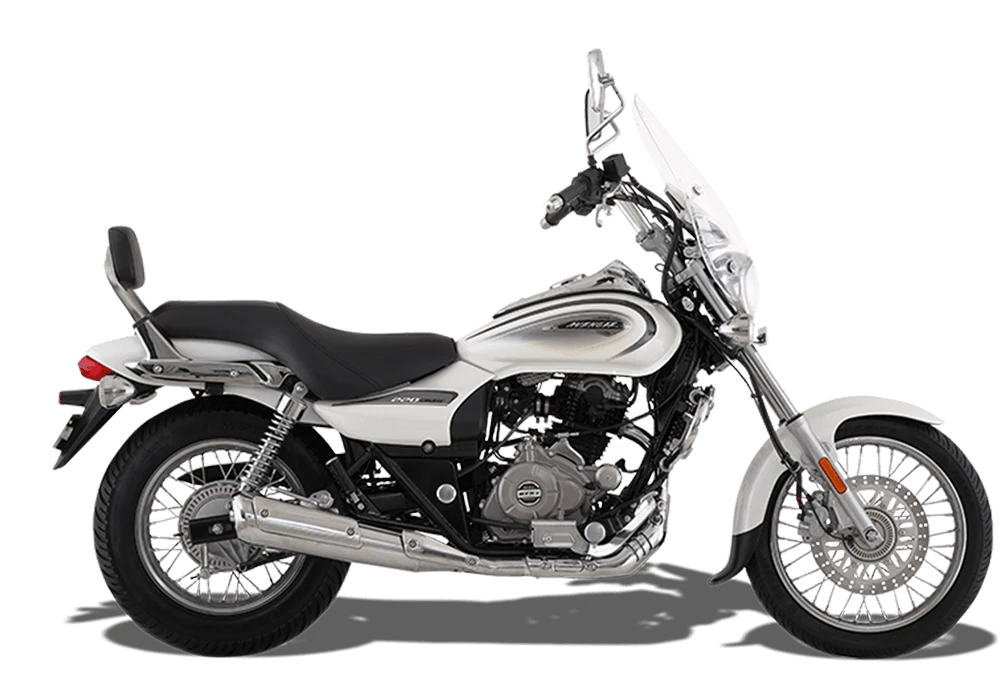
Bajaj Avenger Cruise 220
- 220 cc Oil-Cooled, 2-valve
- 19.03 PS @ 8500 rpm
- 40 km/l (ARAI)
- 13-litre tank
- 1 variant available
- Single-channel ABS
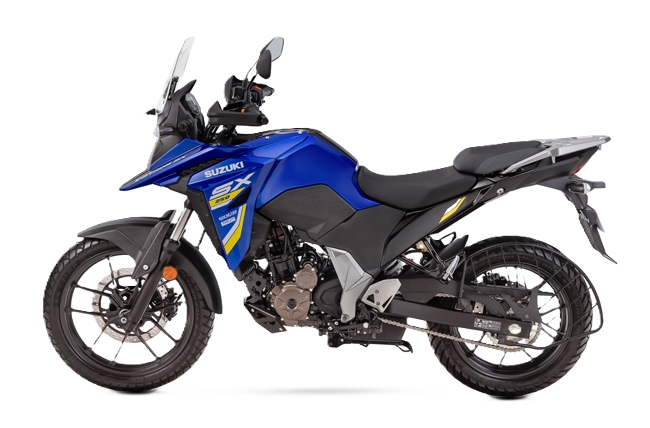
Suzuki V-Strom SX
- 249 cc Oil-Cooled, 4-valve
- 26.5 PS @ 9300 rpm
- 36 km/l (ARAI)
- 12-litre tank
- 1 variant available
- Dual-channel ABS + Bluetooth
Full Specification Comparison
Every number that matters — side by side
| Specification | Bajaj Avenger Cruise 220 | Suzuki V-Strom SX |
|---|---|---|
| Engine & Performance | ||
| Displacement | 220 cc | 249 cc |
| Cooling System | Oil-Cooled | Oil-Cooled |
| Max Power | 19.03 PS @ 8500 rpm | 26.5 PS @ 9300 rpm |
| Max Torque | 17.55 Nm @ 7000 rpm | 22.2 Nm @ 7300 rpm |
| Valves per Cylinder | 2 | 4 |
| Compression Ratio | 9.8 : 1 | 10.7 : 1 |
| Bore × Stroke | 67 × 62.4 mm | 76.0 × 54.9 mm |
| Emission Standard | BS6 Phase 2 | BS6 Phase 2 |
| Transmission | 5-Speed Manual | 6-Speed Manual |
| Top Speed | ~120 km/h | ~140 km/h |
| Riding Modes | No | No |
| Traction Control | No | No |
| Fuel & Range | ||
| Mileage (Claimed) | 40 km/l (ARAI) | 36 km/l (ARAI) |
| Mileage (Real-world) | ~39 km/l | ~34–36 km/l |
| Fuel Tank | 13 litres | 12 litres |
| Reserve Capacity | 3.8 litres | 2.4 litres |
| Riding Range | ~507 km | ~432 km |
| Brakes & Wheels | ||
| Braking System | Single Channel ABS | Dual Channel ABS |
| Front Brake | Disc – 280 mm | Disc – 300 mm |
| Rear Brake | Drum – 130 mm | Disc – 220 mm |
| Tyre Type | Tubed | Tubeless |
| Tyre Size (F / R) | 90/90-17 / 130/90-15 | 100/90-19 / 140/70-17 |
| Wheel Type | Spoke | Alloy |
| Suspension & Chassis | ||
| Front Suspension | Telescopic with double anti friction bush | Telescopic, Coil Spring, Oil Damped |
| Rear Suspension | 5-step adjustable Twin Shock Absorber | Swing Arm, Coil Spring, Oil Damped |
| Chassis | Tubular Double Cradle | Diamond |
| Rear Preload Adjuster | Yes | Yes |
| Dimensions & Weight | ||
| Kerb Weight | 163 kg | 167 kg |
| Seat Height | 737 mm | 835 mm |
| Ground Clearance | 169 mm | 205 mm |
| Wheelbase | 1490 mm | 1440 mm |
| Overall L × W × H | 2210 × 806 × 1321 mm | 2180 × 880 × 1355 mm |
| Features & Electronics | ||
| Instrument Console | Semi-Digital | Fully Digital LCD |
| Headlight | Halogen | LED |
| DRLs | Yes | Yes |
| Turn Signals | LED | Bulb |
| Hazard Warning Lights | No | Yes |
| Riding Modes | No | No |
| Traction Control | No | No |
| Bluetooth Connectivity | No | Yes |
| Call & SMS Alerts | No | Yes |
| USB Charging Port | No | Yes |
| Distance to Empty | No | Yes |
| Gear Indicator | No | Yes |
| Tachometer | No | Digital |
| Keyless Ignition | No | No |
| Pillion Backrest | Yes | No |
| Price & Warranty | ||
| Starting Price (ex-showroom) | ₹1,26,620 | ₹2,00,382 |
| Number of Variants | 1 | 1 |
| Standard Warranty | 5 Years / 75,000 km | 2 Years / 30,000 km |
★ Green highlights indicate the stronger value in each row. Prices are ex-showroom India averages and may vary by city.
Variant-wise Price Comparison
All variants laid out — find the right one for your budget
Avenger Cruise 220 Variants
V-Strom SX Variants
Pros & Cons
Honest strengths and weaknesses of each bike
Pros
- Significantly lower price — ₹73,762 cheaper than V-Strom SX
- Better fuel efficiency at 40 km/l (ARAI)
- Larger 13-litre tank for a longer riding range (~507 km)
- Very low 737 mm seat height — accessible for most riders
- Lighter at 163 kg — easier to manage
- Pillion backrest for comfortable two-up touring
- Exceptional 5-year / 75,000 km warranty
- Long 1490 mm wheelbase for highway stability
- Larger 3.8-litre reserve fuel capacity
Cons
- Significantly lower peak power (19.03 PS vs 26.5 PS)
- Only single-channel ABS; rear drum brake
- No Bluetooth, USB charging or digital navigation
- Semi-digital instrument console, no tachometer or gear indicator
- Tubed tyres on spoke wheels
- No hazard warning lights
- Halogen headlight vs LED on V-Strom SX
- Less ground clearance (169 mm vs 205 mm)
Pros
- Superior power output — 26.5 PS @ 9300 rpm
- Modern 4-valve oil-cooled engine with 6-speed gearbox
- Dual-channel ABS with rear disc brake as standard
- Bluetooth connectivity with call & SMS alerts
- Fully digital LCD console with tachometer, gear indicator, DTE
- LED headlight and hazard warning lights
- Excellent 205 mm ground clearance for rough roads
- 19-inch front wheel for better touring stability
- Tubeless alloy wheels for convenience
- USB charging port standard
Cons
- Significantly higher price at ₹2,00,382 ex-showroom
- Lower official mileage (36 km/l vs 40 km/l)
- Smaller 12-litre tank, less riding range (~432 km)
- Very tall 835 mm seat height — challenging for shorter riders
- Weak 2-year / 30,000 km warranty vs Bajaj's 5-year coverage
- No pillion backrest
- No riding modes or traction control
- Turn indicators use bulbs instead of LED
Key Differences Explained
What really sets these two bikes apart
Engine Character
The Avenger uses a 220cc oil-cooled, 2-valve engine delivering smooth, low-rev torque tuned for leisurely cruising. The V-Strom SX uses a 249cc oil-cooled, 4-valve unit producing 26.5 PS — nearly 39% more power — with a modern 6-speed gearbox. The V-Strom's engine is more versatile, performing equally well at city speeds and during high-speed highway runs.
Fuel Efficiency & Range
The Avenger leads on efficiency with an ARAI-certified 40 km/l against the V-Strom's 36 km/l. Its larger 13-litre tank also gives it a theoretical range of ~507 km versus ~432 km for the V-Strom SX's 12-litre tank. For budget-conscious daily riders, the Avenger's superior mileage and range make a meaningful difference to running costs.
Braking & Safety
The V-Strom SX has a clear braking advantage: it comes standard with dual-channel ABS, a larger 300 mm front disc, and a 220 mm rear disc. The Avenger Cruise 220 makes do with single-channel ABS, a smaller 280 mm front disc, and a rear drum brake. For highway riding and emergency stops, the V-Strom SX's braking package is significantly more reassuring.
Features & Technology
The V-Strom SX leads decisively on modern features: Bluetooth connectivity, call & SMS alerts, a fully digital LCD console with gear indicator, tachometer, distance-to-empty display, a USB charging port, LED headlight, and hazard warning lights are all standard. The Avenger's semi-digital console lacks a gear indicator, tachometer, and Bluetooth entirely — it relies on a simpler, proven feature set.
Warranty & Ownership
This is where the Avenger Cruise 220 scores a decisive win. Bajaj offers an outstanding 5-year / 75,000 km warranty, while Suzuki's coverage is limited to just 2 years / 30,000 km — less than half the kilometre coverage. For riders who travel high distances, the Avenger's warranty represents far lower financial risk over the ownership period.
Price & Value
The Avenger Cruise 220 starts at ₹1,26,620, while the V-Strom SX commands ₹2,00,382 — a gap of nearly ₹74,000. These are fundamentally different budget segments. For riders who want a capable, comfortable cruiser under ₹1.5 lakh, the Avenger is a clear choice. Those who can stretch to ₹2 lakh get a substantially more capable and feature-rich motorcycle in the V-Strom SX.
Expert Verdict
Which one should you actually buy?
Buy the Avenger Cruise 220 if…
- Your budget is under ₹1.5 lakh
- You want a relaxed cruiser for highway rides
- Low seat height and easy rideability are priorities
- You value the exceptional 5-year / 75,000 km warranty
- Better fuel economy and longer riding range matter to you
- Pillion comfort with a backrest is important
- Long-distance touring with proven, low-maintenance reliability
Buy the V-Strom SX if…
- You can stretch budget to ₹2 lakh for a more capable bike
- Strong outright performance (26.5 PS) matters to you
- Dual-channel ABS and rear disc brake are non-negotiable
- Bluetooth connectivity and modern console features are priorities
- You want adventure touring capability and high ground clearance
- You frequently ride on rough or uneven roads
- You enjoy spirited performance alongside comfortable touring
Overall Verdict: Two very different bikes for very different budgets. The Bajaj Avenger Cruise 220 and Suzuki V-Strom SX are separated by nearly ₹74,000, making a direct recommendation dependent entirely on budget and use case. If you want a comfortable, reliable, affordable cruiser with a stellar warranty, the Avenger delivers excellent value under ₹1.5 lakh. If your budget stretches to ₹2 lakh, the V-Strom SX is a significantly more capable motorcycle — offering superior power, dual-channel ABS, rear disc braking, Bluetooth connectivity, and adventure-tourer versatility that the Avenger cannot match. Choose based on budget first; both are strong performers within their respective price brackets.
Frequently Asked Questions
Common questions answered by our experts
The answer depends on your budget and riding priorities. The Bajaj Avenger Cruise 220 is the better choice for riders seeking an affordable, comfortable cruiser with a lower seat height, superior mileage (40 km/l), a larger tank, and an outstanding 5-year / 75,000 km warranty — all at ₹1,26,620. The Suzuki V-Strom SX at ₹2,00,382 offers a more capable package with 26.5 PS, dual-channel ABS, rear disc braking, Bluetooth, a fully digital console, and greater ground clearance for adventure touring.
The Bajaj Avenger Cruise 220 starts at ₹1,26,620 while the Suzuki V-Strom SX starts at ₹2,00,382 ex-showroom — a difference of approximately ₹73,762. Both bikes are single-variant models, so there are no higher trims to compare. The price gap places them in distinctly different market segments.
The Bajaj Avenger Cruise 220 delivers better mileage at 40 km/l (ARAI certified) compared to the Suzuki V-Strom SX's 36 km/l (ARAI certified). The Avenger also has a larger 13-litre tank versus the V-Strom's 12-litre unit, giving it a theoretical riding range of ~507 km versus ~432 km for the V-Strom SX.
The Suzuki V-Strom SX makes significantly more power at 26.5 PS @ 9300 rpm compared to the Bajaj Avenger Cruise 220's 19.03 PS @ 8500 rpm. The V-Strom also produces more torque at 22.2 Nm vs 17.55 Nm, and uses a more modern 249cc 4-valve engine with a 6-speed gearbox versus the Avenger's 220cc 2-valve engine with a 5-speed gearbox.
Yes, the Suzuki V-Strom SX comes equipped with dual-channel ABS as standard on its single variant, along with a 300 mm front disc and a 220 mm rear disc. The Bajaj Avenger Cruise 220 offers only single-channel ABS with a 280 mm front disc and a rear drum brake, which is a significant safety disadvantage compared to the V-Strom SX.
The Bajaj Avenger Cruise 220 has a significantly better warranty at 5 years / 75,000 km compared to the Suzuki V-Strom SX's 2 years / 30,000 km. The Avenger's warranty covers 2.5 times the duration and 2.5 times the kilometre limit of the V-Strom SX, making it a much stronger ownership proposition for high-mileage riders who want long-term peace of mind.