At a Glance
Key differences that define each motorcycle
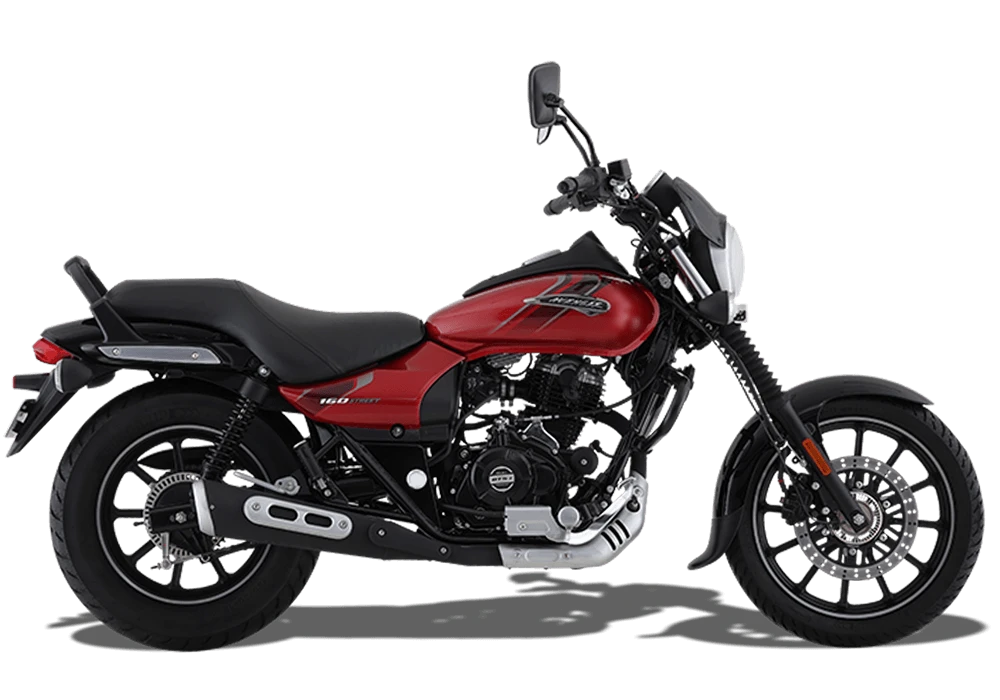
Bajaj Avenger Street 160
- 160 cc Air-Cooled, 2-valve
- 15 PS @ 8500 rpm
- 45 km/l (ARAI)
- 13-litre tank
- 1 variant available
- Single-channel ABS
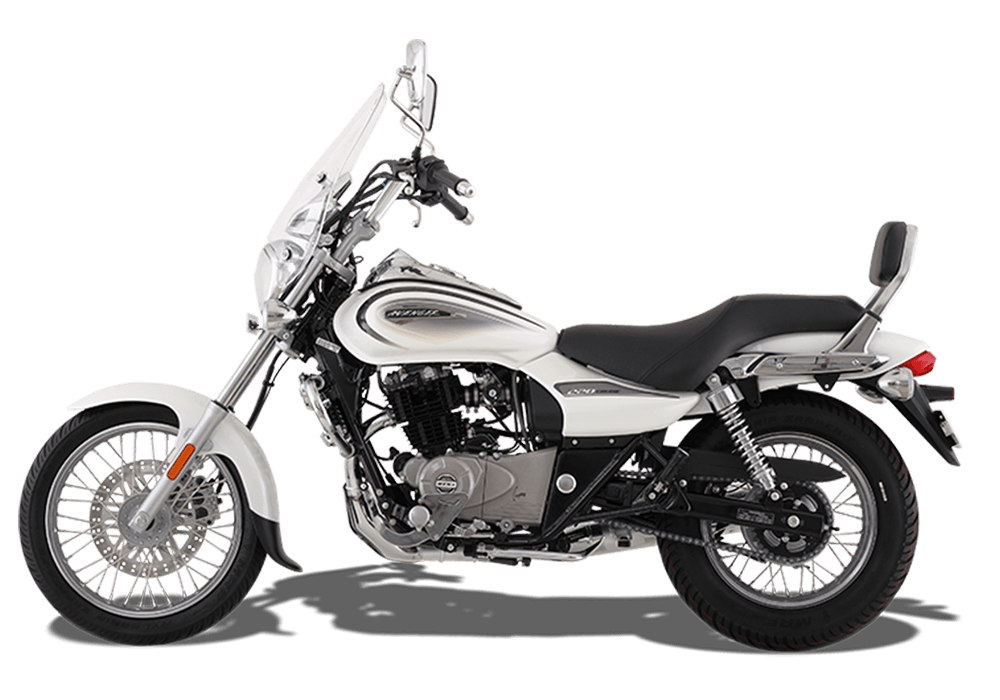
Bajaj Avenger Cruise 220
- 220 cc Oil-Cooled, 2-valve
- 19.03 PS @ 8500 rpm
- 40 km/l (ARAI)
- 13-litre tank
- 1 variant available
- Single-channel ABS
Full Specification Comparison
Every number that matters — side by side
| Specification | Avenger Street 160 | Avenger Cruise 220 |
|---|---|---|
| Engine & Performance | ||
| Displacement | 160 cc | 220 cc |
| Cooling System | Air-Cooled | Oil-Cooled |
| Max Power | 15 PS @ 8500 rpm | 19.03 PS @ 8500 rpm |
| Max Torque | 13.7 Nm @ 7000 rpm | 17.55 Nm @ 7000 rpm |
| Valves per Cylinder | 2 | 2 |
| Compression Ratio | 9.8 ± 0.3 : 1 | 9.8 : 1 |
| Bore × Stroke | 58 × 60.7 mm | 67 × 62.4 mm |
| Spark Plugs | 2 | 2 per cylinder |
| Emission Standard | BS6 | BS6 Phase 2 |
| Transmission | 5-Speed Manual | 5-Speed Manual |
| Top Speed | ~105 km/h | ~120 km/h |
| Riding Modes | No | No |
| Fuel & Range | ||
| Mileage (ARAI) | 45 km/l | 40 km/l |
| Fuel Tank | 13 litres | 13 litres |
| Reserve Capacity | 3.8 litres | 3.8 litres |
| Riding Range | ~585 km | ~507 km |
| Brakes & Wheels | ||
| Braking System | Single-Channel ABS | Single-Channel ABS |
| Front Brake | Disc – 280 mm | Disc – 280 mm |
| Rear Brake | Drum – 130 mm | Drum – 130 mm |
| Tyre Type | Tubeless | Tubed |
| Wheel Type | Alloy | Spoke |
| Front Wheel Size | 17 inch | 17 inch |
| Rear Wheel Size | 15 inch | 15 inch |
| Tyre Size (F / R) | 90/90-17 / 130/90-15 | 90/90-17 / 130/90-15 |
| Suspension & Chassis | ||
| Front Suspension | Telescopic Fork | Telescopic with Double Anti-Friction Bush |
| Rear Suspension | Twin Shock Absorbers | 5-step adj. Twin Shock Absorbers |
| Chassis | Tubular Double Cradle | Tubular Double Cradle |
| Rear Preload Adjuster | Yes | Yes |
| Dimensions & Weight | ||
| Kerb Weight | 156 kg | 163 kg |
| Seat Height | 737 mm | 737 mm |
| Ground Clearance | 169 mm | 169 mm |
| Wheelbase | 1490 mm | 1490 mm |
| Overall L × W × H | 2210 × 806 × 1070 mm | 2210 × 806 × 1321 mm |
| Features & Electronics | ||
| Instrument Console | Semi-Digital | Semi-Digital |
| Speedometer | Analogue | Digital |
| Headlight Type | Halogen | Halogen |
| DRLs | No | Yes |
| Brake / Tail Light | LED | LED |
| Turn Signals | Bulb | LED |
| Bluetooth Connectivity | No | No |
| USB Charging Port | No | No |
| Gear Indicator | No | No |
| Tachometer | No | No |
| Tripmeter | Digital | 2 Digital Tripmeters |
| Distance to Empty | No | No |
| Pillion Backrest | Yes | Yes |
| Traction Control | No | No |
| Keyless Ignition | No | No |
| Battery | 12V 4Ah | 12V 8Ah VRLA |
| Price & Warranty | ||
| Starting Price (ex-showroom) | ₹1,12,280 | ₹1,26,620 |
| Number of Variants | 1 | 1 |
| Standard Warranty | 5 Years / 75,000 km | 5 Years / 75,000 km |
★ Green highlights indicate the stronger value in each row. Prices are ex-showroom India averages and may vary by city.
Variant-wise Price Comparison
All variants laid out — find the right one for your budget
Avenger Street 160 Variants
Avenger Cruise 220 Variants
Pros & Cons
Honest strengths and weaknesses of each bike
Pros
- Significantly lower starting price (₹1,12,280)
- Better fuel efficiency at 45 km/l (ARAI)
- Longer riding range (~585 km vs ~507 km)
- Lighter at 156 kg — easier in city traffic
- Tubeless alloy wheels for convenience
- Identical seat height (737 mm) — equally accessible
- Same strong 5-year / 75,000 km warranty
Cons
- Less power (15 PS vs 19.03 PS)
- Lower top speed (~105 km/h vs ~120 km/h)
- Air-cooled engine less suited for sustained highway use
- No DRLs or LED turn signals
- Analogue speedometer feels dated
- Less torque (13.7 Nm vs 17.55 Nm)
Pros
- More power – 19.03 PS @ 8500 rpm
- Higher torque – 17.55 Nm for better overtaking
- Oil-cooled engine handles sustained speeds better
- Higher top speed (~120 km/h)
- DRLs and LED turn signals for better visibility
- Classic spoke wheels for authentic cruiser character
- 5-step adjustable rear suspension
- Same 5-year / 75,000 km warranty coverage
Cons
- Higher price (₹1,26,620 — ₹14,340 more)
- Lower mileage (40 km/l vs 45 km/l)
- Shorter riding range (~507 km vs ~585 km)
- Heavier at 163 kg
- Tubed spoke tyres require more maintenance
- No modern features (Bluetooth, USB charging)
Key Differences Explained
What really sets these two bikes apart
Engine Character
The Street 160 uses a 160 cc air-cooled DTS-i engine producing 15 PS, tuned for smooth city commuting and everyday fuel efficiency. The Cruise 220 steps up significantly with a 220 cc oil-cooled DTS-i engine making 19.03 PS and 17.55 Nm — a 27% power advantage that translates to noticeably stronger overtaking ability and more relaxed cruising at highway speeds.
Fuel Efficiency & Range
The Street 160 leads in fuel economy with an ARAI-certified 45 km/l against the Cruise 220's 40 km/l. Both bikes share the same 13-litre tank, giving the Street 160 a theoretical range of ~585 km versus ~507 km for the Cruise 220. For daily commuters, the Street 160's mileage advantage results in meaningful long-term savings.
Wheel & Tyre Setup
The Street 160 uses alloy wheels with tubeless tyres, making puncture repairs faster and easier — a practical advantage for urban riders. The Cruise 220 uses classic spoke wheels with tubed tyres that give it a more authentic cruiser aesthetic and a smoother ride on uneven roads, but require more maintenance effort.
Highway Touring Capability
The Cruise 220 is purpose-built for highway cruising. Its oil-cooled engine handles sustained high speeds with less thermal stress, and its 19.03 PS output allows comfortable cruising at 90–100 km/h without the engine straining. The Street 160's air-cooled engine and lower power make highway riding more demanding, especially on long stretches above 80 km/h.
Warranty & Ownership
Both bikes offer an identical and class-leading 5-year / 75,000 km warranty, which is one of the best in the cruiser segment. Bajaj's widespread service network ensures affordable ownership costs for both models. Spare parts are readily available and competitively priced across India.
Price & Value
The Street 160 starts at ₹1,12,280 — approximately ₹14,340 less than the Cruise 220's ₹1,26,620. For budget-conscious buyers, the Street 160 offers strong cruiser comfort, better mileage and identical warranty coverage at a significantly lower price. The Cruise 220's premium is justified only if highway performance and the 220cc engine are priorities.
Expert Verdict
Which one should you actually buy?
Buy the Avenger Street 160 if…
- Budget is your primary concern (saves ₹14,340)
- You primarily commute in city traffic daily
- Fuel efficiency and lower running costs matter
- You want tubeless alloy wheels for convenience
- You are a new rider wanting an accessible cruiser
- Longer riding range per fill is important to you
Buy the Avenger Cruise 220 if…
- You frequently do long highway rides and weekend tours
- More power (19.03 PS) and torque for overtaking matters
- You want an oil-cooled engine for sustained high-speed use
- Classic spoke wheel aesthetics appeal to you
- A higher top speed (~120 km/h) is important
- You want the full cruiser touring experience
Overall Winner for Most Riders: Bajaj Avenger Street 160. With a price advantage of ₹14,340, superior fuel efficiency (45 km/l vs 40 km/l), longer riding range (~585 km), lighter weight, tubeless alloy wheels and an identical class-leading 5-year / 75,000 km warranty, the Street 160 offers outstanding value for city commuters and budget-conscious buyers. Choose the Avenger Cruise 220 only if you regularly ride long highway distances and want the extra performance and thermal resilience of the 220cc oil-cooled engine to justify its higher price.
Frequently Asked Questions
Common questions answered by our experts
The Bajaj Avenger Street 160 is better for city commuters and budget buyers who want a lighter, more fuel-efficient cruiser at a lower price. The Avenger Cruise 220 is better for riders who prioritise highway touring, more engine power (19.03 PS vs 15 PS) and a smoother sustained-speed experience from its oil-cooled 220cc engine.
The Bajaj Avenger Street 160 is priced at ₹1,12,280 while the Avenger Cruise 220 costs ₹1,26,620 ex-showroom — a difference of ₹14,340. Both are available in a single variant. Prices may vary by city and dealer.
The Bajaj Avenger Street 160 delivers better mileage at an ARAI-certified 45 km/l compared to the Avenger Cruise 220's 40 km/l. Both bikes share the same 13-litre tank, which gives the Street 160 a longer theoretical riding range of ~585 km versus ~507 km for the Cruise 220.
The Bajaj Avenger Cruise 220 makes significantly more power at 19.03 PS @ 8500 rpm and 17.55 Nm of torque compared to the Street 160's 15 PS @ 8500 rpm and 13.7 Nm. The Cruise 220's oil-cooled 220cc engine also achieves a higher top speed of approximately 120 km/h versus 105 km/h for the Street 160.
Yes, both the Bajaj Avenger Street 160 and the Avenger Cruise 220 come equipped with single-channel ABS on the front wheel. Neither model offers dual-channel ABS, and both use a rear drum brake. The front disc brake size is identical on both bikes at 280 mm.
The Bajaj Avenger Cruise 220 is significantly better suited for long highway rides. Its 220cc oil-cooled engine handles sustained speeds more comfortably without thermal stress, while its higher power (19.03 PS) and torque (17.55 Nm) allow relaxed cruising at 90–100 km/h. The Avenger Street 160, while comfortable, is better suited for city commuting and occasional short highway runs.