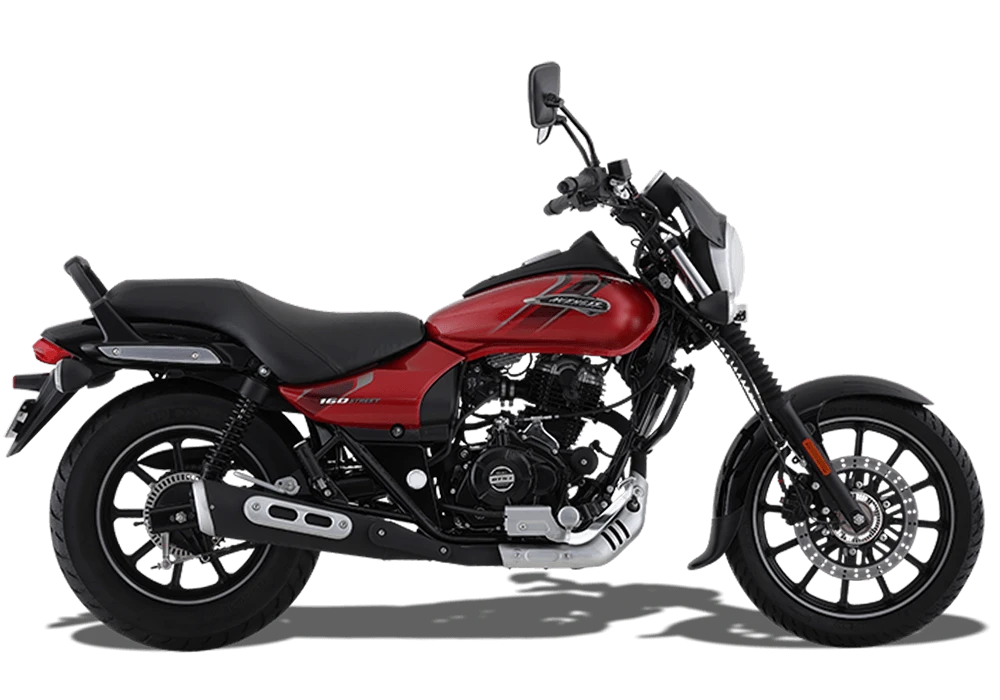
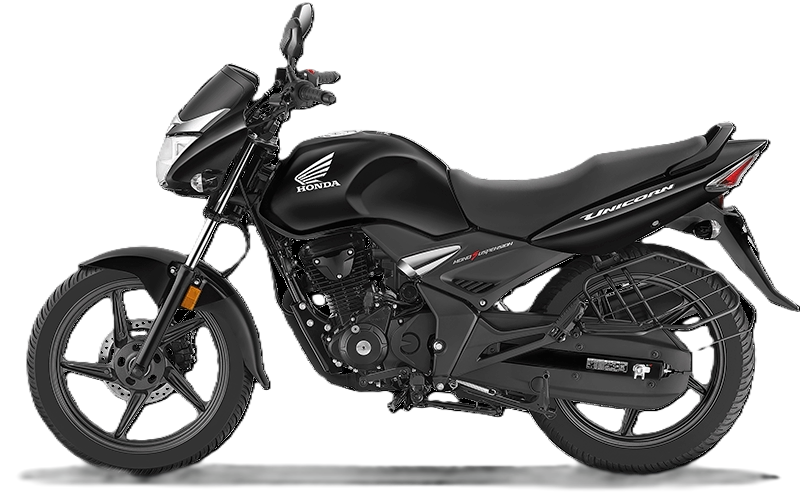
At a Glance
Key differences that define each motorcycle
Bajaj Avenger Street 160
- 160 cc Air-Cooled DTS-i, 2-valve
- 15 PS @ 8500 rpm
- 45 km/l (ARAI)
- 13-litre tank
- 1 variant available
- Cruiser ergonomics, 737 mm seat
Honda Unicorn
- 162.71 cc Air-Cooled, 2-valve
- 13.18 PS @ 7500 rpm
- 50 km/l (ARAI)
- 13-litre tank
- 1 variant available
- Single-Channel ABS, 187 mm clearance
Full Specification Comparison
Every number that matters — side by side
| Specification | Bajaj Avenger Street 160 | Honda Unicorn |
|---|---|---|
| Engine & Performance | ||
| Displacement | 160 cc | 162.71 cc |
| Cooling System | Air-Cooled | Air-Cooled |
| Max Power | 15 PS @ 8500 rpm | 13.18 PS @ 7500 rpm |
| Max Torque | 13.7 Nm @ 7000 rpm | 14.8 Nm @ 5250 rpm |
| Valves per Cylinder | 2 | 2 |
| Compression Ratio | 9.8 ± 0.3 : 1 | 10 ± 0.2 : 1 |
| Bore × Stroke | 58 × 60.7 mm | 57.3 × 63.1 mm |
| Emission Standard | BS6 | BS6 Phase 2 (OBD2) |
| Transmission | 5-Speed Manual | 5-Speed Manual |
| Top Speed | ~105 km/h | ~106 km/h |
| Riding Modes | No | No |
| Traction Control | No | No |
| Fuel & Range | ||
| Mileage (ARAI) | 45 km/l | 50 km/l |
| Fuel Tank | 13 litres | 13 litres |
| Reserve Capacity | 3.8 litres | 2 litres |
| Riding Range | ~585 km | ~650 km |
| Brakes & Wheels | ||
| Braking System | Single-Channel ABS | Single-Channel ABS |
| Front Brake | Disc – 280 mm | Disc – 240 mm |
| Rear Brake | Drum – 130 mm | Drum – 130 mm |
| Tyre Type | Tubeless | Tubeless |
| Tyre Size (F / R) | 90/90-17 / 130/90-15 | 80/100-18 / 100/90-18 |
| Wheel Size | 17-inch (F) / 15-inch (R) | 18-inch (F) / 18-inch (R) |
| Wheel Type | Alloy | Alloy |
| Suspension & Chassis | ||
| Front Suspension | Telescopic Fork | Telescopic |
| Rear Suspension | Twin Shock Absorbers | Monoshock |
| Chassis | Tubular Double Cradle | Diamond Type |
| Rear Preload Adjuster | Yes | No |
| Dimensions & Weight | ||
| Kerb Weight | 156 kg | 139 kg |
| Seat Height | 737 mm | 798 mm |
| Ground Clearance | 169 mm | 187 mm |
| Wheelbase | 1490 mm | 1335 mm |
| Overall L × W × H | 2210 × 806 × 1070 mm | 2081 × 756 × 1103 mm |
| Features & Electronics | ||
| Instrument Console | Semi-Digital | Digi-Analog |
| Headlight | Halogen | Halogen |
| DRLs | No | No |
| Turn Signals | Bulb | Bulb |
| Tail Light | LED | – |
| Hazard Warning Lights | No | No |
| Riding Modes | No | No |
| Bluetooth Connectivity | No | No |
| USB Charging Port | No | Yes (Type-C) |
| Tachometer | No | Yes |
| Gear Indicator | No | No |
| Service Reminder | Yes | No |
| Pillion Backrest | Yes | No |
| Keyless Ignition | No | No |
| Price & Warranty | ||
| Starting Price (ex-showroom) | ₹1,12,280 | ₹1,12,898 |
| Number of Variants | 1 | 1 |
| Standard Warranty | 5 Years / 75,000 km | 3 Years / 42,000 km |
★ Green highlights indicate the stronger value in each row. Prices are ex-showroom India averages and may vary by city.
Variant-wise Price Comparison
All variants laid out — find the right one for your budget
Avenger Street 160 Variants
Honda Unicorn Variants
Pros & Cons
Honest strengths and weaknesses of each bike
Pros
- Unique cruiser-style ergonomics in the 160cc segment
- Very low 737 mm seat height — ideal for shorter riders
- Higher peak power (15 PS vs 13.18 PS)
- Larger 280 mm front disc brake
- Massive 3.8-litre reserve fuel capacity (vs 2 litres)
- Exceptional 5-year / 75,000 km warranty
- Pillion backrest for improved pillion comfort
- Rear preload adjuster on twin shocks
- Slightly lower starting price (₹618 cheaper)
- LED tail light
- Service reminder on console
Cons
- Lower fuel efficiency (45 km/l vs 50 km/l)
- Less ground clearance (169 mm vs 187 mm)
- Heavier at 156 kg vs 139 kg
- No USB charging port
- No tachometer on console
- Halogen headlight — no LED
- Bulb turn signals — not LED
- No DRLs
- Cruiser style limits sporty riding flexibility
Pros
- Best-in-class ARAI mileage of 50 km/l
- Longer riding range (~650 km vs ~585 km)
- Superior ground clearance (187 mm vs 169 mm)
- Significantly lighter at 139 kg — easiest to handle
- Higher torque delivered lower in the rev range (14.8 Nm @ 5250 rpm)
- USB Type-C charging port standard
- Tachometer on instrument console
- Monoshock rear suspension for better ride quality
- Honda's legendary reliability and service network
- BS6 Phase 2 OBD2 compliance
Cons
- Lower peak power (13.18 PS vs 15 PS)
- Smaller 240 mm front disc brake
- Very limited reserve fuel capacity (2 litres)
- Weaker warranty — 3 years / 42,000 km
- Higher seat height (798 mm — less accessible)
- No pillion backrest
- No rear preload adjuster
- Halogen headlight — no LED
- Conservative commuter styling — less distinctive
Key Differences Explained
What really sets these two bikes apart
Style & Ergonomics
This is the most fundamental difference between the two bikes. The Bajaj Avenger Street 160 is a cruiser motorcycle — with a low 737 mm seat height, forward-set foot pegs, wide handlebars and a relaxed, outstretched riding posture. It even includes a pillion backrest. The Honda Unicorn is a conventional upright commuter with a 798 mm seat height and a neutral riding position. If you want the cruiser experience at a commuter price, only the Avenger delivers it.
Fuel Efficiency & Range
The Honda Unicorn leads clearly on economy with an ARAI-certified 50 km/l against the Avenger's 45 km/l — an 11% efficiency advantage. With the same 13-litre tank, the Unicorn delivers approximately 650 km of riding range versus ~585 km for the Avenger. However, the Avenger counters with a much larger 3.8-litre reserve capacity against the Unicorn's very modest 2 litres — a practical edge when running low far from a fuel station.
Engine Performance
The Avenger Street 160's 160 cc engine produces 15 PS — marginally more than the Unicorn's 13.18 PS. However, the Honda Unicorn makes considerably more torque — 14.8 Nm at just 5250 rpm versus the Avenger's 13.7 Nm at 7000 rpm. This means the Unicorn's pulling power arrives much earlier, making it feel stronger and smoother in stop-and-go city traffic without needing to rev the engine. Both bikes use air-cooled 2-valve engines with 5-speed gearboxes.
Braking & Ground Clearance
The Avenger holds a braking hardware edge with its 280 mm front disc (vs 240 mm on the Unicorn), though both bikes use single-channel ABS with a rear drum brake. The Unicorn counters strongly with 187 mm of ground clearance — 18 mm more than the Avenger's 169 mm. On rough and potholed Indian roads, the Unicorn's higher clearance is a meaningful daily advantage that the Avenger's low-slung cruiser design cannot match.
Weight & Handling
The Honda Unicorn is substantially lighter at 139 kg versus 156 kg for the Avenger — a 17 kg difference. This translates to noticeably easier manoeuvring in tight traffic, simpler parking, and less fatigue during slow-speed riding. The Unicorn's monoshock rear suspension also provides a more refined ride quality compared to the Avenger's twin shock setup. For pure city handling ease, the Unicorn wins outright.
Warranty & Ownership
The Bajaj Avenger Street 160 overwhelmingly wins on warranty. It offers an exceptional 5 years / 75,000 km against the Honda Unicorn's 3 years / 42,000 km. That is nearly double the kilometre coverage and 2 additional years. For a daily commuter clocking 15,000 km per year, the Avenger's warranty lasts 5 years while the Unicorn's runs out after less than 3 years of use. The Avenger's warranty advantage is one of the most compelling in this segment.
Expert Verdict
Which one should you actually buy?
Buy the Avenger Street 160 if…
- You want a cruiser-style motorcycle at a commuter price
- The very low 737 mm seat height fits your stature
- Relaxed ergonomics for long daily rides are a priority
- The exceptional 5-year / 75,000 km warranty matters to you
- You carry a pillion regularly and want the backrest comfort
- The large 3.8-litre reserve capacity gives peace of mind on highways
- Distinctive cruiser styling sets it apart from regular commuters
Buy the Honda Unicorn if…
- Best-in-class fuel efficiency (50 km/l) is your top priority
- You want the longest riding range (~650 km per tank)
- Ground clearance (187 mm) matters on your daily routes
- A lighter, easier-to-handle 139 kg motorcycle suits you
- USB Type-C charging and a tachometer are useful daily
- Honda's legendary reliability and service network give you peace of mind
- You prefer an upright commuter posture over cruiser ergonomics
Overall Winner for Most Riders: Honda Unicorn. The Honda Unicorn edges ahead as the better all-round commuter motorcycle — its best-in-class 50 km/l ARAI mileage and longer ~650 km riding range, 187 mm ground clearance, 17 kg lighter 139 kg kerb weight, monoshock rear suspension, USB Type-C charging port, and Honda's renowned long-term reliability make it the more practical daily choice for the majority of Indian commuters. However, the Bajaj Avenger Street 160 is the clear winner for anyone who specifically wants cruiser-style ergonomics with a low seat height — it is the only motorcycle in this price range that delivers that experience, backed by an outstanding 5-year / 75,000 km warranty that comprehensively beats the Unicorn's 3-year / 42,000 km coverage.
Frequently Asked Questions
Common questions answered by our experts
The Honda Unicorn is the better all-round commuter for most buyers — offering superior fuel efficiency (50 km/l ARAI), longer riding range, better ground clearance (187 mm), lighter weight (139 kg), a USB Type-C port and Honda reliability. The Bajaj Avenger Street 160 is the clear choice if you want cruiser-style ergonomics, a very low 737 mm seat height, a pillion backrest, a larger reserve fuel capacity, or the outstanding 5-year / 75,000 km warranty.
The Bajaj Avenger Street 160 starts at ₹1,12,280 while the Honda Unicorn starts at ₹1,12,898 ex-showroom — a difference of just ₹618. Both bikes are available in a single variant. This makes the price gap essentially negligible, and the decision should be based entirely on which bike's strengths better match your riding priorities. All prices are ex-showroom India averages and may vary by city.
The Honda Unicorn has better ARAI-certified mileage at 50 km/l compared to the Avenger Street 160's 45 km/l. With identical 13-litre tanks, the Unicorn delivers approximately 650 km of range versus ~585 km for the Avenger — a 65 km advantage per tank. For a daily commuter filling up twice a month, the Unicorn's better efficiency translates to meaningful monthly fuel savings. However, the Avenger's larger 3.8-litre reserve (vs 2 litres) gives more buffer when running close to empty.
The Bajaj Avenger Street 160 makes more peak power at 15 PS @ 8500 rpm versus the Honda Unicorn's 13.18 PS @ 7500 rpm. However, the Honda Unicorn produces more torque at 14.8 Nm @ 5250 rpm compared to 13.7 Nm @ 7000 rpm for the Avenger — and crucially, the Unicorn's torque arrives much earlier in the rev range. This makes the Honda feel punchier and more effortless in everyday city traffic without needing to rev hard. For pure commuting usability, the Unicorn's low-end torque advantage is more practical than the Avenger's peak power figure.
In terms of hardware, the Bajaj Avenger Street 160 has a larger 280 mm front disc versus the Honda Unicorn's 240 mm unit — a 40 mm advantage. Both bikes use single-channel ABS with a rear drum brake of the same 130 mm size. The Avenger's bigger front disc provides greater stopping power on paper, though both bikes are adequate for their intended riding styles. Neither offers dual-channel ABS at this price point.
The Bajaj Avenger Street 160 has a dramatically better warranty at 5 years / 75,000 km compared to the Honda Unicorn's 3 years / 42,000 km. That is nearly double the kilometre coverage and 2 additional years. For a daily commuter covering 15,000 km per year, the Avenger's warranty runs for 5 years of coverage while the Unicorn's expires after just under 3 years of similar usage. This is one of the most significant advantages the Avenger holds in this comparison.