At a Glance
Key differences that define each motorcycle
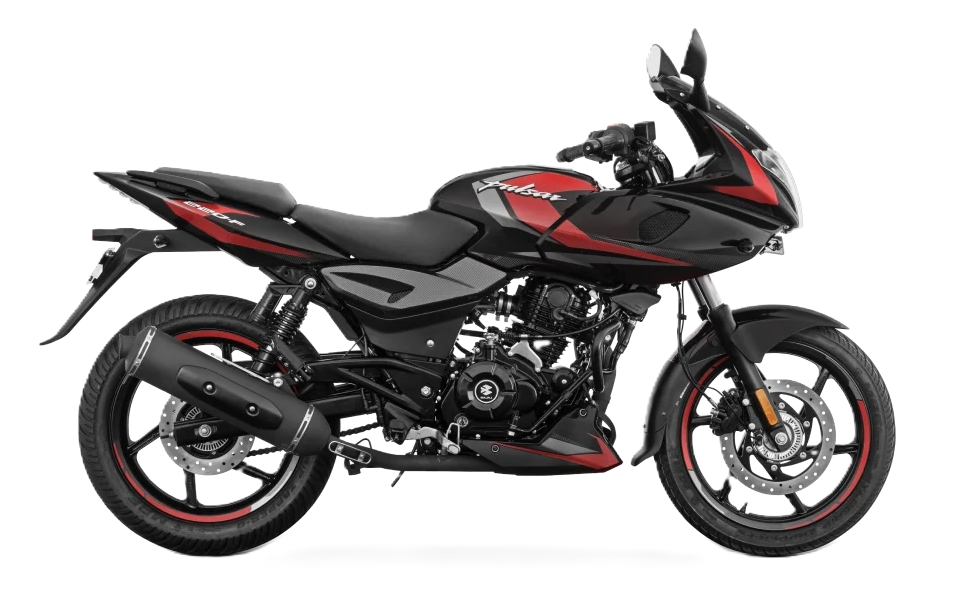
Bajaj Pulsar 220F
- 220.4 cc Oil-Cooled, 2-valve DTS-i
- 20.4 PS @ 8500 rpm
- 40 km/l (Claimed)
- 15-litre tank
- 1 variant available
- Single-channel ABS
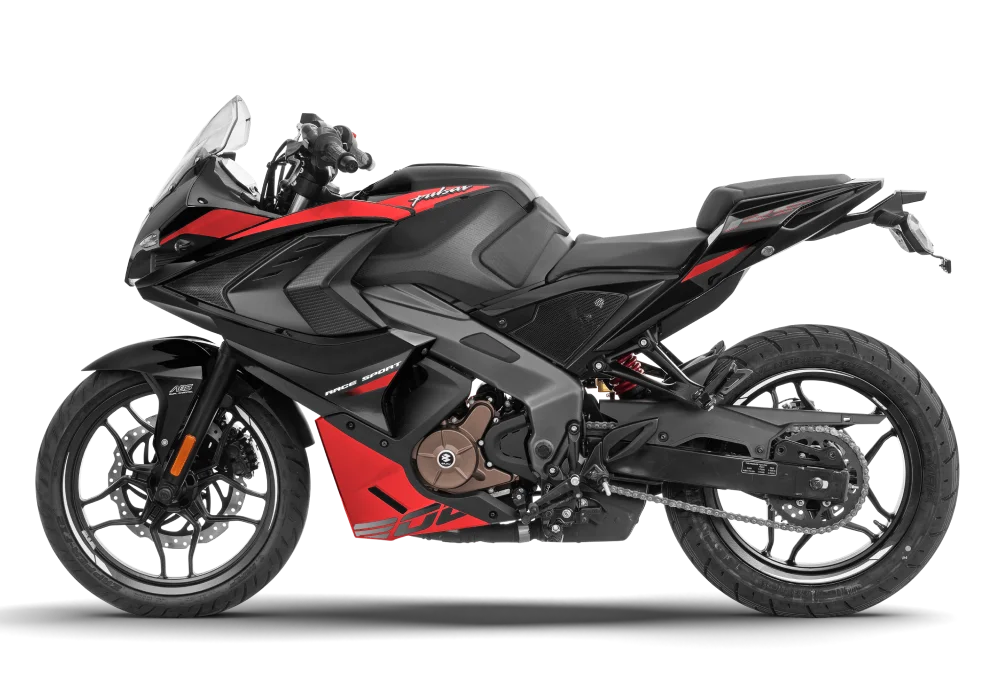
Bajaj Pulsar RS200
- 199.5 cc Liquid-Cooled, 4-valve SOHC
- 24.5 PS @ 9750 rpm
- 35 km/l (ARAI)
- 13-litre tank
- 1 variant available
- Dual-channel ABS + Riding Modes
Full Specification Comparison
Every number that matters — side by side
| Specification | Bajaj Pulsar 220F | Bajaj Pulsar RS200 |
|---|---|---|
| Engine & Performance | ||
| Displacement | 220.4 cc | 199.5 cc |
| Cooling System | Oil-Cooled | Liquid-Cooled |
| Engine Type | SOHC, 2-valve DTS-i | SOHC, 4-valve, Triple Spark |
| Max Power | 20.4 PS @ 8500 rpm | 24.5 PS @ 9750 rpm |
| Max Torque | 18.55 Nm @ 7000 rpm | 18.74 Nm @ 8000 rpm |
| Valves per Cylinder | 2 | 4 |
| Bore × Stroke | 67 × 62.4 mm | 72 × 49 mm |
| Compression Ratio | 9.5 : 1 | 11 ± 0.5 : 1 |
| Emission Standard | BS6 | BS6 |
| Transmission | 5-Speed Manual | 6-Speed Manual |
| Clutch | Wet Multi-Plate | Wet Multiplate |
| Top Speed | ~135 km/h | ~141 km/h |
| Riding Modes | No | Road, Rain, Offroad |
| Traction Control | No | No |
| Fuel & Range | ||
| Mileage (Claimed) | 40 km/l (Claimed) | 35 km/l (ARAI) |
| Fuel Tank | 15 litres | 13 litres |
| Reserve Capacity | 3.2 litres | 2.6 litres |
| Riding Range | ~600 km | ~455 km |
| Brakes & Wheels | ||
| Braking System | Single Channel ABS | Dual Channel ABS |
| Front Brake | Disc – 280 mm | Disc – 300 mm |
| Rear Brake | Disc – 230 mm | Disc – 230 mm |
| Tyre Type | Tubeless | Tubeless |
| Tyre Size (F / R) | 90/90-17 / 120/80-17 | 110/70-17 / 140/70-17 |
| Wheel Type | Alloy | Alloy |
| Suspension & Chassis | ||
| Front Suspension | Telescopic Fork | Telescopic Fork with Anti-Friction Bush |
| Rear Suspension | Nitrox Twin Shock Absorber | Nitrox Monoshock with Canister |
| Chassis | Double Cradle Frame | Perimeter Frame |
| Rear Preload Adjuster | Yes | Yes |
| Dimensions & Weight | ||
| Kerb Weight | 160 kg | 167 kg |
| Seat Height | 795 mm | 810 mm |
| Ground Clearance | 165 mm | 157 mm |
| Wheelbase | 1350 mm | 1345 mm |
| Overall L × W × H | 2035 × 750 × 1165 mm | 1999 × 765 × 1114 mm |
| Features & Electronics | ||
| Instrument Console | Semi-Digital | Fully Digital LCD |
| Headlight | Halogen Projector | Halogen Projector |
| DRLs | No | Yes |
| Turn Signals | Halogen Bulb | Bulb |
| Hazard Warning Lights | No | Yes |
| Riding Modes | No | Road / Rain / Offroad |
| Traction Control | No | No |
| Bluetooth Connectivity | No | Yes |
| Call & SMS Alerts | No | Yes |
| USB Charging Port | No | No |
| Distance to Empty | No | Yes |
| Gear Indicator | No | Yes |
| Tachometer | Analogue | Digital |
| Fuel Gauge | Analogue | Digital |
| Service Reminder | No | Yes |
| Keyless Ignition | No | No |
| Price & Warranty | ||
| Ex-Showroom Price | ₹1,29,924 | ₹1,72,857 |
| Number of Variants | 1 | 1 |
| Standard Warranty | 5 Years / 75,000 km | 5 Years / 75,000 km |
★ Green highlights indicate the stronger value in each row. Prices are ex-showroom India averages and may vary by city.
Variant-wise Price Comparison
Both bikes are single-variant — here's exactly what each price buys you
Pulsar 220F Variants
Pulsar RS200 Variants
Pros & Cons
Honest strengths and weaknesses of each bike
Pros
- ₹42,933 cheaper than the RS200 — significantly lower price
- Larger 220.4 cc engine — bigger displacement
- Better mileage — ~40 km/l vs 35 km/l
- Larger 15-litre tank with ~600 km riding range
- Lighter at 160 kg vs 167 kg
- Better ground clearance (165 mm vs 157 mm)
- Iconic semi-faired design with projector headlamp
- Same 5-year / 75,000 km warranty as RS200
- Proven, low-maintenance oil-cooled engine platform
- Lower running and maintenance costs
Cons
- Lower peak power (20.4 PS vs 24.5 PS)
- Only single-channel ABS vs dual-channel
- Older 2-valve engine — less refined at high rpm
- No riding modes
- No Bluetooth or digital connectivity
- Semi-digital console — analogue tachometer & fuel gauge
- No DRLs, no hazard warning lights, no gear indicator
- Smaller 280 mm front disc vs 300 mm
- Twin shock rear suspension vs monoshock
- Narrower 120/80-17 rear tyre vs 140/70-17
Pros
- Higher peak power – 24.5 PS @ 9750 rpm
- Liquid-cooled 4-valve engine with smoother power delivery
- Dual-channel ABS as standard
- Fully-faired aerodynamic design with DRLs and hazard lights
- Riding modes: Road, Rain and Off-Road
- Bluetooth connectivity with Call & SMS alerts
- Fully digital LCD console with gear indicator & DTE
- Larger 300 mm front disc brake
- Monoshock rear suspension for better handling
- Perimeter frame for superior rigidity and cornering
- Wider 140/70-17 rear tyre for better grip
- Higher top speed (~141 km/h vs ~135 km/h)
- 6-speed gearbox vs 5-speed
Cons
- ₹42,933 more expensive than the 220F
- Lower mileage — 35 km/l vs ~40 km/l
- Smaller 13-litre tank, shorter range (~455 km)
- Heavier at 167 kg vs 160 kg
- Less ground clearance (157 mm vs 165 mm)
- No USB charging port
- Halogen projector headlight (not LED)
- Bulb turn signals (not LED)
- Smaller displacement — 199.5 cc vs 220.4 cc
Key Differences Explained
What really sets these two Pulsars apart
Engine & Performance
The 220F uses a 220.4 cc oil-cooled, 2-valve DTS-i engine producing 20.4 PS — larger in displacement but tuned for mid-range torque and fuel efficiency. The RS200 runs a more advanced 199.5 cc liquid-cooled, 4-valve triple-spark unit delivering 24.5 PS — 20% more power despite smaller displacement. The RS200's liquid cooling and 4-valve design also result in better high-rpm refinement and a more energetic character, while the 220F engine is more relaxed and highway-oriented.
Price & Value
The 220F is priced at ₹1,29,924 versus ₹1,72,857 for the RS200 — a difference of ₹42,933. That is a significant premium for the RS200's upgrades: dual-channel ABS, full fairing, liquid-cooled engine, riding modes and Bluetooth. For buyers on a tighter budget, the 220F delivers strong highway performance and Bajaj reliability at a considerably lower price, with the same 5-year / 75,000 km warranty.
Fuel Efficiency & Range
The 220F leads clearly in this category. With a claimed 40 km/l and a large 15-litre tank, it delivers a riding range of roughly 600 km — a full 145 km more than the RS200's ~455 km from its 13-litre tank at 35 km/l ARAI mileage. For daily commuters and long-distance tourers who want to minimise fuel stops, the 220F's range advantage is very practical.
Braking & Safety
The RS200 has a meaningful safety edge. It comes with dual-channel ABS and a larger 300 mm front disc, versus the 220F's single-channel ABS and 280 mm front disc. The RS200 also gets a wider 140/70-17 rear tyre for better grip during braking. In emergency situations, especially on uneven or wet surfaces, the RS200's dual-channel setup provides superior stability and control.
Features & Design
The RS200 is a generation ahead on features. It offers a fully digital LCD console with gear indicator, distance-to-empty and service reminder, plus Bluetooth connectivity with Call & SMS alerts, riding modes and DRLs. The 220F has a semi-digital console with an analogue tachometer and fuel gauge, no connectivity, no DRLs, no riding modes and no hazard warning lights. Design-wise, the RS200's full fairing gives it a more premium sport bike appearance.
Chassis & Handling
The RS200 has the stronger chassis package. Its perimeter frame offers greater rigidity than the 220F's double cradle frame, and its monoshock rear suspension with canister delivers better cornering composure than the 220F's Nitrox twin shocks. However, the 220F weighs 7 kg less (160 kg vs 167 kg) and has better ground clearance (165 mm vs 157 mm), which benefits it on rougher roads and in tighter city manoeuvring.
Expert Verdict
Which one should you actually buy?
Buy the Pulsar 220F if…
- Budget is key — you save ₹42,933 over the RS200
- Long riding range (~600 km) is important for your daily routes
- Better fuel efficiency (~40 km/l vs 35 km/l) matters to you
- You want a lighter motorcycle (160 kg) for easier city handling
- Highway touring is your primary use case
- A proven, low-maintenance, widely-available engine is a priority
- You're happy with single-channel ABS for the price point
Buy the Pulsar RS200 if…
- You want more outright power (24.5 PS) and a sportier ride
- Dual-channel ABS and a 300 mm front disc matter for safety
- A fully-faired sport bike design with DRLs is important
- Riding modes (Road, Rain, Off-Road) are a useful feature
- Bluetooth connectivity and a fully digital console are priorities
- The perimeter frame and monoshock setup improve your riding confidence
- You can stretch your budget by ₹42,933 for a more capable bike
Two Pulsars, two very different use cases. The Bajaj Pulsar 220F is the right choice if you want the most affordable entry into the Pulsar performance family — with a bigger engine displacement, better mileage, a longer range of ~600 km, a lighter body and the same 5-year / 75,000 km warranty, all at ₹1,29,924. The Bajaj Pulsar RS200 is the right step-up if you can invest ₹42,933 more for meaningfully better performance (24.5 PS), dual-channel ABS, a fully-faired sport design, riding modes, Bluetooth and a more modern feature set — making it the better all-round Pulsar for 2026.
Frequently Asked Questions
Common questions answered by our experts
The Bajaj Pulsar 220F is better for budget buyers who want a larger 220.4 cc engine, better mileage (~40 km/l), a bigger 15-litre tank with ~600 km range, a lower price of ₹1,29,924 and a lighter 160 kg body. The Bajaj Pulsar RS200 is better if you can spend ₹42,933 more and want stronger performance (24.5 PS), dual-channel ABS, a fully-faired design, riding modes, Bluetooth connectivity and a modern fully digital instrument cluster.
The Bajaj Pulsar 220F is priced at ₹1,29,924 ex-showroom while the Bajaj Pulsar RS200 is priced at ₹1,72,857 ex-showroom. The RS200 is approximately ₹42,933 more expensive. Both bikes are available in a single variant in India. Prices may vary by city.
The Bajaj Pulsar 220F has better mileage at around 40 km/l compared to the Bajaj Pulsar RS200's ARAI-certified 35 km/l. The 220F's advantage is even greater when considering range — its larger 15-litre tank delivers ~600 km versus ~455 km for the RS200's 13-litre tank. The 220F is the clear winner for fuel economy and riding range.
The Bajaj Pulsar RS200 makes significantly more power at 24.5 PS @ 9750 rpm compared to the Bajaj Pulsar 220F's 20.4 PS @ 8500 rpm — a 20% power advantage despite a smaller 199.5 cc displacement. The RS200 also produces marginally more torque at 18.74 Nm vs 18.55 Nm. Its liquid-cooled 4-valve engine with triple spark plugs delivers better refinement and a more performance-oriented character than the 220F's oil-cooled 2-valve motor.
No, the Bajaj Pulsar 220F comes with single-channel ABS only, working only on the front wheel. The Bajaj Pulsar RS200 comes with dual-channel ABS as standard, working on both wheels and offering better braking stability on slippery or uneven surfaces. The RS200 also has a larger 300 mm front disc versus 280 mm on the 220F.
Both are capable highway tourers but with different strengths. The Pulsar 220F offers better mileage (~40 km/l), a much larger 15-litre tank (~600 km range) and a lighter body, making it ideal for economy long-distance touring with fewer refuelling stops. The RS200 offers more power (24.5 PS), a fully-faired aerodynamic design with wind protection, riding modes and a higher top speed (~141 km/h), making it better suited for faster, sportier highway runs. Choose the 220F for range and economy; choose the RS200 for performance and speed.