At a Glance
Key differences that define each motorcycle
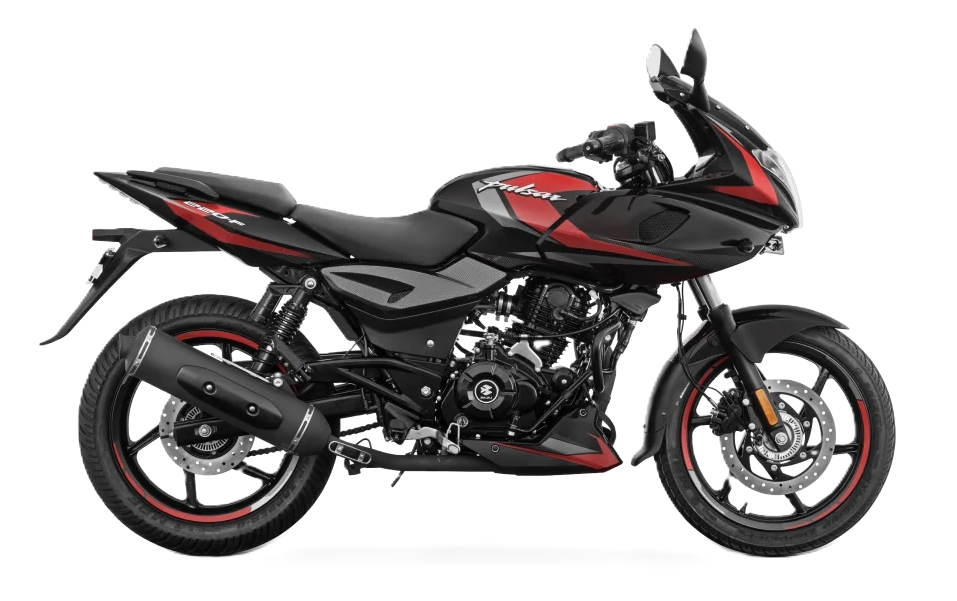
Bajaj Pulsar 220F
- 220.4 cc Oil-Cooled, 2-valve DTS-i
- 20.4 PS @ 8500 rpm
- 40 km/l (Claimed)
- 15-litre tank
- 1 variant available
- Single-channel ABS
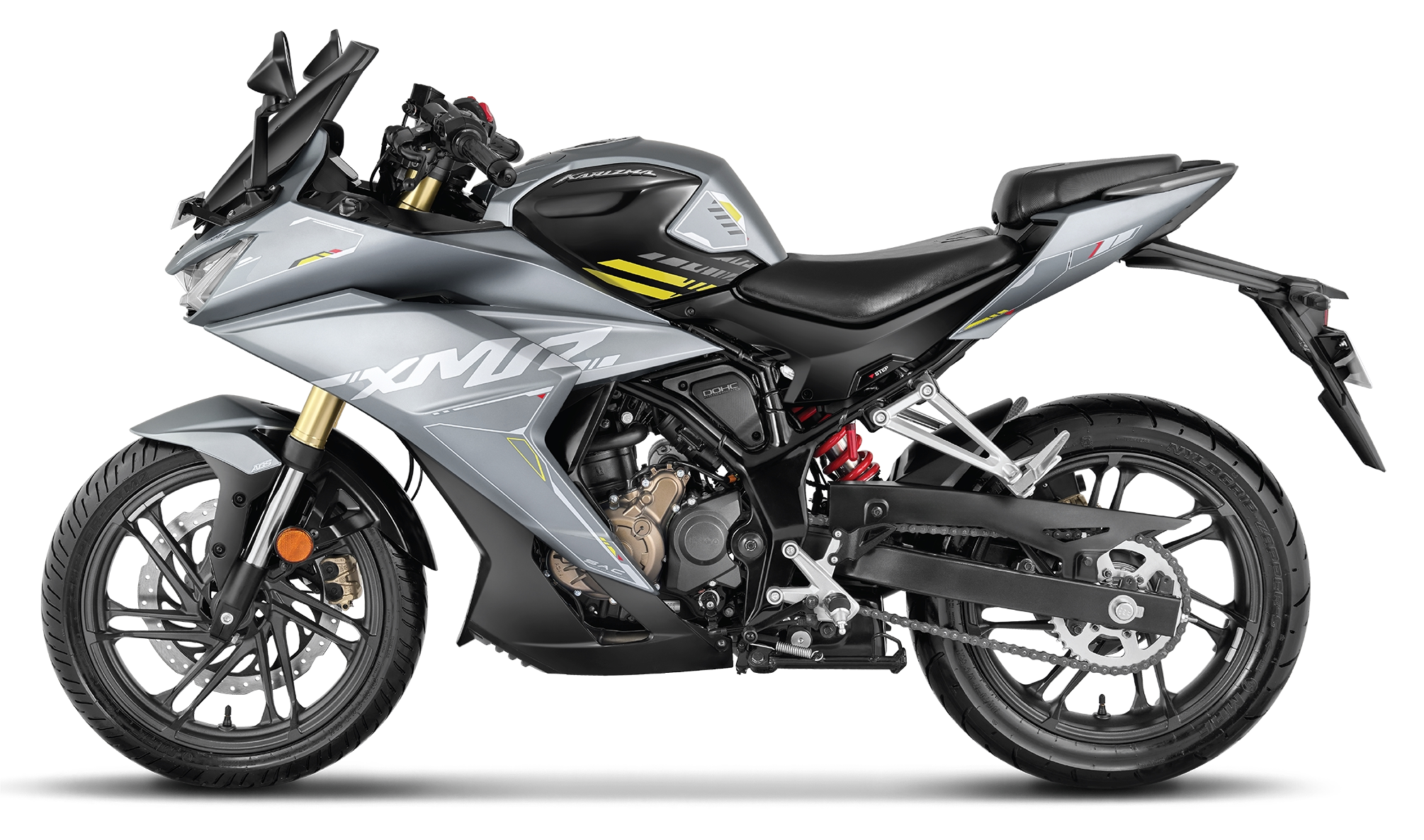
Hero Karizma XMR
- 210 cc Liquid-Cooled, DOHC 4-valve
- 25.5 PS @ 9250 rpm
- 41.55 km/l (ARAI)
- 11-litre tank
- 2 variants available
- Dual-channel ABS + Slipper Clutch
Full Specification Comparison
Every number that matters — side by side
| Specification | Bajaj Pulsar 220F | Hero Karizma XMR |
|---|---|---|
| Engine & Performance | ||
| Displacement | 220.4 cc | 210 cc |
| Cooling System | Oil-Cooled | Liquid-Cooled |
| Engine Type | SOHC, 2-valve DTS-i | DOHC, 4-valve |
| Max Power | 20.4 PS @ 8500 rpm | 25.5 PS @ 9250 rpm |
| Max Torque | 18.55 Nm @ 7000 rpm | 20.4 Nm @ 7250 rpm |
| Valves per Cylinder | 2 | 4 |
| Bore × Stroke | 67 × 62.4 mm | 73 × 50 mm |
| Compression Ratio | 9.5 : 1 | 12 : 1 |
| Emission Standard | BS6 | BS6 Phase 2 |
| Transmission | 5-Speed Manual | 6-Speed Manual |
| Clutch | Wet Multi-Plate | Wet Type Slip & Assist |
| Top Speed | ~135 km/h | ~130 km/h |
| Riding Modes | No | No |
| Traction Control | No | No |
| Fuel & Range | ||
| Mileage (Claimed) | 40 km/l (Claimed) | 41.55 km/l (ARAI) |
| Fuel Tank | 15 litres | 11 litres |
| Reserve Capacity | 3.2 litres | 2.2 litres |
| Riding Range | ~600 km | ~457 km |
| Brakes & Wheels | ||
| Braking System | Single Channel ABS | Dual Channel ABS |
| Front Brake | Disc – 280 mm | Petal Disc – 300 mm |
| Rear Brake | Disc – 230 mm | Petal Disc – 230 mm |
| Tyre Type | Tubeless | Tubeless |
| Tyre Size (F / R) | 90/90-17 / 120/80-17 | 100/80-17 / 140/70-17 |
| Wheel Type | Alloy | Alloy |
| Suspension & Chassis | ||
| Front Suspension | Telescopic Fork | 37 mm Telescopic Fork with Anti-Friction Bush (USD on Combat Edition) |
| Rear Suspension | Nitrox Twin Shock Absorber | Gas Charged Monoshock (6-step adjustable) |
| Chassis | Double Cradle Frame | Steel Trellis Frame |
| Rear Preload Adjuster | Yes | Yes |
| Dimensions & Weight | ||
| Kerb Weight | 160 kg | 163.5 kg |
| Seat Height | 795 mm | 810 mm |
| Ground Clearance | 165 mm | 160 mm |
| Wheelbase | 1350 mm | 1351 mm |
| Overall L × W × H | 2035 × 750 × 1165 mm | 2068 × 760 × 1110 mm |
| Features & Electronics | ||
| Instrument Console | Semi-Digital | Digital LCD (TFT on Combat Edition) |
| Headlight | Halogen Projector | LED Projector |
| DRLs | No | Yes |
| Turn Signals | Halogen Bulb | LED |
| Hazard Warning Lights | No | Yes |
| Riding Modes | No | No |
| Traction Control | No | No |
| Bluetooth Connectivity | No | Yes |
| Call & SMS Alerts | No | Yes |
| USB Charging Port | No | Yes |
| Distance to Empty | No | Yes |
| Gear Indicator | No | Yes |
| Tachometer | Analogue | Digital |
| Fuel Gauge | Analogue | Digital |
| Service Reminder | No | Yes |
| Keyless Ignition | No | No |
| Price & Warranty | ||
| Starting Price (ex-showroom) | ₹1,29,924 | ₹1,84,154 |
| Top Variant Price | ₹1,29,924 | ₹1,85,767 (Combat Edition) |
| Number of Variants | 1 | 2 |
| Standard Warranty | 5 Years / 75,000 km | 5 Years / 70,000 km |
★ Green highlights indicate the stronger value in each row. Prices are ex-showroom India averages and may vary by city.
Variant-wise Price Comparison
All variants laid out — find the right one for your budget
Pulsar 220F Variants
Karizma XMR Variants
Pros & Cons
Honest strengths and weaknesses of each bike
Pros
- Significantly lower price — ₹54,230 cheaper than Karizma XMR
- Larger 220.4 cc engine displacement
- Massive 15-litre fuel tank — longest range (~600 km) in comparison
- Lighter kerb weight at 160 kg vs 163.5 kg
- Better ground clearance (165 mm vs 160 mm)
- Slightly higher top speed (~135 km/h vs ~130 km/h)
- Excellent 5-year / 75,000 km warranty
- Proven, long-term reliable engine platform
- Iconic semi-faired design with wide aftermarket support
- Low maintenance costs and wide Bajaj service network
Cons
- Lower peak power (20.4 PS vs 25.5 PS)
- Only single-channel ABS vs dual-channel
- No Bluetooth, no digital console, no LED headlight
- No DRLs, no hazard warning lights, no gear indicator
- Smaller 280 mm front disc vs 300 mm petal disc
- Older 2-valve SOHC engine vs modern 4-valve DOHC
- No assist and slipper clutch
- Twin shock rear suspension vs monoshock
- Semi-digital instrument cluster (analogue tachometer & fuel gauge)
- No USB charging port or mobile connectivity
Pros
- Higher peak power – 25.5 PS @ 9250 rpm
- Modern liquid-cooled DOHC 4-valve engine
- Dual-channel ABS with 300 mm petal disc — superior braking safety
- Full-faired aerodynamic design with LED projector headlamp
- Bluetooth connectivity with Call & SMS alerts
- Assist and slipper clutch for smoother riding
- Fully digital instrument cluster with gear indicator & DTE
- Gas-charged monoshock rear suspension (6-step adjustable)
- LED turn signals, DRLs and hazard warning lights
- USB charging port standard
- Combat Edition gets USD forks and TFT display
- ARAI-certified mileage of 41.55 km/l
- Steel trellis frame for better rigidity
Cons
- Significantly more expensive — starts ₹54,230 above the 220F
- Smaller 11-litre tank, shorter riding range (~457 km)
- 5-year / 70,000 km warranty (5,000 km less than 220F)
- No riding modes on any variant
- Higher kerb weight (163.5 kg vs 160 kg)
- Less ground clearance (160 mm vs 165 mm)
- Hero's service network smaller than Bajaj's
Key Differences Explained
What really sets these two bikes apart
Engine & Performance
The gap here is significant. The Karizma XMR's 210 cc liquid-cooled DOHC 4-valve engine produces 25.5 PS and 20.4 Nm — 25% more power than the 220F's 220.4 cc oil-cooled 2-valve motor at 20.4 PS. The Karizma also gains an assist and slipper clutch and a 6-speed gearbox versus the 220F's 5-speed unit. Despite having a smaller displacement, the Karizma's modern engine architecture soundly outperforms the older Pulsar powerplant in both outright performance and refinement.
Price & Value
The Pulsar 220F is dramatically more affordable at ₹1,29,924 versus ₹1,84,154 for the base Karizma XMR — a difference of ₹54,230. For most budget-conscious buyers, this gap is decisive. The 220F delivers proven highway performance and a massive 15-litre tank at a very accessible price. The Karizma commands a significant premium that is partly justified by its modern engine, full fairing and rich feature set.
Braking & Safety
The Karizma XMR holds a clear advantage. It features dual-channel ABS with a larger 300 mm petal disc up front and a 230 mm petal disc at the rear — offering superior braking performance and stability during emergency stops. The Pulsar 220F makes do with single-channel ABS and a smaller 280 mm front disc. In real-world emergency braking, especially on uneven surfaces, the Karizma's dual-channel setup is meaningfully safer.
Fuel Tank & Range
The Pulsar 220F wins comprehensively here. Its 15-litre tank and ~40 km/l mileage yield a theoretical range of around 600 km on a full tank — over 140 km more than the Karizma XMR. The Karizma's 11-litre tank gives a range of only ~457 km despite its superior ARAI mileage of 41.55 km/l. For long-distance touring and daily commuters who dislike frequent refuelling, the 220F's range advantage is a practical and meaningful benefit.
Features & Technology
The Karizma XMR is a generation ahead in terms of features. It offers Bluetooth connectivity, Call & SMS alerts, USB charging, a fully digital instrument cluster with gear indicator, distance-to-empty, service reminder, LED projector headlamp, DRLs, LED turn signals and hazard warning lights. The Pulsar 220F, by contrast, offers a semi-digital console with an analogue tachometer and fuel gauge, halogen headlight, no DRLs, no Bluetooth and no connectivity of any kind.
Warranty & Ownership
Both bikes offer a 5-year warranty, but the Pulsar 220F covers 75,000 km versus the Karizma XMR's 70,000 km — a 5,000 km advantage. However, Bajaj's wider and denser dealer network gives the 220F a stronger everyday ownership advantage over Hero. Spare parts for the long-running 220F platform are also widely available and extremely affordable. The Karizma XMR's maintenance costs are expected to be moderately higher given its liquid-cooled engine.
Expert Verdict
Which one should you actually buy?
Buy the Pulsar 220F if…
- Budget is the primary consideration — saves ₹54,230 over the Karizma XMR
- Long riding range on a single tank (600 km) matters to you
- You do regular highway touring and want the largest fuel tank
- A proven, low-maintenance, widely-serviced engine is important
- You prefer the iconic semi-faired Pulsar styling
- The superior 5-year / 75,000 km warranty and Bajaj service network are priorities
- You want a lighter, slightly more nimble motorcycle at 160 kg
Buy the Karizma XMR if…
- You want significantly stronger performance (25.5 PS vs 20.4 PS)
- Dual-channel ABS and a 300 mm petal disc are safety must-haves
- A modern fully-faired design with LED lighting and DRLs matters
- Bluetooth connectivity, USB charging and a digital console are important
- You want the assist and slipper clutch for a refined riding experience
- ARAI-certified mileage figures give you peace of mind
- Budget allows — you're comfortable spending ₹54,230 more
- The Combat Edition's USD forks and TFT display are appealing upgrades
These bikes serve very different buyers at very different price points. The Bajaj Pulsar 220F is the right choice if budget, long riding range, proven reliability and low ownership costs are your priorities — it delivers strong highway performance and an iconic design at an unbeatable price of ₹1,29,924 with a class-leading 5-year / 75,000 km warranty. The Hero Karizma XMR is the right choice if you can stretch to ₹1,84,154 and want a significantly more powerful, fully-featured and modern motorcycle — with 25.5 PS, dual-channel ABS, LED lighting throughout, Bluetooth connectivity and a slipper clutch, it is comprehensively more capable and better-equipped for 2026. Choose the 220F for value; choose the Karizma XMR for performance and modernity.
Frequently Asked Questions
Common questions answered by our experts
The answer depends on your budget and priorities. The Bajaj Pulsar 220F is better for budget buyers who want proven reliability, a large 15-litre tank with ~600 km range, a lower price of ₹1,29,924 and a 5-year / 75,000 km warranty. The Hero Karizma XMR is better if you want stronger performance (25.5 PS), dual-channel ABS, full fairing design, Bluetooth connectivity, LED lighting, assist and slipper clutch, and a modern engine — and are willing to pay ₹54,230 more starting at ₹1,84,154.
The Bajaj Pulsar 220F is priced at ₹1,29,924 ex-showroom while the Hero Karizma XMR starts at ₹1,84,154 (Top variant) and ₹1,85,767 (Combat Edition). The Karizma XMR is approximately ₹54,230 more expensive at base level. Both prices are for India and may vary by city.
The Hero Karizma XMR has a marginally better ARAI-certified mileage of 41.55 km/l versus the Pulsar 220F's claimed 40 km/l. However, the Pulsar 220F's significantly larger 15-litre fuel tank gives it a riding range of ~600 km — considerably more than the Karizma XMR's ~457 km from its 11-litre tank. For long-distance touring, the 220F's tank range advantage is highly practical.
The Hero Karizma XMR makes significantly more power at 25.5 PS @ 9250 rpm compared to the Bajaj Pulsar 220F's 20.4 PS @ 8500 rpm — a 25% power advantage. The Karizma XMR also produces more torque at 20.4 Nm versus 18.55 Nm. Its modern DOHC 4-valve liquid-cooled engine with assist and slipper clutch also delivers better refinement and a more engaging riding experience than the 220F's older oil-cooled 2-valve motor.
No, the Bajaj Pulsar 220F comes with single-channel ABS only. The Hero Karizma XMR offers dual-channel ABS as standard on both its variants — the Top and Combat Edition. The Karizma also benefits from a larger 300 mm petal disc at the front vs the 220F's 280 mm disc, giving it superior braking performance and stability on varied road surfaces.
Both bikes offer a 5-year warranty. The Bajaj Pulsar 220F covers 75,000 km while the Hero Karizma XMR covers 70,000 km. The Pulsar 220F's 5,000 km additional coverage is a slight advantage, particularly for high-mileage riders who clock 15,000–20,000 km per year. Bajaj also has a wider and more accessible service network across India, contributing to a lower overall cost of ownership.