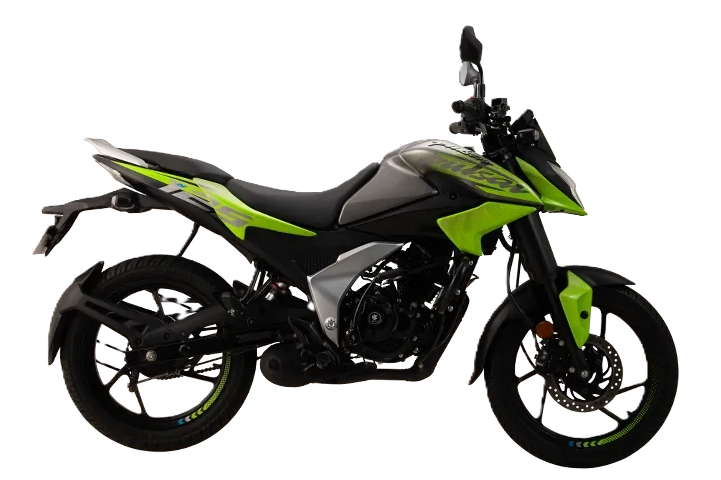
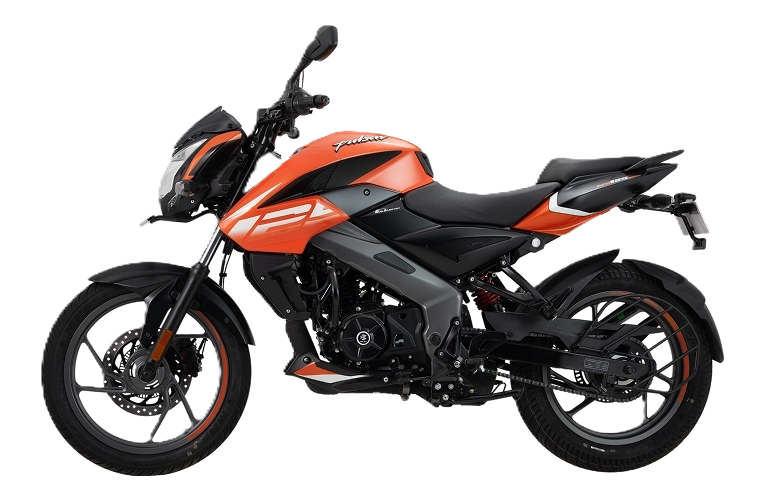
At a Glance
Key differences that define each motorcycle
Bajaj Pulsar N125
- 124.58 cc Air-Cooled, 2-valve
- 12 PS @ 8500 rpm
- 60 km/l (ARAI)
- 9.5-litre tank
- 2 variants available
- LED headlight + DRLs standard
Bajaj Pulsar NS125
- 124.45 cc Air-Cooled, 4-valve DTS-i
- 12 PS @ 8500 rpm
- 46.9 km/l (ARAI)
- 12-litre tank
- 3 variants available
- Perimeter frame + ABS (top variant)
Full Specification Comparison
Every number that matters — side by side
| Specification | Bajaj Pulsar N125 | Bajaj Pulsar NS125 |
|---|---|---|
| Engine & Performance | ||
| Displacement | 124.58 cc | 124.45 cc |
| Cooling System | Air-Cooled | Air-Cooled |
| Max Power | 12 PS @ 8500 rpm | 12 PS @ 8500 rpm |
| Max Torque | 11 Nm @ 6000 rpm | 11 Nm @ 7000 rpm |
| Valves per Cylinder | 2 | 4 (DTS-i) |
| Compression Ratio | 10.05 ± 0.3 : 1 | 10 ± 0.5 : 1 |
| Bore × Stroke | 54 × 54.4 mm | 52 × 58.6 mm |
| Emission Standard | BS6 Phase 2 | BS6 / OBD2 |
| Transmission | 5-Speed Manual | 5-Speed Manual |
| Top Speed | ~100 km/h | ~103 km/h |
| Riding Modes | No | No |
| Traction Control | No | No |
| Fuel & Range | ||
| Mileage (ARAI) | 60 km/l | 46.9 km/l |
| Mileage (Real-world) | ~52–56 km/l | 45–50 km/l |
| Fuel Tank | 9.5 litres | 12 litres |
| Reserve Capacity | 1.5 litres | 2.6 litres |
| Riding Range | ~570 km | ~560 km (est.) |
| Brakes & Wheels | ||
| Braking System | CBS | CBS / Single-Ch ABS (top variant) |
| Front Brake | Disc – 240 mm | Disc – 240 mm |
| Rear Brake | Drum – 130 mm | Drum – 130 mm |
| Tyre Type | Tubeless | Tubeless |
| Tyre Size (F / R) | 80/100-17 / 110/80-17 | 90/90-17 / 120/80-17 |
| Wheel Type | Alloy | Alloy |
| Suspension & Chassis | ||
| Front Suspension | Telescopic Fork | Telescopic Fork |
| Rear Suspension | Mono-shock | Nitrox Mono Shock |
| Chassis | Diamond Frame | Perimeter Frame |
| Rear Preload Adjuster | Yes | Yes |
| Dimensions & Weight | ||
| Kerb Weight | 125 kg | 144 kg |
| Seat Height | 795 mm | 805 mm |
| Ground Clearance | 198 mm | 178 mm |
| Wheelbase | 1295 mm | 1352 mm |
| Overall L × W × H | 2018 × 810 × 1078 mm | 2012 × 810 × 1078 mm |
| Features & Electronics | ||
| Instrument Console | Fully Digital LCD | Semi-Digital / Digital (LED BT variants) |
| Headlight | LED (all variants) | Halogen (base) / LED (LED BT variants) |
| DRLs | Yes (all variants) | Yes |
| Turn Signals | LED | Halogen |
| Hazard Warning Lights | Yes | No |
| Tachometer | Digital | Digital |
| Gear Indicator | Yes | No |
| Distance to Empty | Yes | No |
| Service Reminder | Yes | Yes |
| Clock | Yes | Yes |
| Bluetooth Connectivity | Yes (BT variant) | Yes (LED BT variants) |
| Call & SMS Alerts | Yes (BT variant) | No |
| USB Charging Port | Yes (all variants) | Yes (variant dependent) |
| Keyless Ignition | No | No |
| Price & Warranty | ||
| Starting Price (ex-showroom) | ₹93,668 | ₹92,671 |
| Top Variant Price | ₹94,661 | ₹1,01,934 |
| Number of Variants | 2 | 3 |
| Standard Warranty | 5 Years / 75,000 km | 5 Years / 75,000 km |
★ Green highlights indicate the stronger value in each row. Prices are ex-showroom India averages and may vary by city.
Variant-wise Price Comparison
All variants laid out — find the right one for your budget
Pulsar N125 Variants
Pulsar NS125 Variants
Pros & Cons
Honest strengths and weaknesses of each bike
Pros
- Superior ARAI-certified mileage — 60 km/l vs 46.9 km/l
- Significantly lighter at just 125 kg vs 144 kg
- Fully digital LCD console on both variants
- LED headlight standard on all variants
- LED turn signals and hazard warning lights standard
- Gear indicator standard
- Distance-to-empty display included
- USB charging port on all variants
- Exceptional ground clearance — 198 mm
- Much lower top variant price (₹94,661 vs ₹1,01,934)
- Smaller price gap between base and top variant (₹993)
Cons
- 2-valve engine — less sporty character than 4-valve DTS-i
- Smaller 9.5-litre tank with 1.5L reserve
- Narrower rear tyre (110/80-17 vs 120/80-17)
- No ABS option on any variant
- Diamond frame — less rigid than perimeter frame
- Lower top speed (~100 vs ~103 km/h)
- Shorter wheelbase (1295 vs 1352 mm)
- Only 2 variants — limited choice
Pros
- Sportier 4-valve DTS-i engine with higher-revving character
- Aggressive naked streetfighter NS-series styling
- Perimeter frame for sharper handling and rigidity
- Larger 12-litre tank with 2.6L reserve
- Wider rear tyre (120/80-17) for more grip
- ABS available on top LED BT ABS variant
- Nitrox monoshock rear suspension
- Longer wheelbase (1352 mm) for highway stability
- Higher top speed (~103 km/h)
- Lower base variant price (₹92,671)
- 3 variants — more buyer choice
- 5-year / 75,000 km warranty (same as N125)
Cons
- Significantly lower ARAI mileage (46.9 vs 60 km/l)
- Heavier at 144 kg — 19 kg more than the N125
- Halogen headlight on base variant
- No hazard warning lights on any variant
- Semi-digital console on base variant
- No gear indicator
- No distance-to-empty display
- No LED turn signals
- Top ABS variant significantly pricier at ₹1,01,934
- No Call & SMS alerts even on BT variants
Key Differences Explained
What really sets these two Pulsars apart
Engine Character
On paper, both bikes share the same 12 PS power and 11 Nm torque. But they are very different under the skin. The N125 uses a 2-valve air-cooled engine tuned for smooth efficiency, while the NS125 uses Bajaj's 4-valve DTS-i unit — the same engine architecture used in larger Pulsar NS models. The 4-valve setup breathes more freely, revs more eagerly and delivers a harder, sportier character. The NS125's torque peak arrives 1000 rpm later (7000 vs 6000 rpm), confirming its higher-revving, performance-oriented tuning.
Fuel Efficiency & Range
The N125 leads convincingly with ARAI-certified 60 km/l — a 28% advantage over the NS125's 46.9 km/l. Real-world figures are estimated at ~52–56 km/l for the N125 vs 45–50 km/l for the NS125. However, the NS125's significantly larger 12-litre tank (vs 9.5 litres) and bigger 2.6L reserve (vs 1.5L) mean both bikes deliver a broadly similar estimated ARAI-based range of ~560–570 km. In real-world use, the N125's superior efficiency still delivers better actual range per fill-up at typical riding speeds.
Weight, Chassis & Handling
This is where the two bikes diverge most sharply. The N125 weighs just 125 kg — a full 19 kg lighter than the NS125's 144 kg. That is a substantial difference that makes the N125 noticeably more agile and easier to handle, especially for new or smaller-statured riders. The NS125 counters with a perimeter frame — the same architecture used in the larger N160 and NS200 — giving it superior rigidity, cornering confidence and high-speed stability. The NS125 also has a longer 1352 mm wheelbase vs 1295 mm, contributing to better highway composure.
Lighting & Feature Set
The N125 is clearly better equipped in features. It comes with LED headlight, LED DRLs, LED turn signals and hazard warning lights standard across both variants — the NS125's base has a halogen headlight and no hazard lights in any variant. The N125 also adds a fully digital console, gear indicator, and distance-to-empty display — all absent or partial on the NS125. Both bikes offer Bluetooth on higher variants, but only the N125 supports Call & SMS alerts. USB charging is standard on all N125 variants versus variant-dependent on the NS125.
Braking & Safety
Both bikes share identical 240 mm front disc and 130 mm rear drum setups. The key difference is the NS125's top LED BT ABS variant, which adds single-channel ABS at ₹1,01,934 — the only ABS option in this comparison. Neither bike's base variants offer ABS; both use CBS. The NS125 also has wider tyres (90/90-17 front and 120/80-17 rear vs the N125's 80/100-17 and 110/80-17), providing a larger contact patch and more grip.
Price & Value
The NS125 starts ₹997 cheaper at ₹92,671 vs ₹93,668, but the gap reverses quickly — the N125's top BT variant is only ₹94,661, while the NS125 LED BT is ₹97,904 and the ABS top variant reaches ₹1,01,934. Both bikes carry the same outstanding 5-year / 75,000 km warranty. For feature-for-feature value, the N125 delivers significantly more standard equipment (full LED, hazard lights, gear indicator, distance-to-empty) at a lower price ceiling.
Expert Verdict
Which one should you actually buy?
Buy the Bajaj Pulsar N125 if…
- Best-in-class ARAI mileage (60 km/l) is your top priority
- You want the lightest bike in this comparison (125 kg)
- Full LED lighting with DRLs and hazard lights matter to you
- A fully digital console with gear indicator is important
- You want USB charging and distance-to-empty standard
- You prefer a lower price ceiling (tops out at ₹94,661)
- You are a new or city-focused rider prioritising agility
- Ground clearance (198 mm) matters on your daily roads
Buy the Bajaj Pulsar NS125 if…
- You want the iconic naked streetfighter NS-series styling
- A sportier 4-valve DTS-i engine character excites you
- A perimeter frame for sharper cornering matters
- A larger 12-litre tank for fewer fill-stops is important
- ABS is a priority — available on the top LED BT ABS variant
- Wider tyres (120/80 rear) for better grip appeal to you
- You want the lowest possible entry price (₹92,671)
- Highway stability via longer wheelbase suits your riding
Overall Winner for Most Riders: Bajaj Pulsar NS125. Despite the N125's meaningful advantages in mileage, weight and feature set, the NS125 earns the nod as the overall choice for most buyers in this price band. Its sporty 4-valve DTS-i engine, aggressive NS-series styling, perimeter frame chassis, wider tyres, larger tank and the availability of ABS on the top variant collectively make it the more aspirational and engaging motorcycle. For budget and feature-first buyers, however — especially those who prioritise fuel savings, lighter weight, full LED lighting standard and a lower price ceiling — the Pulsar N125 is the smarter, more practical pick and should be shortlisted seriously.
Frequently Asked Questions
Common questions answered by our experts
The Bajaj Pulsar NS125 is better for sporty riders who want an engaging 4-valve DTS-i engine, perimeter frame chassis, wider tyres, a larger 12-litre tank, and ABS on the top variant. The Bajaj Pulsar N125 is better for practical commuters who want 60 km/l ARAI mileage, a lighter 125 kg body, full LED lighting with hazard lights standard, a fully digital console with gear indicator and distance-to-empty, and a significantly lower price ceiling (₹94,661 vs ₹1,01,934).
The Bajaj Pulsar NS125 starts ₹997 cheaper at ₹92,671 vs the N125's ₹93,668. However, at the top trim the N125 BT is only ₹94,661 while the NS125 LED BT is ₹97,904 and the NS125 ABS top variant reaches ₹1,01,934 — a gap of ₹7,273 over the N125's most expensive variant. Both prices are ex-showroom India averages.
The Bajaj Pulsar N125 has considerably better ARAI-certified mileage at 60 km/l compared to the Pulsar NS125's 46.9 km/l — a 28% advantage. Real-world estimates are ~52–56 km/l for the N125 vs 45–50 km/l for the NS125. Despite the N125's smaller 9.5-litre tank, both bikes deliver a broadly similar riding range (~560–570 km) thanks to the N125's superior efficiency.
Both bikes produce 12 PS and 11 Nm, but use different engine architectures. The Pulsar N125 uses a 2-valve engine tuned for efficiency and smooth power delivery. The Pulsar NS125 uses Bajaj's 4-valve DTS-i engine, which breathes more freely, revs more eagerly and delivers a sportier, higher-revving character. The NS125's torque peak arrives 1000 rpm later (7000 rpm vs 6000 rpm), reflecting its performance-oriented tuning.
Yes, but only on its top NS125 LED BT ABS variant priced at ₹1,01,934 ex-showroom. This variant gets single-channel ABS. The NS125's two lower variants (NS125 at ₹92,671 and NS125 LED BT at ₹97,904) use CBS only. The Bajaj Pulsar N125 does not offer ABS on any of its two variants — both use CBS.
The Bajaj Pulsar N125 is substantially lighter at 125 kg compared to the Pulsar NS125's 144 kg — a difference of 19 kg. This makes the N125 significantly more agile in city traffic and easier to manage for new or shorter riders. The NS125's extra weight comes with the benefit of a heavier perimeter frame chassis and more substantial components that improve high-speed stability.