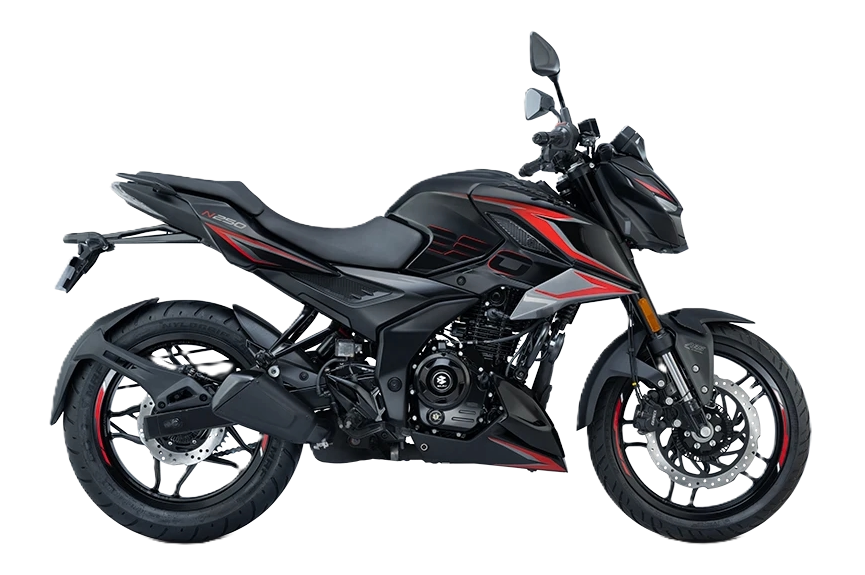
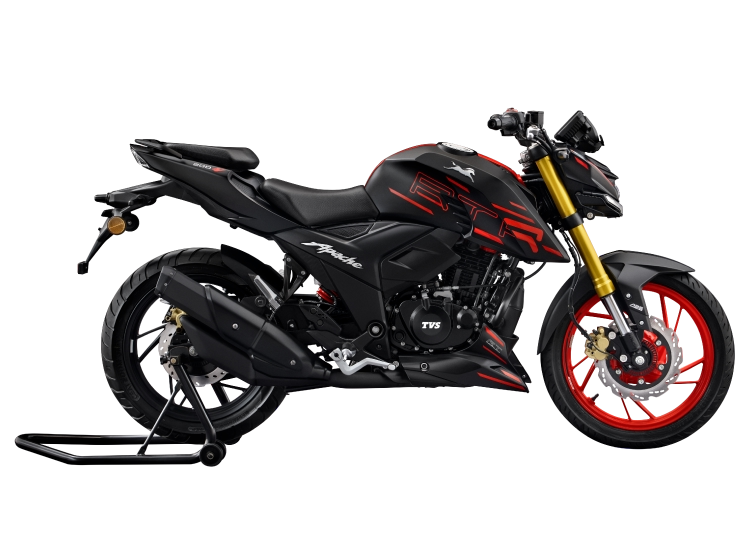
At a Glance
Key differences that define each motorcycle
Bajaj Pulsar N250
- 249.07 cc Oil-Cooled, 2-valve
- 24.5 PS @ 8750 rpm
- 39 km/l (Owner Reported)
- 14-litre tank
- 1 variant available
- Dual-Ch ABS + Traction Control
TVS Apache RTR 200 4V
- 197.75 cc Oil-Cooled, 4-valve
- 20.82 PS @ 9000 rpm
- 41.9 km/l (ARAI)
- 12-litre tank
- 3 variants available
- Ride modes: Sport, Urban, Rain
Full Specification Comparison
Every number that matters — side by side
| Specification | Bajaj Pulsar N250 | TVS Apache RTR 200 4V |
|---|---|---|
| Engine & Performance | ||
| Displacement | 249.07 cc | 197.75 cc |
| Cooling System | Oil-Cooled | Oil-Cooled |
| Max Power | 24.5 PS @ 8750 rpm | 20.82 PS @ 9000 rpm |
| Max Torque | 21.5 Nm @ 6500 rpm | 17.25 Nm @ 7250 rpm |
| Valves per Cylinder | 2 | 4 |
| Compression Ratio | 10.5 : 1 | 9.7 : 1 |
| Bore × Stroke | 72 × 61 mm | 66 × 57.8 mm |
| Emission Standard | BS6 Phase 2 | BS6 OBD-2B |
| Transmission | 5-Speed Manual | 5-Speed Manual |
| Clutch | Slipper Clutch | Assist & Slipper Clutch |
| Top Speed | ~132 km/h | ~127 km/h |
| Riding Modes | Road, Rain, Off-Road | Sport, Urban, Rain |
| Traction Control | Yes (standard) | Yes (top variant only) |
| Spark Plugs per Cylinder | 2 | 1 |
| Fuel & Range | ||
| Mileage (Claimed) | 39 km/l (Owner Reported) | 41.9 km/l (ARAI) |
| Fuel Tank | 14 litres | 12 litres |
| Reserve Capacity | 2.8 litres | 2.5 litres |
| Riding Range | ~546 km | ~502 km |
| Brakes & Wheels | ||
| Braking System | Dual Channel ABS | Dual Channel ABS |
| Front Brake | Disc – 300 mm | Disc – 270 mm |
| Rear Brake | Disc – 230 mm | Disc – 240 mm |
| Tyre Type | Tubeless | Tubeless |
| Tyre Size (F / R) | 110/70-17 / 140/70-17 | 90/90-17 / 130/70-17 |
| Wheel Type | Alloy | Alloy |
| Suspension & Chassis | ||
| Front Suspension | 37 mm USD Fork | Telescopic Fork (USD on top 2 variants) |
| Rear Suspension | Nitrox Monoshock | Mono Shock with Preload Adjust |
| Chassis | Tubular Frame | Double Cradle Split Synchro Stiff Frame |
| Rear Preload Adjuster | Yes | Yes |
| Dimensions & Weight | ||
| Kerb Weight | 164 kg | 152 kg |
| Seat Height | 795 mm | 800 mm |
| Ground Clearance | 165 mm | 180 mm |
| Wheelbase | 1351 mm | 1353 mm |
| Overall L × W × H | 1989 × 743 × 1050 mm | 2050 × 790 × 1050 mm |
| Features & Electronics | ||
| Instrument Console | Fully Digital LCD | Digital LCD / TFT (top variant) |
| Headlight | LED Projector | LED Projector |
| DRLs | Yes | Yes |
| Turn Signals | LED | LED |
| Hazard Warning Lights | Yes | Yes |
| Riding Modes | Road / Rain / Off-Road | Sport / Urban / Rain |
| Traction Control | Yes (standard) | Yes (top variant only) |
| Bluetooth Connectivity | Yes | Yes (SmartXonnect) |
| Navigation | Yes (Turn-by-Turn) | Yes |
| Call & SMS Alerts | Yes | Yes |
| Voice Assist | No | Yes |
| USB Charging Port | Yes | Yes |
| Distance to Empty | Yes | Yes |
| Gear Indicator | Yes | Yes |
| Service Reminder | Yes | Yes |
| Keyless Ignition | No | No |
| Price & Warranty | ||
| Starting Price (ex-showroom) | ₹1,34,758 | ₹1,38,407 |
| Top Variant Price | ₹1,34,758 | ₹1,47,582 |
| Number of Variants | 1 | 3 |
| Standard Warranty | 5 Years / 75,000 km | 5 Years / 60,000 km |
★ Green highlights indicate the stronger value in each row. Prices are ex-showroom India averages and may vary by city.
Variant-wise Price Comparison
All variants laid out — find the right one for your budget
Pulsar N250 Variants
Apache RTR 200 4V Variants
Pros & Cons
Honest strengths and weaknesses of each bike
Pros
- Lower starting price (₹1,34,758 vs ₹1,38,407)
- Larger 249.07 cc engine — significantly more power (24.5 PS vs 20.82 PS)
- Higher torque — 21.5 Nm vs 17.25 Nm
- Larger 14-litre fuel tank for longer range (~546 km)
- USD front forks standard from base variant
- Traction control standard on all variants
- Wider front tyre (110/70 vs 90/90) for better grip
- Larger 300 mm front disc brake
- Dual spark plugs per cylinder for better combustion
- Hazard warning lights standard
- Turn-by-turn navigation standard
- Superior 5-year / 75,000 km warranty
Cons
- Owner-reported mileage (39 km/l) vs ARAI-certified (41.9 km/l) on Apache
- 2-valve engine — less high-rpm refinement than 4-valve
- Only 3 riding modes vs Sport/Urban/Rain on Apache
- Single variant — no choice of trim levels
- Heavier at 164 kg vs 152 kg
- Lower ground clearance (165 mm vs 180 mm)
- No voice assist feature
Pros
- ARAI-certified mileage of 41.9 km/l — officially tested
- Oil-cooled 4-valve engine — sporty, revvy character
- Ride modes: Sport, Urban & Rain across all variants
- 3 variants — flexibility to choose your budget & hardware
- Lighter at 152 kg — more agile and nimble
- Superior ground clearance (180 mm)
- Larger rear disc — 240 mm vs 230 mm
- Voice assist via SmartXonnect
- USD forks and TFT cluster available on higher variants
- Race-derived chassis with Double Cradle Split Synchro frame
Cons
- Smaller 197.75 cc engine — 3.68 PS less power than N250
- Lower torque (17.25 Nm vs 21.5 Nm)
- Higher starting price (₹1,38,407 vs ₹1,34,758)
- Top variant expensive at ₹1,47,582
- Smaller 12-litre tank — less riding range (~502 km)
- Traction control only on top TFT variant
- Smaller 270 mm front disc
- Narrower front tyre (90/90 vs 110/70)
- Shorter 5-year / 60,000 km warranty
Key Differences Explained
What really sets these two bikes apart
Engine Character
This is the most fundamental divide. The Pulsar N250 uses a 249.07 cc oil-cooled 2-valve engine producing a substantial 24.5 PS and 21.5 Nm — a mid-range powerhouse tuned for accessible pull. The Apache RTR 200 4V runs a 197.75 cc oil-cooled 4-valve unit making 20.82 PS and 17.25 Nm — a higher-revving, more responsive motor inspired by TVS Racing. The N250's 51.3 cc displacement advantage translates to 3.68 PS and 4.25 Nm more output, giving it a clear edge in overtaking punch and highway-speed confidence.
Fuel Efficiency & Range
The Apache RTR 200 4V holds a notable advantage in official mileage figures — its ARAI-certified 41.9 km/l is a verified standard, while the N250's ~39 km/l is owner-reported and varies by riding style. However, the N250's 14-litre tank versus the Apache's 12-litre unit gives it a longer practical range of ~546 km versus ~502 km — a gap of 44 km per fill. For daily commuters, the ARAI figure advantage matters; for tourers, the tank size tips it toward the N250.
Braking & Safety
The Pulsar N250 leads on front braking with a larger 300 mm front disc versus the Apache's 270 mm. The N250 also runs a wider 110/70 front tyre (vs 90/90) for a bigger contact patch. Both bikes include dual-channel ABS as standard. The Apache edges ahead with a slightly larger 240 mm rear disc (vs 230 mm). Critically, the N250 includes traction control on all variants while the Apache reserves it for the top TFT variant only.
Ride Modes & Technology
Both bikes offer three riding modes, but they differ in character. The N250's Road, Rain, and Off-Road modes integrate with ABS thresholds for different surfaces. The Apache's Sport, Urban, and Rain modes adjust throttle response and power delivery for different riding scenarios — with Sport mode adding a more performance-oriented edge. The Apache also adds voice assist via SmartXonnect, while the N250 counters with turn-by-turn navigation and standard traction control.
Weight, Agility & Ground Clearance
The Apache RTR 200 4V is meaningfully lighter at 152 kg versus the N250's 164 kg — a 12 kg difference that makes it noticeably more nimble in city traffic and sharper through corners. The Apache also has significantly better ground clearance at 180 mm versus 165 mm — a 15 mm advantage that makes it more capable on broken urban roads and light off-road sections. For city-focused riding, the Apache's lighter, taller stance is a genuine advantage.
Price, Value & Warranty
The Pulsar N250 starts ₹3,649 cheaper (₹1,34,758 vs ₹1,38,407) and there is only one variant — no premium required for USD forks or traction control, which come standard. The Apache's top TFT Cluster variant reaches ₹1,47,582 — ₹12,824 more than the N250. On warranty, the N250 covers a superior 5 years / 75,000 km versus the Apache's 5 years / 60,000 km. For the entry price, the N250 delivers more power, a larger tank, wider tyres, USD forks, and better warranty — making its value proposition exceptionally strong.
Expert Verdict
Which one should you actually buy?
Buy the Pulsar N250 if…
- You want more power and torque — 24.5 PS and 21.5 Nm
- A lower starting price with no compromise on hardware matters
- USD forks, traction control and riding modes standard from base
- A larger 14-litre tank for 546 km range suits your touring pattern
- A wider 110/70 front tyre and larger 300 mm disc inspire confidence
- The superior 5-year / 75,000 km warranty gives long-term peace of mind
- You're upgrading from a 150–200cc bike and want a genuine step up in power
Buy the Apache RTR 200 4V if…
- ARAI-certified mileage of 41.9 km/l is important to you
- You want a lighter, more agile bike (152 kg) for city riding
- Higher ground clearance (180 mm) matters on your roads
- Sport mode and TVS Racing-inspired engine character excites you
- You want variant flexibility — choose base, USD or TFT
- A high-revving 4-valve engine feel appeals to you
- You prefer the Apache's race-derived chassis and handling pedigree
Overall Winner for Most Riders: Bajaj Pulsar N250. At ₹3,649 less than the Apache RTR 200 4V's base variant, the Pulsar N250 delivers 24.5 PS (vs 20.82 PS), 21.5 Nm (vs 17.25 Nm), a larger 14-litre tank, USD forks, traction control, a wider front tyre and 300 mm front disc — all as standard — along with a superior 5-year / 75,000 km warranty. The TVS Apache RTR 200 4V fights back with an ARAI-certified 41.9 km/l mileage advantage, a lighter 152 kg frame, 15 mm more ground clearance, Sport/Urban/Rain modes, and the iconic TVS Racing pedigree. If raw performance, range, and value define your purchase, choose the N250. If city agility, verified fuel efficiency, and a sporty lightweight character are your priorities, the Apache RTR 200 4V is the right pick.
Frequently Asked Questions
Common questions answered by our experts
The Bajaj Pulsar N250 is better for most buyers who want more power (24.5 PS vs 20.82 PS), a lower price, standard USD forks, traction control, a larger tank (14L vs 12L), and a superior 5-year / 75,000 km warranty. The TVS Apache RTR 200 4V is better if you prioritise ARAI-certified mileage (41.9 km/l), a lighter and more agile bike (152 kg), greater ground clearance (180 mm), Sport/Urban/Rain ride modes, and the flexibility of 3 variant choices.
The Bajaj Pulsar N250 starts at ₹1,34,758 while the TVS Apache RTR 200 4V starts at ₹1,38,407 ex-showroom — a base difference of ₹3,649 in the N250's favour. The gap widens at higher trims: the Apache's TFT Cluster top variant reaches ₹1,47,582 — ₹12,824 more than the N250. The Pulsar N250 is a single-variant bike while the Apache offers 3 variants. Prices are ex-showroom India averages and may vary by city.
The TVS Apache RTR 200 4V has better ARAI-certified mileage at 41.9 km/l compared to the Bajaj Pulsar N250's ~39 km/l (owner reported, not ARAI certified). However, the Pulsar N250's larger 14-litre tank gives it a longer riding range of ~546 km versus ~502 km for the Apache's 12-litre unit — a difference of 44 km per tank.
The Bajaj Pulsar N250 makes significantly more power at 24.5 PS @ 8750 rpm from its 249.07 cc engine, versus the TVS Apache RTR 200 4V's 20.82 PS @ 9000 rpm from a 197.75 cc engine — a difference of 3.68 PS. The Pulsar N250 also produces more torque at 21.5 Nm versus 17.25 Nm. The larger displacement engine gives the N250 a clear advantage in mid-range pull and outright acceleration.
Yes, the Bajaj Pulsar N250 offers three ABS-integrated riding modes — Road, Rain, and Off-Road — as standard. The TVS Apache RTR 200 4V also offers three riding modes — Sport, Urban, and Rain — across all its variants. The Apache's Sport mode sharpens throttle response for performance riding, while the N250's Off-Road mode adjusts ABS for loose surfaces. Both bikes include traction control, though on the Apache it is only available on the top TFT Cluster variant (₹1,47,582).
The Bajaj Pulsar N250 offers a better warranty at 5 years / 75,000 km compared to the TVS Apache RTR 200 4V's 5 years / 60,000 km. Both offer 5-year coverage, but the N250 covers 15,000 km more. For high-mileage commuters clocking 15,000–20,000 km per year, the N250's additional 15,000 km of warranty coverage provides meaningful protection against potential out-of-warranty repair costs.