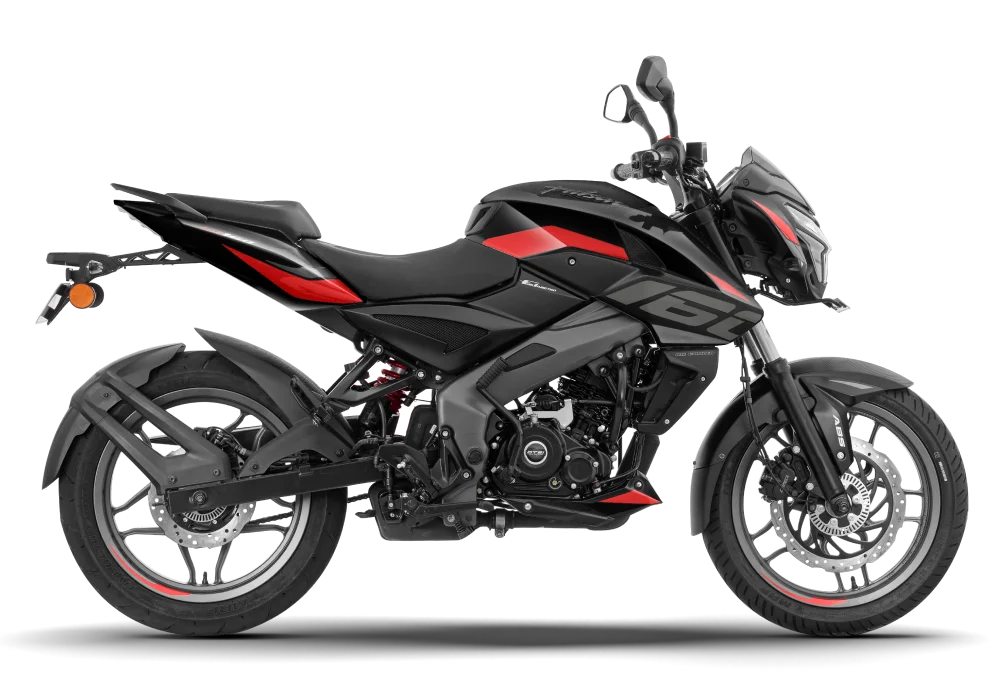
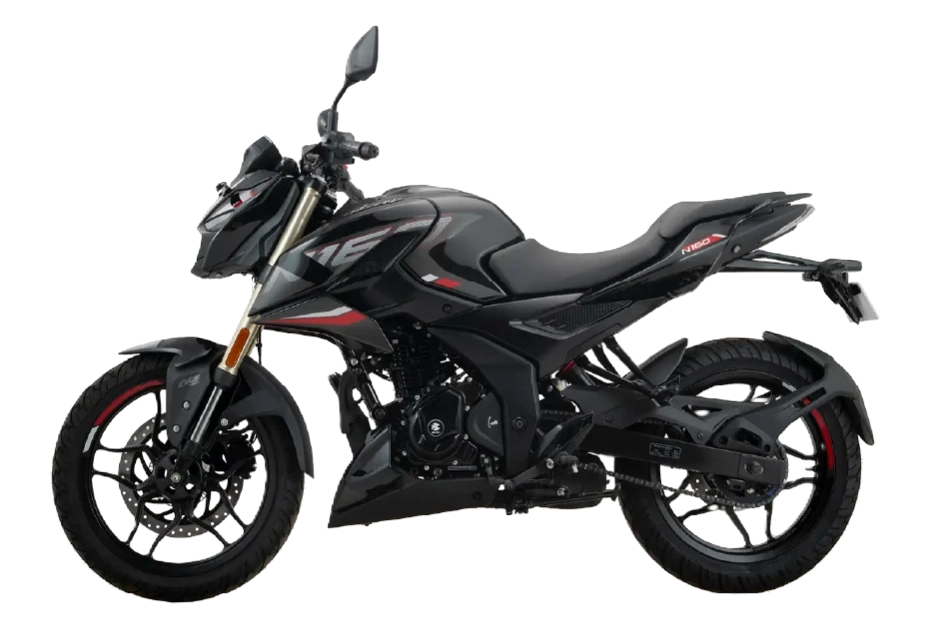
At a Glance
Key differences that define each motorcycle
Bajaj Pulsar NS160
- 160.3 cc Oil-Cooled, 4-valve
- 17.2 PS @ 9000 rpm
- ~44 km/l (Owner Reported)
- 12-litre tank
- 2 variants available
- Dual-channel ABS (top variant)
Bajaj Pulsar N160
- 164.82 cc Air-Cooled, 2-valve
- 16 PS @ 8750 rpm
- 51.6 km/l (ARAI)
- 14-litre tank
- 4 variants available
- Dual-channel ABS (from 2nd variant)
Full Specification Comparison
Every number that matters — side by side
| Specification | Bajaj Pulsar NS160 | Bajaj Pulsar N160 |
|---|---|---|
| Engine & Performance | ||
| Displacement | 160.3 cc | 164.82 cc |
| Cooling System | Oil-Cooled | Air-Cooled |
| Max Power | 17.2 PS @ 9000 rpm | 16 PS @ 8750 rpm |
| Max Torque | 14.6 Nm @ 7250 rpm | 14.65 Nm @ 6750 rpm |
| Valves per Cylinder | 4 | 2 |
| Compression Ratio | 9.8 ± 0.5 : 1 | 10.3 ± 0.3 : 1 |
| Bore × Stroke | 58 × 60.7 mm | 58 × 62.38 mm |
| Emission Standard | BS6 Phase 2 | BS6 Phase 2 |
| Transmission | 5-Speed Manual | 5-Speed Manual |
| Top Speed | ~120 km/h | ~120 km/h |
| Riding Modes | No | No (Road/Rain/Off-Road on top variant) |
| Traction Control | No | No |
| Fuel & Range | ||
| Mileage (Claimed) | ~44 km/l (Owner Reported) | 51.6 km/l (ARAI) |
| Fuel Tank | 12 litres | 14 litres |
| Reserve Capacity | 2.4 litres | 2.8 litres |
| Riding Range | ~528 km | ~722 km |
| Brakes & Wheels | ||
| Braking System | Single / Dual Channel ABS | Single / Dual Channel ABS |
| Front Brake | Disc – 300 mm | Disc – 300 mm |
| Rear Brake | Disc – 230 mm | Disc – 230 mm |
| Dual-Ch ABS Available From | ₹1,29,487 (top variant only) | ₹1,17,619 (2nd variant) |
| Tyre Type | Tubeless | Tubeless |
| Tyre Size (F / R) | 100/80-17 / 130/70-17 | 100/80-17 / 130/70-17 |
| Wheel Type | Alloy | Alloy |
| Suspension & Chassis | ||
| Front Suspension | Telescopic Fork (base) / USD (top) | Telescopic Fork (base) / USD (top variants) |
| Rear Suspension | Nitrox Monoshock | Monoshock |
| Chassis | Perimeter Frame | Perimeter Frame |
| Rear Preload Adjuster | Yes | Yes |
| Dimensions & Weight | ||
| Kerb Weight | 152 kg | 152–154 kg |
| Seat Height | 805 mm | 795 mm |
| Ground Clearance | 170 mm | 165 mm |
| Wheelbase | 1372 mm | 1358 mm |
| Overall L × W × H | 2017 × 804 × 1060 mm | 1989 × 743 × 1050 mm |
| Features & Electronics | ||
| Instrument Console | Digital LCD | Digital |
| Headlight | LED Projector | LED Projector |
| DRLs | Yes | Yes |
| Turn Signals | Halogen | LED |
| Hazard Warning Lights | No | Yes |
| Bluetooth Connectivity | Yes (both variants) | Yes (all variants) |
| Call & SMS Alerts | Yes | Yes |
| USB Charging Port | Yes | Yes |
| Distance to Empty | Yes | Yes |
| Gear Indicator | Yes | Yes |
| Tachometer | Digital | Digital |
| Service Reminder | Yes | Yes |
| Traction Control | No | No |
| Keyless Ignition | No | No |
| Price & Warranty | ||
| Starting Price (ex-showroom) | ₹1,21,109 | ₹1,14,840 |
| Top Variant Price | ₹1,29,487 | ₹1,27,333 |
| Number of Variants | 2 | 4 |
| Standard Warranty | 2 Years / 30,000 km | 5 Years / 75,000 km |
★ Green highlights indicate the stronger value in each row. Prices are ex-showroom India averages and may vary by city.
Variant-wise Price Comparison
All variants laid out — find the right one for your budget
Pulsar NS160 Variants
Pulsar N160 Variants
Pros & Cons
Honest strengths and weaknesses of each bike
Pros
- Higher peak power — 17.2 PS (7.5% more than N160)
- Oil-cooled 4-valve engine — more performance-oriented character
- Better ground clearance (170 mm vs 165 mm)
- Longer wheelbase (1372 mm vs 1358 mm) for greater stability
- USD forks on top variant at ₹1,29,487
- LED projector headlamp standard
- Bluetooth and USB charging on both variants
- Inspired by NS200 platform — proven sporty chassis
Cons
- Significantly worse mileage (~44 km/l vs 51.6 km/l ARAI)
- Smaller 12-litre tank — ~194 km less range per fill
- Much weaker warranty — 2 years / 30,000 km only
- Dual-ch ABS only on top variant at ₹1,29,487
- Higher starting price (₹1,21,109 vs ₹1,14,840)
- No hazard warning lights
- Halogen turn signals vs LED on N160
- Only 2 variants — limited choice
Pros
- Best-in-class mileage — 51.6 km/l ARAI certified
- Larger 14-litre fuel tank — ~722 km theoretical range
- Outstanding 5-year / 75,000 km warranty
- Dual-channel ABS from just ₹1,17,619 (2nd variant)
- Lower starting price — ₹1,14,840
- 4 variants — wider choice for every budget
- LED turn signals and hazard warning lights standard
- Riding modes on top split-seat variant
- Larger 164.82 cc displacement
- Larger 2.8-litre reserve capacity (vs 2.4 litres)
Cons
- Lower peak power (16 PS vs 17.2 PS)
- Air-cooled 2-valve engine — less performance-oriented character
- Lower ground clearance (165 mm vs 170 mm)
- Shorter wheelbase (1358 mm vs 1372 mm)
- No riding modes on base 3 variants
Key Differences Explained
What really sets these two Bajaj siblings apart
Engine Philosophy
This is the core difference between the two bikes. The NS160 uses a 160.3 cc oil-cooled, 4-valve engine producing 17.2 PS — borrowed from the NS200 platform and built for sporty, higher-revving performance. The N160 uses a 164.82 cc air-cooled, 2-valve engine producing 16 PS, tuned for smooth mid-range torque, fuel efficiency and everyday rideability. The NS160 is the enthusiast's choice; the N160 is the commuter's champion. Torque figures are almost identical — 14.6 Nm (NS160) vs 14.65 Nm (N160).
Fuel Efficiency & Range
The N160 wins decisively on both counts. Its ARAI-certified 51.6 km/l dwarfs the NS160's owner-reported ~44 km/l — a difference of nearly 17%. Combined with a larger 14-litre tank versus 12 litres, the N160 achieves a theoretical range of ~722 km against the NS160's ~528 km — a gap of roughly 194 km per tank. For a daily commuter covering 40–50 km per day, this means significantly fewer fuel stops every week.
Braking & ABS Accessibility
Both bikes share identical braking hardware — 300 mm front disc and 230 mm rear disc — which is a genuine tie on stopping power. The key difference is dual-channel ABS accessibility: the N160 offers it from just ₹1,17,619 (second variant), while the NS160 only includes dual-channel ABS on its top USD variant at ₹1,29,487. A buyer wanting the safety of dual-channel ABS pays ₹11,868 more for it on the NS160 versus just ₹2,779 extra on the N160.
Features & Lighting
Both bikes share Bluetooth connectivity, USB charging, LED projector headlamps, DRLs and digital consoles. The N160 edges ahead with LED turn signals and hazard warning lights — both absent on the NS160 which uses halogen indicators. The N160's top split-seat variant also gains riding modes (Road/Rain/Off-Road). The NS160's console is Digital LCD versus the N160's Digital display — functionally similar but the NS160 lacks the N160's hazard lights and LED blinkers.
Warranty — A Shocking Gap
Despite being motorcycles from the same manufacturer launched within a similar period, the warranty difference is striking. The N160 carries a 5-year / 75,000 km warranty, while the NS160 offers only 2 years / 30,000 km — the same as many basic commuters. This is 3 extra years and 45,000 more kilometres of coverage on the N160. For a daily commuter clocking 15,000–20,000 km per year, the NS160's warranty expires in under 2 years, while the N160's runs for 3.75–5 years.
Price & Value
The N160 is the clear value winner. It starts ₹6,269 cheaper (₹1,14,840 vs ₹1,21,109) and tops out at ₹1,27,333 — ₹2,154 less than the NS160's top at ₹1,29,487. Critically, the N160's ₹1,17,619 dual-channel ABS variant delivers arguably more value than the NS160's ₹1,21,109 base single-channel ABS variant: better mileage, larger tank, dual-ch ABS, LED signals, hazard lights and a vastly superior warranty — all for ₹3,490 less.
Expert Verdict
Which one should you actually buy?
Buy the Pulsar NS160 if…
- Outright engine performance (17.2 PS) is your top priority
- The oil-cooled 4-valve character excites you more than efficiency
- You want higher ground clearance (170 mm) for rough roads
- The longer NS wheelbase (1372 mm) and NS200-derived platform appeal to you
- You're okay with the 2-year / 30,000 km warranty
- You plan to upgrade to the USD fork variant for ₹1,29,487
- Short daily distances mean mileage matters less to you
Buy the Pulsar N160 if…
- Fuel efficiency and riding range are your daily priorities
- The 5-year / 75,000 km warranty gives you long-term peace of mind
- You want dual-channel ABS at the lowest possible price (₹1,17,619)
- Lower starting price (₹1,14,840) fits your budget better
- LED turn signals, hazard warning lights and 4 variant choices matter
- You do 30–50 km daily and want fewer fuel stops
- Long-term ownership cost and warranty coverage are priority
Overall Winner for Most Riders: Bajaj Pulsar N160. Despite being siblings from the same manufacturer, the N160 comprehensively outpaces the NS160 on value: it starts ₹6,269 cheaper, delivers 51.6 km/l ARAI-certified mileage (vs ~44 km/l owner-reported), carries a 14-litre tank for ~722 km range, offers dual-channel ABS from just ₹1,17,619, includes LED turn signals and hazard warning lights, provides 4 variant choices and backs it all with an exceptional 5-year / 75,000 km warranty. The NS160 is the right pick only if the extra 1.2 PS of performance and the oil-cooled 4-valve character of the NS platform genuinely matter more to you than everything else.
Frequently Asked Questions
Common questions answered by our experts
For most buyers, the Bajaj Pulsar N160 is the better choice — it offers superior mileage (51.6 km/l ARAI), a larger 14-litre tank (~722 km range), dual-channel ABS from ₹1,17,619, a lower starting price, LED turn signals, hazard warning lights and a vastly better 5-year / 75,000 km warranty. The Bajaj Pulsar NS160 is better if you specifically want more power (17.2 PS), an oil-cooled 4-valve engine, higher ground clearance (170 mm) and the sporty NS platform character — and are comfortable with its weaker 2-year / 30,000 km warranty.
The Bajaj Pulsar N160 starts at ₹1,14,840 while the Bajaj Pulsar NS160 starts at ₹1,21,109 — the NS160 is ₹6,269 more expensive at the base level. At the top, the NS160's Dual Channel ABS USD variant at ₹1,29,487 is ₹2,154 more than the N160's top at ₹1,27,333. Prices are approximate ex-showroom averages and may vary by city.
The Bajaj Pulsar N160 has far better mileage at 51.6 km/l (ARAI certified) compared to the Bajaj Pulsar NS160's approximately 44 km/l based on owner reports — Bajaj does not claim an ARAI figure for the NS160. The N160 also has a larger 14-litre tank versus 12 litres, delivering a theoretical range of ~722 km against ~528 km for the NS160. For a daily commuter, this means roughly 3–4 fewer fuel stops per month on the N160.
The Bajaj Pulsar NS160 makes more peak power at 17.2 PS @ 9000 rpm compared to the Bajaj Pulsar N160's 16 PS @ 8750 rpm — a difference of 1.2 PS (approximately 7.5% more). Torque is virtually identical: the NS160 makes 14.6 Nm @ 7250 rpm versus the N160's 14.65 Nm @ 6750 rpm. The NS160's oil-cooled 4-valve engine revs more freely and delivers a sportier riding character at higher speeds.
The Bajaj Pulsar NS160 uses a 160.3 cc oil-cooled, 4-valve engine derived from the NS200 platform — tuned for sporty performance, with 17.2 PS output. The Bajaj Pulsar N160 uses a 164.82 cc air-cooled, 2-valve engine — a larger displacement unit tuned for fuel efficiency, smooth mid-range torque and everyday rideability, producing 16 PS. The N160's engine is less performance-oriented but delivers significantly better fuel economy and ARAI-certified 51.6 km/l mileage.
The Bajaj Pulsar N160 has a dramatically better warranty at 5 years or 75,000 km versus the Bajaj Pulsar NS160's 2 years or 30,000 km — despite both being Bajaj motorcycles. The gap is 3 extra years and 45,000 additional km of coverage. For a high-mileage daily commuter riding 15,000–20,000 km per year, the NS160's warranty expires in under 2 years while the N160's warranty provides meaningful protection for close to 5 years of use.