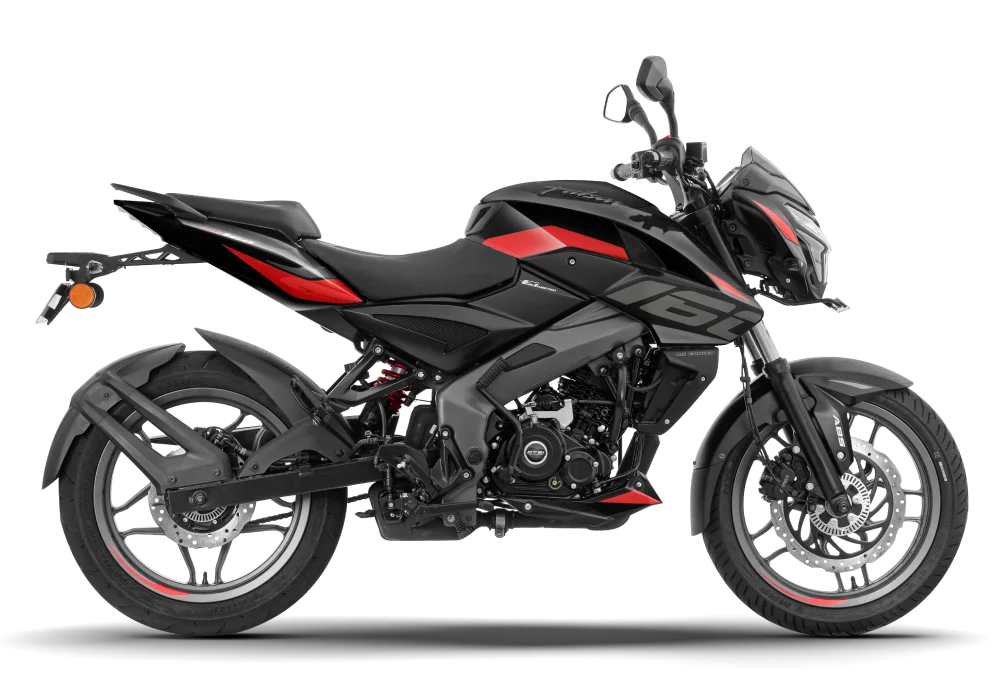
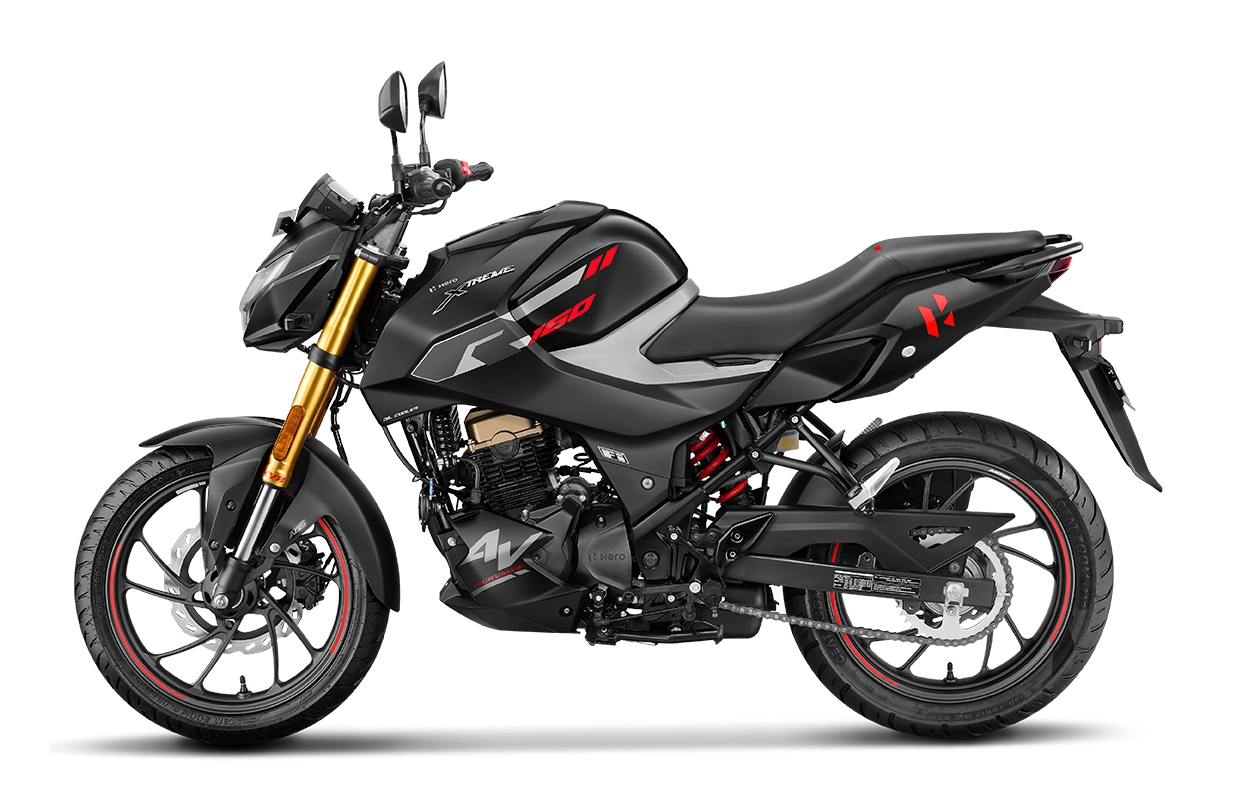
At a Glance
Key differences that define each motorcycle
Bajaj Pulsar NS160
- 160.3 cc Oil-Cooled, 4-valve DTS-i
- 17.2 PS @ 9000 rpm
- ~44 km/l (Owner Reported)
- 12-litre tank
- 2 variants available
- Perimeter frame + ABS
Hero Xtreme 160R 4V
- 163.2 cc Air-Oil Cooled, 4-valve
- 16.9 PS @ 8500 rpm
- 48 km/l (Claimed)
- 12-litre tank
- 2 variants available
- Dual-Ch ABS + 37 mm KYB USD Forks
Full Specification Comparison
Every number that matters — side by side
| Specification | Bajaj Pulsar NS160 | Hero Xtreme 160R 4V |
|---|---|---|
| Engine & Performance | ||
| Displacement | 160.3 cc | 163.2 cc |
| Cooling System | Oil-Cooled | Air-Oil Cooled |
| Max Power | 17.2 PS @ 9000 rpm | 16.9 PS @ 8500 rpm |
| Max Torque | 14.6 Nm @ 7250 rpm | 14.6 Nm @ 6500 rpm |
| Valves per Cylinder | 4 | 4 |
| Compression Ratio | 9.8 ± 0.5 : 1 | 10.1 : 1 |
| Bore × Stroke | 58 × 60.7 mm | 66.5 × 47 mm |
| Emission Standard | BS6 Phase 2 | BS6 OBD2B |
| Transmission | 5-Speed Manual | 5-Speed Manual |
| Top Speed | ~120 km/h | ~115 km/h |
| Riding Modes | No | No |
| Traction Control | No | No |
| Cruise Control | No | Yes (top variant) |
| Fuel & Range | ||
| Mileage (Claimed / Reported) | ~44 km/l (Owner Reported) | 48 km/l (Claimed) |
| Fuel Tank | 12 litres | 12 litres |
| Reserve Capacity | 2.4 litres | 1.9 litres |
| Riding Range | ~528 km | ~576 km |
| Brakes & Wheels | ||
| Braking System | Single-Ch / Dual-Ch ABS (variant) | Dual-Ch ABS (both variants) |
| Front Brake | Disc – 300 mm | Disc – 276 mm |
| Rear Brake | Disc – 230 mm | Disc – 220 mm |
| Tyre Type | Tubeless | Tubeless |
| Tyre Size (F / R) | 100/80-17 / 130/70-17 | 100/80-17 / 130/70-17 |
| Wheel Type | Alloy | Alloy |
| Suspension & Chassis | ||
| Front Suspension | Telescopic / USD Fork (top variant) | 37 mm KYB USD Forks (both variants) |
| Rear Suspension | Nitrox Mono Shock | 7-Step Adjustable Monoshock |
| Chassis | Perimeter Frame | Tubular Underbone Diamond Frame |
| Rear Preload Adjuster | Yes | Yes |
| Dimensions & Weight | ||
| Kerb Weight | 152 kg | 146 kg |
| Seat Height | 805 mm | 795 mm |
| Ground Clearance | 170 mm | 165 mm |
| Wheelbase | 1372 mm | 1333 mm |
| Overall L × W × H | 2017 × 804 × 1060 mm | 2029 × 793 × 1052 mm |
| Features & Electronics | ||
| Instrument Console | Digital LCD | Fully Digital LCD |
| Headlight | LED Projector | LED |
| DRLs | Yes | Yes |
| Turn Signals | Halogen | LED |
| Hazard Warning Lights | No | Yes |
| Bluetooth Connectivity | Yes | Yes (top variant) |
| Call & SMS Alerts | Yes | Yes (top variant) |
| USB Charging Port | Yes | Yes |
| Distance to Empty | Yes | Yes |
| Gear Indicator | Yes | Yes |
| Tachometer | Digital | Digital |
| Cruise Control | No | Yes (top variant) |
| Silent Start | No | Yes |
| Keyless Ignition | No | No |
| Price & Warranty | ||
| Starting Price (ex-showroom) | ₹1,21,109 | ₹1,31,755 |
| Top Variant Price | ₹1,29,487 | ₹1,34,994 |
| Number of Variants | 2 | 2 |
| Standard Warranty | 2 Years / 30,000 km | 5 Years / 70,000 km |
★ Green highlights indicate the stronger value in each row. Prices are ex-showroom India averages and may vary by city.
Variant-wise Price Comparison
All variants laid out — find the right one for your budget
Pulsar NS160 Variants
Xtreme 160R 4V Variants
Pros & Cons
Honest strengths and weaknesses of each bike
Pros
- Higher peak power — 17.2 PS vs 16.9 PS
- Higher top speed (~120 vs ~115 km/h)
- Sporty perimeter frame chassis for sharper cornering
- Larger 300 mm front disc for stronger braking
- Larger 230 mm rear disc vs 220 mm
- Greater ground clearance (170 mm vs 165 mm)
- Longer wheelbase (1372 mm) for highway stability
- Significantly lower starting price (₹1,21,109 vs ₹1,31,755)
- Lower top variant price (₹1,29,487 vs ₹1,34,994)
- LED projector headlight
- Bluetooth and USB charging standard
Cons
- Only single-channel ABS on the base variant
- Telescopic forks on base — USD only on top variant
- Lower claimed mileage (~44 km/l vs 48 km/l)
- Heavier at 152 kg vs 146 kg
- No hazard warning lights
- Halogen turn signals — no LED
- Very short warranty — only 2 years / 30,000 km
- No cruise control on any variant
- No silent start feature
Pros
- Dual-channel ABS standard on both variants
- 37 mm KYB USD forks on both variants
- 7-step adjustable rear monoshock
- Better claimed mileage (48 km/l) and longer range (~576 km)
- Lighter at 146 kg — 6 kg less than NS160
- LED turn signals standard
- Hazard warning lights standard
- Cruise control on top variant
- Silent start feature
- Outstanding 5-year / 70,000 km warranty
- Lower seat height (795 mm vs 805 mm)
Cons
- Lower peak power (16.9 PS vs 17.2 PS)
- Lower top speed (~115 vs ~120 km/h)
- Tubular diamond frame — less rigid than perimeter frame
- Smaller 276 mm front disc vs 300 mm
- Higher starting price (₹1,31,755 vs ₹1,21,109)
- Less ground clearance (165 mm vs 170 mm)
- Bluetooth only on top Cruise Control variant
Key Differences Explained
What really sets these two bikes apart
Engine & Performance
The NS160 uses a 160.3 cc oil-cooled 4-valve DTS-i engine producing 17.2 PS — slightly more than the Xtreme 160R 4V's 163.2 cc air-oil cooled 4-valve motor at 16.9 PS. Both deliver identical 14.6 Nm torque, but the Xtreme's torque arrives earlier at 6500 rpm vs 7250 rpm for the NS160, giving the Hero more accessible pull in city traffic. The NS160's higher redline and oil cooling give it a sportier, harder-revving character, while the Xtreme's short-stroke design (47 mm vs 60.7 mm) contributes to its smooth, broad power delivery.
Braking & Safety
This is a decisive area for the Xtreme 160R 4V. It comes with dual-channel ABS standard on both variants, while the NS160's base variant only gets single-channel ABS — dual-channel is available only on the more expensive ₹1,29,487 USD variant. The NS160 partially compensates with a larger 300 mm front disc (vs 276 mm) and 230 mm rear disc (vs 220 mm), giving it stronger absolute braking force. But the Xtreme's across-the-range dual-channel ABS availability is a meaningful safety advantage.
Fuel Efficiency & Range
The Hero Xtreme 160R 4V claims 48 km/l, compared to owner-reported figures of around 44 km/l for the NS160. Both bikes share a 12-litre tank, but the Xtreme's better efficiency translates into a longer estimated range of ~576 km versus ~528 km for the NS160. It's worth noting that the NS160's figure is owner-reported rather than official, so the gap may narrow in real-world riding; the Xtreme's figure is a manufacturer claim under test conditions.
Suspension & Chassis
The Hero Xtreme 160R 4V carries a significant equipment advantage: 37 mm KYB USD forks and a 7-step adjustable monoshock on both variants. The NS160 only gets USD forks on its top variant (₹1,29,487), while its base still runs a telescopic setup. The NS160 counters with a superior perimeter frame — the same architecture used in the NS200 — which is inherently more rigid and cornering-capable than the Xtreme's tubular underbone diamond frame. Buyers who pick the NS160's top variant get comparable front suspension while retaining the chassis advantage.
Features & Technology
The Xtreme 160R 4V leads in lighting and convenience features. It comes with LED turn signals and hazard warning lights standard — the NS160 uses halogen indicators and has no hazard lights on any variant. The Xtreme's top variant adds cruise control, while neither bike offers it on the NS160. Both bikes include Bluetooth connectivity (standard on all NS160 variants; top variant only on the Xtreme), digital consoles, USB charging, gear indicator, and distance-to-empty displays. The NS160 has a slight edge with its LED projector headlight versus the Xtreme's standard LED unit.
Price & Warranty
The NS160 starts ₹10,646 cheaper (₹1,21,109 vs ₹1,31,755) and its top USD variant at ₹1,29,487 is ₹5,507 less than the Xtreme's Cruise Control variant. However, the warranty comparison is dramatically one-sided: the Xtreme 160R 4V offers 5 years / 70,000 km while the NS160 offers just 2 years / 30,000 km — a vast difference that significantly impacts total ownership cost for high-mileage commuters.
Expert Verdict
Which one should you actually buy?
Buy the Bajaj Pulsar NS160 if…
- Budget is the primary concern — starts ₹10,646 cheaper
- You want the sportier perimeter frame chassis feel
- Higher peak power (17.2 PS) and top speed matter to you
- Larger 300 mm front disc braking is important
- More ground clearance (170 mm) benefits your roads
- Bluetooth standard on all variants (not just the top) is useful
- Spirited riding and aggressive NS-series styling appeal to you
Buy the Hero Xtreme 160R 4V if…
- Dual-channel ABS standard from the base variant matters
- 37 mm KYB USD forks on both variants is important
- Better mileage (48 km/l) and longer range (~576 km) appeal
- A lighter motorcycle (146 kg) suits your riding style
- LED turn signals and hazard lights are important to you
- The 5-year / 70,000 km warranty is a major priority
- Cruise control or Bluetooth on the top variant is needed
Overall Winner for Most Riders: Hero Xtreme 160R 4V. Dual-channel ABS standard on both variants, 37 mm KYB USD forks across the range, better claimed mileage and riding range, a lighter 146 kg chassis, LED turn signals and hazard lights, cruise control, and an outstanding 5-year / 70,000 km warranty make the Xtreme 160R 4V the more complete and safer package overall. The premium over the NS160 (₹10,646 at base) is well justified by the safety and feature advantages. Choose the Bajaj Pulsar NS160 if budget is the deciding factor, or if you specifically value the sporty perimeter frame chassis, higher raw performance, and Bluetooth connectivity standard on all variants.
Frequently Asked Questions
Common questions answered by our experts
The Hero Xtreme 160R 4V is better for most buyers thanks to dual-channel ABS and 37 mm KYB USD forks standard on both variants, better claimed mileage (48 km/l), lighter weight (146 kg), full LED lighting including turn signals and hazard lights, cruise control on the top variant, and a far superior 5-year / 70,000 km warranty. The Bajaj Pulsar NS160 is better if budget is primary (starts ₹10,646 cheaper), or if you want the sportier perimeter frame chassis, higher peak power (17.2 PS), larger 300 mm front disc, or Bluetooth standard on all variants rather than just the top.
The Bajaj Pulsar NS160 starts at ₹1,21,109 while the Hero Xtreme 160R 4V starts at ₹1,31,755 — the NS160 is ₹10,646 cheaper at base. At the top variant level, the NS160 USD is ₹1,29,487 against the Xtreme 160R 4V Cruise Control at ₹1,34,994 — a ₹5,507 difference. Both prices are ex-showroom India averages and may vary by city.
The Hero Xtreme 160R 4V has better claimed mileage at 48 km/l versus the Bajaj Pulsar NS160's owner-reported ~44 km/l. Both bikes carry a 12-litre tank, giving the Xtreme an estimated riding range of ~576 km against ~528 km for the NS160. Note that the NS160's figure is based on owner reports while the Xtreme's is a manufacturer claim — actual real-world results may be closer.
The Bajaj Pulsar NS160 makes marginally more peak power at 17.2 PS @ 9000 rpm compared to the Hero Xtreme 160R 4V's 16.9 PS @ 8500 rpm. Both bikes produce the same 14.6 Nm of torque. However, the Xtreme's torque arrives at a lower 6500 rpm versus 7250 rpm for the NS160, meaning the Hero's power is more accessible during everyday city riding.
Yes, the Hero Xtreme 160R 4V comes with dual-channel ABS as standard on both variants — the Double Disc (₹1,31,755) and Cruise Control (₹1,34,994). The Bajaj Pulsar NS160 only offers single-channel ABS on its base variant (₹1,21,109), with dual-channel ABS available only on the Dual Channel ABS USD top variant (₹1,29,487).
The Hero Xtreme 160R 4V has a far superior warranty at 5 years or 70,000 km, compared to the Bajaj Pulsar NS160's 2 years or 30,000 km. This is one of the most significant differences between the two bikes in terms of ownership cost. High-mileage daily commuters who clock 15,000–20,000 km per year will exhaust the NS160's warranty in under 2 years, while the Xtreme 160R 4V's warranty offers meaningful long-term coverage.