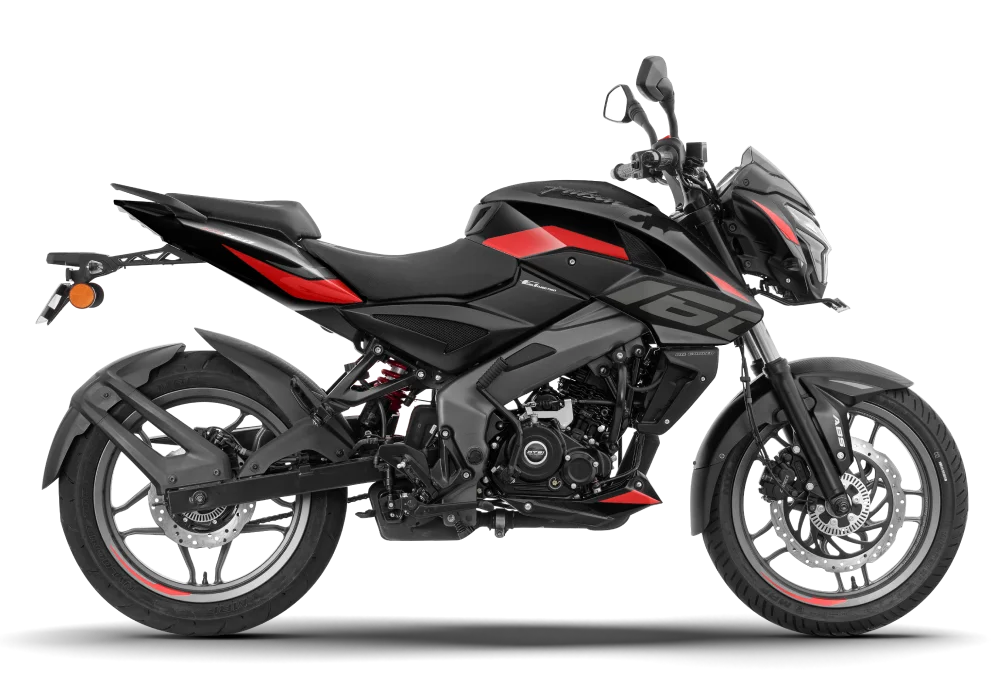
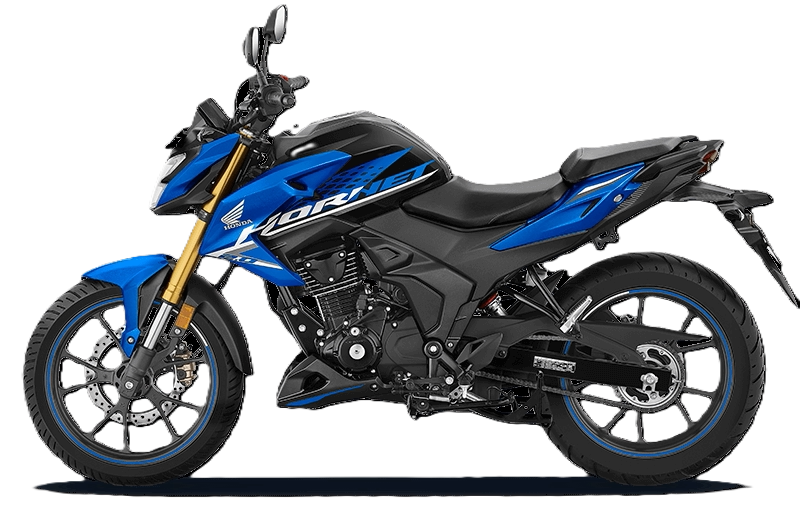
At a Glance
Key differences that define each motorcycle
Bajaj Pulsar NS160
- 160.3 cc Oil-Cooled, 4-valve
- 17.2 PS @ 9000 rpm
- ~44 km/l (Owner Reported)
- 12-litre tank
- 2 variants available
- Dual-channel ABS (top variant)
Honda Hornet 2.0
- 184.4 cc Air-Cooled, 2-valve
- 17.03 PS @ 8500 rpm
- 42.3 km/l (ARAI)
- 12-litre tank
- 1 variant available
- USD forks + 16.1 Nm torque
Full Specification Comparison
Every number that matters — side by side
| Specification | Bajaj Pulsar NS160 | Honda Hornet 2.0 |
|---|---|---|
| Engine & Performance | ||
| Displacement | 160.3 cc | 184.4 cc |
| Cooling System | Oil-Cooled | Air-Cooled |
| Max Power | 17.2 PS @ 9000 rpm | 17.03 PS @ 8500 rpm |
| Max Torque | 14.6 Nm @ 7250 rpm | 16.1 Nm @ 6000 rpm |
| Valves per Cylinder | 4 | 2 |
| Compression Ratio | 9.8 ± 0.5 : 1 | 9.5 : 1 |
| Bore × Stroke | 58 × 60.7 mm | 61 × 63.1 mm |
| Emission Standard | BS6 Phase 2 | BS6 OBD2 |
| Transmission | 5-Speed Manual | 5-Speed Manual |
| Top Speed | ~120 km/h | ~130 km/h |
| Riding Modes | No | No |
| Traction Control | No | No |
| Fuel & Range | ||
| Mileage (Claimed) | ~44 km/l (Owner Reported) | 42.3 km/l (ARAI) |
| Fuel Tank | 12 litres | 12 litres |
| Reserve Capacity | 2.4 litres | 1.9 litres |
| Riding Range | ~528 km | ~504 km |
| Brakes & Wheels | ||
| Braking System | Single / Dual Channel ABS | Single Channel ABS |
| Front Brake | Disc – 300 mm | Disc – 276 mm |
| Rear Brake | Disc – 230 mm | Disc – 220 mm |
| Tyre Type | Tubeless | Tubeless |
| Tyre Size (F / R) | 100/80-17 / 130/70-17 | 110/70-17 / 140/70-17 |
| Wheel Type | Alloy | Alloy |
| Suspension & Chassis | ||
| Front Suspension | Telescopic Fork (base) / USD (top) | USD Fork (standard) |
| Rear Suspension | Nitrox Monoshock | Monoshock |
| Chassis | Perimeter Frame | Diamond Type Frame |
| Rear Preload Adjuster | Yes | Yes |
| Dimensions & Weight | ||
| Kerb Weight | 152 kg | 142 kg |
| Seat Height | 805 mm | 790 mm |
| Ground Clearance | 170 mm | 168 mm |
| Wheelbase | 1372 mm | 1355 mm |
| Overall L × W × H | 2017 × 804 × 1060 mm | 2047 × 783 × 1064 mm |
| Features & Electronics | ||
| Instrument Console | Digital LCD | Fully Digital LCD |
| Headlight | LED Projector | LED |
| DRLs | Yes | Yes |
| Turn Signals | Halogen | LED |
| Hazard Warning Lights | No | Yes |
| Riding Modes | No | No |
| Traction Control | No | No |
| Bluetooth Connectivity | Yes (both variants) | No |
| Call & SMS Alerts | Yes | No |
| USB Charging Port | Yes | No |
| Distance to Empty | Yes | No |
| Gear Indicator | Yes | Yes |
| Tachometer | Digital | Digital |
| Service Reminder | Yes | Yes |
| Keyless Ignition | No | No |
| Price & Warranty | ||
| Starting Price (ex-showroom) | ₹1,21,109 | ₹1,47,151 |
| Top Variant Price | ₹1,29,487 | ₹1,47,151 |
| Number of Variants | 2 | 1 |
| Standard Warranty | 2 Years / 30,000 km | 3 Years |
★ Green highlights indicate the stronger value in each row. Prices are ex-showroom India averages and may vary by city.
Variant-wise Price Comparison
All variants laid out — find the right one for your budget
Pulsar NS160 Variants
Honda Hornet 2.0 Variants
Pros & Cons
Honest strengths and weaknesses of each bike
Pros
- Significantly lower price — saves ₹26,042 over Hornet 2.0
- Dual-channel ABS available on top variant (₹1,29,487)
- Larger 300 mm front disc — better than Hornet's 276 mm
- Larger 230 mm rear disc (vs 220 mm)
- Oil-cooled 4-valve engine — more performance-oriented
- Marginally higher peak power (17.2 PS vs 17.03 PS)
- Bluetooth standard on both variants
- USB charging port standard
- Distance to empty indicator
- Better ground clearance (170 mm vs 168 mm)
- Longer wheelbase (1372 mm) for highway stability
- LED projector headlamp
Cons
- Lower torque (14.6 Nm vs 16.1 Nm) — 1.5 Nm less
- Smaller engine displacement (160.3 cc vs 184.4 cc)
- No ARAI mileage claim — only owner-reported ~44 km/l
- Halogen turn signals vs LED on Hornet 2.0
- No hazard warning lights
- Shorter 2-year / 30,000 km warranty
- USD forks only on top variant — not base
- Heavier at 152 kg (vs 142 kg)
Pros
- Larger 184.4 cc engine with significantly more torque (16.1 Nm)
- ARAI-certified 42.3 km/l — official mileage claim
- USD forks standard from the base — only variant
- Lighter at 142 kg — 10 kg less than NS160
- Higher top speed (~130 km/h vs ~120 km/h)
- LED turn signals standard
- Hazard warning lights included
- Wider rear tyre (140/70-17 vs 130/70-17) for better grip
- 3-year warranty — longer than NS160's 2 years
- Honda reliability and long-term durability
- BS6 OBD2 emission standard
Cons
- Significantly more expensive — ₹26,042 more than NS160 base
- No Bluetooth connectivity at all
- No USB charging port
- No distance to empty indicator
- Single-channel ABS only — no dual-channel option
- Smaller 276 mm front disc
- Only 1 variant — no cheaper entry point
- Air-cooled 2-valve engine — less revvy character
Key Differences Explained
What really sets these two bikes apart
Engine Character
The NS160 uses a 160.3 cc oil-cooled, 4-valve engine making 17.2 PS — tuned for sporty, higher-revving performance. The Hornet 2.0 uses a 184.4 cc air-cooled, 2-valve engine making 17.03 PS but a substantially higher 16.1 Nm of torque versus the NS160's 14.6 Nm — a difference of 1.5 Nm. The Hornet's torque advantage arrives at a lower 6000 rpm, giving it noticeably stronger low and mid-range pulling power. In character, the NS160 revs harder and feels sportier; the Hornet 2.0 feels more tractable and refined.
Fuel Efficiency & Range
The Hornet 2.0 has an ARAI-certified 42.3 km/l, while the NS160 claims approximately 44 km/l based only on owner reports — Bajaj has not published an ARAI figure. Despite the NS160's slightly higher owner-reported number, the Hornet's official certification makes it the more trustworthy figure. Both bikes have identical 12-litre fuel tanks, giving a theoretical range of ~504 km for the Hornet and ~528 km for the NS160. The NS160 also has a larger 2.4-litre reserve versus the Hornet's 1.9 litres.
Braking & Safety
The NS160 leads on braking hardware: its 300 mm front disc is 24 mm larger than the Hornet's 276 mm, and the rear disc is also bigger at 230 mm versus 220 mm. Crucially, the NS160 offers dual-channel ABS on its top variant — the Hornet 2.0 is limited to single-channel ABS with no dual-channel option anywhere in its lineup. However, the Hornet's wider rear tyre (140/70-17 vs 130/70-17) does provide a larger contact patch for cornering grip and braking stability.
Features & Connectivity
This is a decisive win for the NS160. It includes Bluetooth, USB charging, distance to empty and call/SMS alerts standard on both variants — the Hornet 2.0 has none of these. The Hornet counters with LED turn signals and hazard warning lights (both absent on the NS160) and a wider tyre for stability. For a rider who wants to stay connected to their phone, charge devices, and monitor remaining range, the NS160's feature set is meaningfully more complete despite its lower price.
Weight & Handling
The Hornet 2.0 is 10 kg lighter at 142 kg versus the NS160's 152 kg, and comes with USD front forks as standard — equipment the NS160 only provides on its ₹1,29,487 top variant. The Hornet's lighter weight and USD setup give it a more premium, agile feel, especially in tight city traffic. The NS160 fights back with a longer 1372 mm wheelbase (vs 1355 mm) for greater straight-line stability and a perimeter frame for confident cornering.
Price & Value
The NS160 starts at ₹1,21,109 — ₹26,042 cheaper than the Hornet 2.0's single variant at ₹1,47,151. Even the NS160's top Dual Channel ABS USD variant at ₹1,29,487 is ₹17,664 less. For most buyers, the NS160 at ₹1,21,109 or ₹1,29,487 represents better value per rupee: more features (Bluetooth, USB, distance to empty), larger brakes, dual-ch ABS option, and only marginally less performance. The Hornet justifies its premium through larger displacement, higher torque, lighter weight, and USD forks standard.
Expert Verdict
Which one should you actually buy?
Buy the Pulsar NS160 if…
- Budget is a priority — you save ₹26,042 over the Hornet 2.0
- You want Bluetooth and USB charging standard from base
- Dual-channel ABS is important and the top variant at ₹1,29,487 fits your budget
- Larger 300 mm front brakes and stronger braking hardware matter
- The oil-cooled 4-valve sporty engine character appeals to you
- You value distance to empty and connectivity features daily
- Bajaj's widespread service network suits your location
Buy the Honda Hornet 2.0 if…
- Higher torque (16.1 Nm) and stronger real-world pulling power matter
- You want USD forks and lighter weight (142 kg) from base — no compromises
- Honda's reliability reputation and 3-year warranty give you confidence
- A larger 184.4 cc engine and higher top speed (~130 km/h) suit your riding
- LED turn signals and hazard warning lights are must-have safety features
- Budget allows spending ₹1,47,151 for a complete premium package
- You prefer Honda's long-term engine durability for high mileage riding
Overall Winner: Bajaj Pulsar NS160 on value; Honda Hornet 2.0 on premium completeness. The Bajaj Pulsar NS160 wins convincingly on value — it costs ₹26,042 less, packs Bluetooth, USB charging, distance to empty, larger brakes (300 mm front) and a dual-channel ABS option, making it the smarter buy for budget-conscious riders who want more features per rupee. The Honda Hornet 2.0 justifies its price premium with a notably larger 184.4 cc engine, 1.5 Nm more torque arriving lower in the rev range, USD forks standard from its only variant, lighter 142 kg weight, LED turn signals, hazard lights and Honda's renowned engine longevity. Choose the Hornet if you ride hard, want refined power delivery, and can spend the extra ₹26,000 for a complete premium package with Honda backing.
Frequently Asked Questions
Common questions answered by our experts
The Bajaj Pulsar NS160 is better for riders who want more features per rupee — it costs ₹26,042 less, includes Bluetooth, USB charging, distance to empty, larger brakes (300 mm front) and a dual-channel ABS option on the top variant. The Honda Hornet 2.0 is better if you want a larger 184.4 cc engine with significantly more torque (16.1 Nm vs 14.6 Nm), USD forks standard, a lighter 142 kg chassis, LED turn signals, hazard lights and Honda's long-term reliability backing — and are comfortable spending ₹1,47,151.
The Bajaj Pulsar NS160 starts at ₹1,21,109 while the Honda Hornet 2.0 is priced at ₹1,47,151 — the Hornet 2.0 costs ₹26,042 more. Even the NS160's top Dual Channel ABS USD variant at ₹1,29,487 remains ₹17,664 cheaper than the Hornet 2.0's single standard variant. Prices are approximate ex-showroom averages and may vary by city.
The Honda Hornet 2.0 has an ARAI-certified mileage of 42.3 km/l — an official government-certified figure. The Bajaj Pulsar NS160 has a higher owner-reported mileage of approximately 44 km/l, but Bajaj has not published an official ARAI claim for the NS160. Both bikes have identical 12-litre fuel tanks, giving the NS160 a slightly longer theoretical range of ~528 km versus ~504 km for the Hornet 2.0.
The Bajaj Pulsar NS160 makes marginally more peak power at 17.2 PS @ 9000 rpm versus the Honda Hornet 2.0's 17.03 PS @ 8500 rpm. However, the Honda Hornet 2.0 produces significantly more torque at 16.1 Nm @ 6000 rpm compared to the NS160's 14.6 Nm @ 7250 rpm — a difference of 1.5 Nm arriving lower in the rev range. In practical riding, the Hornet 2.0 feels stronger at city speeds and when pulling from low revs, while the NS160 feels more energetic at higher rpm.
No, the Honda Hornet 2.0 comes only with single-channel ABS in its single available variant. There is no dual-channel ABS option at any price point for the Hornet 2.0. The Bajaj Pulsar NS160 offers single-channel ABS on the base variant and dual-channel ABS on the top Dual Channel ABS USD variant at ₹1,29,487, making the NS160 the better choice for buyers who specifically want dual-channel braking safety.
The Honda Hornet 2.0 has a better warranty at 3 years compared to the Bajaj Pulsar NS160's 2 years or 30,000 km. The Hornet's 3-year warranty provides one additional year of coverage. However, neither warranty is particularly long — buyers seeking extended coverage should compare the Bajaj Pulsar N160 which offers an exceptional 5-year / 75,000 km warranty as an alternative in the 160cc segment.