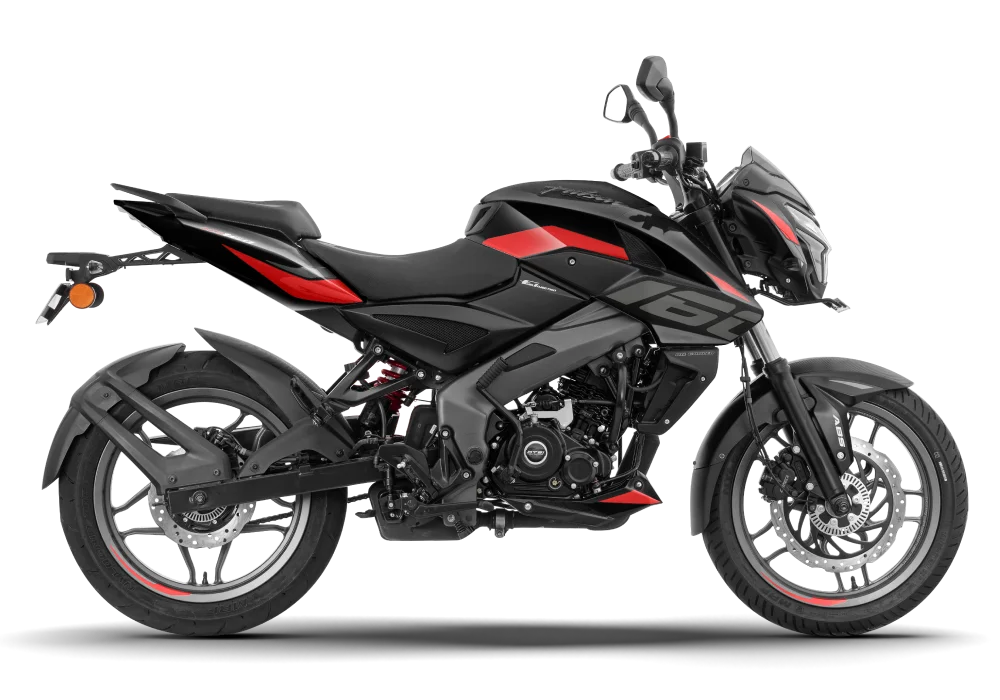
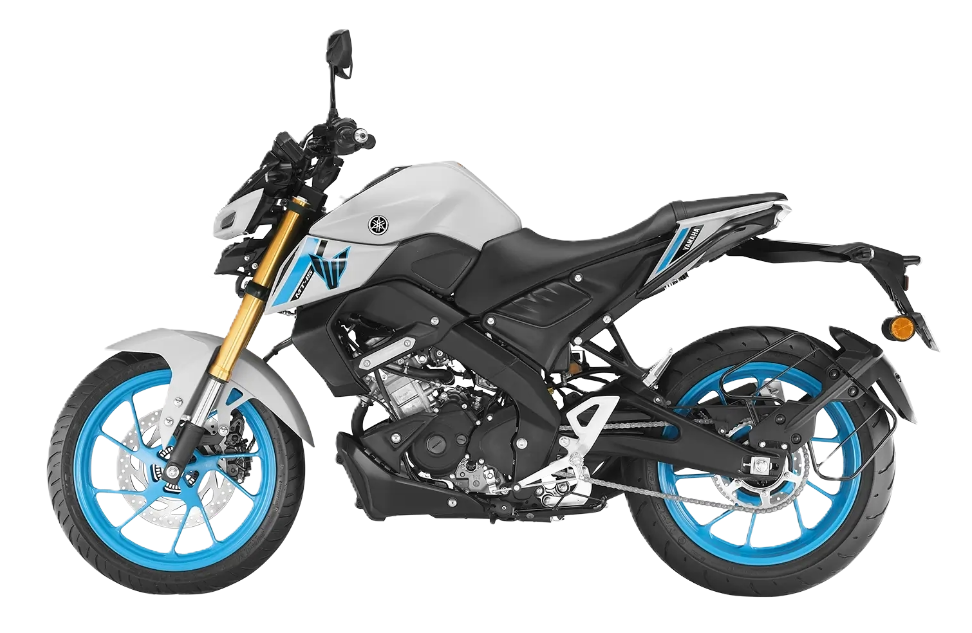
At a Glance
Key differences that define each motorcycle
Bajaj Pulsar NS160
- 160.3 cc Oil-Cooled, 4-valve
- 17.2 PS @ 9000 rpm
- ~44 km/l (Owner Reported)
- 12-litre tank
- 2 variants available
- Dual-channel ABS (top variant)
Yamaha MT-15 V2
- 155 cc Liquid-Cooled, 4-valve, VVA
- 18.4 PS @ 10,000 rpm
- 56.87 km/l (ARAI)
- 10-litre tank
- 2 variants available
- Traction control + Dual-Ch ABS (both variants)
Full Specification Comparison
Every number that matters — side by side
| Specification | Bajaj Pulsar NS160 | Yamaha MT-15 V2 |
|---|---|---|
| Engine & Performance | ||
| Displacement | 160.3 cc | 155 cc |
| Cooling System | Oil-Cooled | Liquid-Cooled |
| Max Power | 17.2 PS @ 9000 rpm | 18.4 PS @ 10,000 rpm |
| Max Torque | 14.6 Nm @ 7250 rpm | 14.1 Nm @ 7500 rpm |
| Valves per Cylinder | 4 | 4 |
| Compression Ratio | 9.8 ± 0.5 : 1 | 11.6 : 1 |
| Bore × Stroke | 58 × 60.7 mm | 58.0 × 58.7 mm |
| Variable Valve Actuation | No | Yes (VVA) |
| Clutch | Wet Multiplate | Assist & Slipper Clutch |
| Emission Standard | BS6 Phase 2 | BS6 OBD2 |
| Transmission | 5-Speed Manual | 6-Speed Manual |
| Top Speed | ~120 km/h | ~122 km/h |
| Riding Modes | No | No |
| Traction Control | No | Yes (both variants) |
| Fuel & Range | ||
| Mileage (Claimed) | ~44 km/l (Owner Reported) | 56.87 km/l (ARAI) |
| Fuel Tank | 12 litres | 10 litres |
| Reserve Capacity | 2.4 litres | 1.6 litres |
| Riding Range | ~528 km | ~568 km |
| Brakes & Wheels | ||
| Braking System | Single / Dual Channel ABS | Dual Channel ABS (both variants) |
| Front Brake | Disc – 300 mm | Disc – 282 mm |
| Rear Brake | Disc – 230 mm | Disc – 220 mm |
| Tyre Type | Tubeless | Tubeless |
| Tyre Size (F / R) | 100/80-17 / 130/70-17 | 100/80-17 / 140/70-17 |
| Wheel Type | Alloy | Alloy |
| Suspension & Chassis | ||
| Front Suspension | Telescopic Fork (base) / USD (top) | USD Fork (both variants) |
| Rear Suspension | Nitrox Monoshock | Linked-Type Monoshock |
| Chassis | Perimeter Frame | Deltabox Frame |
| Rear Preload Adjuster | Yes | Yes |
| Dimensions & Weight | ||
| Kerb Weight | 152 kg | 141 kg |
| Seat Height | 805 mm | 810 mm |
| Ground Clearance | 170 mm | 170 mm |
| Wheelbase | 1372 mm | 1325 mm |
| Overall L × W × H | 2017 × 804 × 1060 mm | 2015 × 800 × 1070 mm |
| Features & Electronics | ||
| Instrument Console | Digital LCD | Fully Digital LCD |
| Headlight | LED Projector | LED |
| DRLs | Yes | Yes |
| Turn Signals | Halogen | LED |
| Hazard Warning Lights | No | Yes (DLX variant) |
| Traction Control | No | Yes |
| Bluetooth Connectivity | Yes (both variants) | Yes (DLX variant only) |
| Call & SMS Alerts | Yes | Yes (DLX variant) |
| Navigation | No | Yes (DLX variant) |
| USB Charging Port | Yes | No |
| Distance to Empty | Yes | Yes |
| Gear Indicator | Yes | Yes |
| Tachometer | Digital | Digital |
| Service Reminder | Yes | Yes |
| Keyless Ignition | No | No |
| Price & Warranty | ||
| Starting Price (ex-showroom) | ₹1,21,109 | ₹1,60,096 |
| Top Variant Price | ₹1,29,487 | ₹1,68,507 |
| Number of Variants | 2 | 2 |
| Standard Warranty | 2 Years / 30,000 km | 2 Years / 30,000 km |
★ Green highlights indicate the stronger value in each row. Prices are ex-showroom India averages and may vary by city.
Variant-wise Price Comparison
All variants laid out — find the right one for your budget
Pulsar NS160 Variants
Yamaha MT-15 V2 Variants
Pros & Cons
Honest strengths and weaknesses of each bike
Pros
- Significantly lower price — saves ~₹39,000 over MT-15 V2
- Higher torque (14.6 Nm vs 14.1 Nm) for stronger mid-range pull
- Larger 300 mm front disc — biggest in segment
- Larger 230 mm rear disc
- Bigger 12-litre fuel tank (vs 10 litres)
- LED projector headlamp standard
- Bluetooth standard on both variants
- USB charging port standard
- Longer wheelbase (1372 mm) for better highway stability
- Perimeter frame — proven platform for sporty handling
Cons
- No traction control on any variant
- No ARAI mileage claim — only owner-reported ~44 km/l
- Oil-cooled engine — less refined than liquid-cooled
- 5-speed gearbox vs 6-speed on MT-15 V2
- No assist & slipper clutch
- Single-ch ABS on base variant only
- Halogen turn signals
- Weaker warranty year-for-year same, but older tech
- No navigation on any variant
Pros
- Highest power in class — 18.4 PS from liquid-cooled VVA engine
- ARAI-certified 56.87 km/l — best mileage in the segment
- Traction control standard on both variants
- Dual-channel ABS standard on both variants
- USD front forks standard on both variants
- Assist & slipper clutch for smoother downshifts
- 6-speed gearbox for relaxed highway cruising
- LED turn signals standard
- Lighter at 141 kg (vs 152 kg) — more agile
- Navigation available on DLX variant
Cons
- Very high price — ₹38,987 more than NS160 base
- Smaller 10-litre fuel tank — more frequent refuelling
- No USB charging port on any variant
- Bluetooth only on DLX variant (₹1,68,507)
- Smaller front brake disc (282 mm vs 300 mm)
- Lower torque (14.1 Nm vs 14.6 Nm)
- Pillion comfort is limited
- Shorter wheelbase — slightly less stable at high speed
Key Differences Explained
What really sets these two bikes apart
Engine & Technology
This is the defining difference. The MT-15 V2 uses a 155 cc liquid-cooled, 4-valve engine with VVA (Variable Valve Actuation) — technology borrowed from the R15 — producing 18.4 PS @ 10,000 rpm. The NS160 uses a 160.3 cc oil-cooled, 4-valve unit making 17.2 PS @ 9,000 rpm. The MT-15 V2 also adds a 6-speed gearbox and assist & slipper clutch, while the NS160 has a 5-speed box and a conventional wet multiplate clutch. In character, the MT-15 V2 is silkier and higher-revving; the NS160 is more torque-focused and tractable at city speeds.
Fuel Efficiency & Range
The MT-15 V2 comprehensively wins on efficiency: its ARAI-certified 56.87 km/l is dramatically better than the NS160's owner-reported ~44 km/l. Despite its smaller 10-litre tank, the MT-15 V2 achieves a theoretical range of ~568 km — slightly ahead of the NS160's ~528 km from a 12-litre tank. For a performance motorcycle, the MT-15 V2's fuel economy is extraordinary, driven by its liquid-cooled VVA engine and lighter overall weight.
Braking & Safety
The NS160 wins on hardware: its 300 mm front disc is the largest in this comparison, beating the MT-15 V2's 282 mm unit, and it pairs with a 230 mm rear disc (vs 220 mm). However, the MT-15 V2 counters with dual-channel ABS standard on both variants — including the base STD — while the NS160 only gets dual-channel ABS on the more expensive USD variant (₹1,29,487). The MT-15 V2 also adds traction control, a safety net the NS160 lacks entirely.
Weight, Suspension & Handling
The MT-15 V2 is 11 kg lighter at 141 kg versus the NS160's 152 kg, and runs USD front forks on both variants — standard equipment that the NS160 only provides on its ₹1,29,487 top variant. The MT-15 V2's lightweight Deltabox frame makes it highly nimble in city traffic. The NS160 fights back with a longer 1372 mm wheelbase (vs 1325 mm) for greater straight-line stability and a Nitrox monoshock that handles rougher roads well. Both bikes offer monoshock rear suspension.
Features & Connectivity
The NS160 has Bluetooth on both variants and includes a USB charging port — the MT-15 V2 has neither on the STD variant and no USB port at all. The MT-15 V2 DLX gains Bluetooth, navigation, call/SMS alerts and hazard warning lights. The NS160 includes an LED projector headlamp while the MT-15 V2 uses standard LED. Both have digital consoles with DRLs, distance to empty, gear indicator and tachometer. The MT-15 V2 has the edge in electronics (traction control, LED indicators), while the NS160 wins on everyday convenience (Bluetooth standard, USB charging).
Price & Value
The NS160 is the decisive winner here. Starting at ₹1,21,109 versus ₹1,60,096 for the MT-15 V2 — a gap of nearly ₹39,000 — the NS160 is one of the most performance-packed bikes in India for its price. Even the NS160's top Dual Channel ABS USD variant at ₹1,29,487 costs ₹30,609 less than the MT-15 V2's base STD. The MT-15 V2 justifies its premium with superior technology, but for riders who prioritise performance per rupee, the NS160's value proposition is hard to beat.
Expert Verdict
Which one should you actually buy?
Buy the Pulsar NS160 if…
- Budget is the primary concern — saves up to ₹39,000+
- You want Bluetooth and USB charging on the base variant
- The 300 mm front disc and strong mid-range torque matter
- You want a larger fuel tank (12L) for fewer pit stops
- Perimeter frame handling and NS-series styling appeal to you
- You're comfortable getting dual-ch ABS on the top variant at ₹1,29,487
- You value Bajaj's widespread service network across India
Buy the Yamaha MT-15 V2 if…
- You want the most advanced technology in a 155cc street naked
- Traction control and dual-ch ABS standard from base matter to you
- Class-leading mileage (56.87 km/l ARAI) is a priority
- Liquid-cooled VVA engine refinement and high-rpm performance excite you
- USD forks and assist & slipper clutch from base are desirable
- Lightweight agility (141 kg) and the Deltabox frame suit your riding
- Budget is not the primary constraint and premium build is valued
Overall Winner: Yamaha MT-15 V2 on technology; Bajaj Pulsar NS160 on value. The Yamaha MT-15 V2 is the technically superior motorcycle — with a liquid-cooled VVA engine, 18.4 PS, 56.87 km/l ARAI mileage, traction control, dual-channel ABS, USD forks and a slipper clutch all standard from the base variant — and is the right choice for riders who want the best technology available in the 155cc naked segment and are willing to pay the ~₹39,000 premium. The Bajaj Pulsar NS160 is the undisputed value champion: for under ₹1,30,000, it delivers strong 160cc performance, a 300 mm front disc, dual-channel ABS with USD forks on the top variant, Bluetooth and USB charging standard, and engaging perimeter-frame handling — making it one of the best performance bikes for its price in India in 2026.
Frequently Asked Questions
Common questions answered by our experts
It depends on your priority. The Yamaha MT-15 V2 is technologically superior with a liquid-cooled VVA engine (18.4 PS), traction control, dual-ch ABS and USD forks standard from base, and exceptional ARAI-certified mileage of 56.87 km/l. The Bajaj Pulsar NS160 offers very strong performance (17.2 PS, 14.6 Nm) with a 300 mm front disc, Bluetooth and USB charging standard on both variants, at a price of ~₹39,000 less — making it one of India's best-value performance streetfighters.
The Bajaj Pulsar NS160 starts at ₹1,21,109 while the Yamaha MT-15 V2 starts at ₹1,60,096 — a difference of approximately ₹38,987. The NS160 tops out at ₹1,29,487 (Dual Channel ABS USD), while the MT-15 V2's DLX variant reaches ₹1,68,507. Even the NS160's top variant is ₹30,609 less than the MT-15 V2's base. Prices are approximate ex-showroom averages and may vary by city.
The Yamaha MT-15 V2 has significantly better mileage with an ARAI-certified 56.87 km/l — compared to the Bajaj Pulsar NS160's owner-reported ~44 km/l (no official ARAI claim). Despite having a smaller 10-litre tank versus the NS160's 12 litres, the MT-15 V2's superior efficiency gives it a slightly longer theoretical range of ~568 km against the NS160's ~528 km. In real-world riding, the MT-15 V2's mileage advantage is consistently reported by owners as well.
The Yamaha MT-15 V2 makes more peak power at 18.4 PS @ 10,000 rpm versus the Bajaj Pulsar NS160's 17.2 PS @ 9,000 rpm. However, the NS160 produces more torque at 14.6 Nm @ 7,250 rpm versus 14.1 Nm @ 7,500 rpm for the MT-15 V2. In practical riding, the NS160 feels stronger at city speeds thanks to its higher torque, while the MT-15 V2 pulls harder at higher revs due to its liquid-cooled VVA engine.
Yes, the Yamaha MT-15 V2 comes with traction control standard on both the STD (₹1,60,096) and DLX (₹1,68,507) variants. This prevents rear wheel spin during hard acceleration, especially on slippery surfaces. The Bajaj Pulsar NS160 does not offer traction control on any of its variants, making the MT-15 V2's inclusion of this feature a meaningful safety and performance advantage.
Both the Bajaj Pulsar NS160 and Yamaha MT-15 V2 offer the same standard warranty of 2 years or 30,000 km. This is a tie — neither bike has an advantage on warranty terms. Riders who want extended protection should ask their dealer about extended warranty packages available from both Bajaj and Yamaha service networks.