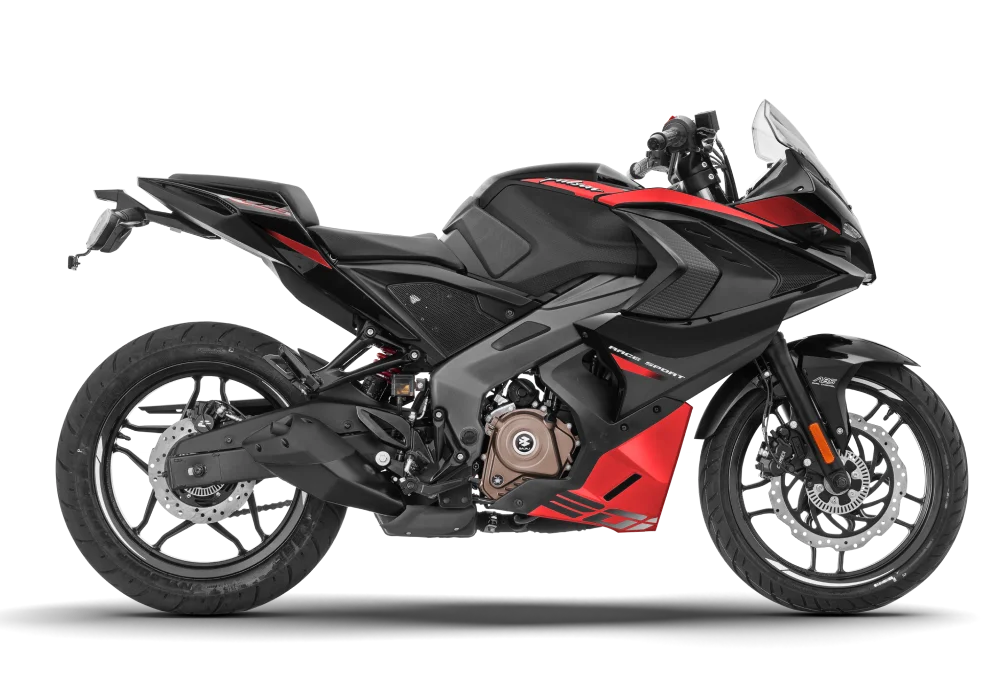
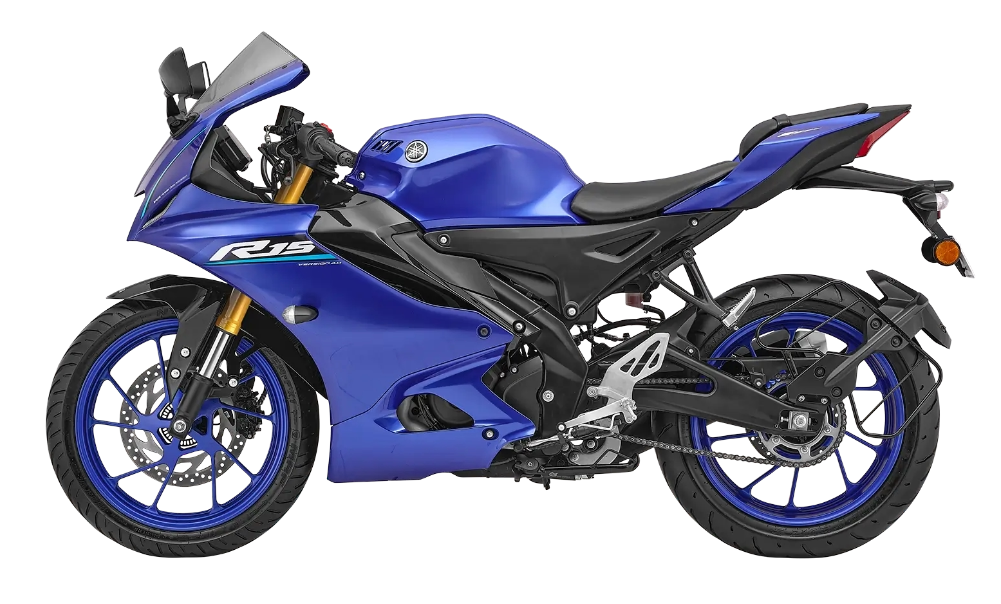
At a Glance
Key differences that define each motorcycle
Bajaj Pulsar RS200
- 199.5 cc Liquid-Cooled, 4-valve
- 24.5 PS @ 9750 rpm
- 35 km/l (ARAI)
- 13-litre tank
- 1 variant available
- Dual-channel ABS + Riding Modes
Yamaha R15 V4
- 155 cc Liquid-Cooled, 4-valve VVA
- 18.4 PS @ 10000 rpm
- 45 km/l (ARAI)
- 11-litre tank
- 3 variants available
- Traction control + Track/Street modes
Full Specification Comparison
Every number that matters — side by side
| Specification | Bajaj Pulsar RS200 | Yamaha R15 V4 |
|---|---|---|
| Engine & Performance | ||
| Displacement | 199.5 cc | 155 cc |
| Cooling System | Liquid-Cooled | Liquid-Cooled |
| Max Power | 24.5 PS @ 9750 rpm | 18.4 PS @ 10000 rpm |
| Max Torque | 18.74 Nm @ 8000 rpm | 14.2 Nm @ 7500 rpm |
| Valves per Cylinder | 4 | 4 (VVA) |
| Compression Ratio | 11 ± 0.5 : 1 | 11.6 : 1 |
| Bore × Stroke | 72 × 49 mm | 58 × 58.7 mm |
| Spark Plugs | 3 (Triple Spark) | 1 |
| Emission Standard | BS6 | BS6 Phase 2 |
| Transmission | 6-Speed Manual | 6-Speed Manual |
| Clutch | Wet Multiplate | Assist & Slipper |
| Top Speed | 141 km/h | 140 km/h |
| Riding Modes | Road, Rain, Offroad | Track, Street |
| Traction Control | No | Yes (standard) |
| Quick Shifter | No | Yes (optional) |
| Fuel & Range | ||
| Mileage (ARAI) | 35 km/l | 45 km/l |
| Fuel Tank | 13 litres | 11 litres |
| Reserve Capacity | 2.6 litres | 1.76 litres |
| Riding Range | ~455 km | ~495 km |
| Brakes & Wheels | ||
| Braking System | Dual Channel ABS | Dual Channel ABS |
| Front Brake | Disc – 300 mm | Disc – 282 mm |
| Rear Brake | Disc – 230 mm | Disc – 220 mm |
| Tyre Type | Tubeless | Tubeless |
| Tyre Size (F / R) | 110/70-17 / 140/70-17 | 100/80-17 / 140/70-17 |
| Wheel Type | Alloy | Alloy |
| Suspension & Chassis | ||
| Front Suspension | Telescopic with Anti-Friction Bush | USD Fork |
| Rear Suspension | Nitrox Monoshock with Canister | Linked Monoshock |
| Chassis | Perimeter Frame | Deltabox Frame |
| Rear Preload Adjuster | Yes | Yes |
| Dimensions & Weight | ||
| Kerb Weight | 167 kg | 141 kg |
| Seat Height | 810 mm | 815 mm |
| Ground Clearance | 157 mm | 170 mm |
| Wheelbase | 1345 mm | 1325 mm |
| Overall L × W × H | 1999 × 765 × 1114 mm | 1990 × 725 × 1135 mm |
| Features & Electronics | ||
| Instrument Console | Fully Digital LCD | Fully Digital LCD |
| Headlight | Halogen Projector | LED Projector |
| DRLs | Yes | Yes |
| Turn Signals | Bulb | LED |
| Hazard Warning Lights | Yes | Yes |
| Riding Modes | Road, Rain, Offroad | Track, Street |
| Traction Control | No | Yes |
| Bluetooth Connectivity | Yes | Yes |
| Call & SMS Alerts | Yes | Yes |
| USB Charging Port | No | No |
| Distance to Empty | Yes | Yes |
| Gear Indicator | Yes | Yes |
| Tachometer | Digital | Digital |
| Keyless Ignition | No | No |
| Price & Warranty | ||
| Starting Price (ex-showroom) | ₹1,72,857 | ₹1,67,085 |
| Top Variant Price | ₹1,72,857 (single variant) | ₹1,71,686 |
| Number of Variants | 1 | 3 |
| Standard Warranty | 5 Years / 75,000 km | 2 Years / 30,000 km |
★ Green highlights indicate the stronger value in each row. Prices are ex-showroom India averages and may vary by city.
Variant-wise Price Comparison
All variants laid out — find the right one for your budget
Pulsar RS200 Variants
Yamaha R15 V4 Variants
Pros & Cons
Honest strengths and weaknesses of each bike
Pros
- Significantly more power — 24.5 PS vs 18.4 PS
- Higher torque — 18.74 Nm vs 14.2 Nm
- Larger 199.5cc engine for stronger acceleration
- Larger 300 mm front disc for more stopping power
- Bigger 13-litre fuel tank
- Triple spark combustion for engine efficiency
- Riding modes (Road, Rain, Offroad) standard
- Hazard warning lights included
- Outstanding 5-year / 75,000 km warranty
- Wider front tyre (110/70 vs 100/80) for more grip
Cons
- Lower ARAI mileage (35 km/l vs 45 km/l)
- Significantly heavier at 167 kg vs 141 kg
- Halogen headlight instead of LED
- Bulb turn signals instead of LED
- No traction control
- Conventional telescopic fork instead of USD
- Single variant — no choice
- Higher starting price (₹1,72,857 vs ₹1,67,085)
- No slipper clutch
- Less ground clearance (157 mm vs 170 mm)
Pros
- Significantly lighter at 141 kg — 26 kg less than RS200
- Traction control standard on all variants
- USD front forks standard — superior handling feel
- Assist & slipper clutch for smoother downshifts
- Full LED lighting — headlight, tail, turn signals
- Better ARAI mileage (45 km/l vs 35 km/l)
- VVA technology for optimised performance across RPM range
- Track & Street ride modes
- 3 variants — more choice at different budgets
- Lower starting price (₹1,67,085)
- Greater ground clearance (170 mm vs 157 mm)
- Quick shifter (optional)
Cons
- Significantly less power (18.4 PS vs 24.5 PS)
- Lower torque (14.2 Nm vs 18.74 Nm)
- Smaller 155cc engine — less overtaking grunt
- Smaller 11-litre fuel tank
- Smaller 282 mm front disc
- Very weak warranty: only 2 years / 30,000 km
- No hazard warning lights
- Aggressive posture limits daily comfort
Key Differences Explained
What really sets these two bikes apart
Engine & Power
The RS200's 199.5cc liquid-cooled engine produces 24.5 PS and 18.74 Nm — a 33% power advantage over the R15 V4's 18.4 PS from its 155cc VVA unit. This translates to noticeably stronger mid-range punch, easier highway overtakes, and a more visceral acceleration experience. The R15 V4 counters with Yamaha's Variable Valve Actuation (VVA) technology which optimises valve timing for a broader power band, and revs slightly higher to 10,000 rpm. The RS200 wins on grunt; the R15 V4 wins on engine sophistication.
Weight & Chassis
At 141 kg, the R15 V4 is 26 kg lighter than the RS200's 167 kg — a substantial difference that transforms handling feel. The R15 V4's Yamaha Deltabox frame combined with USD front forks delivers superior cornering precision and front-end feedback. The RS200 uses a perimeter frame which is competent but heavier, and standard telescopic forks. For track-day use and twisty road enjoyment, the R15 V4's chassis is the clear choice.
Fuel Efficiency & Range
The R15 V4's 155cc engine returns 45 km/l ARAI — 29% more efficient than the RS200's 35 km/l. However, the RS200's larger 13-litre tank partially compensates, giving it a range of ~455 km versus ~495 km for the R15 V4 with its 11-litre tank. For daily commuters, the R15 V4's efficiency advantage saves meaningfully on fuel costs over time. The RS200's larger tank means fewer stops on longer rides.
Electronics & Technology
The R15 V4 leads clearly in electronic sophistication. Traction control is standard on all three variants — a feature the RS200 completely lacks. The R15 V4 also offers an optional quick shifter, USD forks standard across the range, and an assist & slipper clutch. The RS200 responds with riding modes (Road, Rain, Offroad) while the R15 V4 offers Track and Street modes. Both have Bluetooth and LED taillights, but the R15 V4 adds full LED turn signals and a full LED headlight versus the RS200's halogen projector.
Warranty & Ownership
The RS200 dominates this category with a 5-year / 75,000 km warranty versus the R15 V4's very limited 2-year / 30,000 km coverage. That is 2.5x more time and 2.5x more kilometre coverage. For riders doing 15,000+ km per year, the R15 V4's warranty runs out in under 2 years. The RS200 remains fully covered for the entire 5-year ownership period. This is the single most impactful ownership difference in this comparison.
Price & Value
The R15 V4 starts ₹5,772 cheaper (₹1,67,085 vs ₹1,72,857) and its top Dual Tone variant at ₹1,71,686 remains below the RS200's single variant price. The R15 V4 offers 3 variants while the RS200 has only one. However, the RS200's 5-year / 75,000 km warranty dramatically improves its total cost of ownership versus the R15 V4's 2-year / 30,000 km coverage — a premium the RS200 justifies when viewed over the full ownership period.
Expert Verdict
Which one should you actually buy?
Buy the Pulsar RS200 if…
- Raw power and acceleration are your priority (24.5 PS)
- You want the larger 199.5cc displacement advantage
- Highway riding and overtaking performance matter most
- The 5-year / 75,000 km warranty is a priority
- A larger 300 mm front disc and bigger tank suit you
- Riding modes including Offroad mode appeal to you
- You don't mind paying a slight premium over the R15 V4
Buy the Yamaha R15 V4 if…
- Handling precision and cornering finesse are your priority
- Traction control and advanced electronics matter to you
- A lighter 141 kg motorcycle suits your riding style
- USD forks and Deltabox chassis for track-capable dynamics
- Better fuel efficiency (45 km/l) is important daily
- Full LED lighting and premium finishing are non-negotiable
- You want the assist & slipper clutch advantage
- A lower starting price (₹1,67,085) fits your budget
Overall Winner for Most Riders: Yamaha R15 V4. Despite the RS200's decisive power advantage (24.5 PS vs 18.4 PS), the Yamaha R15 V4 wins the overall comparison for most buyers thanks to its superior electronics package (traction control, USD forks, slipper clutch, full LED lighting), a significantly lighter chassis, better fuel efficiency, more variant choices, and a lower starting price. Choose the Bajaj Pulsar RS200 if raw engine power, a larger 199.5cc displacement, stronger braking hardware, or the outstanding 5-year / 75,000 km warranty are your absolute top priorities — the RS200's warranty advantage in particular is a genuine long-term ownership benefit over the R15 V4's very limited 2-year / 30,000 km coverage.
Frequently Asked Questions
Common questions answered by our experts
The Yamaha R15 V4 is the better choice for most buyers due to its traction control, USD forks, assist & slipper clutch, full LED lighting, lighter weight (141 kg vs 167 kg), better fuel efficiency (45 km/l vs 35 km/l) and lower starting price. The Bajaj Pulsar RS200 is better if outright power (24.5 PS vs 18.4 PS), the larger 199.5cc engine, stronger braking hardware, or the 5-year / 75,000 km warranty are your priorities.
The Yamaha R15 V4 starts at ₹1,67,085 while the Bajaj Pulsar RS200 is priced at ₹1,72,857 ex-showroom — a difference of ₹5,772 in favour of the R15 V4. The R15 V4 tops out at ₹1,71,686 for its Dual Tone variant, which remains below the RS200's single standard variant price. Both prices may vary by city.
The Yamaha R15 V4 has significantly better ARAI certified mileage at 45 km/l compared to the Bajaj Pulsar RS200's 35 km/l. The R15 V4's smaller 155cc engine is considerably more fuel-efficient. However, the RS200's larger 13-litre tank (vs 11 litres) partially compensates, giving it a theoretical range of ~455 km versus ~495 km for the R15 V4.
The Bajaj Pulsar RS200 produces significantly more power at 24.5 PS @ 9750 rpm and 18.74 Nm of torque, compared to the Yamaha R15 V4's 18.4 PS @ 10000 rpm and 14.2 Nm. The RS200's 199.5cc liquid-cooled engine provides approximately 33% more power than the R15 V4's 155cc unit, resulting in noticeably stronger acceleration and overtaking ability.
Yes, the Yamaha R15 V4 comes with traction control as standard across all three variants (Standard, Dark Knight, and Dual Tone). The Bajaj Pulsar RS200 does not offer traction control on its single standard variant, making the R15 V4 the safer choice in low-grip conditions.
The Bajaj Pulsar RS200 has a far superior warranty at 5 years / 75,000 km compared to the Yamaha R15 V4's very limited 2 years / 30,000 km. This is 2.5x more time and 2.5x more kilometre coverage. Riders doing 15,000+ km per year will exhaust the R15 V4's warranty in under 2 years, while the RS200 remains covered for the full ownership period.