At a Glance
Key differences that define each motorcycle
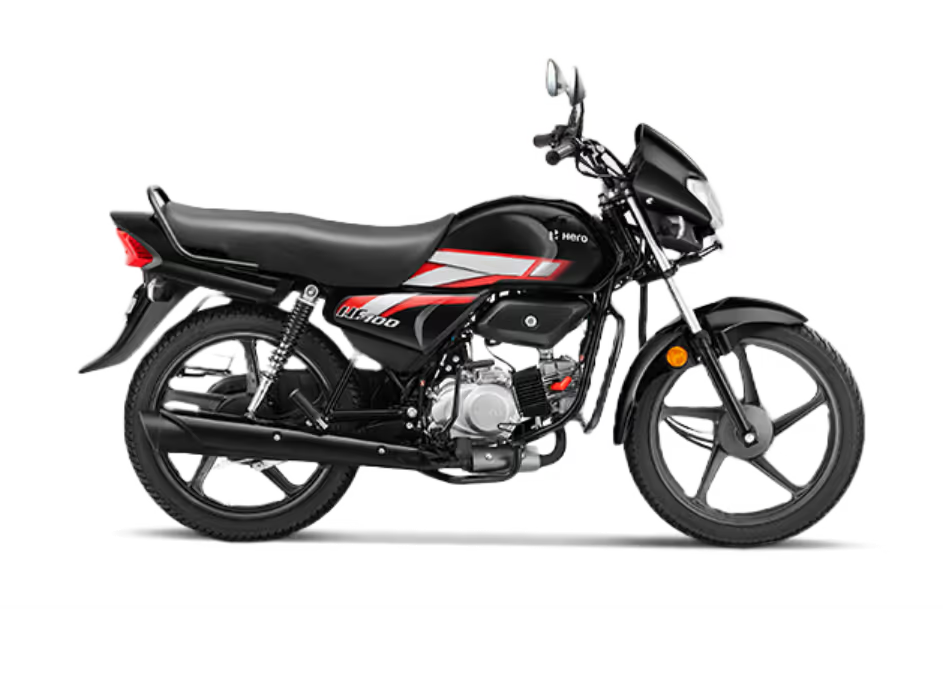
Hero HF 100
- 97.2 cc Air-Cooled
- 8.02 PS @ 8000 rpm
- 70 km/l (ARAI)
- 9.1-litre tank
- 1 variant available
- CBS (Integrated Braking System)
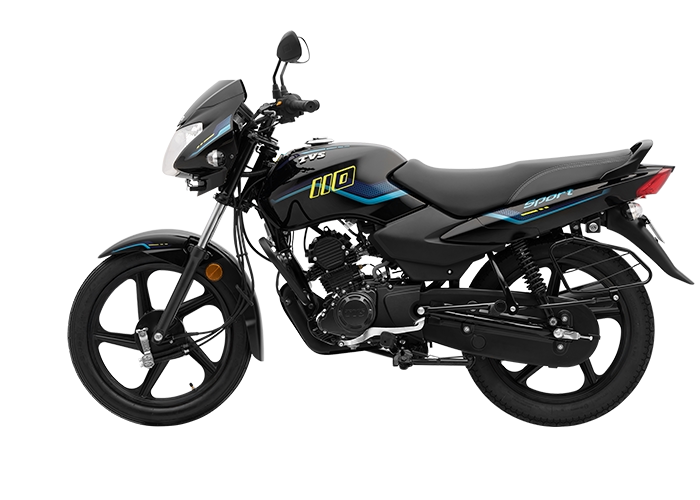
TVS Sport
- 109.7 cc Air-Cooled
- 8.19 PS @ 7350 rpm
- 80 km/l (ARAI)
- 10-litre tank
- 2 variants available
- Combi Brake System (CBS)
Full Specification Comparison
Every number that matters — side by side
| Specification | Hero HF 100 | TVS Sport |
|---|---|---|
| Engine & Performance | ||
| Displacement | 97.2 cc | 109.7 cc |
| Cooling System | Air Cooled | Air Cooled |
| Max Power | 8.02 PS @ 8000 rpm | 8.19 PS @ 7350 rpm |
| Max Torque | 8.05 Nm @ 6000 rpm | 8.7 Nm @ 4500 rpm |
| Valves per Cylinder | 2 | 2 |
| Compression Ratio | 9.9 : 1 | 9.5 : 1 |
| Bore × Stroke | 50.0 × 49.5 mm | 53.5 × 48.8 mm |
| Emission Standard | BS6 Phase 2 (OBD2B) | BS6 Phase 2 (OBD2) |
| Transmission | 4-Speed Manual | 4-Speed Manual |
| Top Speed | ~85 km/h | ~90 km/h |
| Start Type | Kick Start Only | Electric & Kick Start |
| Idle Stop-Start | No | No |
| Fuel & Range | ||
| Mileage (ARAI) | 70 km/l | 80 km/l |
| Mileage (Real-world) | 60–65 km/l | 65–75 km/l |
| Fuel Tank | 9.1 litres | 10 litres |
| Reserve Capacity | 1 litre | 2 litres |
| Riding Range (estimated) | ~550–620 km | ~650–750 km |
| Brakes & Wheels | ||
| Braking System | CBS (Integrated Braking System) | Combi Brake System (CBS) |
| Front Brake | Drum – 130 mm | Drum – 130 mm |
| Rear Brake | Drum – 130 mm | Drum – 130 mm |
| Tyre Type | Tubeless | Tubeless |
| Tyre Size (F / R) | 80/100-18 / 80/100-18 | 80/100-17 / 80/100-17 |
| Wheel Type | Cast Alloy | Alloy |
| Wheel Size | 18-inch (F & R) | 17-inch (F & R) |
| Suspension & Chassis | ||
| Front Suspension | Telescopic Hydraulic Shock Absorbers | Telescopic Hydraulic |
| Rear Suspension | 2-step Adjustable Hydraulic | 5-step Adjustable Hydraulic |
| Chassis | Tubular Double Cradle | Single Cradle Tubular Frame |
| Rear Preload Adjuster | Yes | Yes |
| Dimensions & Weight | ||
| Kerb Weight | 110 kg | 112 kg |
| Seat Height | 805 mm | 790 mm |
| Ground Clearance | 165 mm | 175 mm |
| Wheelbase | 1235 mm | 1236 mm |
| Overall L × W × H | 1965 × 720 × 1045 mm | 1950 × 705 × 1080 mm |
| Features & Electronics | ||
| Instrument Console | Analogue | Analogue |
| Headlight | Halogen | Halogen |
| DRLs | No | No |
| Turn Signals | Bulb | Bulb |
| Hazard Warning Lights | No | No |
| USB Charging Port | No | Yes (ES+ variant) |
| Gear Indicator | No | No |
| Low Fuel Indicator | Yes | Yes |
| Traction Control | No | No |
| Keyless Ignition | No | No |
| Side Stand Engine Cut-off | Yes | Yes |
| Price & Warranty | ||
| Starting Price (ex-showroom) | ₹59,839 | ₹62,143 |
| Top Variant Price | ₹59,839 | ₹63,626 |
| Number of Variants | 1 | 2 |
| Standard Warranty | 5 Years / 70,000 km | 5 Years / 60,000 km |
★ Green highlights indicate the stronger value in each row. Prices are ex-showroom India averages and may vary by city.
Variant-wise Price Comparison
All variants laid out — find the right one for your budget
Hero HF 100 Variants
TVS Sport Variants
Pros & Cons
Honest strengths and weaknesses of each bike
Pros
- Lowest purchase price in the segment (₹59,839)
- ARAI-certified mileage of 70 km/l
- Slightly lighter at 110 kg
- Excellent 5-year / 70,000 km warranty
- Very low annual maintenance cost (₹1,500–₹2,500)
- Wide Hero MotoCorp service network
- Larger 18-inch wheels for better road absorption
Cons
- Kick start only — no electric start option
- Lower ARAI mileage (70 km/l vs 80 km/l)
- Smaller 9.1-litre fuel tank
- Less ground clearance (165 mm vs 175 mm)
- Only 1 variant — no choice
- No USB charging port
- Only 2-step rear suspension adjustment
Pros
- Highest ARAI mileage in segment — 80 km/l
- Electric start as standard on both variants
- Larger 109.7 cc engine with more power (8.19 PS)
- Higher ground clearance (175 mm) for rough roads
- 5-step adjustable rear suspension
- Larger 10-litre fuel tank for greater range
- 2 variants with USB charging on ES+ variant
- Lower seat height (790 mm) for easier reach
Cons
- Higher starting price (₹62,143 vs ₹59,839)
- Shorter warranty by km — 5 years / 60,000 km
- Slightly heavier at 112 kg
- 17-inch wheels offer less comfort over large bumps
- No disc brake option
Key Differences Explained
What really sets these two bikes apart
Engine & Performance
The TVS Sport uses a larger 109.7 cc engine producing 8.19 PS with 8.7 Nm of torque, peaked lower in the rev range at 4500 rpm for better low-end pull. The HF 100 runs a 97.2 cc engine with 8.02 PS and slightly less torque. In everyday riding the Sport feels marginally punchier, especially for two-up riding.
Fuel Efficiency & Range
The TVS Sport leads convincingly with an ARAI-certified 80 km/l and a 10-litre tank giving an estimated range of 650–750 km. The HF 100 offers 70 km/l (ARAI) from a 9.1-litre tank — roughly 550–620 km per fill. The Sport's advantage here is substantial and directly impacts running costs.
Start Type & Convenience
The TVS Sport comes with both electric start and kick start on all variants — a major daily convenience advantage. The Hero HF 100 is available only with kick start, which can be inconvenient in traffic, on slopes, or for older and less physically able riders.
Warranty & Ownership Cost
Both bikes offer strong 5-year warranties. The HF 100 edges ahead with 5 years / 70,000 km vs the Sport's 5 years / 60,000 km. The HF 100 also has a slightly lower annual maintenance cost of ₹1,500–₹2,500 compared to the Sport's ₹2,000–₹3,000. Hero's wide service network is an added ownership advantage.
Price & Value
The HF 100 starts at ₹59,839 — about ₹2,304 less than the Sport's ₹62,143. It is also the only option in the segment with a sub-₹60,000 starting price. However, the TVS Sport offers more for the modest premium: electric start, higher mileage, a bigger tank, and better ground clearance.
Ride & Handling
The TVS Sport wins on ground clearance at 175 mm vs the HF 100's 165 mm, making it more confident on broken rural roads. The Sport also offers a 5-step adjustable rear suspension versus the HF 100's 2-step, giving more ride customisation. However, the HF 100's larger 18-inch wheels absorb surface irregularities slightly better.
Expert Verdict
Which one should you actually buy?
Buy the Hero HF 100 if…
- Your budget is strictly under ₹60,000
- You want the lowest possible purchase price
- You are comfortable using kick start daily
- You ride mostly on smooth city or town roads
- You want the highest kilometre warranty coverage
- Long-term spares availability is a priority
Buy the TVS Sport if…
- You want the best ARAI mileage in the segment (80 km/l)
- Electric start convenience matters to you
- You ride on rough or rural roads (175 mm clearance)
- You want more range per tank fill (~650–750 km)
- You want variant choice including USB charging
- You can stretch ₹2,000–₹4,000 more for better all-round value
Overall Winner for Most Riders: TVS Sport. Despite costing around ₹2,300–₹3,800 more, the TVS Sport delivers meaningfully better value through its significantly higher ARAI mileage (80 vs 70 km/l), electric start convenience, larger fuel tank, greater ground clearance, and a wider range of variants. The fuel savings from the higher mileage will recover the small price premium within months. Choose the Hero HF 100 only if your budget is strictly capped below ₹60,000 or if kick start is not an issue for your daily use.
Frequently Asked Questions
Common questions answered by our experts
The TVS Sport is the better all-round choice for most riders, offering a higher ARAI mileage of 80 km/l (vs 70 km/l), electric start, a larger 10-litre fuel tank, greater ground clearance, and two variants to choose from. The Hero HF 100 is the right choice only if budget is the primary concern, as it starts at ₹59,839 — the lowest price in the segment.
The Hero HF 100 starts at ₹59,839 while the TVS Sport starts at ₹62,143 ex-showroom — a difference of approximately ₹2,304. The TVS Sport ES+ top variant is priced at ₹63,626, making the maximum gap around ₹3,787. Both prices may vary by city.
The TVS Sport has significantly better mileage with an ARAI-certified 80 km/l compared to the Hero HF 100's 70 km/l. In real-world conditions, TVS Sport owners report 65–75 km/l while HF 100 riders typically get 60–65 km/l. The TVS Sport's mileage advantage translates into meaningful fuel savings over time.
No, the Hero HF 100 is available only with kick start. This is one of its most notable disadvantages compared to the TVS Sport, which offers both electric start and kick start as standard on all its variants.
Both bikes offer impressive 5-year warranties. The Hero HF 100 covers 5 years or 70,000 km while the TVS Sport covers 5 years or 60,000 km. The HF 100 edges ahead on kilometre coverage, making it slightly better for high-mileage riders.
The TVS Sport is better suited to rough and rural roads, thanks to its higher ground clearance of 175 mm versus the HF 100's 165 mm. It also has a more adjustable 5-step rear suspension compared to the HF 100's 2-step setup. The HF 100's larger 18-inch wheels do help absorb road imperfections somewhat, but the Sport's overall package is more capable off smooth tarmac.
Yes, but only on the top variant — TVS Sport ES+ (₹63,626). The base ES variant does not include USB charging. The Hero HF 100 does not offer USB charging on any variant.