At a Glance
Key differences that define each motorcycle
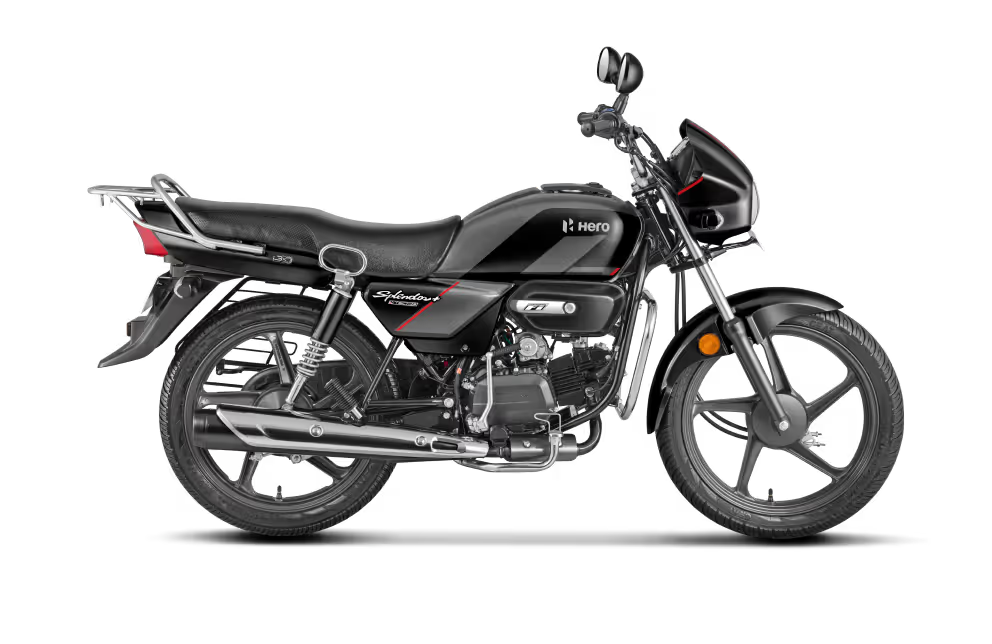
Hero Splendor Plus XTEC 2.0
- 97.2 cc Air-Cooled
- 8.02 PS @ 8000 rpm
- 73 km/l (ARAI certified)
- 9.8-litre tank
- 1 variant available
- CBS · Drum brakes · Bluetooth
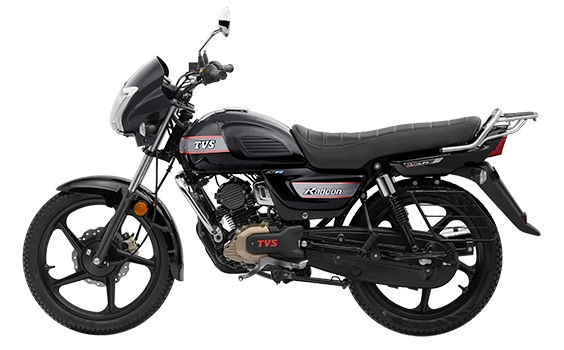
TVS Radeon
- 109.7 cc Air-Cooled
- 8.08 bhp @ 7350 rpm
- 62–73.68 km/l (Owner reported)
- 10-litre tank
- 4 variants available
- CBS · Disc option · 180 mm clearance
Full Specification Comparison
Every number that matters — side by side
| Specification | Splendor Plus XTEC 2.0 | TVS Radeon |
|---|---|---|
| Engine & Performance | ||
| Displacement | 97.2 cc | 109.7 cc |
| Cooling System | Air Cooled | Air Cooled |
| Max Power | 8.02 PS @ 8000 rpm | 8.08 bhp @ 7350 rpm |
| Max Torque | 8.05 Nm @ 6000 rpm | 8.7 Nm @ 4500 rpm |
| Valves per Cylinder | 2 | 2 |
| Compression Ratio | 9.9 : 1 | 10.0 : 1 |
| Bore × Stroke | 50.0 × 49.5 mm | 53.5 × 48.8 mm |
| Emission Standard | BS6 Phase 2 (OBD2B) | BS6 Phase 2 |
| Transmission | 4-Speed Manual | 4-Speed Manual |
| Top Speed | 90 km/h | 90 km/h |
| Idle Stop-Start (i3S) | Yes | No |
| Start Type | Kick & Electric Start | Kick / Electric (variant dependent) |
| Fuel & Range | ||
| Mileage (ARAI) | 73 km/l | Not Claimed |
| Mileage (Real-world) | ~60–68 km/l | 62–73.68 km/l (Owner reported) |
| Fuel Tank | 9.8 litres | 10 litres |
| Reserve Capacity | 1 litre | 1.5 litres |
| Riding Range (approx.) | ~650–700 km | ~620–736 km |
| Brakes & Wheels | ||
| Braking System | CBS (Integrated Braking System) | CBS (Combined Braking System) |
| Front Brake | Drum – 130 mm | Drum 130 mm / Disc 240 mm (variant dependent) |
| Rear Brake | Drum – 130 mm | Drum – 110 mm |
| Tyre Type | Tubeless | Tubeless |
| Tyre Size (F / R) | 80/100-18 / 80/100-18 | 2.75×18 / 3.00×18 |
| Wheel Type | Cast Alloy | Premium 5-Spoke Alloy |
| Suspension & Chassis | ||
| Front Suspension | Telescopic Hydraulic Shock Absorbers | Telescopic Fork |
| Rear Suspension | 2-step Adjustable Hydraulic | 5-step Adjustable Hydraulic Shock Absorbers |
| Chassis | Tubular Double Cradle | Single Cradle Tubular Frame |
| Rear Preload Adjuster | Yes | Yes |
| Dimensions & Weight | ||
| Kerb Weight | 112 kg | 113–115 kg |
| Seat Height | 805 mm | 780 mm |
| Ground Clearance | 165 mm | 180 mm |
| Wheelbase | 1235 mm | 1265 mm |
| Overall L × W × H | 1965 × 720 × 1045 mm | 2025 × 705 × 1080 mm |
| Features & Electronics | ||
| Instrument Console | Fully Digital | Analogue / Digital (variant dependent) |
| Bluetooth Connectivity | Yes | No |
| Call & SMS Alerts | Yes | No |
| Real Time Mileage Indicator | Yes (RTMI) | No |
| Distance to Empty | Yes | No |
| Gear Indicator | Yes | No |
| Service Reminder | Yes | No |
| Clock | Yes | No |
| USB Charging Port | No | Yes (Digi Cluster variants) |
| Headlight | Halogen with LED Position Lamp | Halogen |
| DRLs | LED Position Lamp | No |
| Hazard Warning Lights | Yes | No |
| Traction Control | No | No |
| Keyless Ignition | No | No |
| Price & Warranty | ||
| Starting Price (ex-showroom) | ₹81,060 | ₹70,143 |
| Top Variant Price | ₹81,060 | ₹80,881 |
| Number of Variants | 1 | 4 |
| Standard Warranty | 5 Years / 70,000 km | 5 Years / 60,000 km |
★ Green highlights indicate the stronger value in each row. Prices are ex-showroom India averages and may vary by city.
Variant-wise Price Comparison
All variants laid out — find the right one for your budget
Hero Splendor Plus XTEC 2.0 Variants
TVS Radeon Variants
Pros & Cons
Honest strengths and weaknesses of each bike
Pros
- Bluetooth-enabled fully digital console — unique in class
- Call and SMS alerts via paired smartphone
- ARAI-certified mileage of 73 km/l
- i3S idle stop-start for better fuel savings in traffic
- Real Time Mileage Indicator (RTMI) helps eco-riding
- Distance to Empty display
- Gear indicator and service reminder
- Hazard warning lights and LED position lamp
- Better warranty coverage (5 years / 70,000 km)
- Lighter kerb weight (112 kg)
- Hero's extensive nationwide service network
Cons
- No disc brake option in any variant
- No USB charging port
- Higher price — ₹10,917 more than Radeon's base
- Only 1 variant — zero choice for buyers
- Smaller 97.2 cc engine with less torque
- Lower ground clearance (165 mm vs 180 mm)
- Smaller fuel tank (9.8L) and reserve (1L)
Pros
- Significantly lower starting price (₹70,143)
- 4 variants spanning a wide price range
- Larger 109.7 cc engine with more torque (8.7 Nm)
- Outstanding ground clearance of 180 mm
- Front disc brake option available (Digi Disc variant)
- USB charging on Digi Cluster variants
- Larger 10-litre fuel tank and 1.5L reserve
- 5-step rear suspension adjuster
- Longer wheelbase (1265 mm) for stability
- Lower, more accessible seat height (780 mm)
Cons
- No Bluetooth connectivity on any variant
- No official ARAI mileage certification
- No i3S idle stop-start technology
- No hazard warning lights or DRLs
- No gear indicator or service reminder
- No call/SMS alerts
- Analogue console on base variants
- Shorter warranty (5 years / 60,000 km)
Key Differences Explained
What really sets these two bikes apart
Connectivity & Technology
The XTEC 2.0's biggest selling point is its Bluetooth-enabled fully digital console with call/SMS alerts, RTMI, distance to empty, gear indicator, and service reminder — features unmatched in the commuter segment. The Radeon has no Bluetooth at all, even on its top Digi Cluster variants which offer only a basic digital display.
Fuel Efficiency & Range
The XTEC 2.0 leads with an ARAI-certified 73 km/l — a verifiable benchmark. The Radeon has no official ARAI figure, though owner reports suggest 62–73.68 km/l. The Radeon's larger 10-litre tank and 1.5L reserve give it a potential edge in total range, but the XTEC 2.0's i3S technology helps recover fuel efficiency in stop-and-go city traffic.
Ground Clearance & Ride
The TVS Radeon is the clear winner here — 180 mm of ground clearance versus 165 mm on the XTEC 2.0, a 5-step adjustable rear suspension versus 2-step, and a longer 1265 mm wheelbase. For riders navigating rough roads, potholes, and speed breakers, the Radeon is noticeably more capable.
Braking Options
The Radeon offers a front disc brake (240 mm) on its top Digi Cluster Disc variant at ₹80,881. The XTEC 2.0 comes only with drum brakes in its single variant at ₹81,060 — making the Radeon's top variant both cheaper and better-equipped for braking. Both use CBS.
Price & Value
The Radeon starts at ₹70,143 — nearly ₹11,000 less than the XTEC 2.0's ₹81,060. The Radeon Digi Cluster Disc (₹80,881) is actually cheaper than the XTEC 2.0 while offering a disc brake, digital console, and USB charging. The XTEC 2.0 justifies its price premium through Bluetooth and i3S, but the Radeon delivers stronger hardware value.
Warranty & Ownership
The XTEC 2.0 offers a slightly better warranty at 5 years / 70,000 km versus the Radeon's 5 years / 60,000 km. Hero's significantly larger dealership and service network also gives the XTEC 2.0 a practical ownership advantage in accessibility of spare parts and servicing across India.
Expert Verdict
Which one should you actually buy?
Buy the Hero Splendor Plus XTEC 2.0 if…
- Bluetooth connectivity and smartphone alerts are important
- You want ARAI-certified mileage for peace of mind
- i3S stop-start technology fits your stop-go city commute
- You value Hero's wider after-sales service network
- A gear indicator and service reminder matter to you
- Budget allows the ₹81,060 price point
Buy the TVS Radeon if…
- Budget is a priority — starts nearly ₹11,000 cheaper
- You ride on rough roads and need higher ground clearance
- A front disc brake option matters for safety
- USB charging is more useful than Bluetooth for you
- You want 4 variants to match your specific needs
- A lower seat height (780 mm) suits your riding style
Overall Winner for Most Riders: It depends on your priority. The Hero Splendor Plus XTEC 2.0 wins on technology, connectivity, and certified mileage — it is the better pick for urban commuters who want modern smart features and Hero's service reach. The TVS Radeon wins on price, ground clearance, engine size, disc brake availability, and variant range — making it the stronger all-round hardware value. If you commute on rough roads or need a disc brake, choose the Radeon. If Bluetooth connectivity and i3S technology are non-negotiable for you, the XTEC 2.0 is worth the premium.
Frequently Asked Questions
Common questions answered by our experts
Both excel in different areas. The Hero Splendor Plus XTEC 2.0 is better for riders who want Bluetooth connectivity, ARAI-certified mileage (73 km/l), i3S idle stop-start, and Hero's strong service network. The TVS Radeon is better for riders who want a lower price (starts ₹10,917 cheaper), more engine power, superior ground clearance (180 mm), a disc brake option, and more variant choices.
The TVS Radeon starts at ₹70,143 while the Hero Splendor Plus XTEC 2.0 is priced at ₹81,060 ex-showroom. The Radeon is approximately ₹10,917 cheaper at its base variant. Interestingly, the Radeon's fully-loaded top variant — the Digi Cluster Edition Disc at ₹80,881 — is still ₹179 cheaper than the XTEC 2.0, yet it adds a front disc brake and USB charging.
The Hero Splendor Plus XTEC 2.0 has an ARAI-certified mileage of 73 km/l, providing a reliable official figure. The TVS Radeon has no official ARAI claim; owner-reported mileage ranges from 62 to 73.68 km/l. In real-world conditions, both bikes are comparable, though the XTEC 2.0's i3S stop-start technology gives it an additional efficiency advantage in heavy city traffic.
Yes, the Hero Splendor Plus XTEC 2.0 comes standard with a Bluetooth-enabled digital instrument console that enables call and SMS alerts, Real Time Mileage Indicator, distance to empty, service reminders, and gear indicator. The TVS Radeon does not offer Bluetooth connectivity on any of its four variants. This is the single biggest differentiator between the two bikes.
Only the TVS Radeon offers a disc brake — available on its Digi Cluster Edition Disc variant (₹80,881) with a 240 mm front disc. The Hero Splendor Plus XTEC 2.0 comes only with drum brakes at ₹81,060. Notably, the Radeon's disc variant is actually priced slightly lower than the XTEC 2.0 despite having superior braking hardware.
The TVS Radeon has significantly better ground clearance at 180 mm versus the Hero Splendor Plus XTEC 2.0's 165 mm — a difference of 15 mm. This makes the Radeon considerably more capable on rough, pothole-ridden, and rural roads. The Radeon also comes with a 5-step adjustable rear suspension versus the XTEC 2.0's 2-step setup, further enhancing its adaptability to different road conditions.