At a Glance
Key differences that define each motorcycle
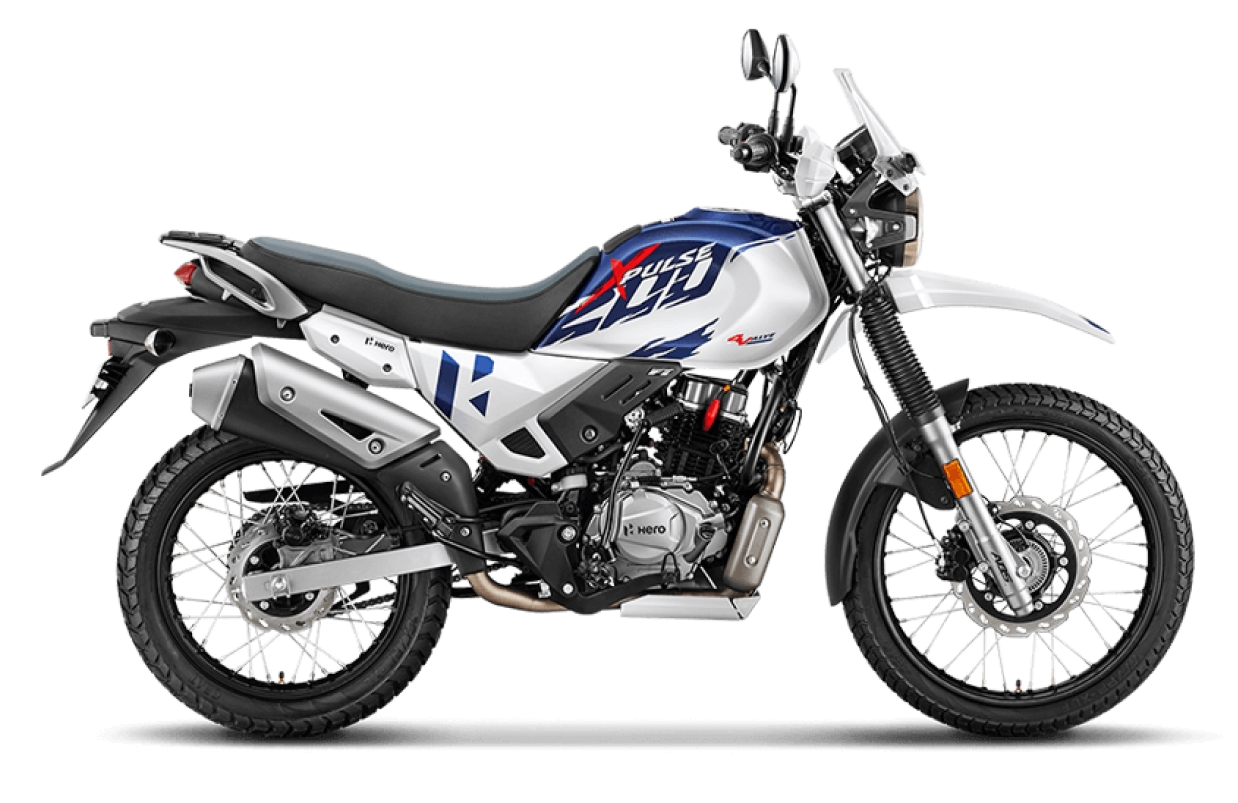
Hero Xpulse 200 4V
- 199.6 cc Oil-Cooled, 4-valve
- 19.16 PS @ 8500 rpm
- 32.9 km/l (ARAI)
- 13-litre tank
- 3 variants available
- 21-inch wheel, 220 mm clearance
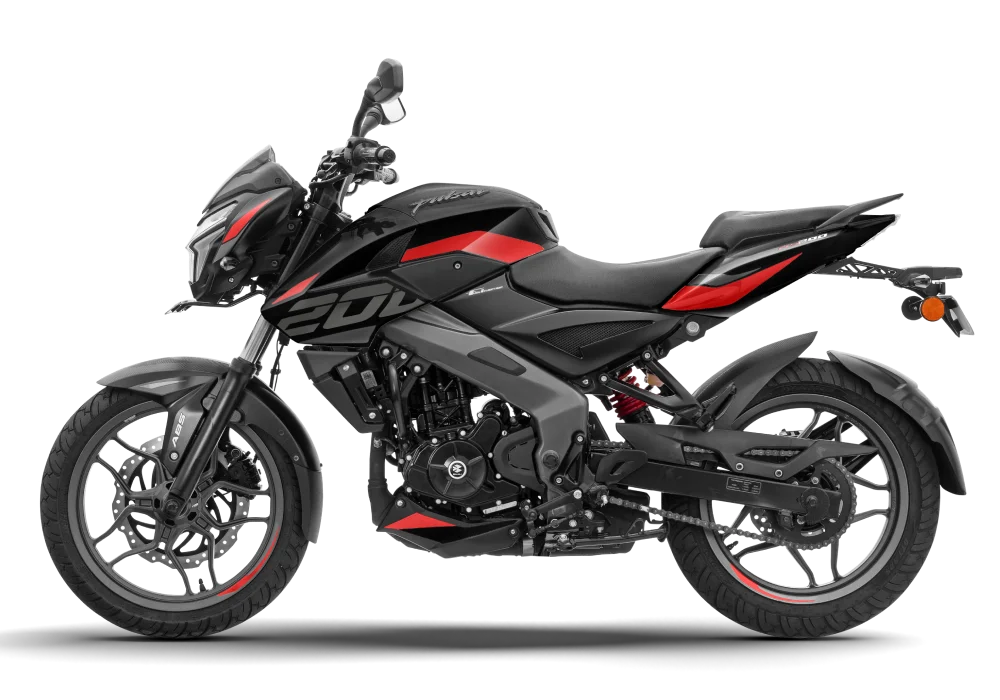
Bajaj Pulsar NS200
- 199.5 cc Liquid-Cooled, 4-valve
- 24.5 PS @ 9750 rpm
- 40.36 km/l (Claimed)
- 12-litre tank
- 2 variants available
- Perimeter frame, 5yr/75k km warranty
Full Specification Comparison
Every number that matters — side by side
| Specification | Hero Xpulse 200 4V | Bajaj Pulsar NS200 |
|---|---|---|
| Engine & Performance | ||
| Displacement | 199.6 cc | 199.5 cc |
| Cooling System | Oil-Cooled | Liquid-Cooled |
| Max Power | 19.16 PS @ 8500 rpm | 24.5 PS @ 9750 rpm |
| Max Torque | 17.35 Nm @ 6500 rpm | 18.74 Nm @ 8000 rpm |
| Valves per Cylinder | 4 | 4 (Triple Spark) |
| Compression Ratio | 10.5 : 1 | 11 : 1 |
| Bore × Stroke | 66.5 × 57.5 mm | 72 × 49 mm |
| Emission Standard | BS6 Phase 2 | BS6 |
| Transmission | 5-Speed Manual | 6-Speed Manual |
| Clutch | Wet Multi Plate | Wet Multi Plate |
| Top Speed | ~135 km/h | ~130 km/h |
| Riding Modes | Yes | Road, Rain, Offroad |
| Traction Control | No | No |
| Fuel & Range | ||
| Mileage (Claimed) | 32.9 km/l (ARAI) | 40.36 km/l (Claimed) |
| Fuel Tank | 13 litres | 12 litres |
| Reserve Capacity | 2.6 litres | 2 litres |
| Riding Range | ~427 km | ~484 km |
| Brakes & Wheels | ||
| Braking System | Single Channel ABS (switchable rear) | Single / Dual Channel ABS |
| Front Brake | Disc – 276 mm | Disc – 300 mm |
| Rear Brake | Disc – 220 mm | Disc – 230 mm |
| Tyre Type | Tube Type | Tubeless |
| Tyre Size (F / R) | 90/90-21 / 120/80-18 | 100/80-17 / 130/70-17 |
| Wheel Type | Spoke (off-road) | Alloy |
| Front Wheel Size | 21 inch | 17 inch |
| Suspension & Chassis | ||
| Front Suspension | Telescopic Fork (190 mm travel) | Telescopic / USD Fork (top variant) |
| Rear Suspension | Mono Shock (170 mm travel) | Nitrox Mono Shock |
| Chassis | Diamond Frame | Perimeter Frame |
| Rear Preload Adjuster | Yes | Yes |
| Dimensions & Weight | ||
| Kerb Weight | 159 kg | 158 kg |
| Seat Height | 825 mm (891 mm on Pro) | 805 mm |
| Ground Clearance | 220 mm (270 mm on Pro) | 167 mm |
| Wheelbase | 1410 mm | 1363 mm |
| Overall L × W × H | 2222 × 850 × 1258 mm | 2017 × 804 × 1075 mm |
| Features & Electronics | ||
| Instrument Console | Fully Digital LCD (Nav-enabled) | Fully Digital LCD |
| Headlight | LED | LED |
| DRLs | Yes | Yes |
| Turn Signals | Halogen | LED |
| Hazard Warning Lights | Yes | Yes |
| Riding Modes | Yes | Road, Rain, Offroad |
| Traction Control | No | No |
| Bluetooth Connectivity | Yes (Navigation enabled) | Yes |
| Call & SMS Alerts | Yes | Yes |
| USB Charging Port | Yes | Yes |
| Distance to Empty | Yes | Yes |
| Gear Indicator | Yes | Yes |
| Start Type | Electric + Kick | Electric Only |
| Keyless Ignition | No | No |
| Price & Warranty | ||
| Starting Price (ex-showroom) | ₹1,41,059 | ₹1,32,962 |
| Top Variant Price | ₹1,55,816 | ₹1,43,146 |
| Number of Variants | 3 | 2 |
| Standard Warranty | 5 Years / 70,000 km | 5 Years / 75,000 km |
★ Green highlights indicate the stronger value in each row. Prices are ex-showroom India averages and may vary by city.
Variant-wise Price Comparison
All variants laid out — find the right one for your budget
Xpulse 200 4V Variants
Pulsar NS200 Variants
Pros & Cons
Honest strengths and weaknesses of each bike
Pros
- Purpose-built off-road capability with 21-inch front wheel
- Excellent ground clearance — 220 mm standard, 270 mm on Pro
- Long-travel suspension (up to 250 mm front on Pro variants)
- Switchable rear ABS for superior off-road braking control
- Navigation-enabled Bluetooth LCD instrument cluster
- 3 variants across a wider price range
- Electric + kick start for added reliability off-road
- ARAI-certified mileage — a government-verified benchmark
- Larger 13-litre fuel tank with 2.6-litre reserve
- Strong 5-year / 70,000 km warranty with Hero's wide service network
Cons
- Lower peak power (19.16 PS vs 24.5 PS)
- Higher starting price (₹1,41,059 vs ₹1,32,962)
- Only single-channel ABS across all variants
- 5-speed gearbox vs 6-speed on the NS200
- Tube-type tyres — puncture repair more involved
- Less suited for pure street or highway performance
- Halogen turn signals vs LED on the NS200
Pros
- Significantly more power — 24.5 PS @ 9750 rpm
- Liquid-cooled engine for better sustained performance
- Perimeter frame for superior stability and cornering
- Dual-channel ABS with USD forks on top variant
- Higher claimed mileage — 40.36 km/l
- Lower starting price (₹1,32,962)
- Top variant also lower priced (₹1,43,146 vs ₹1,55,816)
- 6-speed gearbox for better highway cruising
- Riding modes: Road, Rain and Offroad
- Superior warranty — 5 years / 75,000 km
Cons
- No off-road capability — only 167 mm ground clearance
- Smaller 12-litre tank with only 2-litre reserve
- Dual-channel ABS only on the higher variant (₹1,43,146)
- Smaller 270 mm equivalent braking hardware on base
- Alloy wheels limit adaptability on loose terrain
- No kick-start backup for emergencies
- Mileage figure is claimed, not ARAI-certified
Key Differences Explained
What really sets these two bikes apart
Engine Character
The Xpulse 200 4V uses a 199.6 cc oil-cooled, 4-valve engine delivering 19.16 PS, tuned for linear, predictable power across all surfaces. The Pulsar NS200 runs a 199.5 cc liquid-cooled unit producing 24.5 PS — nearly 28% more power — with a Triple Spark DTS-i setup and an 11:1 compression ratio. The NS200's liquid cooling sustains performance better at high rpm over long stretches, making it the stronger street performer.
Off-Road Capability
The Xpulse 200 4V is purpose-built for adventure with a 21-inch front wheel, 220 mm ground clearance (270 mm on Pro), up to 250 mm of front suspension travel, spoke wheels with off-road tube tyres and switchable rear ABS. The Pulsar NS200 offers just 167 mm ground clearance on alloy wheels with road-biased rubber — it is a street-only motorcycle with no meaningful off-road capability.
Braking & Safety
The Pulsar NS200 holds an advantage in street braking: a 300 mm front disc and 230 mm rear disc with dual-channel ABS available on the ₹1,43,146 variant. The Xpulse uses a 276 mm front disc with single-channel ABS across all variants, but offers switchable rear ABS — critical for off-road control where locking the rear wheel intentionally is sometimes necessary. Each system is optimised for its intended use case.
Fuel Efficiency & Range
The NS200 claims a higher mileage of 40.36 km/l (manufacturer-stated) vs the Xpulse's ARAI-certified 32.9 km/l. The NS200's 12-litre tank delivers approximately 484 km range, while the Xpulse's 13-litre tank gives around 427 km. Note that the Xpulse's figure is government-tested and more reliable, while the NS200's is a claimed figure — real-world NS200 mileage typically ranges between 34–38 km/l.
Warranty & Ownership
Both bikes offer a 5-year warranty, but the Pulsar NS200 covers 75,000 km while the Xpulse 200 4V covers 70,000 km. The NS200's additional 5,000 km of coverage is a marginal but real advantage. Both Bajaj and Hero have excellent service networks spanning urban and rural India, making after-sales support equally accessible for most buyers.
Price & Value
The Pulsar NS200 starts at ₹1,32,962 — approximately ₹8,097 less than the Xpulse's ₹1,41,059 base price. The NS200's top variant at ₹1,43,146 is also ₹12,670 cheaper than the Xpulse's Pro Dakar Edition at ₹1,55,816. The NS200 delivers more raw power and better mileage at a lower price point for street-focused buyers. The Xpulse commands a premium justified by its off-road DNA.
Expert Verdict
Which one should you actually buy?
Buy the Xpulse 200 4V if…
- You want a motorcycle capable of tackling off-road trails and rough terrain
- High ground clearance and long-travel suspension matter for your daily roads
- You do weekend adventure or touring rides on mixed surfaces
- Navigation-enabled Bluetooth connectivity is a priority
- You want the reliability of an ARAI-certified mileage figure
- A backup kick-start is important for remote riding situations
- You want 3 variant options across a wider price spread
Buy the Pulsar NS200 if…
- You want maximum street performance at an accessible price
- Strong acceleration and highway cruising ability are priorities
- Dual-channel ABS and USD forks are desirable within budget
- You ride exclusively on paved city and highway roads
- A lower entry price of ₹1,32,962 suits your budget better
- The superior 5-year / 75,000 km warranty offers peace of mind
- You want riding modes (Road, Rain, Offroad) across variants
Overall Winner for Most Riders: Bajaj Pulsar NS200. These two motorcycles occupy genuinely different niches — the Xpulse for adventure and off-road, the NS200 for street performance. However, for the majority of Indian riders who ride primarily on paved roads, the Pulsar NS200 wins on nearly every street-relevant metric: more power, lower price, better claimed mileage, stronger braking hardware, a superior 75,000 km warranty and a perimeter frame chassis that inspires confidence on highways. Choose the Hero Xpulse 200 4V only if off-road capability, adventure riding versatility and terrain-conquering suspension travel are your primary requirements — areas where no street bike can compete.
Frequently Asked Questions
Common questions answered by our experts
The Hero Xpulse 200 4V is better for riders who want an adventure-capable motorcycle with a 21-inch front wheel, 220–270 mm ground clearance, long-travel suspension and switchable rear ABS for trail riding. The Bajaj Pulsar NS200 is better for street-focused riders who want more power (24.5 PS vs 19.16 PS), a liquid-cooled engine, a perimeter frame chassis, dual-channel ABS, a lower starting price (₹1,32,962 vs ₹1,41,059) and a stronger 5-year / 75,000 km warranty.
The Bajaj Pulsar NS200 starts at ₹1,32,962 ex-showroom, approximately ₹8,097 less than the Hero Xpulse 200 4V's entry price of ₹1,41,059. The gap at the top is more pronounced: the NS200's Dual Channel USD variant is ₹1,43,146, while the Xpulse's Pro Dakar Edition reaches ₹1,55,816 — a difference of ₹12,670. Both prices are for India and may vary by city.
The Bajaj Pulsar NS200 claims 40.36 km/l while the Hero Xpulse 200 4V has an ARAI-certified 32.9 km/l. The NS200's figure is higher, but it is a manufacturer claim. Real-world NS200 mileage typically ranges between 34–38 km/l depending on riding style and conditions. The Xpulse's ARAI figure is more independently reliable. The NS200's 12-litre tank yields approximately 484 km range vs the Xpulse's approximately 427 km from its 13-litre tank.
The Bajaj Pulsar NS200 makes significantly more power at 24.5 PS @ 9750 rpm compared to the Hero Xpulse 200 4V's 19.16 PS @ 8500 rpm — a difference of nearly 28%. The NS200 also produces more torque at 18.74 Nm vs 17.35 Nm. The NS200's liquid-cooled engine is built for higher revving and stronger outright performance, while the Xpulse's oil-cooled engine is tuned for smooth, linear delivery suited to varied terrain.
The Hero Xpulse 200 4V is far superior for off-road riding with no contest. It features a 21-inch front wheel, 220 mm ground clearance on Standard (270 mm on Pro), long-travel suspension with up to 250 mm of front fork travel on Pro variants, spoke wheels with tube-type off-road tyres and switchable rear ABS for loose surface control. The Bajaj Pulsar NS200, with 167 mm ground clearance and road-oriented alloy wheels, is strictly a street motorcycle not intended for off-road use.
The Bajaj Pulsar NS200 has a marginally better warranty at 5 years / 75,000 km compared to the Hero Xpulse 200 4V's 5 years / 70,000 km — an extra 5,000 km of coverage. Both Bajaj and Hero have exceptionally wide service networks across India, covering cities, towns and smaller markets. For riders clocking 15,000–20,000 km annually, the NS200's additional km buffer reduces the risk of out-of-warranty repair costs.