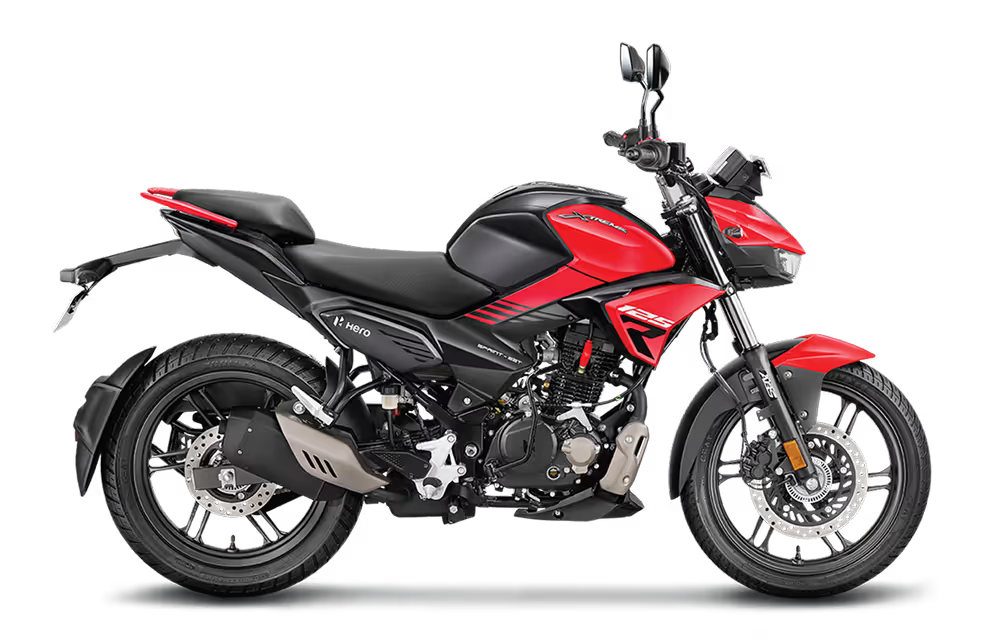
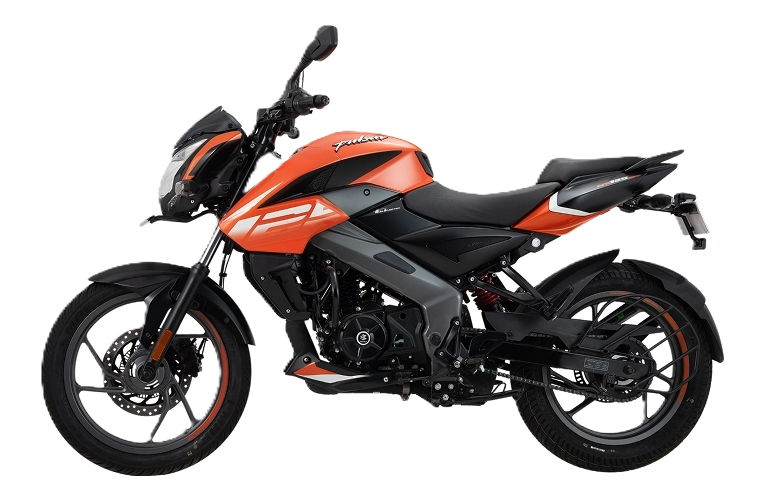
At a Glance
Key differences that define each motorcycle
Hero Xtreme 125R
- 124.7 cc Air-Cooled, 2-valve
- 11.4 PS @ 8250 rpm
- 66 km/l (ARAI)
- 10-litre tank
- 4 variants available
- IBS / Single / Dual Channel ABS
Bajaj Pulsar NS125
- 124.45 cc Air-Cooled, 4-valve
- 12 PS @ 8500 rpm
- 46.9 km/l (ARAI)
- 12-litre tank
- 3 variants available
- Perimeter frame chassis
Full Specification Comparison
Every number that matters — side by side
| Specification | Hero Xtreme 125R | Bajaj Pulsar NS125 |
|---|---|---|
| Engine & Performance | ||
| Displacement | 124.7 cc | 124.45 cc |
| Cooling System | Air-Cooled | Air-Cooled |
| Max Power | 11.4 PS @ 8250 rpm | 12 PS @ 8500 rpm |
| Max Torque | 10.5 Nm @ 6000 rpm | 11 Nm @ 7000 rpm |
| Valves per Cylinder | 2 | 4 |
| Compression Ratio | 10:1 | 10 ± 0.5 : 1 |
| Bore × Stroke | 52.4 × 57.8 mm | 52 × 58.6 mm |
| Emission Standard | BS6 Phase 2 (OBD2B) | BS6 / OBD2 |
| Transmission | 5-Speed Manual | 5-Speed Manual |
| Top Speed | 95 km/h | 103 km/h |
| Riding Modes | No | No |
| Traction Control | No | No |
| Fuel & Range | ||
| Mileage (Claimed / ARAI) | 66 km/l (ARAI) | 46.9 km/l (ARAI) |
| Mileage (Real-world) | 50–55 km/l | 45–50 km/l |
| Fuel Tank | 10 litres | 12 litres |
| Reserve Capacity | 1.6 litres | 2.6 litres |
| Riding Range | ~600–650 km | ~560 km |
| Brakes & Wheels | ||
| Braking System | IBS / Single / Dual Channel ABS | CBS / Single Channel ABS (top variant) |
| Front Brake | Disc – 276 mm | Disc – 240 mm |
| Rear Brake | Drum / Disc (variant dependent) | Drum – 130 mm |
| Tyre Type | Tubeless | Tubeless |
| Tyre Size (F / R) | 90/90-17 / 120/80-17 | 90/90-17 / 120/80-17 |
| Wheel Type | Alloy | Alloy |
| Suspension & Chassis | ||
| Front Suspension | Telescopic Forks | Telescopic Fork |
| Rear Suspension | Monoshock | Nitrox Mono Shock |
| Chassis | Diamond Frame | Perimeter Frame |
| Rear Preload Adjuster | Yes | Yes |
| Dimensions & Weight | ||
| Kerb Weight | 136 kg | 144 kg |
| Seat Height | 794 mm | 805 mm |
| Ground Clearance | 180 mm | 178 mm |
| Wheelbase | 1315 mm | 1352 mm |
| Overall L × W × H | 2020 × 790 × 1080 mm | 2012 × 810 × 1078 mm |
| Features & Electronics | ||
| Instrument Console | Digital | Semi-Digital / Digital (LED BT variants) |
| Headlight | LED Projector | Halogen / LED (LED BT variants) |
| DRLs | Yes | Yes |
| Turn Signals | LED | Halogen |
| Hazard Warning Lights | Yes | No |
| Bluetooth Connectivity | No | Yes (LED BT variants) |
| Call & SMS Alerts | No | No |
| USB Charging Port | No | Yes (LED BT variants) |
| Distance to Empty | No | No |
| Gear Indicator | Yes | No |
| Tachometer | Digital | Digital |
| Keyless Ignition | No | No |
| Silent Start | Yes | No |
| Side Stand Engine Cut-off | Yes | Yes |
| Price & Warranty | ||
| Starting Price (ex-showroom) | ₹90,652 | ₹92,671 |
| Top Variant Price | ₹1,07,163 | ₹1,01,934 |
| Number of Variants | 4 | 3 |
| Standard Warranty | 5 Years / 70,000 km | 5 Years / 75,000 km |
★ Green highlights indicate the stronger value in each row. Prices are ex-showroom India averages and may vary by city.
Variant-wise Price Comparison
All variants laid out — find the right one for your budget
Hero Xtreme 125R Variants
Bajaj Pulsar NS125 Variants
Pros & Cons
Honest strengths and weaknesses of each bike
Pros
- Segment-leading ARAI-certified mileage of 66 km/l
- Widest braking options: IBS, Single & Dual Channel ABS
- Larger 276 mm front disc brake
- Marginally better ground clearance (180 mm vs 178 mm)
- Lower kerb weight at 136 kg vs 144 kg
- Lower seat height (794 mm) — more accessible for shorter riders
- LED projector headlight standard across all variants
- LED turn signals standard
- Hazard warning lights included
- Gear indicator standard
- Silent start feature
- Lower starting price (₹90,652 vs ₹92,671)
- 4 variant choices including a solo-seat option
Cons
- Lower peak power (11.4 PS vs 12 PS)
- 2-valve engine vs 4-valve on NS125
- Lower top speed (~95 km/h vs 103 km/h)
- No Bluetooth connectivity on any variant
- No USB charging port
- Smaller 10-litre fuel tank
- Diamond frame vs perimeter frame on NS125
- Shorter warranty km coverage (70,000 vs 75,000 km)
Pros
- Higher peak power — 12 PS @ 8500 rpm
- 4-valve engine for better breathing and performance
- Higher top speed (~103 km/h)
- Stiffer, sportier perimeter frame chassis
- Bluetooth connectivity on LED BT variants
- USB charging port on LED BT variants
- Larger 12-litre fuel tank
- Slightly better warranty km coverage (75,000 km)
- Iconic Pulsar NS styling with street cred
Cons
- Significantly lower ARAI mileage (46.9 km/l vs 66 km/l)
- No Dual Channel ABS on any variant
- Base variant uses CBS only — no ABS at entry level
- Smaller 240 mm front disc
- Rear drum brake on all variants
- Heavier at 144 kg vs 136 kg
- Higher seat height (805 mm)
- Halogen headlight on base variant
- No hazard warning lights
- No gear indicator
- Semi-digital console on base variant
Key Differences Explained
What really sets these two bikes apart
Engine Character
The Bajaj Pulsar NS125 holds a clear performance edge with its 124.45 cc 4-valve DTS-i engine producing 12 PS @ 8500 rpm and 11 Nm of torque — outgunning the Hero Xtreme 125R's 124.7 cc 2-valve engine at 11.4 PS and 10.5 Nm. The NS125's 4-valve head allows better high-rpm breathing and a freer-revving character, translating into a notably higher top speed of 103 km/h versus approximately 95 km/h for the Xtreme 125R. Both use 5-speed gearboxes and similar bore-stroke dimensions.
Fuel Efficiency & Range
The Hero Xtreme 125R dominates with an ARAI-certified 66 km/l — a massive 19.1 km/l advantage over the NS125's 46.9 km/l ARAI figure. Real-world figures are 50–55 km/l for the Xtreme 125R versus 45–50 km/l for the NS125. Despite having a smaller 10-litre tank versus the NS125's 12-litre unit, the Xtreme 125R's superior efficiency still yields a longer estimated range of 600–650 km compared to approximately 560 km for the NS125.
Braking & Safety
The Hero Xtreme 125R holds a decisive edge in braking safety. It offers three configurations — IBS, Single Channel ABS, and Dual Channel ABS — across its 4 variants, paired with a larger 276 mm front disc. The Bajaj Pulsar NS125 uses CBS on its base two variants and only offers Single Channel ABS on the top ₹1,01,934 variant, with a smaller 240 mm front disc. No dual-channel ABS is available on any NS125 variant, making the Xtreme 125R the safer choice for emergency braking.
Chassis & Handling
The Bajaj Pulsar NS125's perimeter frame is a significant engineering advantage over the Xtreme 125R's diamond frame. A perimeter frame is stiffer, offers a lower centre of gravity and provides superior lateral rigidity for sharper cornering and better stability at higher speeds. However, the Xtreme 125R fights back with a lighter kerb weight of 136 kg versus the NS125's 144 kg, making it more nimble and easier to manoeuvre in traffic.
Features & Electronics
This is a split decision. The Bajaj NS125 gains an edge with Bluetooth connectivity and USB charging on its LED BT variants (₹97,904+). However, the Hero Xtreme 125R counters with a fully digital console (versus semi-digital on NS125 base), LED projector headlight, LED turn signals, hazard warning lights, gear indicator, and silent start — all standard across variants. The NS125's base variant uses a halogen headlight and lacks hazard lights and a gear indicator.
Price & Value
The Xtreme 125R starts ₹2,019 cheaper (₹90,652 vs ₹92,671) and offers more braking safety and better mileage at every price point. The NS125's top ABS variant at ₹1,01,934 is ₹5,229 less than the Xtreme 125R's Dual Channel ABS at ₹1,07,163, but the Xtreme 125R's dual-channel ABS is a meaningfully higher safety spec. Both brands offer strong after-sales networks and warranty coverage, with the NS125 holding a marginal 5,000 km warranty edge.
Expert Verdict
Which one should you actually buy?
Buy the Hero Xtreme 125R if…
- Fuel economy is your priority — 66 km/l ARAI is unmatched
- You want Dual Channel ABS for maximum braking safety
- You do daily commuting and want the best range
- A lower seat height (794 mm) helps you ride confidently
- Lighter weight (136 kg) matters for city manoeuvring
- LED projector headlight and LED signals standard matter
- You want hazard lights and a gear indicator as standard
- Starting price (₹90,652) is important to you
Buy the Bajaj Pulsar NS125 if…
- More outright performance (12 PS, 103 km/h) excites you
- The 4-valve engine's sporty character appeals to you
- The iconic Pulsar NS styling and road presence matter
- A perimeter frame for sharper handling is important
- Bluetooth and USB charging are desired features
- You prefer a larger 12-litre fuel tank
- Highway riding at higher speeds is part of your routine
Overall Winner for Most Riders: Hero Xtreme 125R. Segment-leading fuel efficiency of 66 km/l, the widest braking options in the segment including Dual Channel ABS, a larger 276 mm front disc, superior standard features including an LED projector headlight, LED turn signals, hazard warning lights and a gear indicator across all variants, a lighter 136 kg body, and a lower starting price make the Xtreme 125R the more practical and safety-focused choice for most Indian commuters. Choose the Bajaj Pulsar NS125 only if outright performance, the 4-valve engine, the perimeter frame chassis, a higher top speed, or Bluetooth connectivity on mid-tier variants are your primary priorities.
Frequently Asked Questions
Common questions answered by our experts
The Hero Xtreme 125R is better for most buyers who prioritise fuel efficiency (66 km/l ARAI), multiple braking options including Dual Channel ABS, better standard features, lighter weight and a lower starting price. The Bajaj Pulsar NS125 is the stronger choice if outright performance (12 PS, 103 km/h), a 4-valve engine, a perimeter frame, and Bluetooth connectivity on mid variants are your top priorities.
The Hero Xtreme 125R starts at ₹90,652 while the Bajaj Pulsar NS125 starts at ₹92,671 ex-showroom — a base difference of ₹2,019, making the Xtreme 125R slightly cheaper to enter. At the top variant level, the NS125 LED BT ABS at ₹1,01,934 is ₹5,229 cheaper than the Xtreme 125R Dual Channel ABS at ₹1,07,163, though the Xtreme 125R's dual-channel ABS is a meaningfully higher safety specification.
The Hero Xtreme 125R is substantially more fuel-efficient with an ARAI-certified 66 km/l compared to the Bajaj Pulsar NS125's ARAI-certified 46.9 km/l — a difference of over 19 km/l. In real-world conditions, the Xtreme 125R delivers 50–55 km/l while the NS125 returns approximately 45–50 km/l. Despite having a smaller 10-litre tank, the Xtreme 125R's superior efficiency still gives it a longer estimated riding range of 600–650 km versus approximately 560 km for the NS125.
The Bajaj Pulsar NS125 makes more power at 12 PS @ 8500 rpm and 11 Nm @ 7000 rpm, compared to the Hero Xtreme 125R's 11.4 PS @ 8250 rpm and 10.5 Nm @ 6000 rpm. The NS125 also uses a 4-valve engine versus the Xtreme 125R's 2-valve unit, allowing better high-rpm breathing and a top speed of ~103 km/h versus ~95 km/h for the Xtreme 125R. For outright performance, the NS125 is the stronger machine.
Yes. The Hero Xtreme 125R offers Dual Channel ABS on its top variant priced at ₹1,07,163, making it the only bike in this comparison — and a rarity in the 125cc segment — to offer dual-channel ABS. The Bajaj Pulsar NS125 does not offer Dual Channel ABS on any variant. Its base two variants use CBS (Combined Braking System) while only the top NS125 LED BT ABS variant at ₹1,01,934 gets single-channel ABS.
Both bikes offer a 5-year standard warranty. The Bajaj Pulsar NS125 has a marginal advantage in kilometre coverage at 75,000 km versus the Hero Xtreme 125R's 70,000 km. For very high mileage commuters clocking 15,000–20,000 km per year, the NS125's additional 5,000 km of warranty coverage provides a slight extra buffer before out-of-warranty repairs may become necessary.
Yes, the Bajaj Pulsar NS125 offers Bluetooth connectivity on its NS125 LED BT (₹97,904) and NS125 LED BT ABS (₹1,01,934) variants, along with a USB charging port. The base NS125 variant (₹92,671) does not have Bluetooth. The Hero Xtreme 125R does not offer Bluetooth connectivity on any of its four variants, which is a notable gap compared to the NS125's LED BT variants.