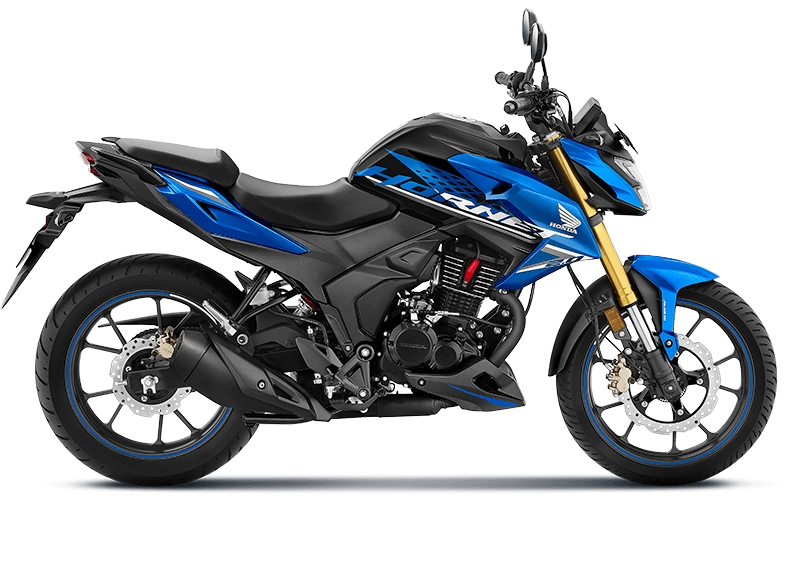
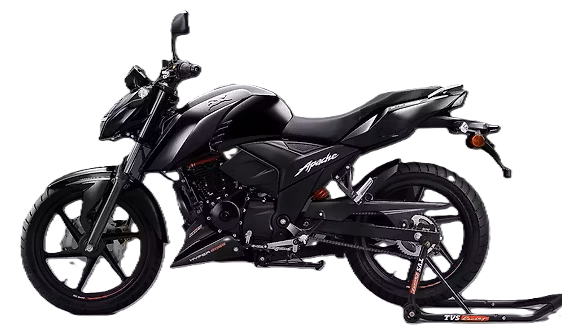
At a Glance
Key differences that define each motorcycle
Honda Hornet 2.0
- 184.4 cc Air-Cooled
- 17.03 PS @ 8500 rpm
- 42.3 km/l (ARAI)
- 12-litre tank
- 1 variant available
- Single-channel ABS, USD forks standard
TVS Apache RTR 160 4V
- 159.7 cc Oil-Cooled
- 17.55 PS @ 9250 rpm
- 47.61 km/l (Claimed)
- 12-litre tank
- 8 variants available
- Single / Dual-channel ABS
Full Specification Comparison
Every number that matters — side by side
| Specification | Honda Hornet 2.0 | TVS Apache RTR 160 4V |
|---|---|---|
| Engine & Performance | ||
| Displacement | 184.4 cc | 159.7 cc |
| Cooling System | Air Cooled | Oil Cooled |
| Max Power | 17.03 PS @ 8500 rpm | 17.55 PS @ 9250 rpm |
| Max Torque | 16.1 Nm @ 6000 rpm | 14.73 Nm @ 7500 rpm |
| Valves per Cylinder | 2 | 4 |
| Compression Ratio | 9.5 : 1 | 9.5 : 1 |
| Bore × Stroke | 61 × 63.1 mm | 62 × 52.9 mm |
| Emission Standard | BS6 OBD2 | BS6 Phase 2 |
| Transmission | 5-Speed Manual | 5-Speed Manual |
| Top Speed | ~130 km/h | ~114 km/h |
| Riding Modes | No | Sport, Urban, Rain |
| Fuel & Range | ||
| Mileage (ARAI / Claimed) | 42.3 km/l (ARAI) | 47.61 km/l (Claimed) |
| Mileage (Real-world) | 40–45 km/l | 41–45 km/l |
| Fuel Tank | 12 litres | 12 litres |
| Reserve Capacity | 1.9 litres | 2.5 litres |
| Riding Range (approx.) | ~504 km | ~570 km |
| Brakes & Wheels | ||
| Braking System | Single-Channel ABS | Single / Dual-Channel ABS (variant) |
| Front Brake | Disc – 276 mm | Disc – 270 mm |
| Rear Brake | Disc – 220 mm | Drum 130 mm / Disc 240 mm (variant) |
| Tyre Type | Tubeless | Tubeless |
| Tyre Size (F / R) | 110/70-17 / 140/70-17 | 90/90-17 / 110/80-17 (base) or 130/70-17 (Radial, higher variants) |
| Wheel Type | Alloy | Alloy |
| Suspension & Chassis | ||
| Front Suspension | USD Fork (standard) | Telescopic / USD Fork (top variants) |
| Rear Suspension | Monoshock | Mono Shock |
| Chassis | Diamond Type Frame | Double Cradle Split Synchro Stiff Frame |
| Rear Preload Adjuster | Yes | Yes |
| Dimensions & Weight | ||
| Kerb Weight | 142 kg | 143–146 kg |
| Seat Height | 790 mm | 800 mm |
| Ground Clearance | 168 mm | 180 mm |
| Wheelbase | 1355 mm | 1357 mm |
| Overall L × W × H | 2047 × 783 × 1064 mm | — |
| Features & Electronics | ||
| Instrument Console | Fully Digital LCD | Digital / TFT (top variant) |
| Headlight | LED | LED Projector |
| DRLs | Yes | Yes |
| Turn Signals | LED | LED |
| Tail Light | LED | LED |
| Hazard Warning Lights | Yes | No |
| Bluetooth Connectivity | No | Yes (select variants) |
| USB Charging Port | No | Yes (select variants) |
| Gear Indicator | Yes | Yes |
| Traction Control | No | Yes (top variant) |
| Riding Modes | No | Sport, Urban, Rain |
| Keyless Ignition | No | No |
| Price & Warranty | ||
| Starting Price (ex-showroom) | ₹1,47,151 | ₹1,16,491 |
| Top Variant Price | ₹1,47,151 | ₹1,37,521 (TFT) |
| Number of Variants | 1 | 8 |
| Standard Warranty | 3 Years | 5 Years / 60,000 km |
★ Green highlights indicate the stronger value in each row. Prices are ex-showroom India averages and may vary by city.
Variant-wise Price Comparison
All variants laid out — find the right one for your budget
Honda Hornet 2.0 Variants
TVS Apache RTR 160 4V Variants
Pros & Cons
Honest strengths and weaknesses of each bike
Pros
- Larger 184.4 cc engine delivers more torque (16.1 Nm) at lower revs
- USD front forks as standard — no need to pay an upgrade premium
- Dual disc brakes standard (276 mm front + 220 mm rear)
- Wider 110/70-17 front and 140/70-17 rear tyres for more grip
- Higher top speed (~130 km/h)
- Full LED lighting including turn signals and hazard warning lights
- Lower accessible seat height (790 mm vs 800 mm)
- Honda's long-term refinement and reliability
Cons
- Significantly more expensive — starts ₹30,660 above Apache base
- Only 1 variant — no flexibility in budget or features
- No ride modes
- No Bluetooth connectivity or USB charging
- No traction control
- Lower claimed mileage (42.3 km/l vs 47.61 km/l)
- Shorter warranty (3 years vs 5 years / 60,000 km)
- Only single-channel ABS despite premium price
Pros
- Higher peak power — 17.55 PS in Sport mode
- Oil-cooled 4-valve engine stays cooler under load
- 3 ride modes (Sport, Urban, Rain) improve versatility and safety
- Traction control available on top TFT variant
- Dual-channel ABS available from ₹1,26,472
- 8 variants across a wide price range (₹1,16,491–₹1,37,521)
- Bluetooth connectivity and USB charging on select variants
- Better ground clearance (180 mm vs 168 mm)
- Superior 5-year / 60,000 km warranty
- TFT display on top variant with navigation
Cons
- Narrower tyres on base variants (90/90-17 front)
- Base variant has rear drum brake
- USD forks only available from ₹1,29,867
- No hazard warning lights
- Lower torque (14.73 Nm vs 16.1 Nm) — less low-end punch
- Lower top speed (~114 km/h) vs Hornet 2.0
- Smaller 159.7 cc engine compared to Hornet's 184.4 cc
Key Differences Explained
What really sets these two bikes apart
Engine Character
The Hornet 2.0 uses a 184.4 cc air-cooled, 2-valve engine tuned for smooth torque — 16.1 Nm arrives low at 6000 rpm, making it effortlessly quick in everyday city riding and more relaxed on highways. The Apache uses a 159.7 cc oil-cooled, 4-valve engine producing a higher peak of 17.55 PS that revs to 9250 rpm, delivering an exciting, sporty character especially in Sport mode.
Fuel Efficiency & Range
The Apache RTR 160 4V claims better mileage at 47.61 km/l versus the Hornet 2.0's ARAI-certified 42.3 km/l. Both bikes share a 12-litre tank, but the Apache's higher efficiency translates to roughly 65–70 km more range per fill (~570 km vs ~504 km) — a meaningful difference for daily commuters.
Braking & Safety
The Hornet 2.0 comes with dual disc brakes (276 mm front + 220 mm rear) and wider tyres as standard, but only single-channel ABS. The Apache starts with a rear drum on base variants and builds up through dual disc to dual-channel ABS from ₹1,26,472. The Apache's top variants also offer traction control — a safety feature the Hornet lacks entirely.
Features & Technology
The Apache RTR 160 4V leads significantly on technology — ride modes, traction control, Bluetooth navigation, USB charging and a TFT display are all available across its variant range. The Hornet 2.0 offers a clean digital display with full LED lighting and hazard warning lights, but no connectivity, no ride modes, and no traction control.
Price & Value
The Apache RTR 160 4V starts ₹30,660 cheaper at ₹1,16,491, and even its fully-loaded TFT variant at ₹1,37,521 is ₹9,630 less than the single Hornet 2.0 variant. The Apache's 8-variant ladder gives buyers a highly flexible upgrade path, while the Hornet offers a single, simpler decision.
Ride & Handling
The Hornet 2.0 gets USD forks as standard and wider radial-profile tyres (110/70-17 front, 140/70-17 rear) — hardware that gives it an edge in grip and front-end stability. The Apache's Double Cradle Split Synchro Stiff frame delivers excellent cornering feedback and higher ground clearance (180 mm vs 168 mm), while USD forks are available on variants from ₹1,29,867.
Expert Verdict
Which one should you actually buy?
Buy the Honda Hornet 2.0 if…
- You want a larger 184.4 cc engine with more torque for relaxed riding
- USD forks, dual disc brakes and wider tyres as standard are priorities
- Higher top speed (~130 km/h) matters for your riding
- You want Honda's long-term refinement and reliability without compromise
- Full LED lighting and hazard warning lights are important to you
- A single no-compromise variant suits your decision style
Buy the TVS Apache RTR 160 4V if…
- You want the most feature-rich 160cc motorcycle at any budget
- Ride modes, traction control and Bluetooth connectivity matter to you
- Dual-channel ABS is a priority without overspending
- Budget is important — starts ₹30,660 cheaper than the Hornet
- You want the freedom to choose from 8 variants to match your budget
- Better fuel efficiency and riding range are important
- A 5-year / 60,000 km warranty gives you long-term confidence
Overall Winner for Most Riders: TVS Apache RTR 160 4V. Starting ₹30,660 cheaper with 8 variants spanning a wide upgrade path, better fuel efficiency, ride modes, available traction control, dual-channel ABS, Bluetooth navigation, and a superior 5-year warranty — the Apache RTR 160 4V delivers more value, more technology, and more flexibility for the majority of Indian buyers. Choose the Honda Hornet 2.0 if you want a larger engine, standard USD forks and wider tyres from the factory, and prefer the simplicity and reassurance of Honda's engineering in a single premium package.
Frequently Asked Questions
Common questions answered by our experts
The TVS Apache RTR 160 4V is better for most buyers — it costs up to ₹30,660 less, offers 8 variants, ride modes, available traction control, dual-channel ABS, Bluetooth, and a 5-year warranty. The Honda Hornet 2.0 is better if you want a larger 184.4 cc engine with significantly more torque (16.1 Nm), USD forks and dual disc brakes as standard from the outset, and a higher top speed of around 130 km/h.
The TVS Apache RTR 160 4V starts at ₹1,16,491 while the Honda Hornet 2.0 is priced at ₹1,47,151 ex-showroom — a difference of ₹30,660 at base. Even comparing the Apache's fully-loaded TFT variant (₹1,37,521), the Hornet 2.0 is still ₹9,630 more expensive. Both prices are for India and may vary by city.
The TVS Apache RTR 160 4V has better claimed mileage at 47.61 km/l compared to the Honda Hornet 2.0's ARAI-certified 42.3 km/l. Both share a 12-litre tank, so the Apache's superior efficiency translates to approximately 570 km of range per fill versus the Hornet's ~504 km. Note that the Apache's figure is company-claimed while the Hornet's is ARAI-certified.
Peak power is very close — the Apache RTR 160 4V makes 17.55 PS @ 9250 rpm vs the Hornet 2.0's 17.03 PS @ 8500 rpm. However, torque tells a different story: the Hornet produces significantly more torque at 16.1 Nm @ 6000 rpm versus the Apache's 14.73 Nm @ 7500 rpm. The Hornet's larger engine and lower torque peak makes it feel stronger at everyday city speeds, while the Apache is more exciting when revved hard.
No, the Honda Hornet 2.0 does not offer ride modes on any variant. The TVS Apache RTR 160 4V offers three ride modes — Sport, Urban, and Rain — across most of its variants. These modes adjust engine performance and ABS behaviour for different riding conditions, which is a notable technology advantage for the Apache.
The TVS Apache RTR 160 4V offers a substantially better warranty of 5 years or 60,000 km compared to the Honda Hornet 2.0's 3-year warranty with no km limit specified. This is a significant advantage for the Apache, especially given that it is also the more affordable motorcycle — making it better value for long-term ownership.