At a Glance
Key differences that define each motorcycle
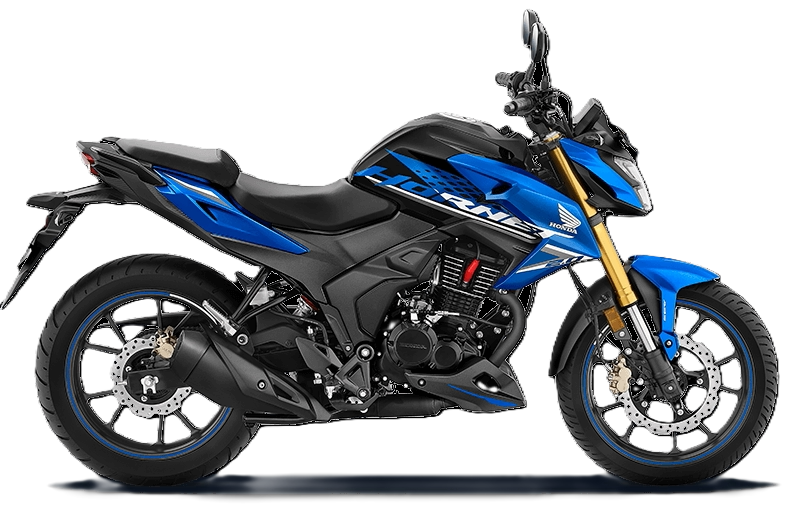
Honda Hornet 2.0
- 184.4 cc Air-Cooled, 2-valve
- 17.03 PS @ 8500 rpm
- 42.3 km/l (ARAI)
- 12-litre tank
- 1 variant available
- USD front forks (standard)
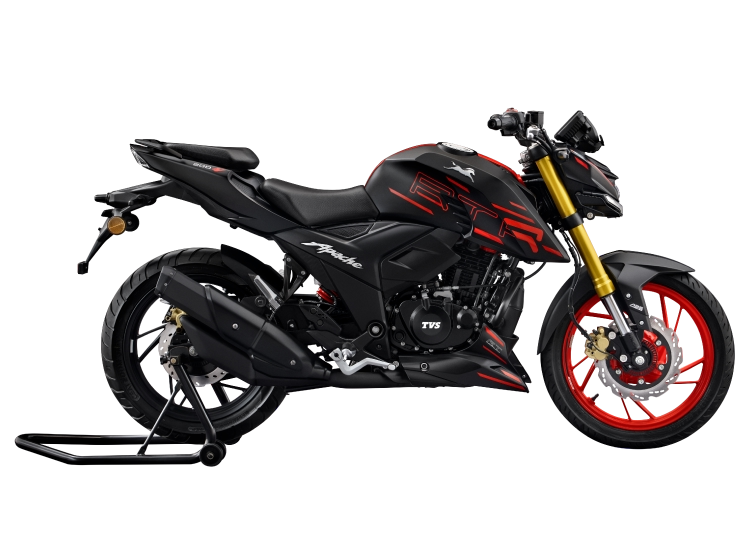
TVS Apache RTR 200 4V
- 197.75 cc Oil-Cooled, 4-valve
- 20.82 PS @ 9000 rpm
- 41.9 km/l (ARAI)
- 12-litre tank
- 3 variants available
- Ride modes: Sport, Urban, Rain
Full Specification Comparison
Every number that matters — side by side
| Specification | Honda Hornet 2.0 | TVS Apache RTR 200 4V |
|---|---|---|
| Engine & Performance | ||
| Displacement | 184.4 cc | 197.75 cc |
| Cooling System | Air-Cooled | Oil-Cooled |
| Max Power | 17.03 PS @ 8500 rpm | 20.82 PS @ 9000 rpm |
| Max Torque | 16.1 Nm @ 6000 rpm | 17.25 Nm @ 7250 rpm |
| Valves per Cylinder | 2 | 4 |
| Compression Ratio | 9.5 : 1 | 9.7 : 1 |
| Bore × Stroke | 61 × 63.1 mm | 66 × 57.8 mm |
| Emission Standard | BS6 OBD2 | BS6 OBD-2B |
| Transmission | 5-Speed Manual | 5-Speed Manual |
| Clutch | Wet Multi Plate | Assist & Slipper Clutch |
| Top Speed | ~130 km/h | 127 km/h |
| Riding Modes | No | Sport, Urban, Rain |
| Traction Control | No | Yes (top variant) |
| Fuel & Range | ||
| Mileage (ARAI) | 42.3 km/l | 41.9 km/l |
| Fuel Tank | 12 litres | 12 litres |
| Reserve Capacity | 1.9 litres | 2.5 litres |
| Riding Range | ~504 km | ~502 km |
| Brakes & Wheels | ||
| Braking System | Single Channel ABS | Dual Channel ABS |
| Front Brake | Disc – 276 mm | Disc – 270 mm |
| Rear Brake | Disc – 220 mm | Disc – 240 mm |
| Tyre Type | Tubeless | Tubeless |
| Tyre Size (F / R) | 110/70-17 / 140/70-17 | 90/90-17 / 130/70-17 |
| Wheel Size | 17 inch (F & R) | 17 inch (F & R) |
| Wheel Type | Alloy | Alloy |
| Suspension & Chassis | ||
| Front Suspension | USD Fork (standard) | Telescopic / USD Fork (top variants) |
| Rear Suspension | Monoshock | Mono Shock with Preload Adjust |
| Chassis | Diamond Type Frame | Double Cradle Split Synchro Stiff Frame |
| Rear Preload Adjuster | Yes | Yes |
| Dimensions & Weight | ||
| Kerb Weight | 142 kg | 152 kg |
| Seat Height | 790 mm | 800 mm |
| Ground Clearance | 168 mm | 180 mm |
| Wheelbase | 1355 mm | 1353 mm |
| Overall L × W × H | 2047 × 783 × 1064 mm | 2050 × 790 × 1050 mm |
| Features & Electronics | ||
| Instrument Console | Fully Digital LCD | Digital LCD / TFT (top variant) |
| Headlight | LED | LED Projector |
| DRLs | Yes | Yes |
| Turn Signals | LED | LED |
| Hazard Warning Lights | Yes | Yes |
| Riding Modes | No | Sport / Urban / Rain |
| Traction Control | No | Yes (TFT variant) |
| Bluetooth Connectivity | No | Yes (all variants) |
| Call & SMS Alerts | No | Yes |
| USB Charging Port | No | Yes |
| Distance to Empty | No | Yes |
| Voice Assist | No | Yes |
| Gear Indicator | Yes | Yes |
| Service Reminder | Yes | Yes |
| Assist & Slipper Clutch | No | Yes |
| Keyless Ignition | No | No |
| Price & Warranty | ||
| Starting Price (ex-showroom) | ₹1,47,151 | ₹1,38,407 |
| Top Variant Price | ₹1,47,151 (single variant) | ₹1,47,582 |
| Number of Variants | 1 | 3 |
| Standard Warranty | 3 Years | 5 Years / 60,000 km |
★ Green highlights indicate the stronger value in each row. Prices are ex-showroom India averages and may vary by city.
Variant-wise Price Comparison
All variants laid out — find the right one for your budget
Honda Hornet 2.0 Variants
Apache RTR 200 4V Variants
Pros & Cons
Honest strengths and weaknesses of each bike
Pros
- USD front forks standard — premium front-end feel
- Lightest in comparison at just 142 kg kerb weight
- Rear disc brake (220 mm) standard as sole variant
- Marginally better official mileage (42.3 vs 41.9 km/l)
- Full LED lighting, DRLs and hazard warning lights
- Trusted Honda reliability and strong long-term durability
- Smooth and refined engine power delivery
- Higher gear indicator on console
- Shorter wheelbase — slightly more nimble feel
Cons
- Lower peak power (17.03 PS vs 20.82 PS)
- Only single-channel ABS — no dual-channel option
- No ride modes at all
- No Bluetooth connectivity
- No USB charging port
- No distance to empty or voice assist
- No traction control
- No assist & slipper clutch
- Only 1 variant — no buyer flexibility
- Higher starting price (₹1,47,151 vs ₹1,38,407)
- Shorter 3-year warranty vs Apache's 5-year / 60,000 km
- Less ground clearance (168 mm vs 180 mm)
Pros
- Significantly more power — 20.82 PS (22% more than Hornet)
- Oil-cooled 4-valve engine — superior high-rpm performance
- Dual-channel ABS standard across all 3 variants
- Ride modes: Sport, Urban & Rain on all variants
- Assist & slipper clutch for smoother shifts
- Bluetooth connectivity, USB charging and voice assist
- Distance to empty on console
- Traction control on top TFT variant
- TFT display on top variant
- Superior ground clearance (180 mm)
- Lower starting price (₹1,38,407 — ₹8,744 cheaper)
- Better warranty — 5 years / 60,000 km
- 3 variants to choose from
Cons
- Heavier at 152 kg vs 142 kg
- Telescopic forks on base variant (not USD)
- Engine vibrations at higher RPM reported by owners
- Pillion comfort limited for long rides
- Styling has remained mostly unchanged for years
Key Differences Explained
What really sets these two bikes apart
Engine & Performance
This is the starkest difference between the two bikes. The Apache RTR 200 4V uses a 197.75 cc oil-cooled, 4-valve engine producing 20.82 PS and 17.25 Nm — 22% more power than the Hornet's 184.4 cc air-cooled, 2-valve unit making 17.03 PS and 16.1 Nm. The Apache's oil cooling manages heat better, and the 4-valve head enables it to breathe more freely at high revs. The Hornet delivers smoother, more linear power focused on everyday usability.
Fuel Efficiency & Range
Both motorcycles are remarkably close on fuel efficiency — the Hornet 2.0 claims 42.3 km/l ARAI and the Apache RTR 200 4V claims 41.9 km/l ARAI, a difference of just 0.4 km/l. Both have identical 12-litre fuel tanks, resulting in nearly identical riding ranges of approximately 500 km. Given the Apache's significant power advantage, this near-parity in fuel efficiency is impressive and a genuine engineering achievement from TVS.
Braking & Safety
The Apache RTR 200 4V wins decisively here. It comes with dual-channel ABS as standard across all three variants — something the Hornet 2.0 does not offer at all, despite its higher price. The Apache also features a larger 240 mm rear disc versus the Hornet's 220 mm. The Hornet counters with a marginally larger 276 mm front disc versus the Apache's 270 mm. Traction control is available on the Apache's top TFT variant, further widening the safety electronics gap.
Suspension & Handling
The Honda Hornet 2.0 has an edge on base hardware: USD front forks are standard on its only variant, delivering superior front-end stability and feel. The Apache RTR 200 4V offers USD forks only from its second variant (₹1,42,659) — its base variant uses telescopic forks. However, the Apache's double cradle split synchro stiff frame is purpose-built for performance riding and offers sharper cornering dynamics. The Hornet's 142 kg weight versus the Apache's 152 kg also contributes to its nimbler feel.
Features & Technology
The Apache RTR 200 4V comprehensively outclasses the Hornet 2.0 on technology. Ride modes (Sport, Urban, Rain), Bluetooth connectivity, USB charging, distance to empty, voice assist, an assist & slipper clutch and traction control (top variant) are all standard or available on the Apache. The Hornet 2.0 offers none of these features. Despite costing ₹8,744 more, the Hornet's feature list looks sparse against the Apache's rich technology package.
Price, Value & Warranty
The Apache RTR 200 4V starts at ₹1,38,407 — ₹8,744 cheaper than the Hornet's ₹1,47,151. The Apache's top TFT variant at ₹1,47,582 is almost identical in price to the Hornet, but adds traction control, a TFT display and Bluetooth on top of the performance advantage. The Apache also offers a far superior 5-year / 60,000 km warranty against the Hornet's 3-year coverage. The Apache delivers more for less across the entire range.
Expert Verdict
Which one should you actually buy?
Buy the Honda Hornet 2.0 if…
- Honda's long-term reliability and brand trust are your top priority
- USD front forks as standard from the base are important to you
- A lighter 142 kg kerb weight matters for city riding
- You prefer smooth, refined power delivery over outright performance
- You ride mainly in the city where power difference is less noticeable
- Honda's dealership and service network coverage in your area is better
Buy the Apache RTR 200 4V if…
- You want significantly more power (20.82 PS vs 17.03 PS)
- Dual-channel ABS on every variant matters for your safety
- Ride modes for Sport, Urban and Rain riding appeal to you
- Bluetooth, USB charging and a richer tech package are priorities
- An assist & slipper clutch for smoother riding is desirable
- You want a lower starting price (₹8,744 cheaper at base)
- A longer 5-year / 60,000 km warranty is important for peace of mind
- Ground clearance (180 mm vs 168 mm) matters on your roads
- You want variant choice to suit your budget and needs
Overall Winner for Most Riders: TVS Apache RTR 200 4V. More power (20.82 PS vs 17.03 PS), dual-channel ABS standard on all variants, ride modes, Bluetooth, USB charging, a slipper clutch, traction control on the top variant, greater ground clearance, a lower starting price (₹1,38,407 vs ₹1,47,151) and a superior 5-year / 60,000 km warranty make the Apache RTR 200 4V the overwhelmingly better-equipped and better-value motorcycle at nearly every price point. Choose the Honda Hornet 2.0 only if standard USD forks, lighter weight, Honda reliability and a smoother refined engine character are worth its higher price and considerably thinner feature set.
Frequently Asked Questions
Common questions answered by our experts
The TVS Apache RTR 200 4V is better for most riders — it offers 22% more power (20.82 PS), dual-channel ABS on all variants, ride modes, Bluetooth, USB charging, a slipper clutch and a lower starting price. The Honda Hornet 2.0 is better if you want Honda's long-term reliability, standard USD front forks, a lighter 142 kg weight and a smoother refined power delivery at the cost of features and performance.
The TVS Apache RTR 200 4V starts at ₹1,38,407 while the Honda Hornet 2.0 is priced at ₹1,47,151 ex-showroom — the Apache is ₹8,744 cheaper at entry level. The Apache's top TFT variant reaches ₹1,47,582, nearly identical to the Hornet's price, but adds traction control, a TFT display and Bluetooth. Both prices are ex-showroom India averages and may vary by city.
Both bikes offer very similar ARAI-certified mileage — the Honda Hornet 2.0 claims 42.3 km/l and the TVS Apache RTR 200 4V claims 41.9 km/l, a negligible difference of 0.4 km/l. Both have identical 12-litre fuel tanks giving nearly identical riding ranges of approximately 500 km. Given the Apache's 22% power advantage, this near-parity in fuel economy is especially noteworthy.
The TVS Apache RTR 200 4V makes significantly more power at 20.82 PS @ 9000 rpm and more torque at 17.25 Nm @ 7250 rpm, compared to the Honda Hornet 2.0's 17.03 PS @ 8500 rpm and 16.1 Nm @ 6000 rpm. The Apache's larger 197.75 cc oil-cooled 4-valve engine gives it roughly 22% more power, making it a substantially faster and more exciting motorcycle.
Yes, the TVS Apache RTR 200 4V offers three rider-selectable modes — Sport, Urban and Rain — across all three of its variants. Sport delivers full performance, Urban optimises throttle for smoother city use, and Rain softens power delivery for wet conditions. The Honda Hornet 2.0 does not offer any ride modes.
No, the Honda Hornet 2.0 only comes with single-channel ABS on its single variant. The TVS Apache RTR 200 4V offers dual-channel ABS as standard across all three variants starting from ₹1,38,407 — making it considerably better equipped for braking safety at a lower price.
The TVS Apache RTR 200 4V offers a significantly better warranty at 5 years / 60,000 km compared to the Honda Hornet 2.0's 3-year coverage. For riders who clock 15,000–20,000 km per year, the Apache's additional two years of warranty coverage provides meaningful protection against unexpected repair costs.