At a Glance
Key differences that define each motorcycle
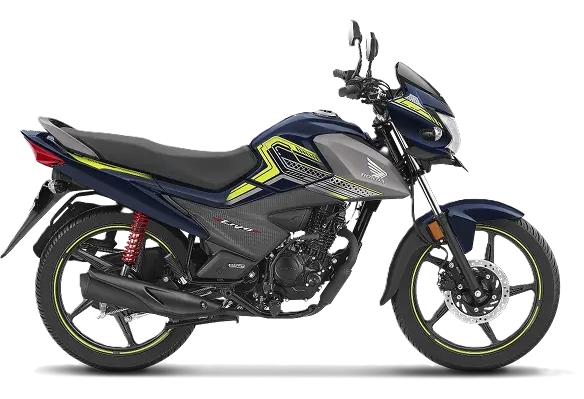
Honda Livo
- 109.51 cc Air-Cooled, 2-valve
- 8.79 PS @ 7500 rpm
- 70 km/l (ARAI Certified)
- 9-litre tank
- 2 variants available
- Drum / Disc + CBS
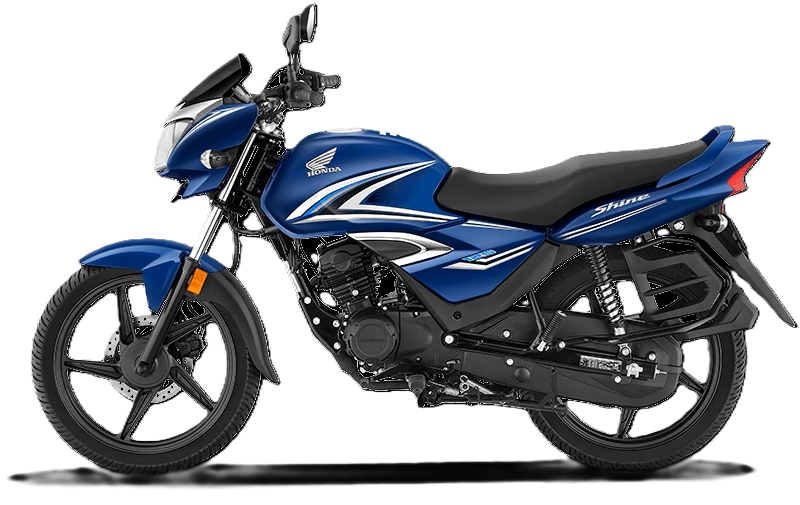
Honda Shine 125
- 123.94 cc Air-Cooled, 2-valve
- 10.74 PS @ 7500 rpm
- 50–55 km/l (Owner Reported)
- 10.5-litre tank
- 2 variants available
- 5-speed gearbox
Full Specification Comparison
Every number that matters — side by side
| Specification | Honda Livo | Honda Shine 125 |
|---|---|---|
| Engine & Performance | ||
| Displacement | 109.51 cc | 123.94 cc |
| Cooling System | Air-Cooled | Air-Cooled |
| Max Power | 8.79 PS @ 7500 rpm | 10.74 PS @ 7500 rpm |
| Max Torque | 9.30 Nm @ 5500 rpm | 11 Nm @ 6000 rpm |
| Valves per Cylinder | 2 | 2 |
| Compression Ratio | 10.0 : 1 | 10.0 : 1 |
| Bore × Stroke | 47.0 × 63.1 mm | 50.0 × 63.1 mm |
| Emission Standard | BS6 Phase 2 (OBD2) | BS6 Phase 2 (OBD2) |
| Transmission | 4-Speed Manual | 5-Speed Manual |
| Gear Shifting Pattern | All 4 gears down | 1 Down, 4 Up |
| Top Speed | 90 km/h | 90 km/h |
| Start Type | Electric & Kick Start | Electric Start |
| Riding Modes | No | No |
| Traction Control | No | No |
| Fuel & Range | ||
| Mileage (ARAI) | 70 km/l (ARAI Certified) | Not Claimed |
| Mileage (Real-world / Owner) | 60–65 km/l | 50–55 km/l |
| Fuel Tank | 9 litres | 10.5 litres |
| Reserve Capacity | 2 litres | 1.3 litres |
| Riding Range (Estimated) | ~550–630 km | ~500–550 km |
| Brakes & Wheels | ||
| Braking System | Combined Braking System (CBS) | CBS |
| Front Brake | Drum 130 mm / Disc 240 mm (variant) | Drum / Disc 240 mm (variant) |
| Rear Brake | Drum – 130 mm | Drum – 130 mm |
| Tyre Type | Tubeless | Tubeless |
| Tyre Size (F / R) | 80/100-17 / 100/80-17 | 80/100-18 / 80/100-18 |
| Wheel Size | 17-inch | 18-inch |
| Wheel Type | Alloy | Alloy |
| Suspension & Chassis | ||
| Front Suspension | Telescopic Fork | Telescopic |
| Rear Suspension | Twin Hydraulic Shock Absorbers | Hydraulic Type |
| Chassis | Diamond Type Frame | Diamond Type |
| Rear Preload Adjuster | No | No |
| Dimensions & Weight | ||
| Kerb Weight | 112 kg | 113–114 kg |
| Seat Height | 790 mm | 791 mm |
| Ground Clearance | 163 mm | 162 mm |
| Wheelbase | 1278 mm | 1285 mm |
| Overall L × W × H | 2020 × 742 × 1102 mm | 2046 × 737 × 1116 mm |
| Features & Electronics | ||
| Instrument Console | Digital LCD | Analogue |
| Speedometer | Digital | Analogue |
| Odometer | Digital | Analogue |
| Fuel Gauge | Digital | Analogue |
| Tripmeter | Digital | Analogue |
| Clock | Yes | No |
| Headlight | Halogen | Halogen |
| DRLs | No | No |
| Hazard Warning Lights | No | No |
| Bluetooth Connectivity | No | No |
| USB Charging Port | No | Yes (Disc variant — USB Type-C) |
| Low Fuel Indicator | Yes | Yes |
| Side Stand Engine Cut-off | Yes | Yes |
| Kill Switch | Yes | Yes |
| Keyless Ignition | No | No |
| Price & Warranty | ||
| Starting Price (ex-showroom) | ₹80,220 | ₹80,852 |
| Top Variant Price | ₹82,787 | ₹85,211 |
| Number of Variants | 2 | 2 |
| Standard Warranty | 3 Years / 42,000 km | 3 Years / 42,000 km |
★ Green highlights indicate the stronger value in each row. Prices are ex-showroom India averages and may vary by city.
Variant-wise Price Comparison
All variants laid out — find the right one for your budget
Honda Livo Variants
Honda Shine 125 Variants
Pros & Cons
Honest strengths and weaknesses of each bike
Pros
- ARAI-certified mileage of 70 km/l — verified official figure
- Digital LCD instrument console with clock
- Lower starting price (₹80,220 vs ₹80,852)
- Lower top variant price (₹82,787 vs ₹85,211)
- Kick start as a reliable backup option
- Wider rear tyre (100/80-17) for better road grip
- Better real-world riding range (~550–630 km)
- Smooth and refined Honda 110cc engine
- Same 3-year / 42,000 km warranty as Shine 125
Cons
- Less power (8.79 PS vs 10.74 PS)
- Smaller 109.51cc engine
- Only 4-speed gearbox
- Smaller 9-litre fuel tank
- No USB charging on any variant
- No LED headlamp
Pros
- Significantly more power – 10.74 PS (22% more than Livo)
- Higher torque – 11 Nm @ 6000 rpm
- Larger 123.94cc engine for better highway capability
- 5-speed gearbox for more relaxed cruising
- Larger 10.5-litre fuel tank
- USB Type-C charging port on Disc variant
- 18-inch wheels for better stability
- Excellent long-term refinement and reliability
Cons
- No ARAI-certified mileage figure — less transparency
- Lower real-world mileage (50–55 km/l vs 60–65 km/l)
- Higher starting price (₹80,852)
- Higher top variant price (₹85,211 vs ₹82,787)
- Analogue instrument cluster — no digital display
- No kick start backup
- Smaller reserve fuel capacity (1.3 litres vs 2 litres)
Key Differences Explained
What really sets these two bikes apart
Engine Character
The Livo uses a 109.51 cc air-cooled engine tuned for smooth, relaxed commuting and high fuel efficiency. The Shine 125 uses a larger 123.94 cc air-cooled PGM-FI engine producing 10.74 PS — over 22% more power — and 11 Nm of torque, giving it notably stronger acceleration and better high-speed composure. The Shine 125's 5-speed gearbox also allows more relaxed cruising at higher speeds, whereas the Livo's 4-speed setup is tuned purely for city use.
Fuel Efficiency & Range
The Honda Livo has a clear and verifiable advantage with its ARAI-certified 70 km/l figure. Honda has not published an official ARAI mileage for the Shine 125, with owners reporting around 50–55 km/l. Real-world Livo owners report 60–65 km/l. While the Shine 125 has a larger 10.5-litre tank, the Livo's superior efficiency partially compensates with an estimated range of 550–630 km against the Shine 125's 500–550 km. The Livo's larger 2-litre reserve (vs 1.3 litres) is also a practical edge.
Braking & Safety
Both bikes offer identical braking setups with CBS across all variants: drum brakes on the base variant and a 240 mm front disc on the top variant. Rear brakes are drum on both. The Livo features a wider 100/80-17 rear tyre, which may provide slightly better grip, while the Shine 125 uses narrower 80/100-18 tyres but on larger 18-inch wheels for added stability. Braking performance is fundamentally matched between the two.
Features & Instrumentation
The Livo holds a significant advantage here with its digital LCD instrument console displaying a digital speedometer, odometer, fuel gauge, tripmeter, and a built-in clock — a feature the Shine 125 lacks entirely with its basic analogue cluster. However, the Shine 125 Disc variant counters with a USB Type-C charging port, which the Livo does not offer on any variant. The Livo also includes a kick start backup, adding reliability in low-battery situations.
Warranty & Ownership
Both bikes offer an identical standard warranty of 3 years or 42,000 km — Honda's uniform policy across this segment. Service intervals are similar, and both benefit from Honda's extensive and trusted dealer network across India. The Shine 125 has slightly higher average service costs (₹700– ₹1,200 vs ₹500–₹1,000 for the Livo), owing to its larger engine. For buyers concerned with long-term running costs, the Livo has a marginal advantage.
Price & Value
At the base drum variant level, the Livo is just ₹632 cheaper (₹80,220 vs ₹80,852). The gap widens at the disc variant: ₹82,787 for the Livo Disc versus ₹85,211 for the Shine 125 Disc — a difference of ₹2,424. For that premium on the Shine 125 Disc, buyers gain 22% more power, a 5-speed gearbox, a larger tank, and a USB Type-C port. Whether that justifies the extra spend depends on whether performance or economy is the primary priority.
Expert Verdict
Which one should you actually buy?
Buy the Honda Livo if…
- Fuel efficiency is your top priority — 70 km/l ARAI certified
- You want a digital LCD console with clock
- Lower purchase price matters (starts ₹632 cheaper)
- You want a kick start as a backup
- You ride primarily in city traffic at moderate speeds
- Lower running and service costs are important to you
- You prefer a wider rear tyre for more road grip
Buy the Honda Shine 125 if…
- More power (10.74 PS) for confident city and highway riding
- A 5-speed gearbox for relaxed cruising appeals to you
- You want a larger 10.5-litre fuel tank for longer trips
- USB Type-C charging is useful for your daily riding
- You occasionally venture onto highways and need more grunt
- Larger 18-inch wheels and a longer wheelbase suit your riding style
- You value a stronger, more capable engine over outright efficiency
Overall Winner for Performance-Focused Riders: Honda Shine 125. With 22% more power, a 5-speed gearbox, a larger fuel tank, and USB Type-C charging on the top variant, the Shine 125 offers substantially more capability for just ₹632 more at the base level. However, for riders whose absolute priority is fuel economy, a modern digital console, lower running costs, and a kick start backup, the Honda Livo remains a highly compelling choice. Both bikes are equally reliable with the same warranty — the decision ultimately comes down to whether you need more power or more efficiency.
Frequently Asked Questions
Common questions answered by our experts
The Honda Shine 125 is better for riders who want more power (10.74 PS), a 5-speed gearbox, a larger 10.5-litre tank, and USB charging on the Disc variant. The Honda Livo is better for riders who prioritise fuel efficiency (70 km/l ARAI certified), a modern digital LCD console with clock, lower purchase and running costs, and a kick start backup. Both bikes carry the same Honda reliability and identical 3-year / 42,000 km warranty.
The Honda Livo starts at ₹80,220 while the Honda Shine 125 starts at ₹80,852 — a base difference of ₹632. At the disc variant level, the Livo Disc is ₹82,787 while the Shine 125 Disc OBD2 is ₹85,211 — a difference of ₹2,424. All prices are ex-showroom India averages and may vary by city.
The Honda Livo has better and officially verified mileage at 70 km/l (ARAI certified), while Honda has not published an ARAI figure for the Shine 125. Shine 125 owners report around 50–55 km/l in real-world conditions, while Livo owners typically report 60–65 km/l. Despite the Shine 125's larger 10.5-litre tank, the Livo's superior efficiency gives it a comparable or better real-world riding range.
The Honda Shine 125 makes significantly more power at 10.74 PS @ 7500 rpm compared to the Honda Livo's 8.79 PS @ 7500 rpm — a difference of approximately 22%. The Shine 125 also produces more torque at 11 Nm vs 9.30 Nm, and its larger 123.94cc engine with a 5-speed gearbox delivers a more confident riding experience, especially at higher speeds or when carrying a pillion.
Yes, the Honda Livo is available with a front disc brake (240 mm) on its Disc variant priced at ₹82,787 ex-showroom. The base Livo Drum variant uses drum brakes on both ends. Similarly, the Honda Shine 125 also offers a front disc (240 mm) on the Disc OBD2 variant at ₹85,211. Both disc variants include CBS (Combined Braking System) for safer braking.
Both the Honda Livo and Honda Shine 125 offer an identical standard warranty of 3 years or 42,000 km — Honda's uniform warranty policy for this segment. There is no difference in warranty terms between these two motorcycles.