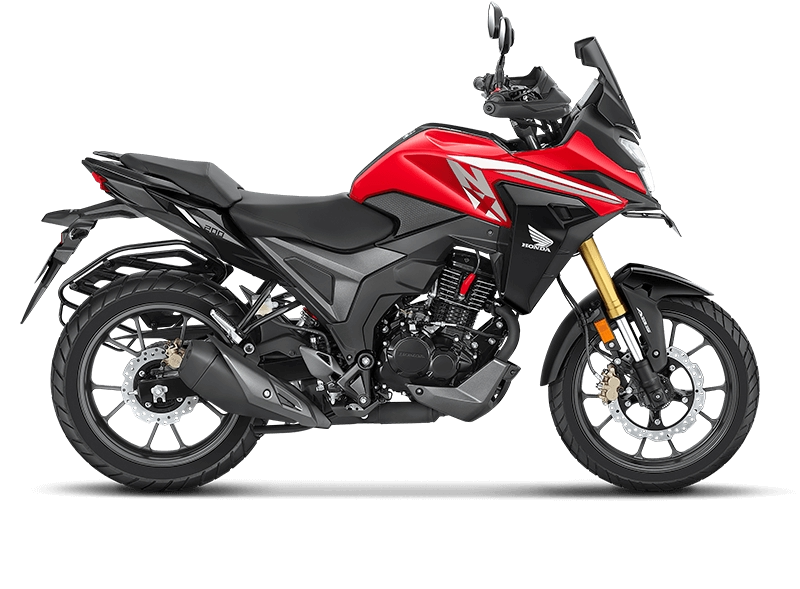
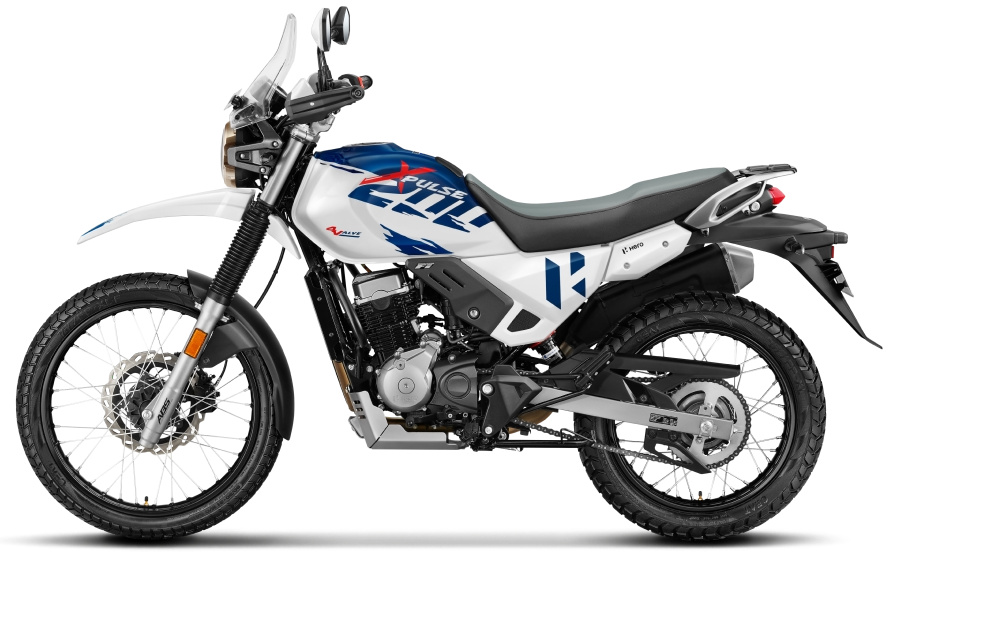
At a Glance
Key differences that define each motorcycle
Honda NX200
- 184.4 cc Air-Cooled, 2-valve
- 16.9 PS @ 8500 rpm
- ~42 km/l (Owner Reported)
- 12-litre tank
- 1 variant available
- TFT display with Bluetooth
Hero Xpulse 200 4V
- 199.6 cc Oil-Cooled, 4-valve
- 19.16 PS @ 8500 rpm
- 32.9 km/l (ARAI)
- 13-litre tank
- 3 variants available
- 220 mm clearance, 21-inch front wheel
Full Specification Comparison
Every number that matters — side by side
| Specification | Honda NX200 | Hero Xpulse 200 4V |
|---|---|---|
| Engine & Performance | ||
| Displacement | 184.4 cc | 199.6 cc |
| Cooling System | Air-Cooled | Oil-Cooled |
| Valves per Cylinder | 2 | 4 |
| Max Power | 16.9 PS @ 8500 rpm | 19.16 PS @ 8500 rpm |
| Max Torque | 15.7 Nm @ 6000 rpm | 17.35 Nm @ 6500 rpm |
| Bore × Stroke | 61 × 63.096 mm | 66.5 × 57.5 mm |
| Compression Ratio | 9.5:1 | 10.5:1 |
| Emission Standard | BS6 Phase 2 | BS6 Phase 2 |
| Transmission | 5-Speed Manual | 5-Speed Manual |
| Clutch | Multiplate Wet Clutch | Wet Multi Plate |
| Top Speed | ~130 km/h | ~135 km/h |
| Riding Modes | No | Yes |
| Start Type | Electric Start | Electric + Kick Start |
| Traction Control | No | No |
| Fuel & Range | ||
| Mileage (Claimed) | ~42 km/l (Owner Reported) | 32.9 km/l (ARAI) |
| Fuel Tank | 12 litres | 13 litres |
| Reserve Capacity | 1.9 litres | 2.6 litres |
| Riding Range | ~504 km | ~427 km |
| Brakes & Wheels | ||
| Braking System | Dual-Channel ABS | Single-Channel ABS (Switchable Rear) |
| Front Brake | Disc – 276 mm | Disc – 276 mm |
| Rear Brake | Disc – 220 mm | Disc – 220 mm |
| Tyre Type | Tubeless | Tube Type |
| Front Wheel Size | 17 inch | 21 inch |
| Rear Wheel Size | 17 inch | 18 inch |
| Tyre Size (F / R) | 110/70-17 / 140/70-17 | 90/90-21 / 120/80-18 |
| Wheel Type | Alloy | Spoke (Off-road ready) |
| Suspension & Chassis | ||
| Front Suspension | USD Fork | Telescopic Fork |
| Front Suspension Travel | – | 190 mm (250 mm on Pro) |
| Rear Suspension | Monoshock | Monoshock |
| Rear Suspension Travel | – | 170 mm (220 mm on Pro) |
| Chassis | Diamond Type | Diamond Frame |
| Rear Preload Adjuster | No | Yes |
| Dimensions & Weight | ||
| Kerb Weight | 148 kg | 159 kg |
| Seat Height | 810 mm | 825 mm (891 mm on Pro) |
| Ground Clearance | 167 mm | 220 mm (270 mm on Pro) |
| Wheelbase | 1355 mm | 1410 mm |
| Overall L × W × H | 2035 × 843 × 1248 mm | 2222 × 850 × 1258 mm |
| Features & Electronics | ||
| Instrument Console | Fully Digital TFT | Fully Digital LCD |
| Headlight | LED | LED |
| DRLs | Yes | Yes |
| Turn Signals | LED | Halogen |
| Hazard Warning Lights | Yes | Yes |
| Bluetooth Connectivity | Yes | Yes |
| Call & SMS Alerts | Yes | Yes |
| Navigation Support | Yes (via app) | Yes (Bluetooth navigation) |
| USB Charging Port | Yes | Yes |
| Distance to Empty | Yes | Yes |
| Gear Indicator | Yes | Yes |
| Riding Modes | No | Yes |
| Side Stand Engine Cut-off | Yes | Yes |
| Keyless Ignition | No | No |
| Handle Bar Riser | No | Yes (Pro & Pro Dakar) |
| Price & Warranty | ||
| Starting Price (ex-showroom) | ₹1,57,748 | ₹1,41,059 |
| Top Variant Price | ₹1,57,748 | ₹1,55,816 |
| Number of Variants | 1 | 3 |
| Standard Warranty | 3 Years / 42,000 km | 5 Years / 70,000 km |
★ Green highlights indicate the stronger value in each row. Prices are ex-showroom India averages and may vary by city.
Variant-wise Price Comparison
All variants laid out — find the right one for your budget
Honda NX200 Variants
Hero Xpulse 200 4V Variants
Pros & Cons
Honest strengths and weaknesses of each bike
Pros
- Premium TFT display — only bike in this comparison with TFT
- USD front forks for sharper, more stable handling
- Dual-channel ABS standard — safer on-road braking
- Lighter at 148 kg vs 159 kg — more nimble in traffic
- Better fuel efficiency (~42 km/l vs 32.9 km/l) and longer riding range (~504 km)
- LED turn signals and full LED lighting
- More accessible seat height (810 mm vs 825 mm)
- Honda brand reliability and refined engine character
- Wider rear tyre (140/70-17) for more road grip
Cons
- Significantly less power (16.9 PS vs 19.16 PS)
- Smaller 184.4 cc air-cooled, 2-valve engine
- Only 1 variant — no choice for buyers
- ₹16,689 more expensive than Xpulse 200 4V base
- No off-road capability — 17-inch wheels, 167 mm clearance
- Shorter warranty — 3 years / 42,000 km vs 5 years / 70,000 km
- No riding modes
- No kick start — electric only
- No rear preload adjuster
Pros
- More power — 19.16 PS and 17.35 Nm vs 16.9 PS and 15.7 Nm
- Larger 199.6 cc oil-cooled 4-valve engine
- 21-inch front wheel purpose-built for off-road riding
- Exceptional ground clearance — 220 mm (270 mm on Pro)
- Long-travel suspension — 190 mm front / 170 mm rear (250/220 on Pro)
- Switchable rear ABS for better off-road control
- Riding modes for different terrain
- Electric + kick start for reliability off the grid
- 3 variants including Dakar Edition — more choice
- Rear preload adjuster for load customisation
- Significantly better warranty — 5 years / 70,000 km
- Starting price ₹16,689 lower at ₹1,41,059
Cons
- Much lower fuel efficiency — 32.9 km/l ARAI vs ~42 km/l
- Heavier at 159 kg vs 148 kg
- Taller seat height (825–891 mm) may challenge shorter riders
- Only single-channel ABS — less safe on paved roads in wet conditions
- Tube-type tyres less convenient than tubeless for punctures
- LCD display instead of premium TFT
- Halogen turn signals instead of LED
- No USD front forks on any variant
Key Differences Explained
What really sets these two bikes apart
Engine & Performance
The Xpulse 200 4V uses a larger 199.6 cc oil-cooled, 4-valve engine producing 19.16 PS and 17.35 Nm — approximately 13.4% more power and 10.5% more torque than the NX200's 184.4 cc air-cooled, 2-valve unit. The Xpulse also has a higher compression ratio (10.5:1 vs 9.5:1) and comes with riding modes to tailor performance to different terrain. For both outright speed and off-road pull, the Xpulse 200 4V has a meaningful advantage.
Fuel Efficiency & Range
The NX200 leads clearly in fuel efficiency at approximately 42 km/l (owner reported) against the Xpulse 200 4V's ARAI-certified 32.9 km/l — a gap of over 9 km/l. Combined with a 12-litre tank, the NX200 delivers a theoretical range of ~504 km, compared to ~427 km from the Xpulse's 13-litre tank. For daily commuters covering long distances, the NX200's fuel economy is a significant long-term cost saving.
Off-Road Capability
The Xpulse 200 4V comprehensively dominates here. Its 21-inch front wheel, 220 mm ground clearance (270 mm on Pro), long-travel suspension (190/170 mm; 250/220 mm on Pro), spoke wheels, tube-type adventure tyres, switchable rear ABS and riding modes make it a purpose-built adventure motorcycle. The NX200 rides on 17-inch wheels with 167 mm ground clearance — suited for urban use and light touring only, not trails or rough terrain.
Features & Technology
The NX200 has a clear edge in on-road feature quality: its TFT display is more premium than the Xpulse's LCD unit, and it comes with USD front forks, dual-channel ABS, LED turn signals and a lighter overall package. The Xpulse 200 4V counters with riding modes, Bluetooth navigation, a rear preload adjuster, kick start backup and handlebar risers on Pro variants — features that serve adventure riders better.
Warranty & Ownership
The Xpulse 200 4V offers a significantly better warranty at 5 years / 70,000 km against the NX200's 3 years / 42,000 km. That's 67% more years and 66% more kilometre coverage. Both bikes benefit from large service networks — Hero's is among the most widespread in India, while Honda's is strong in cities. For high-mileage owners, the Xpulse 200 4V's warranty gives far greater protection.
Price & Value
The Xpulse 200 4V starts ₹16,689 cheaper at ₹1,41,059 and even its top Pro Dakar Edition (₹1,55,816) is still ₹1,932 less than the NX200's single variant price of ₹1,57,748. For the money, the Xpulse delivers more power, more capability, 3 variant choices and a far superior warranty. The NX200 justifies its premium with a TFT display, USD forks, dual-channel ABS and superior fuel economy — but it's a harder value proposition for most buyers.
Expert Verdict
Which one should you actually buy?
Buy the Honda NX200 if…
- You want a premium TFT display and USD front forks
- Dual-channel ABS for maximum on-road safety is a priority
- You do heavy daily commuting and value fuel economy (~42 km/l)
- Longer riding range (~504 km) between fill-ups matters
- A lighter motorcycle (148 kg) is important for city use
- More accessible seat height (810 mm) suits your build
- Honda brand reliability and refinement are non-negotiable
- You ride exclusively on paved roads and highways
Buy the Hero Xpulse 200 4V if…
- Off-road trails, dirt tracks or rough terrain is part of your riding
- You want significantly more power (19.16 PS) for performance
- High ground clearance (220–270 mm) suits your daily roads
- Long-travel suspension for absorbing bad roads is important
- You value 3 variant choices including the Pro & Dakar Edition
- The superior 5-year / 70,000 km warranty is a priority
- Budget matters — starts ₹16,689 cheaper than the NX200
- Riding modes and switchable rear ABS suit your riding style
Overall Winner for Most Riders: Hero Xpulse 200 4V. More power, a larger engine, exceptional off-road hardware (21-inch wheel, 220 mm ground clearance, long-travel suspension), riding modes, switchable rear ABS, 3 variant choices, a superior 5-year / 70,000 km warranty — all at a starting price ₹16,689 lower than the NX200. Even the top Xpulse Pro Dakar Edition undercuts the NX200's single variant price. Choose the Honda NX200 only if you ride exclusively on paved roads, prioritise fuel economy, and want a TFT display and dual-channel ABS in a lighter, more refined package.
Frequently Asked Questions
Common questions answered by our experts
The Hero Xpulse 200 4V is better for most buyers — it delivers significantly more power (19.16 PS vs 16.9 PS), a larger oil-cooled 4-valve engine, outstanding off-road hardware (21-inch wheel, 220 mm ground clearance, long-travel suspension), riding modes, 3 variant choices and a much better 5-year / 70,000 km warranty — all at a lower starting price. The Honda NX200 is the better choice for riders who want a premium TFT display, dual-channel ABS, better fuel economy (~42 km/l) and a lighter, more refined on-road motorcycle.
The Hero Xpulse 200 4V starts at ₹1,41,059 (Standard variant) while the Honda NX200 costs ₹1,57,748 — making the Xpulse ₹16,689 cheaper at entry level. The Xpulse 200 4V range tops out at ₹1,55,816 for the Pro Dakar Edition, which is still ₹1,932 less than the NX200. Prices are ex-showroom India averages and may vary by city.
The Honda NX200 has significantly better fuel efficiency at approximately 42 km/l (owner reported) compared to the Hero Xpulse 200 4V's ARAI-certified 32.9 km/l. Despite the Xpulse's larger 13-litre tank (vs 12 litres), the NX200 achieves a longer theoretical riding range of ~504 km versus ~427 km for the Xpulse. Note that the NX200's mileage is owner-reported and not ARAI-certified, while the Xpulse figure is official.
The Hero Xpulse 200 4V makes significantly more power at 19.16 PS @ 8500 rpm compared to the Honda NX200's 16.9 PS — a difference of 2.26 PS or approximately 13.4%. The Xpulse 200 4V also produces more torque at 17.35 Nm vs 15.7 Nm. This is driven by the Xpulse's larger 199.6 cc oil-cooled 4-valve engine versus the NX200's 184.4 cc air-cooled 2-valve unit.
Yes, significantly so. The Hero Xpulse 200 4V is purpose-built for off-road riding with a 21-inch front wheel, 220 mm ground clearance (270 mm on Pro), long-travel suspension (190 mm front / 170 mm rear on Standard; 250/220 mm on Pro), spoke wheels, tube-type adventure tyres, switchable rear ABS and riding modes. The Honda NX200 rides on 17-inch wheels with only 167 mm ground clearance — it is designed for urban and light touring use, not trails or off-road terrain.
The Hero Xpulse 200 4V comprehensively wins on warranty with 5 years / 70,000 km of coverage compared to the Honda NX200's 3 years / 42,000 km standard warranty. That's 67% more time and 66% more kilometre protection. For riders clocking 15,000–20,000 km per year, the Xpulse 200 4V's warranty advantage translates to several additional years of coverage, significantly reducing the risk of out-of-warranty repair costs.