At a Glance
Key differences that define each motorcycle
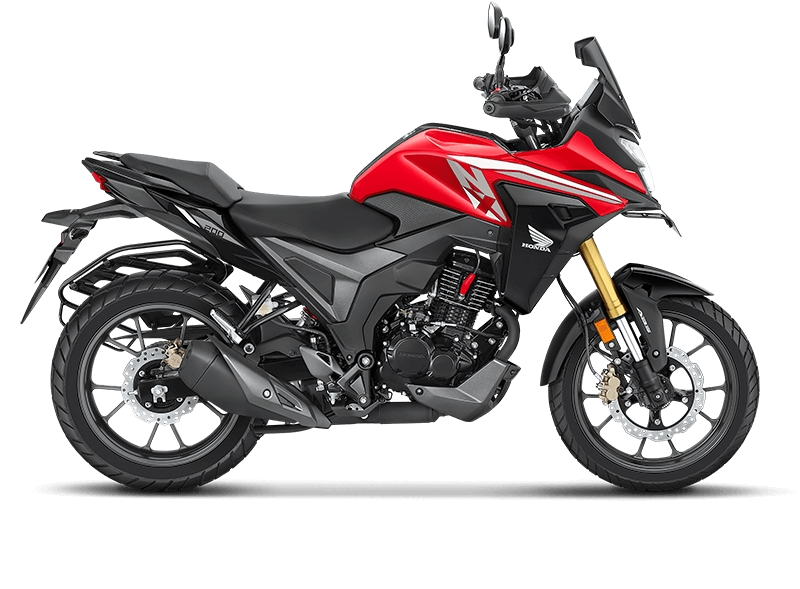
Honda NX200
- 184.4 cc Air-Cooled, 2-valve
- 16.9 PS @ 8500 rpm
- ~42 km/l (Owner Reported)
- 12-litre tank
- 1 variant available
- Dual-channel ABS standard
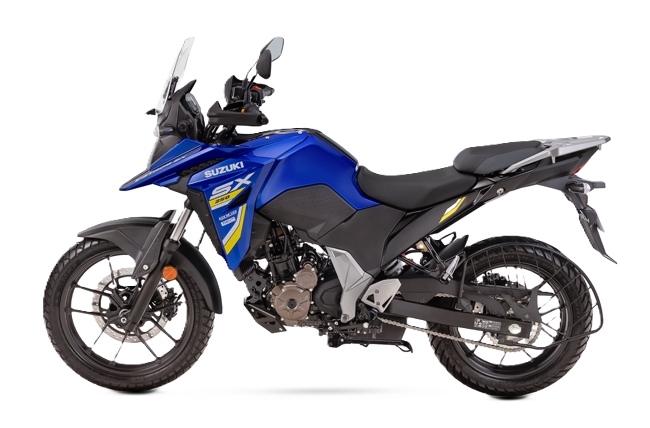
Suzuki V-Strom SX
- 249 cc Oil-Cooled, 4-valve
- 26.5 PS @ 9300 rpm
- 36 km/l (ARAI Certified)
- 12-litre tank
- 1 variant available
- 19-inch front wheel, 205 mm clearance
Full Specification Comparison
Every number that matters — side by side
| Specification | Honda NX200 | Suzuki V-Strom SX |
|---|---|---|
| Engine & Performance | ||
| Displacement | 184.4 cc | 249 cc |
| Cooling System | Air-Cooled | Oil-Cooled |
| Max Power | 16.9 PS @ 8500 rpm | 26.5 PS @ 9300 rpm |
| Max Torque | 15.7 Nm @ 6000 rpm | 22.2 Nm @ 7300 rpm |
| Valves per Cylinder | 2 | 4 |
| Compression Ratio | 9.5:1 | 10.7:1 |
| Bore × Stroke | 61.0 × 63.096 mm | 76.0 × 54.9 mm |
| Emission Standard | BS6 Phase 2 | BS6-2.0 |
| Transmission | 5-Speed Manual | 6-Speed Manual |
| Top Speed | ~130 km/h | ~140 km/h |
| Riding Modes | No | No |
| Traction Control | No | No |
| Fuel & Range | ||
| Mileage (Claimed / ARAI) | Not Claimed (ARAI) | 36 km/l (ARAI) |
| Mileage (Real-world / Owner) | ~42 km/l (Owner) | ~33–36 km/l |
| Fuel Tank | 12 litres | 12 litres |
| Reserve Capacity | 1.9 litres | 2.4 litres |
| Riding Range | ~504 km | ~432 km (ARAI) / ~500 km+ real |
| Brakes & Wheels | ||
| Braking System | Dual Channel ABS | Dual Channel ABS |
| Front Brake | Disc – 276 mm | Disc – 300 mm |
| Rear Brake | Disc – 220 mm | Disc – 220 mm |
| Tyre Type | Tubeless | Tubeless |
| Tyre Size (F / R) | 110/70-17 / 140/70-17 | 100/90-19 / 140/70-17 |
| Front Wheel Size | 17 inch | 19 inch |
| Wheel Type | Alloy | Alloy |
| Suspension & Chassis | ||
| Front Suspension | USD Fork | Telescopic, Coil Spring, Oil Damped |
| Rear Suspension | Monoshock | Monoshock (Swing Arm) |
| Chassis | Diamond Type | Diamond |
| Rear Preload Adjuster | No | Yes |
| Dimensions & Weight | ||
| Kerb Weight | 148 kg | 167 kg |
| Seat Height | 810 mm | 835 mm |
| Ground Clearance | 167 mm | 205 mm |
| Wheelbase | 1355 mm | 1440 mm |
| Overall L × W × H | 2035 × 843 × 1248 mm | 2180 × 880 × 1355 mm |
| Features & Electronics | ||
| Instrument Console | Fully Digital TFT | Fully Digital LCD |
| Headlight | LED | LED |
| DRLs | Yes | Yes |
| Turn Signals | LED | Bulb |
| Hazard Warning Lights | Yes | Yes |
| Riding Modes | No | No |
| Traction Control | No | No |
| Bluetooth Connectivity | Yes | Yes |
| Call & SMS Alerts | Yes | Yes |
| USB Charging Port | Yes | Yes |
| Distance to Empty | Yes | Yes |
| Gear Indicator | Yes | Yes |
| Tachometer | Digital | Digital |
| Keyless Ignition | No | No |
| Price & Warranty | ||
| Starting Price (ex-showroom) | ₹1,57,748 | ₹2,00,382 |
| Number of Variants | 1 | 1 |
| Standard Warranty | 3 Years / 42,000 km | 2 Years / 30,000 km |
★ Green highlights indicate the stronger value in each row. Prices are ex-showroom India averages and may vary by city.
Variant-wise Price Comparison
All variants laid out — find the right one for your budget
Honda NX200 Variants
Suzuki V-Strom SX Variants
Pros & Cons
Honest strengths and weaknesses of each bike
Pros
- Significantly lower price (₹42,634 cheaper)
- Lighter at 148 kg — easier to handle in city traffic
- Premium TFT display with Bluetooth as standard
- USD front forks for superior handling feel
- LED turn signals for better visibility
- Lower seat height (810 mm) — more accessible
- Dual-channel ABS standard
- Better warranty: 3 Years / 42,000 km
- Honda's proven long-term reliability
- Higher owner-reported real-world mileage (~42 km/l)
Cons
- Much lower peak power (16.9 PS vs 26.5 PS)
- Air-cooled 2-valve engine — less performance-oriented
- Smaller 276 mm front disc
- No ARAI-certified mileage figure available
- Less ground clearance (167 mm vs 205 mm)
- Standard 17-inch front wheel limits off-road ability
- Only 5-speed gearbox vs 6-speed
- No rear preload adjuster
Pros
- Significantly more power — 26.5 PS @ 9300 rpm
- Larger 249cc oil-cooled, 4-valve engine
- 19-inch front wheel for better rough-road ability
- Exceptional ground clearance (205 mm)
- Larger 300 mm front disc brake
- 6-speed gearbox for more relaxed highway cruising
- Rear preload adjuster for load flexibility
- ARAI-certified mileage (36 km/l) — official figure
- Adventure-touring design with long wheelbase stability
- Strong highway cruising capability
Cons
- Significantly more expensive (₹2,00,382 vs ₹1,57,748)
- Heavier at 167 kg — less nimble in city traffic
- Tall seat height (835 mm) — may not suit shorter riders
- Bulb turn signals — not LED
- Shorter warranty: 2 Years / 30,000 km
- LCD display instead of TFT
- No riding modes or traction control
- Higher on-road price with insurance & RTO adds up
Key Differences Explained
What really sets these two bikes apart
Engine Character
The NX200 uses a 184.4 cc air-cooled, 2-valve engine tuned for smooth, fuss-free commuting. The V-Strom SX steps up considerably with a 249cc oil-cooled, 4-valve unit making 26.5 PS — over 57% more power — with 22.2 Nm of torque for confident highway overtaking. The V-Strom's larger displacement also means more relaxed cruising at highway speeds with the 6-speed gearbox.
Fuel Efficiency & Range
The V-Strom SX holds an ARAI-certified figure of 36 km/l, while the NX200 has no official ARAI rating but owner reports suggest ~42 km/l in real-world use. Both bikes share a 12-litre tank. The V-Strom's larger reserve (2.4 litres vs 1.9 litres) gives it a slight edge on long tours. For daily commuters, the NX200 may feel more frugal but lacks the credibility of a certified figure.
Braking & Safety
Both bikes come standard with dual-channel ABS, which is a strong baseline. However, the V-Strom SX has a larger 300 mm front disc versus the NX200's 276 mm unit, providing stronger stopping power at speed. The NX200 partially compensates with USD forks that deliver better front-end feel and braking feedback compared to the V-Strom's conventional telescopic setup.
Adventure & Off-Road Capability
This is the V-Strom SX's defining strength. Its 19-inch front wheel, 205 mm ground clearance, long wheelbase (1440 mm), and long-travel suspension make it meaningfully more capable on broken roads, gravel, and mild trails. The NX200 with its 167 mm clearance and 17-inch wheels is a city-biased commuter with adventure styling but not genuine ADV ability.
Technology & Display
The NX200 takes the lead here with a fully digital TFT display — a premium feature uncommon at this segment — plus LED turn signals across the board. The V-Strom SX uses a standard LCD console with bulb turn signals. Both offer Bluetooth connectivity, Call & SMS alerts, USB charging, and distance-to-empty readouts.
Price & Value
The NX200 starts at ₹1,57,748 — a massive ₹42,634 less than the V-Strom SX's ₹2,00,382. For a daily city commuter, the NX200 represents exceptional value with its TFT display, USD forks, dual-channel ABS and Honda reliability. The V-Strom's premium is justified only if touring and highway capability genuinely matter to the buyer, given its significantly stronger powertrain.
Expert Verdict
Which one should you actually buy?
Buy the Honda NX200 if…
- Budget is a priority — it's ₹42,634 less expensive
- You primarily ride in the city and light highways
- A premium TFT display with Bluetooth matters to you
- You want USD forks for better handling feel
- Lower seat height (810 mm) is important for your build
- You want the longer 3-year / 42,000 km warranty
- Honda's long-term reliability is a priority
- Lighter weight (148 kg) helps in city traffic
Buy the Suzuki V-Strom SX if…
- You want significantly more power (26.5 PS vs 16.9 PS)
- Highway touring and long-distance rides are your priority
- 19-inch front wheel and 205 mm ground clearance matter
- You ride on rough roads or occasional off-road terrain
- A 6-speed gearbox for relaxed highway cruising appeals
- An ARAI-certified mileage figure gives you confidence
- Larger 300 mm front disc for stronger braking is needed
- Adventure-touring design and posture suit your riding style
Overall Winner Depends on Use Case. These two bikes serve meaningfully different riders. The Honda NX200 is the smart pick for urban commuters and budget-conscious buyers who want a reliable, feature-rich 185cc motorcycle with a TFT display, USD forks and Honda's dependability at an accessible price of ₹1,57,748. The Suzuki V-Strom SX is the better choice for those who do regular highway rides or touring — its 26.5 PS engine, 249cc displacement, 19-inch front wheel and 205 mm ground clearance justify the ₹42,634 premium for riders who genuinely use those capabilities. Choose based on your use case, not just the spec sheet.
Frequently Asked Questions
Common questions answered by our experts
The answer depends on your riding needs. The Honda NX200 is better for city commuters who want a lighter, more affordable bike with a TFT display, USD forks and Honda reliability at ₹1,57,748. The Suzuki V-Strom SX is better for highway tourers who need more power (26.5 PS), a 19-inch front wheel, 205 mm ground clearance and ADV-touring capability, at a premium price of ₹2,00,382.
The Honda NX200 is priced at ₹1,57,748 ex-showroom while the Suzuki V-Strom SX costs ₹2,00,382 ex-showroom — a difference of approximately ₹42,634. Both are single-variant bikes, so there is no further overlap across variant tiers. Actual on-road prices will vary by city depending on RTO charges and insurance.
The Suzuki V-Strom SX has an ARAI-certified mileage of 36 km/l, while Honda has not officially claimed an ARAI figure for the NX200. Owner reports for the NX200 suggest around 42 km/l in real-world conditions, which is higher. However, since Honda's figure is unverified and the V-Strom's is ARAI-certified, the V-Strom SX offers more confidence in its stated efficiency. Both have a 12-litre fuel tank.
The Suzuki V-Strom SX is significantly more powerful at 26.5 PS @ 9300 rpm compared to the Honda NX200's 16.9 PS @ 8500 rpm — over 57% more peak power. The V-Strom also produces 22.2 Nm of torque versus 15.7 Nm for the NX200. This gap is large enough to be felt meaningfully on highways and during overtaking manoeuvres.
The Suzuki V-Strom SX is designed as a road-focused adventure tourer with mild off-road capability. Its 19-inch front wheel, 205 mm ground clearance and long-travel suspension make it noticeably better than a standard commuter on rough or broken roads. However, it is not suited to hardcore trail riding. The Honda NX200 with 167 mm ground clearance and 17-inch wheels is a city-commuter design that is not intended for off-road use.
The Honda NX200 offers a better warranty at 3 years / 42,000 km compared to the Suzuki V-Strom SX's 2 years / 30,000 km. For riders who clock 15,000–20,000 km per year, the NX200's extra year and 12,000 km of additional coverage is a meaningful advantage that provides greater peace of mind and protection against unexpected repair costs.