At a Glance
Key differences that define each motorcycle
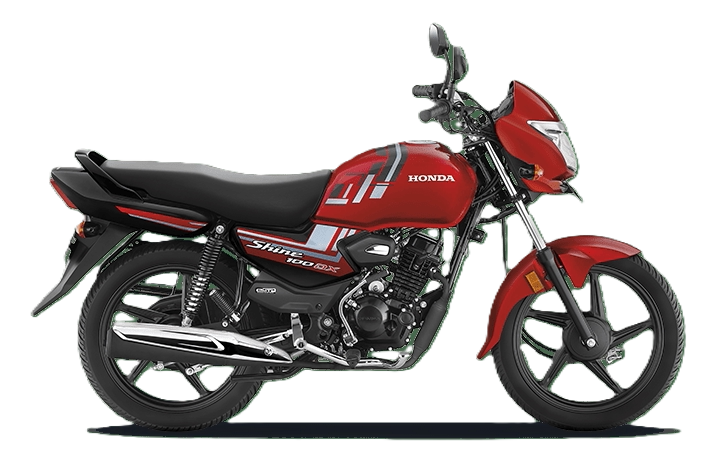
Honda Shine 100 DX
- 98.98 cc Air-Cooled, 2-valve
- 7.28 PS @ 7500 rpm
- 65 km/l (Owner Reported)
- 10-litre tank
- Digital LCD Console
- CBS (Combined Braking System)
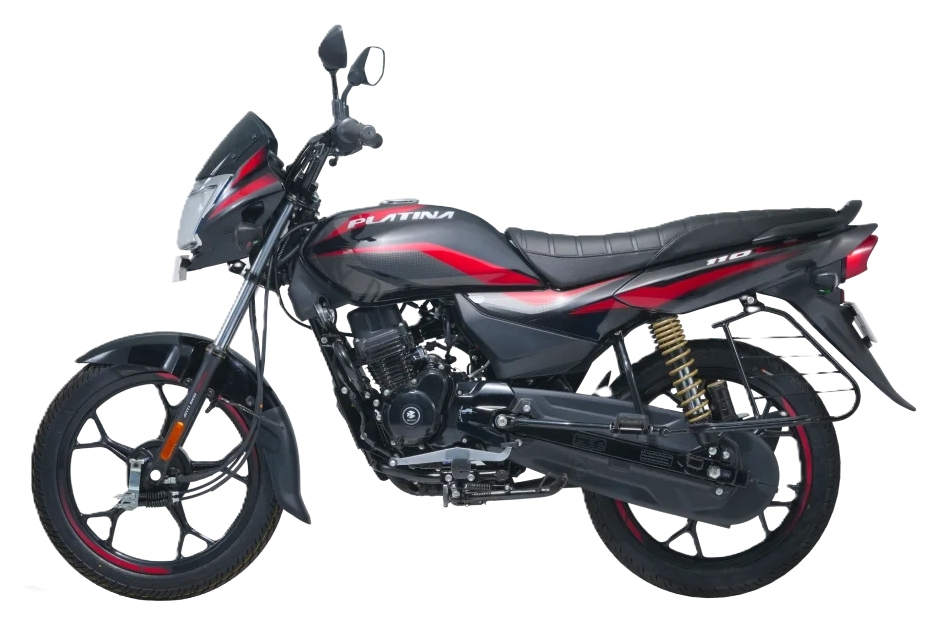
Bajaj Platina 110
- 115.06 cc Air-Cooled, 2-valve
- 9.5 PS @ 7500 rpm
- 70 km/l (ARAI)
- 11-litre tank
- 200 mm ground clearance
- CBS + Nitrox rear suspension
Full Specification Comparison
Every number that matters — side by side
| Specification | Honda Shine 100 DX | Bajaj Platina 110 |
|---|---|---|
| Engine & Performance | ||
| Displacement | 98.98 cc | 115.06 cc |
| Cooling System | Air-Cooled | Air-Cooled |
| Max Power | 7.28 PS @ 7500 rpm | 9.5 PS @ 7500 rpm |
| Max Torque | 8.04 Nm @ 5000 rpm | 9.9 Nm @ 5500 rpm |
| Valves per Cylinder | 2 | 2 |
| Compression Ratio | 9.7:1 | 9.5:1 |
| Bore × Stroke | 47.0 × 57.5 mm | 50 × 58.8 mm |
| Emission Standard | BS6 Phase 2 (OBD2) | BS6 Phase 2 (OBD2) |
| Transmission | 4-Speed Manual | 4-Speed Manual (All Down Shift) |
| Top Speed | 85 km/h | 90 km/h |
| Riding Modes | No | No |
| Traction Control | No | No |
| Fuel & Range | ||
| Mileage (Claimed) | 65 km/l (Owner Reported) | 70 km/l (ARAI) |
| Fuel Tank | 10 litres | 11 litres |
| Reserve Capacity | 1.4 litres | 2 litres |
| Riding Range | ~600–650 km (estimated) | ~630–700 km (estimated) |
| Brakes & Wheels | ||
| Braking System | CBS | CBS |
| Front Brake | Drum – 130 mm | Drum – 130 mm |
| Rear Brake | Drum – 130 mm | Drum – 110 mm |
| Tyre Type | Tubeless | Tubeless |
| Tyre Size (F / R) | 80/100-17 / 100/80-17 | 80/100-17 / 80/100-17 |
| Wheel Type | Alloy | Alloy |
| Suspension & Chassis | ||
| Front Suspension | Telescopic Fork | Telescopic Fork, 135 mm travel |
| Rear Suspension | Twin Hydraulic Shock Absorbers | SOS with Nitrox Canister |
| Chassis | Diamond Type Frame | Tubular Single Down Tube with Lower Cradle |
| Dimensions & Weight | ||
| Kerb Weight | 103 kg | 116 kg |
| Seat Height | 786 mm | 807 mm |
| Ground Clearance | 168 mm | 200 mm |
| Wheelbase | 1245 mm | 1255 mm |
| Overall L × W × H | 1955 × 754 × 1050 mm | 2006 × 729 × 1100 mm |
| Features & Electronics | ||
| Instrument Console | Digital LCD | Analogue |
| Headlight | Halogen | Halogen |
| DRLs | No | Yes (DRL System) |
| Turn Signals | Bulb | Bulb |
| Hazard Warning Lights | No | No |
| Speedometer | Digital | Analogue |
| Tripmeter | Digital | Analogue |
| Fuel Gauge | Digital | Analogue |
| Low Fuel Indicator | Yes | Yes |
| Bluetooth Connectivity | No | No |
| USB Charging Port | No | No |
| Start Type | Self & Kick Start | Electric Start |
| Side Stand Engine Cut-off | Yes | Yes |
| Price & Warranty | ||
| Starting Price (ex-showroom) | ₹71,511 | ₹69,941 |
| Number of Variants | 1 | 1 |
| Standard Warranty | 3 Years / 42,000 km | 5 Years / 75,000 km |
★ Green highlights indicate the stronger value in each row. Prices are ex-showroom India averages and may vary by city.
Variant-wise Price Comparison
Both bikes come in a single variant — a simple buying decision
Shine 100 DX Variants
Platina 110 Variants
Pros & Cons
Honest strengths and weaknesses of each bike
Pros
- Digital LCD instrument console — clearer information display
- Significantly lighter at 103 kg vs 116 kg
- Lower seat height (786 mm) — easier for shorter riders
- Both self start and kick start available
- Refined and smooth Honda engine character
- Trusted Honda reliability and service network
- Wider rear tyre (100/80-17) for better stability
Cons
- Lower power — 7.28 PS vs 9.5 PS
- No ARAI mileage certification (only owner-reported)
- Smaller 10-litre tank, shorter riding range
- Less ground clearance (168 mm vs 200 mm)
- Shorter warranty — 3 years / 42,000 km
- Higher starting price (₹71,511 vs ₹69,941)
- No DRL system
- Analogue-style rear suspension, no Nitrox
Pros
- Higher ARAI-certified mileage — 70 kmpl
- More power — 9.5 PS and 9.9 Nm torque
- Superior 200 mm ground clearance for rough roads
- Nitrox rear suspension for better ride comfort
- Larger 11-litre fuel tank and longer range
- Excellent 5-year / 75,000 km warranty
- DRL (Daytime Running Lights) system
- Lower starting price (₹69,941)
Cons
- Analogue instrument cluster — no digital console
- Heavier at 116 kg vs 103 kg
- Higher seat height (807 mm)
- No kick start — electric only
- Basic feature set with no connectivity
- Not suitable for sustained high-speed highway trips
Key Differences Explained
What really sets these two bikes apart
Engine & Performance
The Platina 110 carries a clear advantage here. Its 115.06 cc fuel-injected engine makes 9.5 PS and 9.9 Nm — roughly 30% more power and torque than the Shine 100 DX's 98.98 cc unit producing 7.28 PS and 8.04 Nm. The Platina's larger displacement also delivers a higher top speed of 90 km/h versus 85 km/h. For daily commuting, both are adequate, but the Platina is noticeably more responsive on inclines and two-up riding.
Fuel Efficiency & Range
The Platina 110 leads with an ARAI-certified 70 kmpl against the Shine 100 DX's 65 kmpl owner-reported figure. The Platina also holds a larger 11-litre tank (vs 10 litres), delivering an estimated range of 630–700 km versus 600–650 km for the Shine. Its 2-litre reserve is also larger than the Shine's 1.4 litres, adding extra buffer on long rides.
Ride Comfort & Ground Clearance
The Platina 110 was designed specifically around ride comfort. Its 200 mm ground clearance — 32 mm more than the Shine 100 DX's 168 mm — combined with the Nitrox rear suspension canister makes it significantly better on potholes, speed bumps, and uneven Indian roads. The Shine 100 DX's twin hydraulic rear absorbers are adequate for smooth city roads but less forgiving on rough terrain.
Instrumentation & Features
The Honda Shine 100 DX wins here — its digital LCD console provides cleaner readouts for speed, trip data, fuel level, and odometer. The Bajaj Platina 110 uses a traditional analogue cluster, which is functional but less informative at a glance. The Shine also gets kick start as a backup ignition option, while the Platina relies solely on electric start.
Warranty & Ownership
The Platina 110 has a decisive advantage: a 5-year / 75,000 km warranty versus the Shine 100 DX's 3 years / 42,000 km. That's 67% more years and 79% more kilometre coverage. For a daily commuter clocking 15,000–20,000 km per year, the Platina's warranty lasts nearly the full duration of typical ownership — an enormous financial safety net.
Weight & Ergonomics
The Shine 100 DX is notably lighter at 103 kg versus the Platina's 116 kg — a 13 kg difference that makes it easier to manoeuvre in traffic, park, and handle at low speeds. Its lower seat height of 786 mm (vs 807 mm) also makes it more accessible for shorter or newer riders. If ease of handling is a priority, the Shine has the edge.
Expert Verdict
Which one should you actually buy?
Buy the Shine 100 DX if…
- A digital console for cleaner data readouts matters to you
- You are a shorter or newer rider preferring lower seat height
- Light weight and easy city manoeuvrability is a priority
- Kick start as a backup is important for peace of mind
- You prefer Honda's reputation for smoothness and reliability
- Your roads are relatively smooth and well-maintained
Buy the Platina 110 if…
- You ride on rough, potholed, or rural roads regularly
- Maximum fuel efficiency and riding range matter most
- You want more power for two-up riding or inclines
- The outstanding 5-year / 75,000 km warranty appeals to you
- Ground clearance of 200 mm is important for your route
- Budget is a priority — starts ₹1,570 cheaper
Overall Winner for Most Riders: Bajaj Platina 110. Better ARAI-certified mileage, more power, superior 200 mm ground clearance for Indian roads, a larger fuel tank for longer range, and an exceptional 5-year / 75,000 km warranty — at a lower starting price — make the Platina 110 the stronger value proposition for the majority of commuter buyers. Choose the Honda Shine 100 DX if a digital console, lighter weight, lower seat height, or Honda's brand reliability are your non-negotiable priorities.
Frequently Asked Questions
Common questions answered by our experts
The Bajaj Platina 110 is better for most buyers thanks to superior ARAI-certified mileage (70 kmpl), more power (9.5 PS), higher ground clearance (200 mm) for rough roads, a larger fuel tank, and an outstanding 5-year / 75,000 km warranty at a lower price. The Honda Shine 100 DX is better if you want a digital console, lighter weight (103 kg), a lower seat height, or Honda's brand reputation.
The Bajaj Platina 110 starts at ₹69,941 while the Honda Shine 100 DX starts at ₹71,511 ex-showroom — a difference of ₹1,570 in favour of the Platina. Both are single-variant offerings, so there is no trade-off of features across variants.
The Bajaj Platina 110 has better mileage at 70 kmpl (ARAI certified), compared to the Honda Shine 100 DX's 65 kmpl owner-reported figure. The Platina's larger 11-litre tank also gives it a longer theoretical riding range of 630–700 km versus 600–650 km for the Shine 100 DX.
The Bajaj Platina 110 makes significantly more power at 9.5 PS @ 7500 rpm and 9.9 Nm torque, compared to the Honda Shine 100 DX's 7.28 PS and 8.04 Nm. The Platina's larger 115.06 cc engine is better suited for two-up riding, inclines, and situations requiring a bit more grunt.
Yes, the Honda Shine 100 DX comes with a digital LCD instrument console as its key differentiating feature over the standard Shine 100. It displays digital speedometer, tripmeter, fuel gauge and odometer. The Bajaj Platina 110 uses a traditional analogue instrument cluster.
The Bajaj Platina 110 has a considerably better warranty at 5 years or 75,000 km, compared to the Honda Shine 100 DX's 3 years or 42,000 km. For a daily commuter covering 40–50 km per day (roughly 14,000–18,000 km per year), the Platina's warranty covers nearly the entire practical ownership period — a major advantage in avoiding unexpected repair costs.