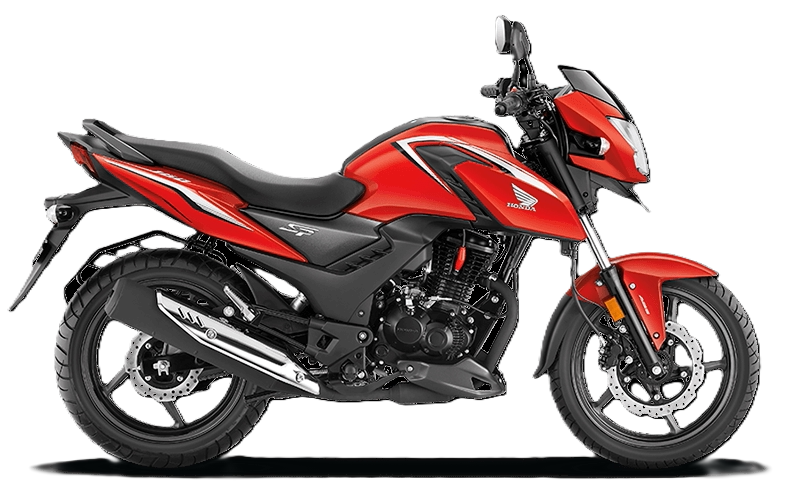
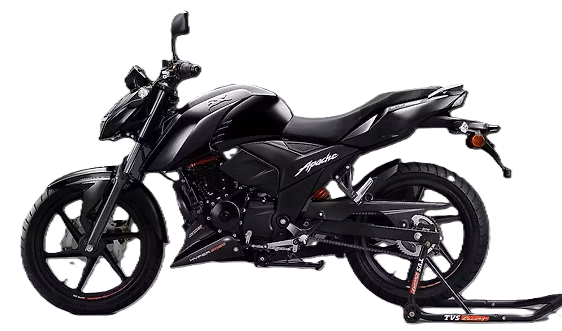
At a Glance
Key differences that define each motorcycle
Honda SP 160
- 162.71 cc Air-Cooled, 2-valve
- 13.18 PS @ 7500 rpm
- ~50 km/l (Owner Reported)
- 12-litre tank
- 2 variants available
- Lightest at 138 kg
TVS Apache RTR 160 4V
- 159.7 cc Oil-Cooled, 4-valve
- 17.55 PS @ 9250 rpm
- 47.61 km/l (Claimed)
- 12-litre tank
- 8 variants available
- Ride modes: Sport, Urban, Rain
Full Specification Comparison
Every number that matters — side by side
| Specification | Honda SP 160 | TVS Apache RTR 160 4V |
|---|---|---|
| Engine & Performance | ||
| Displacement | 162.71 cc | 159.7 cc |
| Cooling System | Air-Cooled | Oil-Cooled |
| Max Power | 13.18 PS @ 7500 rpm | 17.55 PS @ 9250 rpm |
| Max Torque | 14.58 Nm @ 5500 rpm | 14.73 Nm @ 7500 rpm |
| Valves per Cylinder | 2 | 4 |
| Compression Ratio | 10.01 : 1 | – |
| Bore × Stroke | 57.3 × 63.09 mm | – |
| Emission Standard | BS6 Phase 2 (OBD2) | BS6 Phase 2 |
| Transmission | 5-Speed Manual | 5-Speed Manual |
| Top Speed | ~110 km/h | 114 km/h |
| Riding Modes | No | Sport, Urban, Rain |
| Traction Control | No | Yes (top variant only) |
| Fuel & Range | ||
| Mileage (Claimed) | ~50 km/l (Owner Reported) | 47.61 km/l (Claimed) |
| Mileage (Real-world) | ~50 km/l | ~41.4 km/l |
| Fuel Tank | 12 litres | 12 litres |
| Reserve Capacity | 1.9 litres | 2.5 litres |
| Riding Range | ~600 km | ~570 km |
| Brakes & Wheels | ||
| Braking System | Single Channel ABS | Single / Dual Channel ABS |
| Front Brake | Disc – 276 mm | Disc – 270 mm |
| Rear Brake | Drum / Disc (variant dependent) | Drum / Disc (variant dependent) |
| Tyre Type | Tubeless | Tubeless |
| Tyre Size (F / R) | 80/100-17 / 130/70-17 | 90/90-17 / 110/80–130/70-17 |
| Wheel Type | Alloy | Alloy |
| Suspension & Chassis | ||
| Front Suspension | Telescopic Fork | Telescopic / USD Fork (top variants) |
| Rear Suspension | Mono Shock | Mono Shock |
| Chassis | Diamond Frame | Double Cradle Split Synchro Stiff Frame |
| Rear Preload Adjuster | Yes | Yes |
| Dimensions & Weight | ||
| Kerb Weight | 138 kg | 143–146 kg |
| Seat Height | 796 mm | 800 mm |
| Ground Clearance | 177 mm | 180 mm |
| Wheelbase | 1347 mm | 1357 mm |
| Overall L × W × H | 2061 × 786 × 1135 mm | – |
| Features & Electronics | ||
| Instrument Console | Fully Digital LCD | Digital / TFT (top variant) |
| Headlight | LED | LED Projector |
| DRLs | Yes | Yes |
| Turn Signals | Halogen | LED |
| Hazard Warning Lights | No | – |
| Riding Modes | No | Sport / Urban / Rain |
| Traction Control | No | Yes (top variant only) |
| Bluetooth Connectivity | Yes | Yes (select variants) |
| Call & SMS Alerts | Yes | Yes (select variants) |
| USB Charging Port | Yes | Yes (select variants) |
| Distance to Empty | Yes | – |
| Gear Indicator | Yes | Yes |
| Tachometer | Digital | Digital |
| Silent Start | Yes | – |
| Keyless Ignition | No | No |
| Price & Warranty | ||
| Starting Price (ex-showroom) | ₹1,15,556 | ₹1,16,491 |
| Top Variant Price | ₹1,21,066 | ₹1,37,521 |
| Number of Variants | 2 | 8 |
| Standard Warranty | 3 Years / 42,000 km | 5 Years / 60,000 km |
★ Green highlights indicate the stronger value in each row. Prices are ex-showroom India averages and may vary by city.
Variant-wise Price Comparison
All variants laid out — find the right one for your budget
Honda SP 160 Variants
Apache RTR 160 4V Variants
Pros & Cons
Honest strengths and weaknesses of each bike
Pros
- Significantly lighter at 138 kg — easiest to handle in traffic
- Honda's proven engine reliability and refinement
- Slightly larger front disc (276 mm vs 270 mm)
- Better fuel efficiency (~50 km/l vs ~41.4 km/l real-world)
- Longer riding range (~600 km vs ~570 km)
- Fully digital LCD console with distance-to-empty
- Silent start feature for quiet operation
- Lower starting price (₹1,15,556 vs ₹1,16,491)
- Much lower top-variant price (₹1,21,066 vs ₹1,37,521)
- Wide Honda service network across India
- Comfortable upright ergonomics for long commutes
Cons
- Significantly less power (13.18 PS vs 17.55 PS)
- No dual-channel ABS on any variant
- No ride modes whatsoever
- No traction control
- No official ARAI mileage certification
- Weaker warranty — only 3 years / 42,000 km
- Halogen turn signals (not LED)
- No hazard warning lights
- Only 2 variants — limited choice
- Regular telescopic fork only — no USD option
Pros
- Higher peak power – 17.55 PS @ 9250 rpm
- Oil-cooled 4-valve engine — sporty, energetic character
- Ride modes: Sport, Urban & Rain
- 8 variants — widest choice in segment
- Superior ground clearance (180 mm vs 177 mm)
- LED projector headlamp and LED turn signals
- USD forks and TFT cluster on top variants
- Traction control on top variant
- Dual-channel ABS available from ₹1,26,472
- Strong 5-year / 60,000 km warranty
Cons
- Lower real-world mileage (~41.4 km/l vs ~50 km/l)
- Heavier at 143–146 kg vs 138 kg
- Dual-channel ABS only from ₹1,26,472 (6th variant)
- Top TFT variant expensive at ₹1,37,521
- Ride quality can feel firm on rough roads
- Bluetooth and USB charging only on select variants
Key Differences Explained
What really sets these two bikes apart
Engine Character
This is the defining gap between these two bikes. The Honda SP 160's 162.71 cc air-cooled, 2-valve engine produces just 13.18 PS — tuned entirely for smoothness, refinement and minimal vibration at city speeds. The Apache RTR 160 4V's 159.7 cc oil-cooled, 4-valve unit produces 17.55 PS — over 33% more power — with a harder-revving, racing-inspired character. The Apache's oil cooling also manages engine temperatures better in stop-and-go city traffic, while the SP 160's air-cooled unit is simpler and lower-maintenance.
Fuel Efficiency & Range
The Honda SP 160 leads here with owner-reported real-world figures of around 50 km/l against the Apache's real-world ~41.4 km/l — a substantial gap of almost 9 km/l. Both bikes share a 12-litre tank, but the SP 160 converts this into ~600 km of range versus ~570 km for the Apache. For a daily commuter covering 50–70 km per day, the SP 160's efficiency translates to noticeably lower monthly fuel bills. Note that Honda does not provide an official ARAI certification; the Apache's 47.61 km/l figure is TVS's claimed number, not ARAI.
Braking & Safety
The SP 160 has a marginally larger front disc (276 mm vs 270 mm), but the Apache comprehensively wins the braking safety argument with dual-channel ABS available from ₹1,26,472 (sixth variant). The Honda SP 160 is locked to single-channel ABS across both its variants, with its base variant still using a rear drum brake. The Apache additionally offers traction control on its top TFT variant — a safety feature entirely absent from the SP 160.
Weight & Handling
The Honda SP 160 is noticeably lighter at 138 kg compared to the Apache's 143–146 kg — a difference of 5–8 kg. This makes the SP 160 more manageable in slow traffic and easier for shorter or newer riders to handle. The Apache compensates with a sportier double-cradle stiff frame and optional USD forks on higher variants for improved cornering stability and front-end feedback at speed. Ground clearance is nearly identical (177 mm vs 180 mm), with a negligible 3 mm advantage to the Apache.
Ride Modes & Technology
The Apache RTR 160 4V dominates in electronics. Ride modes — Sport, Urban and Rain — are offered across most variants, adjusting power delivery and ABS behaviour for different road conditions. The top TFT variant adds traction control and a full-colour TFT display with navigation. The Honda SP 160 offers no ride modes, no traction control and no TFT display on any variant. It does include distance-to-empty and silent start as standard across both variants.
Price & Value
The SP 160 starts ₹935 cheaper (₹1,15,556 vs ₹1,16,491) and tops out at just ₹1,21,066 — a massive ₹16,455 less than the Apache's ₹1,37,521 TFT top variant. For budget-conscious buyers, the SP 160 offers a lower total ownership cost. However, the Apache offers significantly more performance, ride modes and technology at its mid-range variants (around ₹1,19,695–₹1,22,738), which may justify the price premium for performance-seeking riders.
Expert Verdict
Which one should you actually buy?
Buy the Honda SP 160 if…
- Honda reliability and long-term refinement are your top priority
- You want the lightest, most manageable 160cc bike at 138 kg
- Fuel efficiency and lower running costs matter most
- You're upgrading from a 125cc and want an easy transition
- Your total budget is under ₹1,21,066
- Honda's extensive service network matters for peace of mind
- You prefer a quiet, smooth commuter over a sporty machine
Buy the Apache RTR 160 4V if…
- You want strong outright performance (17.55 PS)
- Ride modes for Sport, Urban and Rain riding appeal to you
- Oil-cooled engine character and high-rpm thrills excite you
- More variant choices help you find the right fit
- You can stretch budget to ₹1,26,472 for dual-channel ABS
- You enjoy spirited riding alongside daily commuting
- A better 5-year / 60,000 km warranty matters to you
Overall Winner for Performance Riders: TVS Apache RTR 160 4V. With 33% more power, ride modes across most variants, an oil-cooled 4-valve engine, traction control, dual-channel ABS, LED projector headlamp and a stronger 5-year / 60,000 km warranty, the Apache RTR 160 4V comprehensively outperforms the Honda SP 160 from a features and performance standpoint. However, the Honda SP 160 wins for budget-conscious daily commuters — it is lighter, more fuel-efficient, significantly cheaper at the top variant (₹1,21,066 vs ₹1,37,521) and backed by Honda's legendary reliability. Choose the SP 160 if smoothness, simplicity and economy matter most; choose the Apache if performance and technology are your priorities.
Frequently Asked Questions
Common questions answered by our experts
It depends on your priorities. The TVS Apache RTR 160 4V is better for riders who want stronger performance (17.55 PS vs 13.18 PS), ride modes (Sport, Urban, Rain), oil-cooled engine character, dual-channel ABS and a superior 5-year / 60,000 km warranty. The Honda SP 160 is better if you prioritise engine smoothness and refinement, a lighter 138 kg kerb weight, significantly better fuel efficiency (~50 km/l vs ~41.4 km/l real-world), Honda's long-term reliability and a much lower top-variant price (₹1,21,066 vs ₹1,37,521).
The Honda SP 160 starts at ₹1,15,556 while the TVS Apache RTR 160 4V starts at ₹1,16,491 ex-showroom — the SP 160 is ₹935 cheaper at the entry level. The difference grows significantly at higher trims: the SP 160 tops out at ₹1,21,066 (Double Disc), while the Apache's TFT top variant reaches ₹1,37,521 — a difference of ₹16,455. Both prices are approximate India averages and may vary by city.
The Honda SP 160 has better real-world mileage at approximately 50 km/l (owner-reported) compared to the TVS Apache RTR 160 4V's real-world figure of approximately 41.4 km/l. TVS claims 47.61 km/l under standard test conditions, while Honda does not provide an official ARAI figure. Both bikes share a 12-litre tank, giving the SP 160 a longer estimated range of ~600 km versus ~570 km for the Apache.
The TVS Apache RTR 160 4V makes significantly more power at 17.55 PS @ 9250 rpm compared to the Honda SP 160's 13.18 PS @ 7500 rpm — a difference of over 4 PS or approximately 33%. The Apache's oil-cooled, 4-valve engine revs more freely, has a more performance-oriented character, and also delivers marginally higher torque (14.73 Nm vs 14.58 Nm). The SP 160 makes its torque much lower in the rev range (5500 rpm vs 7500 rpm) for a smoother, easier city riding experience.
No. The Honda SP 160 does not offer any ride modes on either of its variants. The TVS Apache RTR 160 4V offers three rider-selectable modes — Sport, Urban and Rain — across most of its variants. Sport mode unleashes full power, Urban tunes for smoother city performance, and Rain softens power and adjusts ABS sensitivity for wet roads. This is one of the Apache's most significant advantages over the SP 160.
The TVS Apache RTR 160 4V offers a better warranty at 5 years / 60,000 km compared to the Honda SP 160's 3 years / 42,000 km. The Apache provides 2 additional years and 18,000 km more kilometre coverage. For a daily commuter averaging 15,000–20,000 km per year, Honda's 3-year warranty may expire while the bike still has many years of use remaining. Honda does compensate with a renowned reliability record that reduces the likelihood of warranty claims in the first place.