At a Glance
Key differences that define each motorcycle
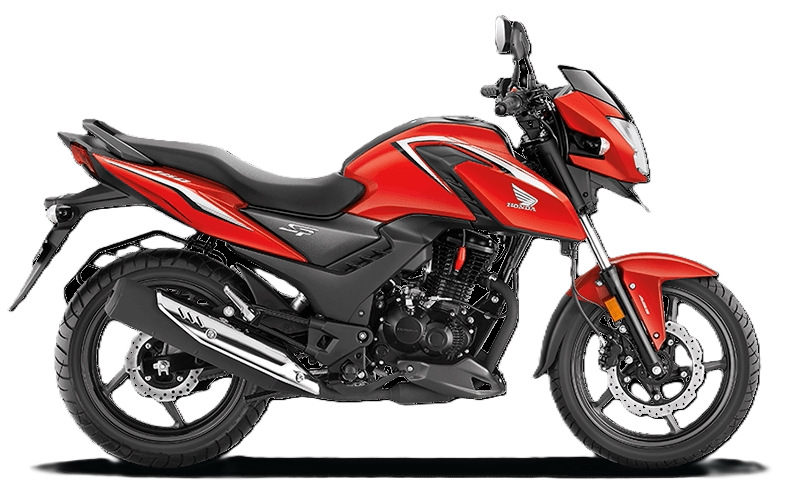
Honda SP 160
- 162.71 cc Air-Cooled, 2-valve
- 13.18 PS @ 7500 rpm
- ~50 km/l (Owner Reported)
- 12-litre tank
- 2 variants available
- USB charging port standard
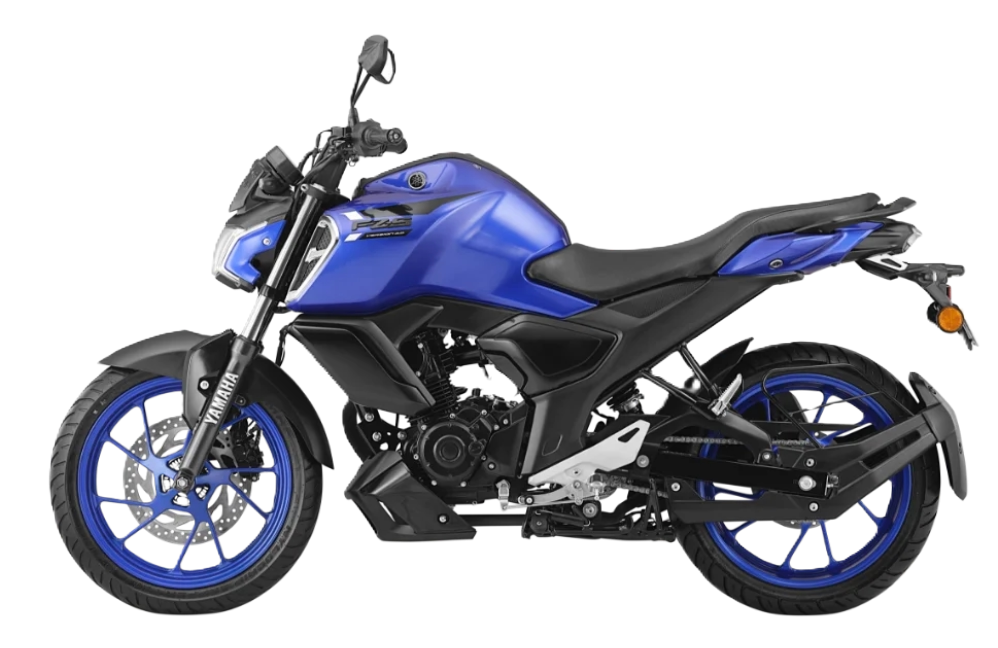
Yamaha FZ-S Fi V4
- 149 cc Air-Cooled, 2-valve
- 12.4 PS @ 7250 rpm
- 60 km/l (ARAI)
- 13-litre tank
- 2 variants available
- Traction Control standard
Full Specification Comparison
Every number that matters — side by side
| Specification | Honda SP 160 | Yamaha FZ-S Fi V4 |
|---|---|---|
| Engine & Performance | ||
| Displacement | 162.71 cc | 149 cc |
| Cooling System | Air-Cooled | Air-Cooled |
| Max Power | 13.18 PS @ 7500 rpm | 12.4 PS @ 7250 rpm |
| Max Torque | 14.58 Nm @ 5500 rpm | 13.3 Nm @ 5500 rpm |
| Valves per Cylinder | 2 | 2 |
| Compression Ratio | 10.01 : 1 | 9.6 : 1 |
| Bore × Stroke | 57.3 × 63.09 mm | 57.3 × 57.9 mm |
| Emission Standard | BS6 Phase 2 (OBD2) | BS6 Phase 2 (OBD2B) |
| Transmission | 5-Speed Manual | 5-Speed Manual |
| Top Speed | ~110 km/h | ~115 km/h |
| Riding Modes | No | No |
| Traction Control | No | Yes (standard) |
| Fuel & Range | ||
| Mileage (Claimed) | ~50 km/l (Owner Reported) | 60 km/l (ARAI) |
| Mileage (Real-world) | ~50 km/l | 45–50 km/l |
| Fuel Tank | 12 litres | 13 litres |
| Reserve Capacity | 1.9 litres | 2 litres |
| Riding Range | ~600 km | ~780 km |
| Brakes & Wheels | ||
| Braking System | Single Channel ABS | Single Channel ABS |
| Front Brake | Disc – 276 mm | Disc – 282 mm |
| Rear Brake | Drum / Disc (variant dependent) | Disc – 220 mm (standard) |
| Tyre Type | Tubeless | Tubeless |
| Tyre Size (F / R) | 80/100-17 / 130/70-17 | 100/80-17 / 140/60-17 |
| Wheel Type | Alloy | Alloy |
| Suspension & Chassis | ||
| Front Suspension | Telescopic Fork | Telescopic Fork |
| Rear Suspension | Mono Shock | 7-Step Adjustable Monoshock |
| Chassis | Diamond Frame | Diamond Frame |
| Rear Preload Adjuster | Yes | Yes (7-step) |
| Dimensions & Weight | ||
| Kerb Weight | 138 kg | 136 kg |
| Seat Height | 796 mm | 790 mm |
| Ground Clearance | 177 mm | 165 mm |
| Wheelbase | 1347 mm | 1330 mm |
| Overall L × W × H | 2061 × 786 × 1135 mm | 2000 × 780 × 1080 mm |
| Features & Electronics | ||
| Instrument Console | Fully Digital LCD | Fully Digital LCD |
| Headlight | LED | LED |
| DRLs | Yes | Yes |
| Turn Signals | Halogen | LED |
| Hazard Warning Lights | No | Yes |
| Riding Modes | No | No |
| Traction Control | No | Yes |
| Bluetooth Connectivity | Yes (both variants) | Yes (Deluxe variant) |
| Call & SMS Alerts | Yes | Yes (Deluxe variant) |
| USB Charging Port | Yes | No |
| Distance to Empty | Yes | Yes |
| Gear Indicator | Yes | Yes |
| Tachometer | Digital | Digital |
| Silent Start | Yes | No |
| Keyless Ignition | No | No |
| Price & Warranty | ||
| Starting Price (ex-showroom) | ₹1,15,556 | ₹1,20,409 |
| Top Variant Price | ₹1,21,066 | ₹1,20,866 |
| Number of Variants | 2 | 2 |
| Standard Warranty | 3 Years / 42,000 km | 2 Years / 30,000 km |
★ Green highlights indicate the stronger value in each row. Prices are ex-showroom India averages and may vary by city.
Variant-wise Price Comparison
All variants laid out — find the right one for your budget
Honda SP 160 Variants
Yamaha FZ-S Fi V4 Variants
Pros & Cons
Honest strengths and weaknesses of each bike
Pros
- More powerful engine — 13.18 PS vs 12.4 PS
- Higher torque — 14.58 Nm vs 13.3 Nm
- Larger 162.71cc displacement
- Greater ground clearance (177 mm vs 165 mm)
- USB charging port standard on both variants
- Bluetooth on both variants (not just Deluxe)
- Silent start feature for quiet operation
- Lower starting price (₹1,15,556 vs ₹1,20,409)
- Better warranty — 3 years / 42,000 km
- Honda's proven long-term reliability and service network
Cons
- No official ARAI mileage certification
- No traction control on any variant
- Smaller 12-litre tank, shorter range (~600 km)
- Rear drum brake on base variant
- Halogen turn signals (not LED)
- No hazard warning lights
- Smaller front disc (276 mm vs 282 mm)
- Less adjustable rear suspension
Pros
- Best-in-class ARAI mileage of 60 km/l
- Traction control standard on both variants
- Larger 13-litre tank — longer range (~780 km)
- Disc brake standard on rear across both variants
- Larger 282 mm front disc
- 7-step adjustable rear monoshock
- LED turn signals and hazard warning lights
- Lighter at 136 kg
- Wider rear tyre (140/60-17) for better grip
- Yamaha Y-Connect with rich ride data (Deluxe variant)
Cons
- Less powerful — 12.4 PS vs 13.18 PS
- Lower torque — 13.3 Nm vs 14.58 Nm
- Smaller 149cc displacement
- No USB charging port on any variant
- Bluetooth only on Deluxe variant (not Standard)
- Weaker warranty — only 2 years / 30,000 km
- Less ground clearance (165 mm vs 177 mm)
- Higher starting price (₹1,20,409 vs ₹1,15,556)
Key Differences Explained
What really sets these two bikes apart
Engine Character
Both are air-cooled, 2-valve, single-cylinder commuters but differ in displacement and tuning. The Honda SP 160's 162.71cc engine produces 13.18 PS and 14.58 Nm — more power and torque than the Yamaha FZ-S V4's 149cc unit at 12.4 PS and 13.3 Nm. Honda's longer stroke (63.09 mm vs 57.9 mm) gives it punchier low-end torque, making overtakes feel more effortless. The Yamaha's shorter stroke and Yamaha Blue Core engineering prioritise fuel combustion efficiency and smoothness over outright power.
Fuel Efficiency & Range
The Yamaha FZ-S V4 wins convincingly here with an ARAI-certified 60 km/l against the Honda SP 160's owner-reported ~50 km/l (Honda does not provide an official ARAI figure). The FZ-S V4 also carries a larger 13-litre tank, translating to a theoretical riding range of ~780 km versus ~600 km for the SP 160's 12-litre unit — a difference of ~180 km per fill. For a daily commuter covering 50–70 km per day, the Yamaha's efficiency advantage adds up to significant fuel savings over the long term.
Braking & Safety
Both bikes use single-channel ABS, but the Yamaha edges ahead in hardware. The FZ-S V4 has a slightly larger 282 mm front disc (vs 276 mm) and — crucially — a rear disc brake standard on both variants, while the SP 160's base variant uses a rear drum. Beyond braking, the Yamaha adds traction control as standard equipment, a safety feature entirely absent from the SP 160. For riding on wet or unpredictable surfaces, the FZ-S V4's combined braking and traction control setup offers a clear safety advantage.
Suspension & Ground Clearance
The Honda SP 160 has a meaningful 12 mm ground clearance advantage (177 mm vs 165 mm), which helps clear speed breakers and rough patches with less risk of scraping. The Yamaha compensates with a superior rear suspension — a 7-step adjustable monoshock versus the SP 160's non-adjustable unit. Riders who frequently carry a pillion or ride with luggage will appreciate the Yamaha's adjustability. The SP 160 also has a longer wheelbase (1347 mm vs 1330 mm) for marginally better straight-line stability.
Features & Connectivity
Both bikes offer a fully digital LCD console with Bluetooth and call/SMS alerts, but the details differ. Honda provides Bluetooth and a USB charging port on both variants — useful for phone charging during long commutes. Yamaha offers Bluetooth only on the Deluxe variant but includes traction control, LED turn signals, hazard warning lights and a 7-step adjustable monoshock across both variants. The Yamaha FZ-S V4 Deluxe also integrates with Yamaha's Y-Connect app for richer ride analytics.
Price & Value
The SP 160 starts ₹4,853 cheaper (₹1,15,556 vs ₹1,20,409) — a meaningful gap at the base level. However, the top variants are nearly identical in price: SP 160 Double Disc at ₹1,21,066 vs FZ-S V4 Deluxe at ₹1,20,866 — a mere ₹200 difference. At the top trim, the Yamaha delivers more: traction control, Bluetooth, rear disc, LED signals and hazard lights for virtually the same money. The Honda's better starting price and stronger warranty make it the better budget entry; the Yamaha's Deluxe variant offers better feature-for-money at the top.
Expert Verdict
Which one should you actually buy?
Buy the Honda SP 160 if…
- You want more power and torque for easier overtaking
- USB charging on the go is a daily priority
- Ground clearance (177 mm) matters on your roads
- Budget is tight — starts ₹4,853 cheaper
- A stronger 3-year / 42,000 km warranty is important
- Honda's vast service network is crucial for you
- You want Bluetooth on the base variant, not just top trim
Buy the Yamaha FZ-S Fi V4 if…
- Maximum fuel efficiency (60 km/l ARAI) is your top priority
- Traction control for wet road safety matters to you
- You want a longer riding range (~780 km per tank)
- Rear disc brakes on both variants appeal to you
- A 7-step adjustable monoshock is a plus for your use
- LED turn signals and hazard lights are important
- You're buying the Deluxe variant and want max features per rupee
Overall Winner for Most Riders: Yamaha FZ-S Fi V4. Despite costing ₹4,853 more at the base level, the Yamaha FZ-S Fi V4 Deluxe (at virtually the same price as the Honda SP 160 Double Disc) delivers traction control, a rear disc brake, the best-in-class ARAI mileage of 60 km/l, a larger 13-litre tank with ~780 km range, a 7-step adjustable monoshock, LED turn signals and hazard lights — a significantly richer feature set at comparable cost. The Honda SP 160 is the better pick if budget is the primary concern (its Single Disc variant at ₹1,15,556 is ₹4,853 cheaper), you need USB charging on the go, or Honda's reliability record and stronger 3-year warranty are non-negotiable priorities.
Frequently Asked Questions
Common questions answered by our experts
At comparable top-variant prices, the Yamaha FZ-S Fi V4 Deluxe (₹1,20,866) delivers better overall value with traction control, rear disc brakes on both variants, the segment's best ARAI mileage of 60 km/l, a longer ~780 km range, 7-step adjustable suspension and LED turn signals. The Honda SP 160 (₹1,15,556 base) is better if you want more power (13.18 PS vs 12.4 PS), USB charging, a stronger 3-year warranty, Bluetooth on the base variant, or Honda's long-term reliability at a lower entry price.
The Honda SP 160 starts at ₹1,15,556 while the Yamaha FZ-S Fi V4 starts at ₹1,20,409 ex-showroom — the SP 160 is ₹4,853 cheaper at entry level. However, at the top variant, prices converge: the SP 160 Double Disc (₹1,21,066) and FZ-S V4 Deluxe (₹1,20,866) are separated by just ₹200, making the Yamaha's Deluxe variant an exceptional value proposition at near-identical pricing. Both prices are approximate India averages and may vary by city.
The Yamaha FZ-S Fi V4 has significantly better official mileage at 60 km/l (ARAI certified) compared to the Honda SP 160's owner-reported ~50 km/l (Honda does not provide an ARAI figure). The Yamaha's larger 13-litre tank also gives it a longer riding range of ~780 km versus ~600 km for the SP 160's 12-litre unit — a difference of approximately 180 km per full tank. For fuel-conscious daily commuters, the Yamaha's efficiency advantage is substantial.
The Honda SP 160 makes more power at 13.18 PS @ 7500 rpm compared to the Yamaha FZ-S Fi V4's 12.4 PS @ 7250 rpm — a difference of 0.78 PS. The SP 160 also has more torque at 14.58 Nm versus 13.3 Nm for the Yamaha. This power advantage, combined with the SP 160's larger 162.71cc displacement, makes it feel noticeably more effortless during city overtaking and highway riding compared to the Yamaha's 149cc motor.
Yes. The Yamaha FZ-S Fi V4 comes equipped with traction control as a standard feature on both its Standard and Deluxe variants. Traction control helps prevent rear wheel spin during sudden acceleration, particularly useful on wet or uneven surfaces. The Honda SP 160 does not offer traction control on any of its variants, making this one of the Yamaha's key safety advantages in this head-to-head comparison.
The Honda SP 160 offers a significantly better warranty at 3 years / 42,000 km compared to the Yamaha FZ-S Fi V4's 2 years / 30,000 km. The Honda provides an additional year and 12,000 km more coverage. For a daily commuter averaging 15,000–20,000 km per year, Yamaha's 2-year warranty may expire while the bike still has many productive years of service ahead. Honda's warranty advantage is one of the strongest arguments in its favour in this comparison.