At a Glance
Key differences that define each motorcycle
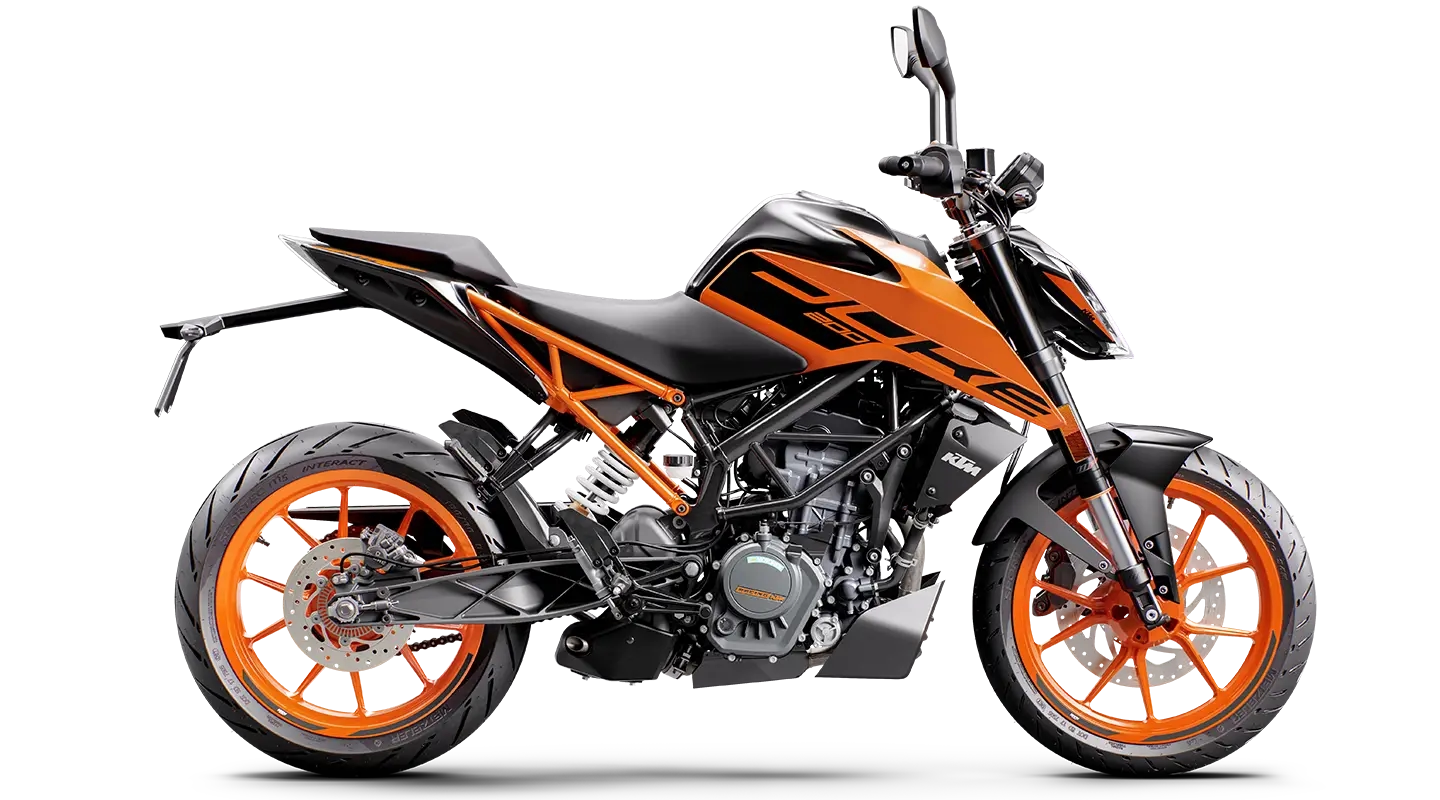
KTM 200 Duke
- 199.5 cc Liquid-Cooled
- 25 PS @ 10,000 rpm
- ~35 km/l (Claimed)
- 13.5-litre tank
- 1 variant available
- Supermoto Dual-Channel ABS
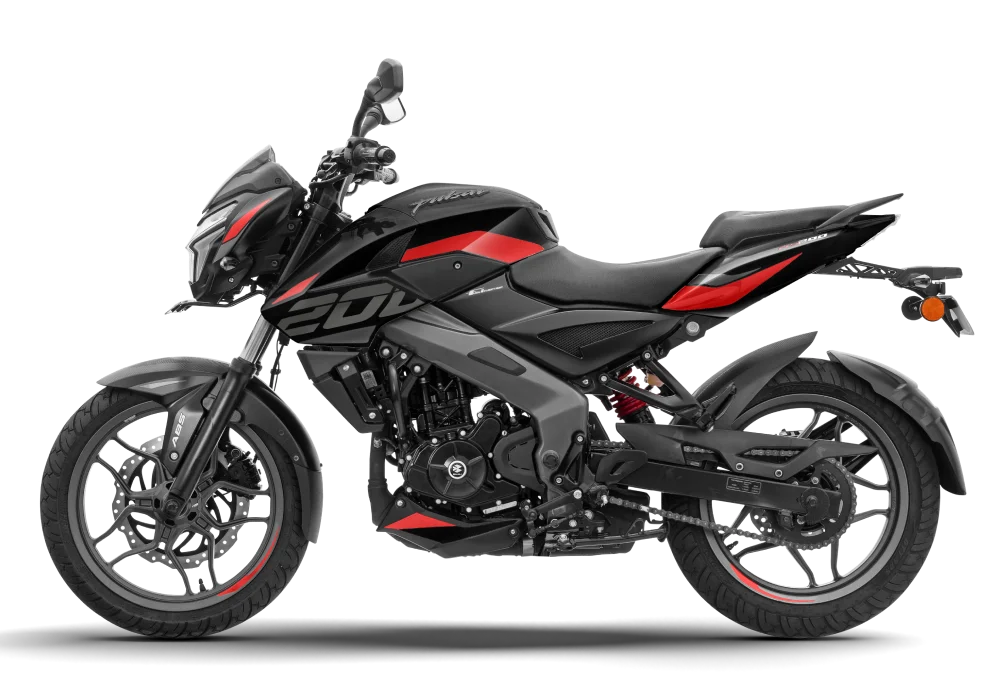
Bajaj Pulsar NS200
- 199.5 cc Liquid-Cooled
- 24.5 PS @ 9,750 rpm
- 40.36 km/l (Claimed)
- 12-litre tank
- 2 variants available
- Single / Dual-Channel ABS (variant dependent)
Full Specification Comparison
Every number that matters — side by side
| Specification | KTM 200 Duke | Bajaj Pulsar NS200 |
|---|---|---|
| Engine & Performance | ||
| Displacement | 199.5 cc | 199.5 cc |
| Cooling System | Liquid Cooled | Liquid Cooled |
| Max Power | 25 PS @ 10,000 rpm | 24.5 PS @ 9,750 rpm |
| Max Torque | 19.3 Nm @ 8,000 rpm | 18.74 Nm @ 8,000 rpm |
| Valves per Cylinder | 4 | 4 |
| Compression Ratio | 11.3 : 1 | 11 : 1 |
| Bore × Stroke | 72 × 49 mm | 72 × 49 mm |
| Spark Plugs | 1 Per Cylinder | Triple Spark |
| Emission Standard | BS6 Phase 2B | BS6 |
| Transmission | 6-Speed Manual | 6-Speed Manual |
| Clutch | Assist & Slipper Clutch | Wet Multi Plate |
| Riding Modes | No | Road, Rain, Offroad |
| Top Speed | ~140 km/h | ~130 km/h |
| Fuel & Range | ||
| Mileage (Claimed) | ~35 km/l | 40.36 km/l |
| Mileage (Real-world) | ~30–33 km/l | 34–38 km/l |
| Fuel Tank | 13.5 litres | 12 litres |
| Reserve Capacity | 2.7 litres | 2 litres |
| Riding Range | ~469 km | ~484 km |
| Brakes & Wheels | ||
| Braking System | Supermoto Dual-Channel ABS | Single / Dual-Channel ABS (Variant Dependent) |
| Front Brake | Disc – 300 mm (Radial Caliper) | Disc – 300 mm |
| Rear Brake | Disc – 230 mm | Disc – 230 mm |
| Tyre Type | Tubeless | Tubeless |
| Tyre Size (F / R) | 110/70-17 / 150/60-17 | 100/80-17 / 130/70-17 |
| Wheel Type | Alloy | Alloy |
| Suspension & Chassis | ||
| Front Suspension | WP APEX USD Forks – 43 mm | Telescopic / USD Fork (Top Variant) |
| Rear Suspension | WP APEX Monoshock (10-step adjustable) | Nitrox Monoshock |
| Chassis | Split-Trellis Frame (Tubular) | Perimeter Frame |
| Rear Preload Adjuster | Yes | Yes |
| Dimensions & Weight | ||
| Kerb Weight | 159 kg | 158 kg |
| Seat Height | 822 mm | 805 mm |
| Ground Clearance | 155 mm | 167 mm |
| Wheelbase | 1357 mm | 1363 mm |
| Overall L × W × H | 2072 × 831 × 1109 mm | 2017 × 804 × 1075 mm |
| Features & Electronics | ||
| Instrument Console | 5-inch TFT Display | Fully Digital LCD |
| Headlight | Dual LED | LED |
| DRLs | Yes | Yes |
| Turn Signals | LED | LED |
| Hazard Warning Lights | No | Yes |
| Bluetooth Connectivity | Yes | Yes |
| USB Charging Port | Yes | Yes |
| Call & SMS Alerts | Yes | Yes |
| Gear Indicator | Yes | Yes |
| Assist & Slipper Clutch | Yes | No |
| Traction Control | No | No |
| Keyless Ignition | No | No |
| Price & Warranty | ||
| Starting Price (ex-showroom) | ₹1,97,980 | ₹1,32,962 |
| Top Variant Price | ₹1,97,980 | ₹1,43,146 |
| Number of Variants | 1 | 2 |
| Standard Warranty | 2 Years / 30,000 km | 5 Years / 75,000 km |
★ Green highlights indicate the stronger value in each row. Prices are ex-showroom India averages and may vary by city.
Variant-wise Price Comparison
All variants laid out — find the right one for your budget
KTM 200 Duke Variants
Bajaj Pulsar NS200 Variants
Pros & Cons
Honest strengths and weaknesses of each bike
Pros
- Higher peak power – 25 PS @ 10,000 rpm
- Higher torque – 19.3 Nm @ 8,000 rpm
- Premium WP APEX USD suspension as standard
- Supermoto Dual-Channel ABS on standard variant
- 5-inch TFT display with Bluetooth connectivity
- Assist & slipper clutch for smoother downshifts
- Wider rear tyre (150/60-17) for better grip
- Higher top speed (~140 km/h vs ~130 km/h)
- Higher compression ratio (11.3:1)
Cons
- Significantly higher price (₹1,97,980 vs ₹1,32,962)
- Lower claimed mileage (~35 km/l vs 40.36 km/l)
- Only 1 variant — no budget entry point
- Shorter warranty (2 years vs 5 years)
- No riding modes
- No hazard warning lights
- Firm suspension on rough roads
- Higher maintenance costs
Pros
- Much lower starting price (₹1,32,962)
- Better claimed mileage (40.36 km/l)
- Exceptional 5-year / 75,000 km warranty
- 3 riding modes – Road, Rain, Offroad
- 2 variants for budget flexibility
- Triple spark DTS-i engine technology
- Higher ground clearance (167 mm vs 155 mm)
- Hazard warning lights included
- Longer wheelbase (1363 mm vs 1357 mm)
Cons
- Lower peak power (24.5 PS vs 25 PS)
- Lower torque (18.74 Nm vs 19.3 Nm)
- No assist & slipper clutch
- Basic LCD console vs TFT display
- Dual-channel ABS only on top variant
- No premium WP suspension
- Narrower rear tyre (130/70-17)
- Lower top speed (~130 km/h)
Key Differences Explained
What really sets these two bikes apart
Engine Character
Both bikes share the same 199.5 cc displacement and bore/stroke dimensions (72 × 49 mm), yet they deliver notably different characters. The KTM 200 Duke produces 25 PS and 19.3 Nm with a high-revving single-spark DOHC setup. The NS200 makes 24.5 PS and 18.74 Nm using Bajaj's triple-spark DTS-i technology with riding modes — giving it a more versatile, adaptable power delivery.
Fuel Efficiency & Range
The NS200 claims a significantly better 40.36 km/l versus the Duke's ~35 km/l. Despite having a larger 13.5-litre tank, the Duke's range (~469 km) is slightly below the NS200's ~484 km from its 12-litre tank — purely because the NS200 engine is more frugal.
Braking & Safety
The KTM 200 Duke offers Supermoto Dual-Channel ABS on its only variant as standard. This allows riders to disable rear ABS for more aggressive riding. The NS200 offers dual-channel ABS only on the top variant (₹1,43,146), with the base variant getting single-channel ABS. The Duke also uses a radial caliper for sharper front brake bite.
Warranty & Ownership
The NS200 offers a class-leading 5-year / 75,000 km warranty — among the best in the 200cc segment. The KTM 200 Duke provides only a 2-year / 30,000 km warranty. Combined with higher spare parts costs for KTM, the NS200 offers considerably lower long-term ownership risk and expense.
Price & Value
At ₹1,97,980, the KTM 200 Duke costs approximately ₹65,018 more than the base NS200 (₹1,32,962) and ₹54,834 more than the top NS200 variant (₹1,43,146). The Duke's premium is backed by WP suspension, a TFT display and slipper clutch — but the NS200 undercuts it dramatically on pure value per rupee.
Ride & Handling
The KTM 200 Duke's WP APEX USD forks and trellis frame deliver exceptional precision and feedback, backed by a wider rear tyre (150/60 vs 130/70). The NS200's perimeter frame and longer wheelbase (1363 mm) offer excellent high-speed stability, while its higher ground clearance (167 mm vs 155 mm) handles rough roads better.
Expert Verdict
Which one should you actually buy?
Buy the KTM 200 Duke if…
- You want the most powerful and exciting 200cc streetfighter
- Premium WP suspension and handling precision matter to you
- You want Supermoto ABS and a slipper clutch as standard
- A large 5-inch TFT display with Bluetooth appeals to you
- Budget is not the primary constraint
- You enjoy hard, aggressive riding on good roads
Buy the Pulsar NS200 if…
- Value for money is a top priority
- You want better real-world mileage from a 200cc bike
- A 5-year / 75,000 km warranty matters for long-term ownership
- Riding modes (Road, Rain, Offroad) appeal to your use case
- You want a capable 200cc bike without the premium price tag
- Higher ground clearance for mixed road conditions is needed
Overall Winner for Most Riders: Bajaj Pulsar NS200. At roughly ₹65,000 less than the KTM, the NS200 offers comparable performance, better mileage, riding modes, a much longer warranty, and lower ownership costs — making it the smarter buy for the majority of Indian riders. Choose the KTM 200 Duke only if you specifically want KTM's premium build quality, the WP suspension experience, the TFT display and the raw edge of Supermoto ABS — and are fully prepared to pay the substantial price premium.
Frequently Asked Questions
Common questions answered by our experts
The KTM 200 Duke is better for performance-focused riders who want the highest power output (25 PS vs 24.5 PS), premium WP suspension, Supermoto ABS, an assist & slipper clutch and a TFT display — and are willing to pay a significant premium. The Bajaj Pulsar NS200 is better for most buyers due to its dramatically lower price (₹1,32,962 vs ₹1,97,980), better mileage (40.36 km/l vs ~35 km/l), riding modes, and an outstanding 5-year warranty.
The Bajaj Pulsar NS200 starts at ₹1,32,962 while the KTM 200 Duke is priced at ₹1,97,980 ex-showroom. The KTM 200 Duke is approximately ₹65,018 more expensive than the base NS200 and ₹54,834 more than the NS200's top Dual Channel USD variant (₹1,43,146). Both prices are for India and may vary by city.
The Bajaj Pulsar NS200 has better mileage at a claimed 40.36 km/l compared to the KTM 200 Duke's claimed ~35 km/l. In real-world riding conditions, the NS200 typically returns 34–38 km/l while the Duke 200 returns around 30–33 km/l. Despite the NS200's smaller 12-litre tank, it actually offers a slightly better riding range (~484 km vs ~469 km).
The KTM 200 Duke makes marginally more power at 25 PS @ 10,000 rpm and 19.3 Nm @ 8,000 rpm compared to the Bajaj Pulsar NS200's 24.5 PS @ 9,750 rpm and 18.74 Nm @ 8,000 rpm. Both bikes share the same 199.5 cc displacement and 72 × 49 mm bore/stroke dimensions. The Duke's advantage is small but noticeable at the top end.
The Bajaj Pulsar NS200 offers a significantly better warranty of 5 years or 75,000 km compared to the KTM 200 Duke's 2 years or 30,000 km. This is a major ownership advantage for the NS200, particularly given that KTM spare parts and servicing can be more expensive than Bajaj.
The KTM 200 Duke comes with Supermoto Dual-Channel ABS as standard on its only variant. The Bajaj Pulsar NS200 offers dual-channel ABS only on the top Dual Channel USD variant (₹1,43,146), with the base single-channel ABS variant at ₹1,32,962. The Duke also features a radial caliper for the front brake, giving it sharper bite compared to the NS200.
No. The KTM 200 Duke does not offer riding modes. The Bajaj Pulsar NS200 has a clear advantage here, featuring Road, Rain and Offroad ride modes that adjust engine power delivery to suit different road conditions — a feature rarely seen at this price point.