At a Glance
Key differences that define each motorcycle
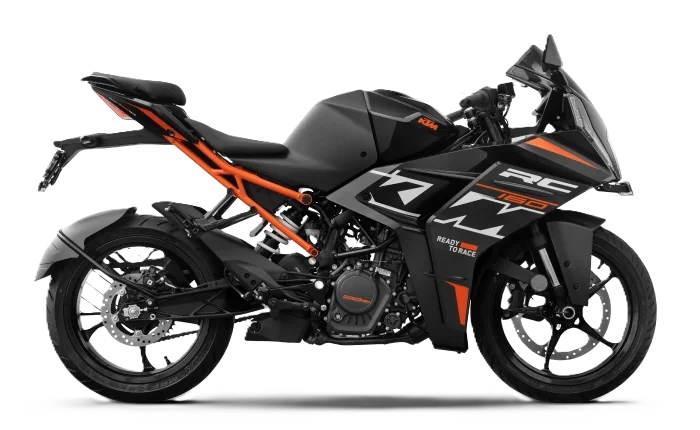
KTM RC 160
- 164.2 cc Liquid-Cooled, 4-valve
- 19 PS @ 9500 rpm
- 36 km/l (ARAI)
- 13.7-litre tank
- 1 variant available
- WP APEX USD Forks + Slipper Clutch
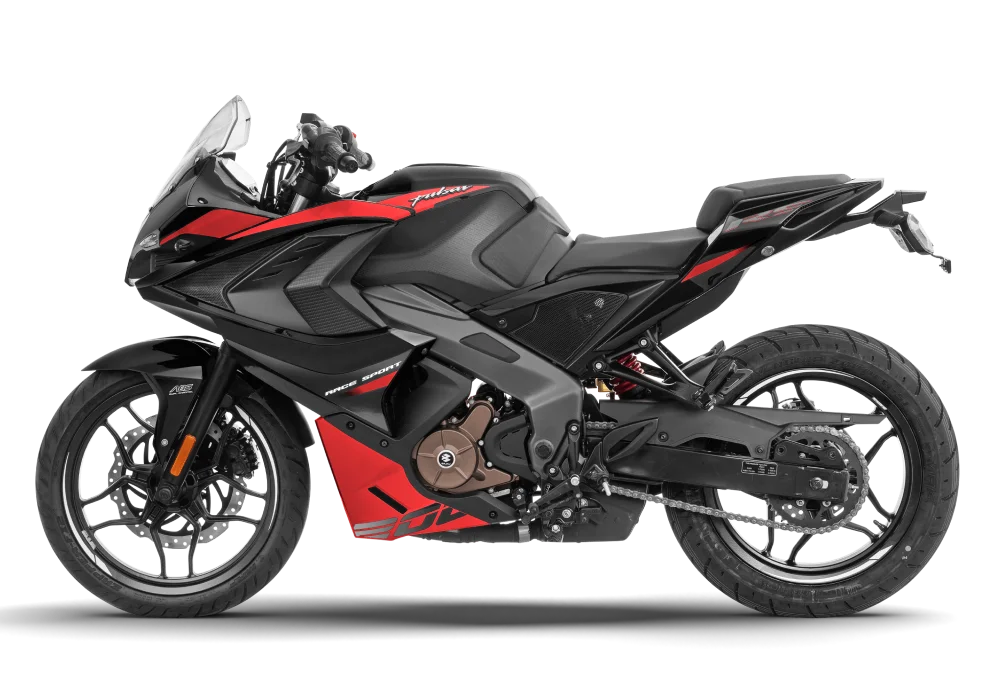
Bajaj Pulsar RS200
- 199.5 cc Liquid-Cooled, 4-valve
- 24.5 PS @ 9750 rpm
- 35 km/l (ARAI)
- 13-litre tank
- 1 variant available
- 5-year / 75,000 km warranty
Full Specification Comparison
Every number that matters — side by side
| Specification | KTM RC 160 | Bajaj Pulsar RS200 |
|---|---|---|
| Engine & Performance | ||
| Displacement | 164.2 cc | 199.5 cc |
| Cooling System | Liquid-Cooled | Liquid-Cooled |
| Max Power | 19 PS @ 9500 rpm | 24.5 PS @ 9750 rpm |
| Max Torque | 15.5 Nm @ 7500 rpm | 18.74 Nm @ 8000 rpm |
| Valves per Cylinder | 4 | 4 |
| Spark Plugs | 1 per cylinder | 3 (Triple Spark) |
| Bore × Stroke | 66 × 48 mm | 72 × 49 mm |
| Compression Ratio | 11.97 : 1 | 11 ± 0.5 : 1 |
| Emission Standard | BS6 Phase 2 | BS6 |
| Transmission | 6-Speed Manual | 6-Speed Manual |
| Clutch | Assist & Slipper Clutch | Wet Multiplate |
| Top Speed | 118 km/h | 141 km/h |
| Riding Modes | No | Road, Rain, Offroad |
| Traction Control | No | No |
| Fuel & Range | ||
| Mileage (ARAI) | 36 km/l | 35 km/l |
| Fuel Tank | 13.7 litres | 13 litres |
| Reserve Capacity | ~1.5–2 litres | 2.6 litres |
| Riding Range | ~493 km | ~455 km |
| Brakes & Wheels | ||
| Braking System | Dual Channel ABS | Dual Channel ABS |
| Front Brake | Disc – 320 mm | Disc – 300 mm |
| Rear Brake | Disc – 230 mm | Disc – 230 mm |
| Tyre Type | Tubeless | Tubeless |
| Tyre Size (F / R) | 110/70-17 / 140/60-17 | 110/70-17 / 140/70-17 |
| Wheel Type | Alloy | Alloy |
| Suspension & Chassis | ||
| Front Suspension | WP APEX USD Forks, 37 mm | Telescopic Fork with Anti-Friction Bush |
| Rear Suspension | Canister Monoshock, 6-step Adjustable | Nitrox Monoshock with Canister |
| Chassis | Trellis Frame | Perimeter Frame |
| Rear Preload Adjuster | Yes | Yes |
| Dimensions & Weight | ||
| Kerb Weight | 155 kg | 167 kg |
| Seat Height | 830 mm | 810 mm |
| Ground Clearance | 168 mm | 157 mm |
| Wheelbase | 1347 mm | 1345 mm |
| Overall L × W × H | 1965 × 701 × 1150 mm | 1999 × 765 × 1114 mm |
| Features & Electronics | ||
| Instrument Console | 5-inch LCD | Fully Digital LCD |
| Headlight | LED | Halogen Projector (Twin) |
| DRLs | Yes | Yes |
| Turn Signals | LED | Bulb |
| Hazard Warning Lights | No | Yes |
| Riding Modes | No | Road, Rain, Offroad |
| Traction Control | No | No |
| Bluetooth Connectivity | Yes | Yes |
| Call & SMS Alerts | Yes | Yes |
| USB Charging Port | No | No |
| Distance to Empty | Yes | Yes |
| Gear Indicator | Yes | Yes |
| Tachometer | Digital | Digital |
| Service Reminder | Yes | Yes |
| Keyless Ignition | No | No |
| Price & Warranty | ||
| Starting Price (ex-showroom) | ₹1,84,998 | ₹1,72,857 |
| Top Variant Price | ₹1,84,998 | ₹1,72,857 |
| Number of Variants | 1 | 1 |
| Standard Warranty | 2 Years / 30,000 km | 5 Years / 75,000 km |
★ Green highlights indicate the stronger value in each row. Prices are ex-showroom India averages and may vary by city.
Variant-wise Price Comparison
All variants laid out — find the right one for your budget
KTM RC 160 Variants
Pulsar RS200 Variants
Pros & Cons
Honest strengths and weaknesses of each bike
Pros
- Premium WP APEX USD forks standard — class-leading suspension hardware
- Largest front disc in this comparison at 320 mm
- Lighter at 155 kg — 12 kg less than the RS200
- Greater ground clearance (168 mm vs 157 mm)
- Assist and slipper clutch for smoother, safer downshifts
- Slightly better ARAI mileage (36 km/l vs 35 km/l)
- Larger 13.7-litre tank for longer riding range (~493 km)
- Bluetooth connectivity and LED lighting throughout
- Tighter, more agile supersport chassis feel
Cons
- Significantly less power (19 PS vs 24.5 PS)
- Lower torque (15.5 Nm vs 18.74 Nm)
- Much lower top speed (118 km/h vs 141 km/h)
- No riding modes on any variant
- Very short warranty: only 2 years / 30,000 km
- ₹12,141 more expensive than the RS200
- No hazard warning lights
- Higher maintenance costs versus Bajaj's service network
Pros
- More powerful — 24.5 PS from 199.5 cc engine
- Higher torque at 18.74 Nm for stronger acceleration
- Higher top speed of 141 km/h
- Riding modes: Road, Rain & Offroad — standard on only variant
- Outstanding 5-year / 75,000 km warranty
- ₹12,141 cheaper than the RC 160
- Hazard warning lights standard
- Triple spark plug technology for better combustion efficiency
- Twin projector headlamps with DRLs
- Bajaj's wide service network across India
Cons
- Heavier at 167 kg — handling feels less sharp than RC 160
- Conventional telescopic forks vs RC 160's premium USD setup
- Smaller front disc (300 mm vs 320 mm)
- Less ground clearance (157 mm vs 168 mm)
- No slipper clutch — less confidence during aggressive downshifts
- Feature list basic compared to newer rivals
- Bulb turn signals instead of LED
Key Differences Explained
What really sets these two bikes apart
Engine & Performance
The RS200's 199.5 cc triple-spark liquid-cooled engine produces 24.5 PS and 18.74 Nm — 29% more power and 21% more torque than the RC 160's 164.2 cc unit. This translates into a significantly higher top speed of 141 km/h versus 118 km/h, and noticeably stronger highway acceleration and overtaking ability. The RC 160 counters with a freer-revving character and the refinement of an assist and slipper clutch, which the RS200 lacks.
Fuel Efficiency & Range
Both bikes are closely matched on efficiency — the RC 160 returns 36 km/l (ARAI) versus 35 km/l for the RS200, a negligible 1 km/l difference. The RC 160's slightly larger 13.7-litre tank gives it a longer riding range (~493 km vs ~455 km). Real-world figures for both performance-oriented machines typically fall in the 30–36 km/l range depending on riding style. Neither bike is an efficiency leader, but neither is significantly worse than the other.
Braking & Safety
The RC 160 holds a clear braking hardware advantage with its 320 mm front disc — 20 mm larger than the RS200's 300 mm unit — and both bikes come with dual-channel ABS as standard. The RC 160's slipper clutch also prevents rear wheel hop during hard downshifts, adding a meaningful safety layer the RS200 lacks. The RS200 partially compensates with riding modes, including a Rain mode that adjusts ABS sensitivity for wet conditions.
Suspension & Handling
The RC 160 ships with KTM's WP APEX USD forks as standard — premium hardware that gives it a decisive handling advantage. The RS200 uses conventional telescopic forks with an anti-friction bush, which are competent but cannot match the feedback and damping quality of the WP USD setup. The RC 160 is also 12 kg lighter (155 kg vs 167 kg), which makes it noticeably more agile in corners and during direction changes. The RS200's perimeter frame does provide excellent high-speed stability on straights.
Warranty & Ownership
This is the RS200's most decisive ownership advantage. Bajaj offers an exceptional 5 years / 75,000 km warranty versus KTM's 2 years / 30,000 km — more than double the time and 2.5 times the kilometre coverage. For a daily rider doing 15,000 km per year, the RS200 stays under warranty through its entire practical life. Bajaj's substantially wider service network across India also makes ownership far more convenient outside metro cities.
Price & Value
The RS200 starts at ₹1,72,857 — a significant ₹12,141 less than the RC 160's ₹1,84,998. For that saving, the RS200 delivers more power, more torque, a higher top speed, riding modes, a superior warranty, and access to Bajaj's nationwide service network. The RC 160 justifies its premium primarily through WP USD forks and slipper clutch hardware — meaningful advantages for riders focused on handling above all else.
Expert Verdict
Which one should you actually buy?
Buy the KTM RC 160 if…
- Premium WP APEX USD forks as standard are a non-negotiable for you
- Sharp, agile handling is your top priority over outright power
- A slipper clutch for safer, smoother downshifts matters
- The RC's iconic fully-faired supersport silhouette appeals most
- You want the largest front disc in this comparison (320 mm)
- Lighter kerb weight (155 kg) for quicker cornering is important
- You primarily ride on well-maintained roads and highways
Buy the Pulsar RS200 if…
- More power (24.5 PS) and torque (18.74 Nm) suit your riding needs
- A higher top speed of 141 km/h matters for highway riding
- Riding modes (Road, Rain, Offroad) add real-world versatility
- The 5-year / 75,000 km warranty gives essential long-term security
- Saving ₹12,141 vs the RC 160 is a meaningful budget decision
- Bajaj's widespread service network makes your life easier
- Twin projector headlamps and hazard warning lights are priorities
Overall Winner for Most Riders: Bajaj Pulsar RS200. More power, more torque, a higher top speed, riding modes, a vastly superior 5-year / 75,000 km warranty, and a ₹12,141 lower price tag make the Pulsar RS200 the more practical, more capable, and considerably better-value choice for the majority of Indian riders. Choose the KTM RC 160 only if premium WP APEX USD forks, slipper clutch hardware, a lighter chassis, and KTM's track-inspired riding experience are your absolute top priorities — and you're willing to pay more for them with a significantly shorter warranty period.
Frequently Asked Questions
Common questions answered by our experts
For most buyers, the Bajaj Pulsar RS200 is the better all-round choice — it delivers more power (24.5 PS vs 19 PS), more torque, a higher top speed (141 km/h vs 118 km/h), riding modes (Road, Rain, Offroad), a far superior 5-year / 75,000 km warranty, and costs ₹12,141 less. The KTM RC 160 is the better pick for riders who prioritise handling precision, WP APEX USD forks as standard, a slipper clutch, and a lighter, more agile chassis.
The Bajaj Pulsar RS200 is priced at ₹1,72,857 ex-showroom, while the KTM RC 160 is priced at ₹1,84,998 — a difference of ₹12,141 in favour of the RS200. Both bikes are available in a single variant each, making this a straightforward direct comparison. Prices are ex-showroom India averages and may vary by city.
The KTM RC 160 has a marginally better ARAI-certified mileage at 36 km/l compared to the Bajaj Pulsar RS200's 35 km/l. In practice, the difference is negligible, with both bikes delivering real-world figures in the 30–36 km/l range depending on riding conditions. The RC 160's slightly larger 13.7-litre tank also gives it a longer riding range of ~493 km versus ~455 km for the RS200's 13-litre tank.
The Bajaj Pulsar RS200 makes significantly more power at 24.5 PS @ 9750 rpm from its 199.5 cc engine compared to the KTM RC 160's 19 PS @ 9500 rpm. The RS200 also produces more torque at 18.74 Nm vs 15.5 Nm, and has a considerably higher top speed of 141 km/h versus 118 km/h for the RC 160. The RS200's larger displacement gives it a clear performance advantage on highways and during overtaking situations.
Yes, the Bajaj Pulsar RS200 comes with three riding modes — Road, Rain and Offroad — as standard on its single variant. These adjust the engine's power delivery and ABS behaviour to suit different road and weather conditions. The KTM RC 160 does not offer any riding modes on its single variant, which is a notable gap given their similar price point.
The Bajaj Pulsar RS200 offers a dramatically better warranty at 5 years / 75,000 km, compared to the KTM RC 160's 2 years / 30,000 km — more than double the coverage on both counts. For a daily commuter riding 15,000–20,000 km per year, the RS200 stays under full factory warranty for the bike's entire useful life, while the RC 160 exits warranty in under two years of typical use.