At a Glance
Key differences that define each motorcycle
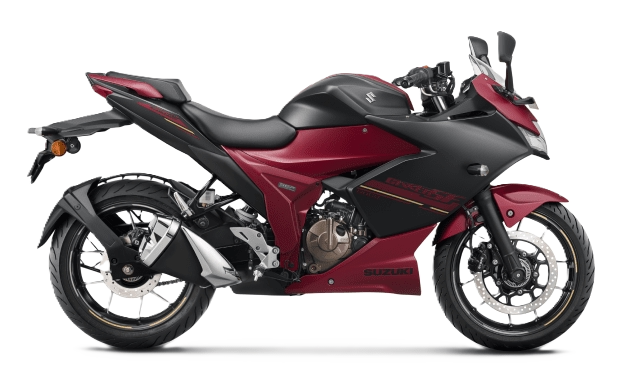
Suzuki Gixxer SF 250 Flex Fuel
- 249cc Oil-Cooled, 4-valve
- 26.13 bhp @ 9300 rpm
- 35 km/l (ARAI)
- 12-litre tank
- 1 variant available
- Flex-Fuel (E20 Compatible)
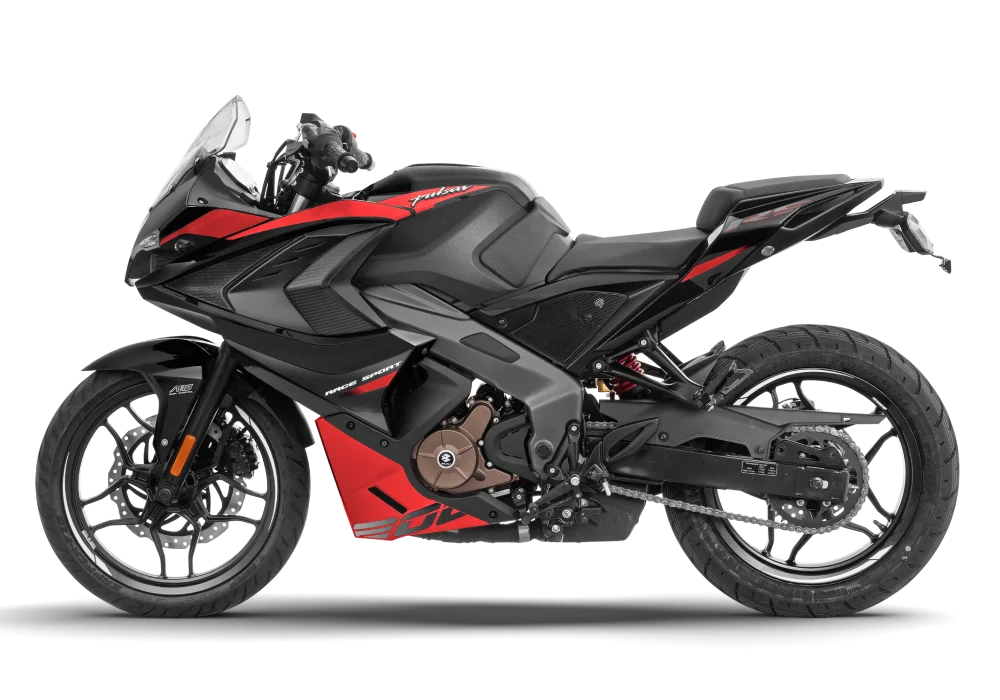
Bajaj Pulsar RS200
- 199.5cc Liquid-Cooled, 4-valve
- 24.5 PS @ 9750 rpm
- 35 km/l (ARAI)
- 13-litre tank
- 1 variant available
- Ride Modes: Road, Rain, Off-Road
Full Specification Comparison
Every number that matters — side by side
| Specification | Suzuki Gixxer SF 250 Flex Fuel | Bajaj Pulsar RS200 |
|---|---|---|
| Engine & Performance | ||
| Displacement | 249 cc | 199.5 cc |
| Cooling System | Oil-Cooled | Liquid-Cooled |
| Max Power | 26.13 bhp @ 9300 rpm | 24.5 PS @ 9750 rpm |
| Max Torque | 22.2 Nm @ 7300 rpm | 18.74 Nm @ 8000 rpm |
| Valves per Cylinder | 4 | 4 |
| Compression Ratio | 10.7:1 | 11 ± 0.5:1 |
| Bore × Stroke | 76 × 54.9 mm | 72 × 49 mm |
| Spark Plugs | 1 Per Cylinder | 3 (Triple Spark) |
| Emission Standard | BS6 Phase 2B | BS6 |
| Transmission | 6-Speed Manual | 6-Speed Manual |
| Top Speed | ~150 km/h | 141 km/h |
| Riding Modes | No | Road, Rain, Off-Road |
| Flex-Fuel (E20) Compatible | Yes | No |
| Traction Control | No | No |
| Fuel & Range | ||
| Mileage (ARAI) | 35 km/l | 35 km/l |
| Fuel Tank | 12 litres | 13 litres |
| Reserve Capacity | 2.4 litres | 2.6 litres |
| Riding Range | ~420 km | ~455 km |
| Brakes & Wheels | ||
| Braking System | Dual Channel ABS | Dual Channel ABS |
| Front Brake | Disc – 300 mm | Disc – 300 mm |
| Rear Brake | Disc – 220 mm | Disc – 230 mm |
| Tyre Type | Tubeless | Tubeless |
| Tyre Size (F / R) | 110/70 R17 / 150/60 R17 | 110/70-17 / 140/70-17 |
| Wheel Type | Alloy | Alloy |
| Suspension & Chassis | ||
| Front Suspension | Telescopic | Telescopic Fork with Anti-Friction Bush |
| Rear Suspension | Monoshock | Nitrox Monoshock with Canister |
| Chassis | Diamond Frame | Perimeter Frame |
| Rear Preload Adjuster | Yes | Yes |
| Dimensions & Weight | ||
| Kerb Weight | 161 kg | 167 kg |
| Seat Height | 800 mm | 810 mm |
| Ground Clearance | 165 mm | 157 mm |
| Wheelbase | 1345 mm | 1345 mm |
| Overall L × W × H | 2010 × 740 × 1035 mm | 1999 × 765 × 1114 mm |
| Features & Electronics | ||
| Instrument Console | Digital Display | Fully Digital LCD |
| Headlight | LED | Halogen Projector |
| Projector Headlamp | No | Yes (Twin) |
| DRLs | No | Yes |
| Turn Signals | LED | Bulb |
| Hazard Warning Lights | No | Yes |
| Riding Modes | No | Road / Rain / Off-Road |
| Traction Control | No | No |
| Bluetooth Connectivity | Yes | Yes |
| Call & SMS Alerts | Yes | Yes |
| USB Charging Port | No | No |
| Distance to Empty | No | Yes |
| Gear Indicator | Yes | Yes |
| Tachometer | Digital | Digital |
| Service Reminder | Yes | Yes |
| Keyless Ignition | No | No |
| Price & Warranty | ||
| Starting Price (ex-showroom) | ₹2,00,791 | ₹1,72,857 |
| Number of Variants | 1 | 1 |
| Standard Warranty | 2 Years / 30,000 km | 5 Years / 75,000 km |
★ Green highlights indicate the stronger value in each row. Prices are ex-showroom India averages and may vary by city.
Variant-wise Price Comparison
All variants laid out — find the right one for your budget
Gixxer SF 250 Flex Fuel Variants
Pulsar RS200 Variants
Pros & Cons
Honest strengths and weaknesses of each bike
Pros
- Larger 249cc engine with more power (26.13 bhp)
- Higher torque output at 22.2 Nm
- Higher top speed of approximately 150 km/h
- Flex-fuel (E20) compatible — future-ready technology
- Refined oil-cooled engine for smooth power delivery
- Lighter at 161 kg vs 167 kg
- Better ground clearance (165 mm vs 157 mm)
- LED turn indicators
- Bluetooth connectivity as standard
Cons
- Significantly higher price (₹2,00,791 vs ₹1,72,857)
- Much weaker warranty: 2 years / 30,000 km only
- No riding modes
- Smaller 12-litre fuel tank and shorter range (~420 km)
- No DRLs or hazard warning lights
- No projector headlamp
- No distance-to-empty display
- Single variant — no choice for buyers
Pros
- Significantly lower price — ₹27,934 cheaper
- Exceptional 5-year / 75,000 km warranty
- Ride modes: Road, Rain and Off-Road
- Larger 13-litre fuel tank with longer ~455 km range
- Twin projector headlamps with DRLs
- Hazard warning lights as standard
- Distance-to-empty display
- Perimeter frame for superior handling rigidity
- Triple spark plug technology
Cons
- Lower engine displacement (199.5cc vs 249cc)
- Less power (24.5 PS) and torque (18.74 Nm)
- Lower top speed (141 km/h vs 150 km/h)
- No flex-fuel compatibility
- Heavier at 167 kg
- Bulb turn signals (not LED)
- Feature list is basic compared to newer rivals
Key Differences Explained
What really sets these two bikes apart
Engine Character
The Gixxer SF 250 Flex Fuel uses a 249cc oil-cooled, 4-valve engine producing 26.13 bhp and 22.2 Nm — giving it a clear displacement and power advantage. The RS200 counters with a 199.5cc liquid-cooled unit producing 24.5 PS and 18.74 Nm, featuring triple spark plugs for efficient combustion. Liquid cooling on the RS200 provides better thermal management in stop-and-go city traffic, while the Gixxer's larger displacement shines at highway speeds.
Fuel Efficiency & Range
Both bikes deliver an identical ARAI-certified mileage of 35 km/l, making efficiency a draw on paper. However, the RS200's larger 13-litre tank gives it a longer riding range of approximately 455 km versus 420 km for the Gixxer SF 250's 12-litre tank. The Gixxer SF 250 also offers flex-fuel (E20) compatibility, allowing it to run on ethanol-blended fuel for cost savings and environmental benefits.
Braking & Safety
Both motorcycles are evenly matched in braking hardware, with identical 300 mm front disc setups and dual-channel ABS as standard. The RS200 edges ahead with a slightly larger 230 mm rear disc versus the Gixxer SF 250's 220 mm unit. Neither bike offers traction control. Overall, the braking package is comparable, with a slight advantage to the RS200 at the rear.
Ride Modes & Technology
The Bajaj Pulsar RS200 holds a clear advantage here with Road, Rain and Off-Road ride modes available as standard, adjusting power delivery and ABS behaviour for different conditions. The Suzuki Gixxer SF 250 Flex Fuel offers no riding modes but compensates with flex-fuel technology — a forward-looking feature that allows it to run on E20 ethanol-blended fuel. Both bikes offer Bluetooth connectivity.
Warranty & Ownership
This is where the gap is most dramatic. The Bajaj Pulsar RS200 offers an industry-leading 5 years / 75,000 km warranty, while the Suzuki Gixxer SF 250 Flex Fuel provides just 2 years / 30,000 km. The RS200's warranty covers 2.5 times the kilometres — a massive advantage for daily commuters who rack up high mileage, providing meaningful protection against out-of-warranty repair costs.
Price & Value
The Bajaj Pulsar RS200 is priced at ₹1,72,857 — nearly ₹28,000 cheaper than the Gixxer SF 250 Flex Fuel at ₹2,00,791. For that price difference, the RS200 offers ride modes, a better warranty, more features and a larger fuel tank. The Gixxer SF 250 justifies its premium with a bigger engine, more power, higher top speed and flex-fuel technology. Value-for-money clearly favours the RS200 for most buyers.
Expert Verdict
Which one should you actually buy?
Buy the Gixxer SF 250 Flex Fuel if…
- You want maximum performance from a 250cc engine
- Higher top speed (~150 km/h) matters for highway rides
- Flex-fuel / E20 compatibility is important to you
- You prefer a refined oil-cooled engine with smooth power
- You're a touring enthusiast who wants extra displacement
- Budget allows spending ₹27,000+ more over the RS200
- You want better ground clearance for Indian road conditions
Buy the Pulsar RS200 if…
- Budget is a priority — saves nearly ₹28,000
- You want ride modes (Road, Rain, Off-Road) as standard
- The superior 5-year / 75,000 km warranty is important
- A larger fuel tank and longer range (~455 km) matter
- Twin projector headlamps and DRLs appeal to you
- You want a proven liquid-cooled engine with sharp handling
- Hazard warning lights and distance-to-empty are useful features
Overall Winner for Most Riders: Bajaj Pulsar RS200. At nearly ₹28,000 less, the Pulsar RS200 delivers an extraordinary package — ride modes, a class-leading 5-year / 75,000 km warranty, twin projector headlamps with DRLs, a larger 13-litre fuel tank, hazard warning lights and a proven liquid-cooled perimeter frame setup. The Suzuki Gixxer SF 250 Flex Fuel is the better pick only if you specifically want the larger 249cc engine, higher outright performance, higher top speed, or the forward-looking flex-fuel (E20) compatibility and are willing to pay a significant premium for it.
Frequently Asked Questions
Common questions answered by our experts
The Bajaj Pulsar RS200 is better for most buyers who prioritise value, ride modes, a class-leading 5-year / 75,000 km warranty, a larger fuel tank and lower price. The Suzuki Gixxer SF 250 Flex Fuel is better if you want stronger outright performance (26.13 bhp vs 24.5 PS), a higher top speed, a larger 249cc engine and flex-fuel (E20) compatibility.
The Bajaj Pulsar RS200 is priced at ₹1,72,857 ex-showroom while the Suzuki Gixxer SF 250 Flex Fuel costs ₹2,00,791 ex-showroom — a difference of approximately ₹27,934. Both are available in single variants and prices may vary by city.
Both motorcycles deliver an identical ARAI-certified mileage of 35 km/l. However, the Bajaj Pulsar RS200's larger 13-litre fuel tank gives it a longer riding range of approximately 455 km compared to approximately 420 km for the Suzuki Gixxer SF 250 Flex Fuel's 12-litre tank.
The Suzuki Gixxer SF 250 Flex Fuel makes more power at 26.13 bhp @ 9300 rpm and more torque at 22.2 Nm @ 7300 rpm, compared to the Bajaj Pulsar RS200's 24.5 PS @ 9750 rpm and 18.74 Nm @ 8000 rpm. The Gixxer SF 250 also has a higher top speed of approximately 150 km/h against 141 km/h for the RS200, owing to its larger 249cc displacement.
Yes, the Bajaj Pulsar RS200 comes with Road, Rain and Off-Road riding modes as standard. These adjust power delivery and ABS behaviour to suit different road conditions. The Suzuki Gixxer SF 250 Flex Fuel does not offer any riding modes.
The Bajaj Pulsar RS200 offers a significantly superior warranty of 5 years / 75,000 km compared to the Suzuki Gixxer SF 250 Flex Fuel's 2 years / 30,000 km. The RS200's warranty covers 2.5 times more kilometres, making it a far better proposition for high-mileage commuters and those concerned about long-term ownership costs.