At a Glance
Key differences that define each motorcycle
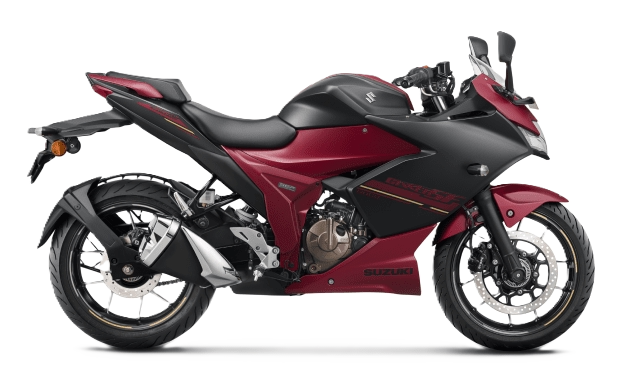
Suzuki Gixxer SF 250 Flex Fuel
- 249 cc Oil-Cooled, 4-valve, SOCS
- 26.13 bhp @ 9300 rpm
- 35 km/l (ARAI)
- 12-litre tank
- 1 variant, 2 colour options
- Flex-fuel (E20) compatible
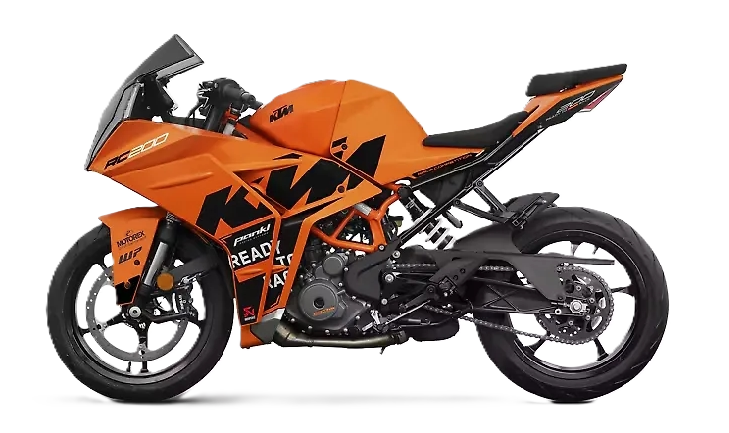
KTM RC 200
- 199.5 cc Liquid-Cooled, 4-valve, DOHC
- 25 PS @ 10000 rpm
- 43.5 km/l (ARAI)
- 13.7-litre tank
- 2 variants, 4 colour options
- WP APEX USD forks + Supermoto ABS
Full Specification Comparison
Every number that matters — side by side
| Specification | Suzuki Gixxer SF 250 Flex Fuel | KTM RC 200 |
|---|---|---|
| Engine & Performance | ||
| Displacement | 249 cc | 199.5 cc |
| Engine Type | Oil-Cooled, 4-valve, SOCS | Liquid-Cooled, 4-valve, DOHC |
| Max Power | 26.13 bhp @ 9300 rpm | 25 PS @ 10000 rpm |
| Max Torque | 22.2 Nm @ 7300 rpm | 19.2 Nm @ 8000 rpm |
| Valves per Cylinder | 4 | 4 |
| Compression Ratio | 10.7:1 | 13.3:1 |
| Bore × Stroke | 76 × 54.9 mm | 72 × 49 mm |
| Emission Standard | BS6 Phase 2B | BS6 Phase 2B |
| Transmission | 6-Speed Manual | 6-Speed Manual |
| Clutch | Wet Multiplate | Wet Multiplate |
| Top Speed | ~150 km/h | ~140 km/h |
| Flex-Fuel (E20) Compatible | Yes | No |
| Riding Modes | No | No |
| Traction Control | No | No |
| Fuel & Range | ||
| Mileage (ARAI) | 35 km/l | 43.5 km/l |
| Fuel Tank | 12 litres | 13.7 litres |
| Reserve Capacity | 2.4 litres | 1.5 litres |
| Riding Range | ~420 km | ~596 km |
| Brakes & Wheels | ||
| Braking System | Dual Channel ABS | Dual Channel ABS + Supermoto Mode |
| Front Brake | Disc – 300 mm | Disc – 320 mm |
| Rear Brake | Disc – 220 mm | Disc – 230 mm |
| Tyre Type | Tubeless | Tubeless |
| Tyre Size (F / R) | 110/70 R17 / 150/60 R17 | 110/70-17 / 150/60-17 |
| Wheel Type | Alloy | Alloy |
| Suspension & Chassis | ||
| Front Suspension | Telescopic Fork | WP APEX USD Fork, 43 mm |
| Rear Suspension | Monoshock | WP APEX Monoshock |
| Chassis | Diamond Frame | Steel Trellis Frame |
| Rear Preload Adjuster | Yes | Yes |
| Dimensions & Weight | ||
| Kerb Weight | 161 kg | 160 kg |
| Seat Height | 800 mm | 835 mm |
| Ground Clearance | 165 mm | 158 mm |
| Wheelbase | 1345 mm | 1341 mm |
| Overall L × W × H | 2010 × 740 × 1035 mm | 1980 × 688 × 1340 mm |
| Features & Electronics | ||
| Instrument Console | Digital Display | Fully Digital TFT |
| Headlight | LED | LED Projector |
| DRLs | No | Yes |
| Turn Signals | LED | LED |
| Hazard Warning Lights | No | No |
| Bluetooth Connectivity | Yes | No |
| Call & SMS Alerts | Yes | No |
| Distance to Empty | No | Yes |
| USB Charging Port | No | No |
| Gear Indicator | Yes | Yes |
| Supermoto ABS Mode | No | Yes |
| Keyless Ignition | No | No |
| Price & Warranty | ||
| Starting Price (ex-showroom) | ₹2,00,791 | ₹2,20,907 |
| Top Variant Price | ₹2,00,791 | ₹2,20,907 (GP Edition) |
| Number of Variants | 1 variant, 2 colours | 2 variants, 4 colours |
| Standard Warranty | 2 Years / 30,000 km | 2 Years / 30,000 km |
★ Green highlights indicate the stronger value in each row. Prices are ex-showroom India averages and may vary by city.
Variant-wise Price Comparison
All variants laid out — find the right one for your budget
Gixxer SF 250 Flex Fuel Colours
KTM RC 200 Variants
Pros & Cons
Honest strengths and weaknesses of each bike
Pros
- More displacement (249 cc vs 199.5 cc) for more mid-range pull
- Higher peak power — 26.13 bhp vs 25 PS
- Significantly more torque — 22.2 Nm vs 19.2 Nm (15% more)
- Higher top speed (~150 km/h vs ~140 km/h)
- More affordable — ₹20,116 cheaper than RC 200
- Flex-fuel (E20) compatibility — future-ready technology
- Bluetooth connectivity with call/SMS alerts
- Lower seat height (800 mm vs 835 mm) — better accessibility
- Better ground clearance (165 mm vs 158 mm)
- Refined oil-cooled engine known for smooth long-distance character
Cons
- Lower ARAI mileage (35 km/l vs 43.5 km/l)
- Smaller 12-litre tank — shorter riding range (~420 km vs ~596 km)
- Conventional telescopic forks vs WP APEX USD on RC 200
- Diamond frame vs superior steel trellis on RC 200
- Smaller 300 mm front disc vs 320 mm on RC 200
- No Supermoto ABS mode
- No TFT display — basic digital console
- No DRLs
- Oil-cooled engine less thermally efficient at extreme performance
Pros
- WP APEX USD front forks — segment-best suspension setup
- Steel trellis frame for superior rigidity and handling precision
- Supermoto ABS mode for experienced riders
- TFT digital display with distance to empty
- Larger 320 mm front disc — stronger braking bite
- Significantly better ARAI mileage (43.5 km/l vs 35 km/l)
- Larger 13.7-litre tank — much longer range (~596 km)
- High-revving DOHC liquid-cooled engine with race character
- Slightly lighter at 160 kg vs 161 kg
- Projector headlamp with DRLs standard
- 2 variants with premium GP Edition livery option
Cons
- More expensive at ₹2,20,907 — ₹20,116 costlier
- Less displacement (199.5 cc) and less torque (19.2 Nm)
- No Bluetooth connectivity despite TFT display
- Very high seat height (835 mm) — not accessible for many riders
- Aggressive committed riding posture — uncomfortable for daily use
- No flex-fuel compatibility
- Engine heat in heavy city traffic — liquid-cooled but tightly faired
- Higher maintenance costs than the Gixxer SF 250
Key Differences Explained
What really sets these two bikes apart
Engine & Performance
The Gixxer SF 250's 249 cc oil-cooled SOCS engine produces 26.13 bhp and 22.2 Nm — more power and significantly more torque than the RC 200's 199.5 cc liquid-cooled DOHC 19.2 Nm output. The Gixxer hits ~150 km/h; the RC 200 reaches ~140 km/h. However, the RC 200's DOHC engine is considerably more high-revving, with peak power at 10,000 rpm, giving it a more electrifying, race-inspired character at the top end.
Fuel Efficiency & Range
The KTM RC 200 dominates this category convincingly. Its ARAI-certified 43.5 km/l is 24% better than the Gixxer SF 250's 35 km/l. Combined with a larger 13.7-litre tank, the RC 200 delivers a riding range of ~596 km versus only ~420 km for the Gixxer SF 250's 12-litre unit. For long-distance riders and daily commuters who want fewer fuel stops, the RC 200 is the substantially more practical choice.
Braking & Safety
Both bikes get dual-channel ABS, but the RC 200 adds a unique Supermoto ABS mode that disables rear ABS for controlled slides during spirited riding. The RC 200 also has a larger 320 mm front disc vs the Gixxer SF 250's 300 mm unit. The Gixxer SF 250 counters with a slightly larger 220 mm rear disc (vs 230 mm for the RC 200 — actually RC 200 wins rear disc too). Overall the RC 200 leads on braking hardware and mode flexibility.
Chassis & Handling
The KTM RC 200's steel trellis frame with WP APEX USD forks is the clear handling winner. The WP suspension is track-calibrated and offers superior feedback and precision during aggressive cornering. The Gixxer SF 250 uses a conventional diamond frame with telescopic forks which is well-tuned for road riding but cannot match the RC 200's dedicated sports chassis. If cornering feel and track-day capability matter, the RC 200 wins emphatically.
Technology & Future Readiness
The Gixxer SF 250 wins on connectivity — Bluetooth with call/SMS alerts is standard, while the RC 200 has no Bluetooth despite its TFT display. The RC 200's TFT, DRLs and Supermoto mode are notable feature wins. The Gixxer SF 250's standout tech advantage is its flex-fuel (E20) compatibility — a forward-looking feature as India transitions to ethanol-blended fuels, potentially reducing running costs over time.
Price & Value
The Gixxer SF 250 Flex Fuel at ₹2,00,791 is ₹20,116 cheaper than the KTM RC 200. It delivers more displacement, more torque, a higher top speed, flex-fuel capability and Bluetooth for less money. The RC 200 commands a premium for its WP suspension, trellis frame, Supermoto ABS, TFT display, significantly better mileage and superior range. Both bikes share the same 2-year / 30,000 km warranty.
Expert Verdict
Which one should you actually buy?
Buy the Gixxer SF 250 Flex Fuel if…
- You want more displacement and torque for real-world pulling power
- Flex-fuel (E20) compatibility and lower fuel costs appeal to you
- Bluetooth connectivity for daily use matters
- Budget caps at ₹2,00,791 — saving ₹20,116 over the RC 200
- A lower seat height (800 mm) is important for comfort
- You value a higher top speed and strong mid-range character
- You ride both city and highway and want a balanced package
Buy the KTM RC 200 if…
- Sharp, track-focused handling with WP APEX USD forks is your priority
- You want significantly better fuel efficiency (43.5 km/l ARAI)
- The much longer fuel range (~596 km) suits your riding
- Supermoto ABS mode and precision braking excite you
- A TFT instrument display matters
- You enjoy aggressive cornering and high-rpm riding
- Race-inspired steel trellis frame and KTM heritage appeal
Overall Winner for Handling Enthusiasts: KTM RC 200. WP APEX USD forks, a steel trellis frame, Supermoto ABS mode, TFT display, significantly better ARAI mileage (43.5 km/l) and a vastly longer riding range (~596 km) make the RC 200 the sharper, more capable sports machine for riders who prioritise track-like handling and real-world efficiency. However, choose the Suzuki Gixxer SF 250 Flex Fuel if you want more raw displacement and torque, flex-fuel future-readiness, Bluetooth connectivity, a lower seat height and a lower price of ₹2,00,791 — it is the stronger value proposition for power-oriented riders who don't need the RC 200's extreme track focus.
Frequently Asked Questions
Common questions answered by our experts
The KTM RC 200 is the better motorcycle for handling enthusiasts who want WP APEX USD suspension, Supermoto ABS mode, significantly better ARAI mileage (43.5 km/l) and a much longer fuel range (~596 km). The Suzuki Gixxer SF 250 Flex Fuel is better for riders who want more displacement (249 cc), more torque (22.2 Nm), flex-fuel (E20) compatibility, Bluetooth connectivity, a lower seat height and a lower price of ₹2,00,791.
The Suzuki Gixxer SF 250 Flex Fuel is priced at ₹2,00,791 ex-showroom while both the KTM RC 200 Standard and GP Edition are priced at ₹2,20,907 — a difference of ₹20,116. The Gixxer SF 250 Flex Fuel is the more affordable option. Both prices are ex-showroom India averages and may vary by city.
The KTM RC 200 has significantly better ARAI-certified mileage at 43.5 km/l compared to the Suzuki Gixxer SF 250 Flex Fuel's 35 km/l — 24% more efficient. The RC 200 also has a larger 13.7-litre tank versus the Gixxer SF 250's 12-litre unit, giving it a riding range of approximately 596 km versus approximately 420 km. For economical riding and fewer fuel stops, the KTM RC 200 is the clear winner.
The Suzuki Gixxer SF 250 Flex Fuel produces more power at 26.13 bhp (approximately 25.8 PS) @ 9300 rpm and significantly more torque at 22.2 Nm @ 7300 rpm compared to the KTM RC 200's 25 PS @ 10000 rpm and 19.2 Nm @ 8000 rpm. The Gixxer SF 250 also has a higher top speed of approximately 150 km/h. However, the RC 200's DOHC engine has a much higher-revving, more intense character that feels more alive at the top end despite the lower peak numbers.
Yes, the Suzuki Gixxer SF 250 Flex Fuel comes with Bluetooth connectivity and call/SMS alerts via its digital instrument cluster. The KTM RC 200 surprisingly does not offer Bluetooth connectivity despite featuring a TFT display. This makes the Gixxer SF 250 Flex Fuel the more connected choice for everyday riders who want smartphone integration.
Yes, the KTM RC 200 features a Supermoto ABS mode which disables rear ABS intervention, allowing experienced riders to perform controlled rear-wheel slides during spirited or track riding. This mode is unique in the segment and is not available on the Suzuki Gixxer SF 250 Flex Fuel, which operates standard dual-channel ABS without any mode adjustment.