At a Glance
Key differences that define each motorcycle
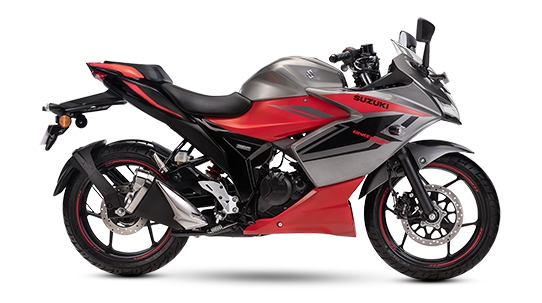
Suzuki Gixxer SF
- 155 cc Air-Cooled, 2-valve
- 13.6 PS @ 8000 rpm
- 45 km/l (Claimed)
- 12-litre tank
- 1 variant available
- Bluetooth with call & SMS alerts
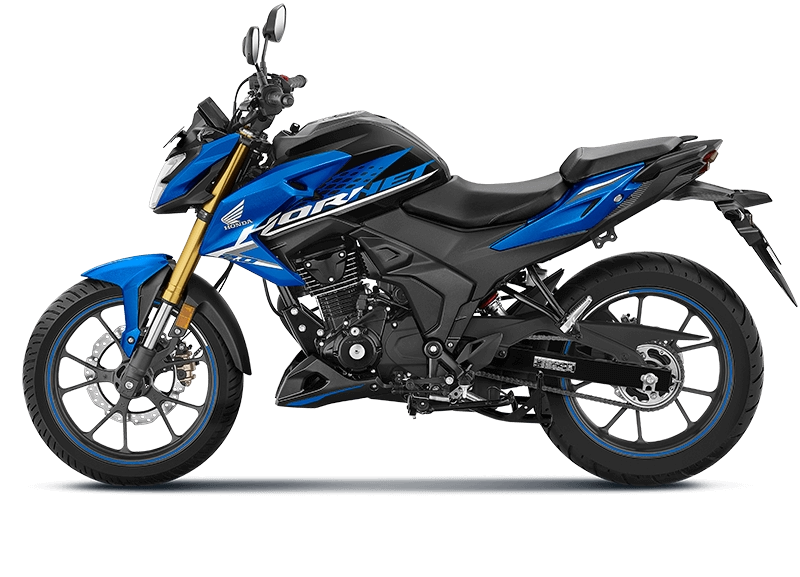
Honda Hornet 2.0
- 184.4 cc Air-Cooled, 2-valve
- 17.03 PS @ 8500 rpm
- 42.3 km/l (ARAI)
- 12-litre tank
- 1 variant available
- USD front forks standard
Full Specification Comparison
Every number that matters — side by side
| Specification | Suzuki Gixxer SF | Honda Hornet 2.0 |
|---|---|---|
| Engine & Performance | ||
| Displacement | 155 cc | 184.4 cc |
| Cooling System | Air-Cooled | Air-Cooled |
| Max Power | 13.6 PS @ 8000 rpm | 17.03 PS @ 8500 rpm |
| Max Torque | 13.8 Nm @ 6000 rpm | 16.1 Nm @ 6000 rpm |
| Valves per Cylinder | 2 | 2 |
| Compression Ratio | 9.8:1 | 9.5:1 |
| Bore × Stroke | 56.0 × 62.9 mm | 61 × 63.1 mm |
| Emission Standard | BS6 Phase 2 | BS6 OBD2 |
| Transmission | 5-Speed Manual | 5-Speed Manual |
| Top Speed | ~115 km/h | ~130 km/h |
| Riding Modes | No | No |
| Traction Control | No | No |
| Fuel & Range | ||
| Mileage (Claimed / ARAI) | 45 km/l (Claimed) | 42.3 km/l (ARAI) |
| Mileage (Real-world) | ~40–43 km/l | ~40–45 km/l |
| Fuel Tank | 12 litres | 12 litres |
| Reserve Capacity | 2.4 litres | 1.9 litres |
| Riding Range | ~540 km | ~504 km |
| Brakes & Wheels | ||
| Braking System | Single Channel ABS | Single Channel ABS |
| Front Brake | Disc – 266 mm | Disc – 276 mm |
| Rear Brake | Disc – 240 mm | Disc – 220 mm |
| Tyre Type | Tubeless | Tubeless |
| Tyre Size (F / R) | 100/80-17 / 140/60R17 | 110/70-17 / 140/70-17 |
| Wheel Type | Alloy | Alloy |
| Suspension & Chassis | ||
| Front Suspension | Telescopic Fork | USD Fork |
| Rear Suspension | Swing Arm Mono Shock | Monoshock |
| Chassis | Diamond Frame | Diamond Type Frame |
| Rear Preload Adjuster | Yes | Yes |
| Dimensions & Weight | ||
| Kerb Weight | 148 kg | 142 kg |
| Seat Height | 795 mm | 790 mm |
| Ground Clearance | 165 mm | 168 mm |
| Wheelbase | 1340 mm | 1355 mm |
| Overall L × W × H | 2025 × 715 × 1035 mm | 2047 × 783 × 1064 mm |
| Features & Electronics | ||
| Instrument Console | Fully Digital LCD | Fully Digital LCD |
| Headlight | LED Projector | LED |
| DRLs | Yes | Yes |
| Turn Signals | Bulb | LED |
| Hazard Warning Lights | No | Yes |
| Riding Modes | No | No |
| Traction Control | No | No |
| Bluetooth Connectivity | Yes | No |
| Call & SMS Alerts | Yes | No |
| USB Charging Port | No | No |
| Distance to Empty | Yes | No |
| Gear Indicator | Yes | Yes |
| Tachometer | Digital | Digital |
| Keyless Ignition | No | No |
| Price & Warranty | ||
| Starting Price (ex-showroom) | ₹1,37,594 | ₹1,47,151 |
| Number of Variants | 1 | 1 |
| Standard Warranty | 2 Years / 30,000 km | 3 Years |
★ Green highlights indicate the stronger value in each row. Prices are ex-showroom India averages and may vary by city.
Variant-wise Price Comparison
All variants laid out — find the right one for your budget
Suzuki Gixxer SF Variants
Honda Hornet 2.0 Variants
Pros & Cons
Honest strengths and weaknesses of each bike
Pros
- Lower price — ₹9,557 cheaper than Hornet 2.0
- Sporty fully-faired design with aerodynamic body
- Bluetooth with call & SMS alerts as standard
- LED projector headlamp for sharper illumination
- Larger 240 mm rear disc brake
- Larger 2.4-litre reserve capacity
- Higher claimed mileage — 45 km/l
- Longer riding range (~540 km vs ~504 km)
- Distance to empty display on instrument cluster
Cons
- Significantly less power — 13.6 PS vs 17.03 PS
- Much lower torque — 13.8 Nm vs 16.1 Nm
- Smaller 155 cc engine vs 184.4 cc
- Conventional telescopic forks vs USD
- Smaller 266 mm front disc
- No LED turn signals — bulb type
- No hazard warning lights
- Shorter 2-year warranty vs 3 years
- Lower top speed (~115 km/h vs ~130 km/h)
Pros
- Significantly more power — 17.03 PS @ 8500 rpm
- More torque — 16.1 Nm at same 6000 rpm
- Larger 184.4 cc engine for stronger performance
- USD front forks for better handling & feedback
- Larger 276 mm front disc for stronger braking
- LED turn signals and hazard warning lights
- Lighter at 142 kg vs 148 kg
- ARAI-certified mileage — 42.3 km/l official figure
- Better 3-year warranty
- Wider 110/70 front tyre for improved stability
Cons
- Higher price — ₹9,557 more expensive
- No Bluetooth connectivity on any variant
- No distance-to-empty display
- Naked streetfighter — no fairing or wind protection
- Smaller 220 mm rear disc vs 240 mm
- Smaller reserve capacity (1.9 litres vs 2.4 litres)
- Slightly lower claimed riding range (~504 km)
Key Differences Explained
What really sets these two bikes apart
Engine Character
The Honda Hornet 2.0's 184.4 cc engine makes 17.03 PS and 16.1 Nm — over 25% more power and 17% more torque than the Suzuki Gixxer SF's 155 cc unit (13.6 PS, 13.8 Nm). Both are air-cooled 2-valve single-cylinder engines, but the Honda's larger displacement delivers meaningfully stronger acceleration and a higher top speed of ~130 km/h vs ~115 km/h. The Gixxer SF's engine is smoother and more efficient by design.
Fuel Efficiency & Range
The Gixxer SF claims 45 km/l, giving it a theoretical range of ~540 km on its 12-litre tank. The Hornet 2.0 carries an ARAI- certified 42.3 km/l, offering ~504 km range. While the Gixxer SF's figure is higher, Honda's is ARAI-verified while Suzuki's is a claimed figure — making direct comparison nuanced. The Gixxer SF also has a 2.4-litre reserve versus 1.9 litres for the Hornet.
Braking & Suspension
The Honda Hornet 2.0 leads on both suspension and front brake hardware. Its USD front forks deliver sharper handling feedback and better front-end stability than the Gixxer SF's conventional telescopic setup. The Hornet's 276 mm front disc is 10 mm larger, though the Gixxer SF counters with a bigger 240 mm rear disc versus 220 mm. Both have single-channel ABS.
Design & Body Style
These bikes take fundamentally different design approaches. The Suzuki Gixxer SF is a fully-faired sportbike — its aerodynamic fairing provides wind protection, a sportier riding posture and distinctive track-influenced styling. The Honda Hornet 2.0 is a naked streetfighter — more aggressive muscle-tank styling, upright ergonomics and better city maneuverability. The choice depends on personal preference for faired vs naked designs.
Technology & Connectivity
The Gixxer SF takes a clear lead here. It includes Bluetooth connectivity with call & SMS alerts, distance to empty, and an LED projector headlamp — none of which are available on the Hornet 2.0. The Hornet does counter with LED turn signals and hazard warning lights that the Gixxer SF lacks (it uses bulb turn signals). Neither offers riding modes, traction control or a USB charging port.
Price & Value
The Gixxer SF starts at ₹1,37,594 versus the Hornet's ₹1,47,151 — a gap of ₹9,557. For that premium, the Honda delivers significantly more power, better suspension and LED lighting upgrades. The Suzuki counters with Bluetooth, an LED projector headlamp, and a sporty fairing that the Honda doesn't offer. The Hornet also offers a longer 3-year warranty versus Suzuki's 2-year coverage.
Expert Verdict
Which one should you actually buy?
Buy the Suzuki Gixxer SF if…
- Budget is a priority — it's ₹9,557 cheaper
- You want a sporty fully-faired motorcycle design
- Bluetooth with call & SMS alerts matters to you
- An LED projector headlamp for better visibility appeals
- You prefer the aerodynamic look of a faired bike
- Higher claimed mileage and longer range are important
- Daily city commuting is your primary use case
- Suzuki's build quality and refinement suits your preference
Buy the Honda Hornet 2.0 if…
- More power (17.03 PS) and torque (16.1 Nm) matter to you
- USD front forks for premium handling feel are important
- You want a larger engine (184.4 cc) for stronger performance
- LED turn signals and hazard warning lights appeal to you
- You prefer the naked streetfighter design and upright posture
- A 3-year warranty gives you better ownership confidence
- Honda's long-term reliability and service network matter
- ARAI-certified mileage gives you confidence in efficiency figures
Overall Winner: Honda Hornet 2.0 — for performance; Suzuki Gixxer SF — for value. These two bikes serve different buyer priorities. The Honda Hornet 2.0 is the stronger performer — its 184.4 cc engine making 17.03 PS, USD front forks, larger front disc, LED turn signals and 3-year warranty justify the ₹9,557 premium for riders who value power and riding dynamics. The Suzuki Gixxer SF is the smarter buy for budget-focused riders who want a fully-faired sportbike with Bluetooth connectivity, an LED projector headlamp, and a longer claimed riding range at a lower price of ₹1,37,594. Choose based on whether performance or design-and-connectivity matter more to you.
Frequently Asked Questions
Common questions answered by our experts
The Honda Hornet 2.0 is better for riders who want stronger performance — its 184.4 cc engine makes 17.03 PS vs 13.6 PS, and it adds USD front forks and LED turn signals for ₹9,557 more. The Suzuki Gixxer SF is better for budget-conscious buyers who want a fully-faired design, Bluetooth connectivity with call alerts, an LED projector headlamp and longer claimed range — all at ₹1,37,594.
The Suzuki Gixxer SF is priced at ₹1,37,594 ex-showroom while the Honda Hornet 2.0 costs ₹1,47,151 — the Honda is ₹9,557 more expensive. Both are single-variant bikes with no further tier options. Actual on-road prices will vary by city depending on RTO charges and insurance rates.
The Suzuki Gixxer SF claims 45 km/l, offering an approximate 540 km range on its 12-litre tank. The Honda Hornet 2.0 carries an ARAI-certified 42.3 km/l for a ~504 km range. While the Gixxer SF's claimed figure is higher, Honda's is ARAI-verified. In real-world riding, both bikes deliver broadly similar efficiency with the Gixxer SF having a slight edge due to its smaller 155 cc engine.
The Honda Hornet 2.0 makes significantly more power at 17.03 PS @ 8500 rpm and 16.1 Nm of torque, compared to the Suzuki Gixxer SF's 13.6 PS @ 8000 rpm and 13.8 Nm. The Honda's 184.4 cc engine has a clear displacement advantage over the Gixxer SF's 155 cc unit, resulting in stronger acceleration and a higher top speed of approximately 130 km/h vs 115 km/h.
Yes, the Suzuki Gixxer SF comes with Bluetooth connectivity as standard, enabling call and SMS alerts through the digital instrument console. The Honda Hornet 2.0 does not offer Bluetooth connectivity or any form of smartphone integration on its single variant. This makes the Gixxer SF a more connected choice for riders who want smart features.
The Honda Hornet 2.0 offers a better warranty at 3 years compared to the Suzuki Gixxer SF's 2 years / 30,000 km. The Honda's extra year of coverage provides greater peace of mind, especially for riders who clock lower annual mileage. However, both Suzuki and Honda engines have strong reputations for long-term reliability, so warranty claims tend to be rare for either motorcycle under normal use.