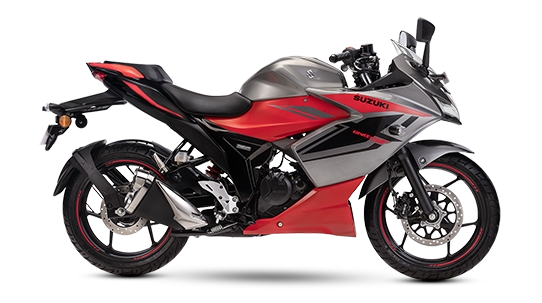
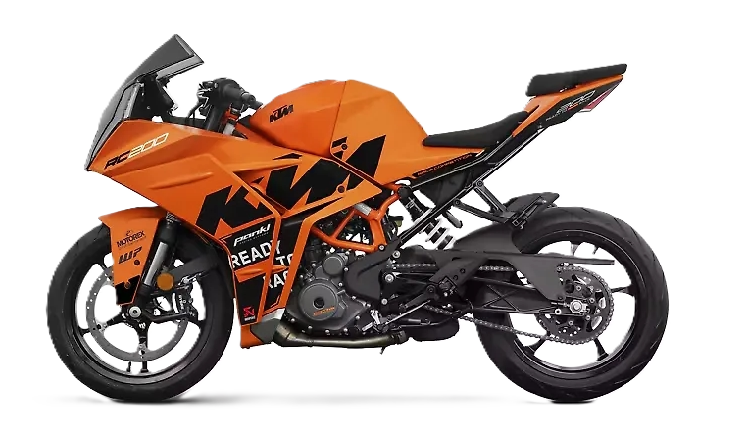
At a Glance
Key differences that define each motorcycle
Suzuki Gixxer SF
- 155 cc Air-Cooled, 2-valve
- 13.6 PS @ 8000 rpm
- 45 km/l (Claimed)
- 12-litre tank
- 1 variant available
- Single-channel ABS standard
KTM RC 200
- 199.5 cc Liquid-Cooled, DOHC 4-valve
- 25 PS @ 10000 rpm
- 43.5 km/l (ARAI)
- 13.7-litre tank
- 2 variants available
- Dual-Ch ABS + Supermoto Mode
Full Specification Comparison
Every number that matters — side by side
| Specification | Suzuki Gixxer SF | KTM RC 200 |
|---|---|---|
| Engine & Performance | ||
| Displacement | 155 cc | 199.5 cc |
| Engine Type | Air-Cooled, 2-valve, SOHC | Liquid-Cooled, DOHC, 4-valve |
| Max Power | 13.6 PS @ 8000 rpm | 25 PS @ 10000 rpm |
| Max Torque | 13.8 Nm @ 6000 rpm | 19.2 Nm @ 8000 rpm |
| Valves per Cylinder | 2 | 4 |
| Compression Ratio | 9.8:1 | 13.3:1 |
| Bore × Stroke | 56.0 × 62.9 mm | 72 × 49 mm |
| Emission Standard | BS6 Phase 2 | BS6 Phase 2B |
| Transmission | 5-Speed Manual | 6-Speed Manual |
| Clutch | Wet Multi Plate | Wet Multiplate |
| Top Speed | 115 km/h | ~140 km/h |
| Riding Modes | No | No |
| Traction Control | No | No |
| Supermoto ABS Mode | No | Yes |
| Fuel & Range | ||
| Mileage (Claimed / Certified) | 45 km/l (Claimed) | 43.5 km/l (ARAI) |
| Fuel Tank | 12 litres | 13.7 litres |
| Reserve Capacity | 2.4 litres | 1.5 litres |
| Riding Range | ~540 km | ~596 km |
| Brakes & Wheels | ||
| Braking System | Single Channel ABS | Dual Channel ABS + Supermoto Mode |
| Front Brake | Disc – 266 mm | Disc – 320 mm |
| Rear Brake | Disc – 240 mm | Disc – 230 mm |
| Tyre Type | Tubeless | Tubeless |
| Tyre Size (F / R) | 100/80-17 / 140/60R17 | 110/70-17 / 150/60-17 |
| Wheel Type | Alloy | Alloy |
| Suspension & Chassis | ||
| Front Suspension | Telescopic Fork | WP APEX USD Forks, 43 mm |
| Rear Suspension | Swing Arm Mono Shock | WP APEX Monoshock |
| Chassis | Diamond Frame | Steel Trellis Frame |
| Rear Preload Adjuster | Yes | Yes |
| Dimensions & Weight | ||
| Kerb Weight | 148 kg | 160 kg |
| Seat Height | 795 mm | 835 mm |
| Ground Clearance | 165 mm | 158 mm |
| Wheelbase | 1340 mm | 1341 mm |
| Overall L × W × H | 2025 × 715 × 1035 mm | 1980 × 688 × 1340 mm |
| Features & Electronics | ||
| Instrument Console | Fully Digital LCD | Fully Digital TFT |
| Headlight | LED Projector | LED Projector |
| DRLs | Yes | Yes |
| Turn Signals | Bulb | LED |
| Hazard Warning Lights | No | No |
| Riding Modes | No | No |
| Traction Control | No | No |
| Bluetooth Connectivity | Yes | No |
| Call & SMS Alerts | Yes | No |
| USB Charging Port | No | No |
| Distance to Empty | Yes | Yes |
| Gear Indicator | Yes | Yes |
| Tachometer | Digital | Digital |
| Service Reminder | Yes | Yes |
| Keyless Ignition | No | No |
| Price & Warranty | ||
| Starting Price (ex-showroom) | ₹1,37,594 | ₹2,20,907 |
| Top Variant Price | ₹1,37,594 | ₹2,20,907 |
| Number of Variants | 1 | 2 (Standard & GP Edition) |
| Standard Warranty | 2 Years / 30,000 km | 2 Years / 30,000 km |
★ Green highlights indicate the stronger value in each row. Prices are ex-showroom India averages and may vary by city.
Variant-wise Price Comparison
All variants laid out — find the right one for your budget
Suzuki Gixxer SF Variants
KTM RC 200 Variants
Pros & Cons
Honest strengths and weaknesses of each bike
Pros
- Much lower price — ₹83,313 cheaper than RC 200
- Lighter at 148 kg vs 160 kg for easy city handling
- Better fuel efficiency (~45 km/l vs 43.5 km/l)
- Bluetooth connectivity with call and SMS alerts
- More comfortable ergonomics for daily commuting
- Lower seat height (795 mm vs 835 mm)
- Better ground clearance (165 mm vs 158 mm)
- Larger reserve tank capacity (2.4 litres vs 1.5 litres)
- Lower maintenance costs and wider service network
- LED projector headlamp standard
Cons
- Significantly less power (13.6 PS vs 25 PS)
- Much lower torque (13.8 Nm vs 19.2 Nm)
- Only single-channel ABS — no dual-channel
- Smaller 266 mm front disc vs 320 mm on RC 200
- Air-cooled 2-valve engine lacks refinement at high RPM
- Only 5-speed gearbox vs 6-speed on RC 200
- No TFT display — standard LCD only
- Conventional telescopic forks vs premium WP APEX USD
- Bulb turn signals vs LED on RC 200
- Lower top speed (~115 km/h vs ~140 km/h)
Pros
- Massively more powerful – 25 PS @ 10000 rpm
- Higher torque – 19.2 Nm @ 8000 rpm
- Dual-channel ABS with Supermoto mode
- Premium WP APEX USD forks (43 mm) + WP monoshock
- Larger 320 mm front disc for superior braking
- Fully digital TFT instrument display
- LED turn signals standard
- 6-speed gearbox for better gear selection at speed
- Wider rear tyre (150/60-17) for more grip
- Larger 13.7-litre tank with longer riding range (~596 km)
- Higher top speed (~140 km/h)
- Steel trellis frame for sharper handling
Cons
- Significantly higher price at ₹2,20,907
- Heavier at 160 kg vs 148 kg
- Very high, aggressive seat height (835 mm)
- No Bluetooth connectivity
- Aggressive clip-on ergonomics uncomfortable in traffic
- Higher maintenance costs
- Smaller reserve tank (1.5 litres)
- Less ground clearance (158 mm vs 165 mm)
- Engine heat noticeable in city stop-and-go traffic
Key Differences Explained
What really sets these two bikes apart
Engine Character
The performance gap here is enormous. The Gixxer SF uses a 155 cc air-cooled 2-valve engine producing just 13.6 PS — smooth and tractable for city use but modest in character. The RC 200 uses a 199.5 cc liquid-cooled DOHC 4-valve unit delivering 25 PS — 84% more power — with a high-revving, purposeful character tuned for track-style performance. The RC 200 pulls hard from mid-range all the way to its 10,000 rpm power peak; the Gixxer SF is better described as a refined, friendly commuter.
Fuel Efficiency & Range
The Gixxer SF claims around 45 km/l — marginally ahead of the RC 200's ARAI-certified 43.5 km/l. However, the RC 200's much larger 13.7-litre tank gives it a theoretical range of ~596 km versus ~540 km for the Gixxer SF's 12-litre tank. The Gixxer SF's larger 2.4-litre reserve is a practical safety cushion. For daily commuters, the Gixxer SF's efficiency edge translates to lower running costs over time.
Braking & Safety
The RC 200 leads decisively. Its 320 mm front disc dwarfs the Gixxer SF's 266 mm unit, and it comes with dual-channel ABS plus an exclusive Supermoto mode that allows the rear wheel to slide while maintaining front ABS — a track-focused feature entirely absent on the Gixxer SF. The Gixxer SF's single-channel ABS only protects the front wheel, leaving the rear unassisted during emergency stops.
Suspension & Chassis
The RC 200 is in a different league here. Its WP APEX 43 mm USD forks and WP APEX monoshock are premium Austrian-made components found on motorcycles costing significantly more. The steel trellis frame provides excellent rigidity for cornering. The Gixxer SF uses a conventional telescopic fork and a swing-arm monoshock in a diamond frame — competent for everyday use, but considerably less sophisticated for aggressive riding.
Comfort & Everyday Usability
The Gixxer SF wins comfortably for daily use. Its 795 mm seat height (vs 835 mm on the RC 200) and upright-ish faired ergonomics are far more manageable in traffic. At 148 kg, it is 12 kg lighter than the RC 200 and easier to manoeuvre at slow speeds. The Gixxer SF also adds Bluetooth connectivity — completely absent on the RC 200 — making it the more modern-feeling package for everyday riders despite being the simpler machine mechanically.
Price & Value
The Gixxer SF at ₹1,37,594 is ₹83,313 cheaper than the RC 200 at ₹2,20,907 — a massive 60% premium for the KTM. The RC 200 justifies its price with far superior performance, premium suspension, dual-channel ABS and a TFT display. However, for buyers who want a stylish fully-faired motorcycle for daily commuting on a budget, the Gixxer SF represents outstanding value. The RC 200 is a purchase decision driven entirely by performance priorities over financial ones.
Expert Verdict
Which one should you actually buy?
Buy the Suzuki Gixxer SF if…
- Budget is the primary consideration (saves ₹83,313)
- You need a fully-faired bike for comfortable daily commuting
- You want Bluetooth connectivity and smart features
- A lighter, lower-seat bike is easier for your build
- Fuel efficiency and low running costs matter
- You want reliable Suzuki build quality and servicing
- You're an entry-level rider upgrading from a commuter
Buy the KTM RC 200 if…
- Performance is your top priority — 25 PS and 19.2 Nm
- You want dual-channel ABS with Supermoto mode
- Premium WP APEX USD suspension is important to you
- A TFT display and LED turn signals appeal to you
- You plan track days or frequent spirited riding
- A 320 mm front disc for strongest braking matters
- Budget is not a constraint and you want the best hardware
These bikes serve fundamentally different buyers. The Suzuki Gixxer SF is a well-priced, comfortable, and efficient faired commuter that punches above its weight with Bluetooth connectivity and reliable Suzuki refinement — ideal for budget-conscious riders wanting sporty aesthetics without the performance compromise. The KTM RC 200 is an uncompromising performance motorcycle that justifies its ₹83,313 premium with 84% more power, dual-channel ABS with Supermoto mode, premium WP APEX suspension and a TFT display. Choose the Gixxer SF for value and daily usability; choose the RC 200 only if outright performance and track-focused hardware are your absolute top priorities and your budget allows.
Frequently Asked Questions
Common questions answered by our experts
The Suzuki Gixxer SF is better for budget buyers and daily commuters who want a stylish fully-faired motorcycle with Bluetooth connectivity, comfortable ergonomics, lower maintenance costs and a significantly lower price of ₹1,37,594. The KTM RC 200 is better for performance enthusiasts who want 25 PS, dual-channel ABS with Supermoto mode, premium WP APEX USD suspension, a TFT display and a true track-inspired riding experience at ₹2,20,907.
The Suzuki Gixxer SF starts at ₹1,37,594 while the KTM RC 200 starts at ₹2,20,907 ex-showroom — a difference of ₹83,313. The RC 200 GP Edition is priced identically to the Standard at ₹2,20,907, differing only in livery. Prices are for India and may vary by city.
The Suzuki Gixxer SF delivers marginally better fuel efficiency at around 45 km/l (claimed) compared to the KTM RC 200's ARAI-certified 43.5 km/l. However, the RC 200's larger 13.7-litre tank gives it a longer estimated riding range of ~596 km versus ~540 km for the Gixxer SF's 12-litre tank. The Gixxer SF's 2.4-litre reserve also provides more cushion than the RC 200's 1.5-litre reserve.
The KTM RC 200 makes significantly more power at 25 PS @ 10000 rpm and 19.2 Nm @ 8000 rpm, compared to the Suzuki Gixxer SF's 13.6 PS @ 8000 rpm and 13.8 Nm @ 6000 rpm. The RC 200 produces 84% more power and 39% more torque. Its 199.5 cc liquid-cooled DOHC engine is substantially more advanced than the Gixxer SF's 155 cc air-cooled 2-valve motor.
No, the Suzuki Gixxer SF only comes with single-channel ABS, which protects the front wheel only. The KTM RC 200 offers dual-channel ABS as standard, along with an exclusive Supermoto mode that disables rear ABS to allow controlled rear wheel slides — a feature aimed at track and spirited riding enthusiasts. For everyday safety, dual-channel ABS on the RC 200 is a meaningful advantage.
The KTM RC 200 has significantly superior suspension. It features premium WP APEX USD forks (43 mm) at the front and a WP APEX monoshock at the rear — Austrian-made components that are rare at this price bracket and offer exceptional performance for cornering and high-speed stability. The Suzuki Gixxer SF uses conventional telescopic forks and a swing-arm monoshock in a standard diamond frame, which is entirely adequate for everyday riding but considerably less capable for aggressive or track-style use.