At a Glance
Key differences that define each motorcycle
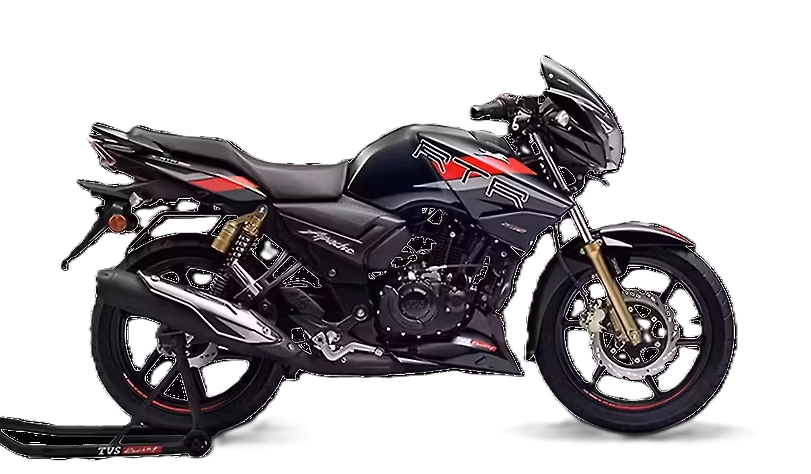
TVS Apache RTR 180
- 177.4 cc Oil-Cooled, 2-valve
- 17.02 PS @ 9000 rpm
- 45 km/l (ARAI)
- 12-litre tank
- 1 variant available
- Ride modes: Sport, Urban, Rain
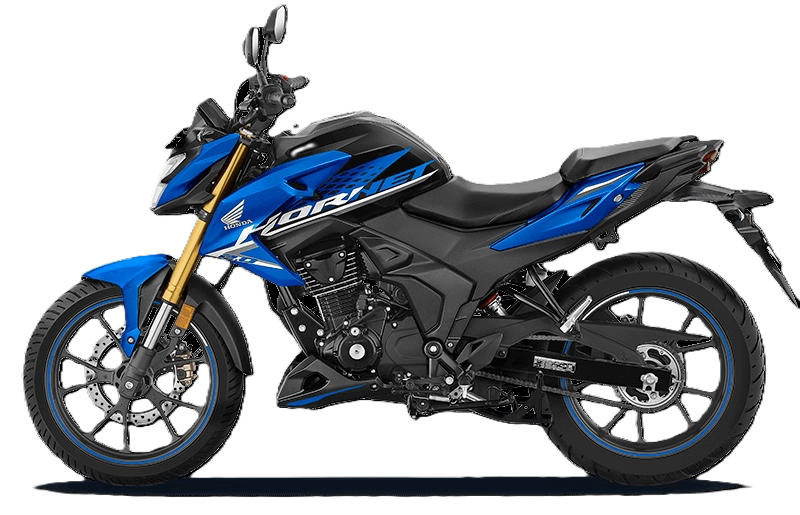
Honda Hornet 2.0
- 184.4 cc Air-Cooled, 2-valve
- 17.03 PS @ 8500 rpm
- 42.3 km/l (ARAI)
- 12-litre tank
- 1 variant available
- USD forks + full LED lighting
Full Specification Comparison
Every number that matters — side by side
| Specification | TVS Apache RTR 180 | Honda Hornet 2.0 |
|---|---|---|
| Engine & Performance | ||
| Displacement | 177.4 cc | 184.4 cc |
| Cooling System | Oil-Cooled | Air-Cooled |
| Max Power | 17.02 PS @ 9000 rpm | 17.03 PS @ 8500 rpm |
| Max Torque | 15.5 Nm @ 7000 rpm | 16.1 Nm @ 6000 rpm |
| Valves per Cylinder | 2 | 2 |
| Bore × Stroke | 62 × 58 mm | 61 × 63.1 mm |
| Compression Ratio | 10.0 : 1 | 9.5 : 1 |
| Emission Standard | BS6 Phase 2 | BS6 OBD2 |
| Transmission | 5-Speed Manual | 5-Speed Manual |
| Clutch | Wet Multiplate | Wet Multi Plate |
| Top Speed | 113 km/h | ~130 km/h |
| Riding Modes | Sport / Urban / Rain | No |
| Traction Control | No | No |
| Start Type | Electric + Kick | Electric |
| Fuel & Range | ||
| Mileage (ARAI) | 45 km/l | 42.3 km/l |
| Mileage (Real-world) | ~38–42 km/l | 40–45 km/l |
| Fuel Tank | 12 litres | 12 litres |
| Reserve Capacity | 2 litres | 1.9 litres |
| Riding Range (ARAI) | ~504 km | ~504 km |
| Brakes & Wheels | ||
| Braking System | Single Channel ABS | Single Channel ABS |
| Front Brake | Disc – 270 mm | Disc – 276 mm |
| Rear Brake | Disc – 200 mm | Disc – 220 mm |
| Tyre Type | Tubeless | Tubeless |
| Tyre Size (Front) | 90/90-17 | 110/70-17 |
| Tyre Size (Rear) | 120/70-17 | 140/70-17 |
| Wheel Type | Alloy | Alloy |
| Suspension & Chassis | ||
| Front Suspension | Telescopic Fork | USD Fork |
| Rear Suspension | Monotube Inverted Gas Shock | Monoshock |
| Chassis | Double Cradle Synchro-Stiff Frame | Diamond Type Frame |
| Rear Preload Adjuster | Yes | Yes |
| Dimensions & Weight | ||
| Kerb Weight | 140 kg | 142 kg |
| Seat Height | 790 mm | 790 mm |
| Ground Clearance | 165 mm | 168 mm |
| Wheelbase | 1326 mm | 1355 mm |
| Overall L × W × H | 2085 × 730 × 1105 mm | 2047 × 783 × 1064 mm |
| Features & Electronics | ||
| Instrument Console | Fully Digital LCD | Fully Digital LCD |
| Headlight | Halogen | LED |
| DRLs | Yes | Yes |
| Turn Signals | Halogen | LED |
| Brake / Tail Light | LED | LED |
| Hazard Warning Lights | Yes | Yes |
| Riding Modes | Sport / Urban / Rain | No |
| Bluetooth Connectivity | Yes | No |
| Call & SMS Alerts | Yes | No |
| USB Charging Port | No | No |
| Distance to Empty | Yes | No |
| Gear Indicator | Yes | Yes |
| Tachometer | Digital | Digital |
| Service Reminder | Yes | Yes |
| Traction Control | No | No |
| Keyless Ignition | No | No |
| Price & Warranty | ||
| Starting Price (ex-showroom) | ₹1,26,245 | ₹1,47,151 |
| Top Variant Price | ₹1,26,245 | ₹1,47,151 |
| Number of Variants | 1 | 1 |
| Standard Warranty | 5 Years / 60,000 km | 3 Years |
★ Green highlights indicate the stronger value in each row. Prices are ex-showroom India averages and may vary by city.
Variant-wise Price Comparison
All variants laid out — find the right one for your budget
Apache RTR 180 Variants
Hornet 2.0 Variants
Pros & Cons
Honest strengths and weaknesses of each bike
Pros
- Significantly lower price — saves ₹20,906 over Hornet 2.0
- Three riding modes: Sport, Urban and Rain
- Bluetooth connectivity standard
- Better ARAI mileage (45 km/l vs 42.3 km/l)
- Lighter at just 140 kg kerb weight
- Distance to empty display on instrument console
- Electric + kick start for added reliability
- Industry-leading 5-year / 60,000 km warranty
- Oil-cooled engine manages heat better in stop-go traffic
Cons
- Conventional telescopic forks instead of USD
- Smaller engine displacement (177.4 cc vs 184.4 cc)
- Lower torque (15.5 Nm vs 16.1 Nm)
- Lower top speed (113 km/h vs ~130 km/h)
- Halogen headlamp and turn signals — no full LED
- Narrower front tyre (90/90-17 vs 110/70-17)
- Smaller 270 mm front disc and 200 mm rear disc
- Dated design compared to newer competitors
Pros
- Larger 184.4 cc engine with higher torque (16.1 Nm)
- Premium USD (upside-down) front forks
- Full LED lighting — headlamp, tail light and turn signals
- Wider front tyre (110/70-17) for better grip and stability
- Higher top speed (~130 km/h)
- Torque peaks lower (6000 rpm) for real-world usability
- Larger brakes: 276 mm front + 220 mm rear disc
- Honda long-term reliability and resale value
- Better rear tyre (140/70-17)
- Longer wheelbase (1355 mm) for highway stability
Cons
- ₹20,906 more expensive than the Apache RTR 180
- No riding modes of any kind
- No Bluetooth connectivity or call/SMS alerts
- Lower ARAI mileage (42.3 km/l vs 45 km/l)
- No distance to empty display
- Shorter warranty — 3 years vs Apache's 5-year / 60,000 km
- Air-cooled engine less efficient at managing heat
Key Differences Explained
What really sets these two bikes apart
Engine Character
Both bikes produce nearly identical peak power — Apache at 17.02 PS and Hornet 2.0 at 17.03 PS — but their characters differ significantly. The Apache uses a 177.4 cc oil-cooled engine that revs keenly and benefits from better thermal management in traffic. The Hornet 2.0 uses a 184.4 cc air-cooled unit with a longer stroke (63.1 mm), delivering more torque (16.1 Nm vs 15.5 Nm) at lower revs (6000 rpm vs 7000 rpm), making it feel effortlessly strong in daily commuting conditions.
Fuel Efficiency & Range
The Apache RTR 180 holds a modest edge in ARAI-certified mileage at 45 km/l versus the Hornet 2.0's 42.3 km/l. Both bikes share a 12-litre fuel tank, so the ARAI-calculated riding range is similar at around 504 km each. In real-world commuting, the Apache is expected to return slightly better efficiency, though the gap is narrow enough that day-to-day running costs would be comparable for most riders.
Braking & Safety
Both bikes come equipped with single-channel ABS only — neither offers dual-channel ABS. However, the Hornet 2.0 has slightly larger braking hardware: a 276 mm front disc (vs 270 mm) and a 220 mm rear disc (vs 200 mm). The Hornet also benefits from wider tyres — a 110/70-17 front versus the Apache's narrower 90/90-17 — which translates to a larger contact patch and better cornering grip and braking stability.
Suspension & Technology
The Honda Hornet 2.0's USD (upside-down) front forks are a premium feature uncommon in this price bracket, offering improved rigidity, better front-end feel and enhanced cornering stability over the Apache's conventional telescopic forks. Conversely, the Apache counters with three riding modes (Sport, Urban, Rain) and Bluetooth connectivity with call and SMS alerts — features the Hornet 2.0 omits entirely. Each bike wins on its own axis of technology.
Warranty & Ownership
This is one of the Apache's strongest advantages. TVS offers a 5-year / 60,000 km warranty, while Honda's Hornet 2.0 comes with just a 3-year warranty with no stated kilometre limit. For high-mileage daily commuters, the Apache's longer warranty coverage provides a meaningful financial safety net. Honda's reputation for long-term reliability and strong resale value partially compensates, but the warranty difference is significant.
Price & Value
The Apache RTR 180 at ₹1,26,245 is ₹20,906 cheaper than the Hornet 2.0 at ₹1,47,151. For the extra money, the Hornet 2.0 delivers USD forks, full LED lighting, wider tyres, a larger engine with more torque and a higher top speed — but no riding modes, no Bluetooth and a shorter warranty. Buyers must weigh whether the Hornet 2.0's hardware advantages justify the premium over the Apache's superior connectivity and warranty.
Expert Verdict
Which one should you actually buy?
Buy the Apache RTR 180 if…
- Budget is your priority — saves nearly ₹21,000
- Riding modes (Sport, Urban, Rain) matter to you
- Bluetooth connectivity and call alerts are important
- You want better ARAI mileage (45 km/l)
- The 5-year / 60,000 km warranty gives you peace of mind
- You prefer an oil-cooled engine for hot city traffic
- You want a lighter motorcycle at 140 kg
Buy the Honda Hornet 2.0 if…
- You want USD front forks for superior handling
- More torque (16.1 Nm) at lower revs appeals to you
- A higher top speed (~130 km/h) matters for highways
- Full LED lighting including headlamp and turn signals
- Wider tyres for better grip and cornering stability
- Honda's long-term reliability and resale value matter
- You plan to keep the bike for many years
Overall Winner for Most Riders: TVS Apache RTR 180. At ₹20,906 less, the Apache RTR 180 delivers riding modes, Bluetooth connectivity, better ARAI mileage and a far superior 5-year / 60,000 km warranty — making it the more feature-rich and better-value choice for the majority of Indian buyers. Choose the Honda Hornet 2.0 if you specifically value the premium USD front forks, full LED lighting, wider tyres, a larger engine with more low-end torque and a higher top speed, and are willing to pay the premium for Honda's proven reliability and stronger long-term resale value.
Frequently Asked Questions
Common questions answered by our experts
The TVS Apache RTR 180 is better for budget-conscious buyers, offering riding modes, Bluetooth, better ARAI mileage (45 km/l) and a class-leading 5-year / 60,000 km warranty at ₹1,26,245. The Honda Hornet 2.0 is better for riders who prioritise USD front forks, a larger 184.4 cc engine with more torque (16.1 Nm), full LED lighting, wider tyres and a higher top speed (~130 km/h), at a premium of ₹1,47,151. Both are strong bikes in their own right — the right choice depends on whether performance hardware or smart features and value matter more to you.
The TVS Apache RTR 180 is priced at ₹1,26,245 ex-showroom while the Honda Hornet 2.0 is priced at ₹1,47,151 ex-showroom — a difference of ₹20,906. Both are single-variant motorcycles with no higher trims available. Prices are India ex-showroom averages and may vary by city.
The TVS Apache RTR 180 offers better ARAI-certified mileage at 45 km/l compared to the Honda Hornet 2.0's 42.3 km/l. Both bikes have identical 12-litre fuel tanks, so the Apache provides a marginally longer riding range. In real-world conditions, the difference is small — most riders can expect around 38–42 km/l from the Apache and 40–45 km/l from the Hornet depending on riding style and traffic.
Peak power is virtually identical — Apache at 17.02 PS versus Hornet 2.0 at 17.03 PS. The meaningful difference is in torque: the Hornet 2.0 produces 16.1 Nm @ 6000 rpm against the Apache's 15.5 Nm @ 7000 rpm. The Hornet's torque peaks at lower revs, making it feel more tractable in city traffic. The Hornet also has a higher top speed of approximately 130 km/h versus the Apache's 113 km/h, making it the quicker machine on open roads.
No. The Honda Hornet 2.0 does not offer any riding modes. The TVS Apache RTR 180 has an advantage here, offering three rider-selectable modes — Sport, Urban and Rain — which adjust power delivery and throttle response to suit different riding conditions. This is a notable point of differentiation, especially for riders who frequently commute in varying road and weather conditions.
The TVS Apache RTR 180 offers a substantially better warranty at 5 years / 60,000 km compared to the Honda Hornet 2.0's 3-year warranty (no stated kilometre limit). For daily commuters who clock 15,000–20,000 km per year, the Apache's extended warranty provides an extra 2 years of financial protection. Honda's strong long-term reliability record and resale value partially offset this gap, but the warranty difference remains a clear advantage for the Apache.