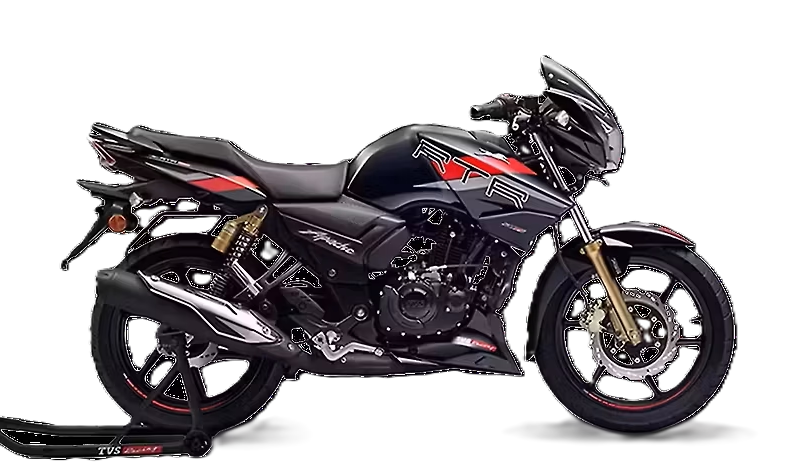
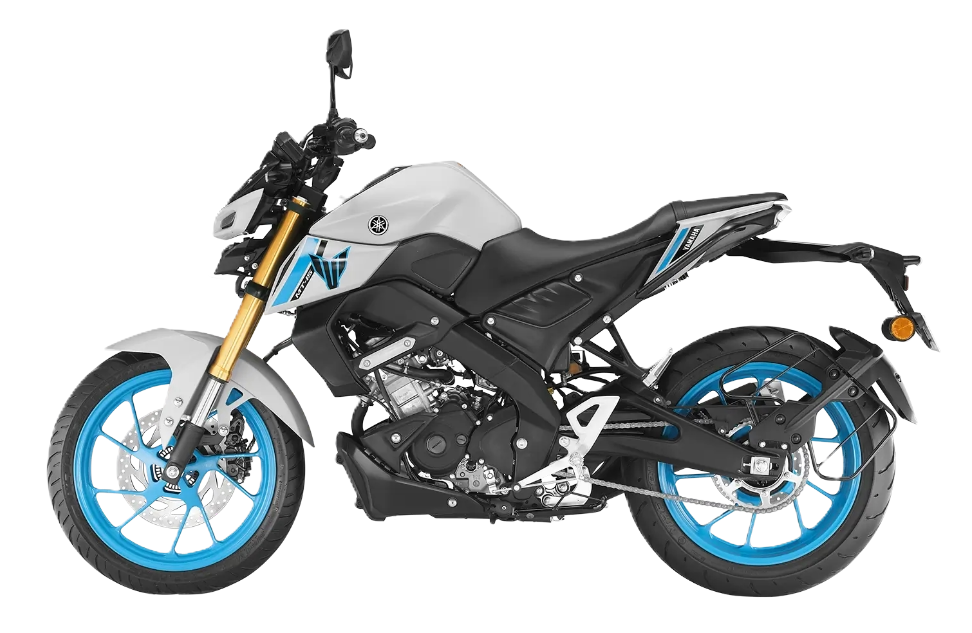
At a Glance
Key differences that define each motorcycle
TVS Apache RTR 180
- 177.4 cc Oil-Cooled, 2-valve
- 17.02 PS @ 9000 rpm
- 45 km/l (ARAI)
- 12-litre tank
- 1 variant available
- Single-channel ABS
Yamaha MT-15 V2
- 155 cc Liquid-Cooled, 4-valve
- 18.4 PS @ 10,000 rpm
- 56.87 km/l (ARAI)
- 10-litre tank
- 2 variants available
- Dual-Ch ABS + Traction Control
Full Specification Comparison
Every number that matters — side by side
| Specification | TVS Apache RTR 180 | Yamaha MT-15 V2 |
|---|---|---|
| Engine & Performance | ||
| Displacement | 177.4 cc | 155 cc |
| Cooling System | Oil-Cooled | Liquid-Cooled |
| Max Power | 17.02 PS @ 9000 rpm | 18.4 PS @ 10,000 rpm |
| Max Torque | 15.5 Nm @ 7000 rpm | 14.1 Nm @ 7,500 rpm |
| Valves per Cylinder | 2 | 4 |
| Bore × Stroke | 62 × 58 mm | 58.0 × 58.7 mm |
| Compression Ratio | 10.0 : 1 | 11.6 : 1 |
| Emission Standard | BS6 Phase 2 | BS6 OBD2 |
| Transmission | 5-Speed Manual | 6-Speed Manual |
| Clutch | Wet Multiplate | Assist & Slipper |
| Top Speed | 113 km/h | 122 km/h |
| Riding Modes | Sport / Urban / Rain | No |
| Traction Control | No | Yes |
| Fuel & Range | ||
| Mileage (ARAI) | 45 km/l | 56.87 km/l |
| Mileage (Real-world) | ~38–42 km/l | 45–50 km/l |
| Fuel Tank | 12 litres | 10 litres |
| Reserve Capacity | 2 litres | 1.6 litres |
| Riding Range (ARAI) | 504 km | 568 km |
| Brakes & Wheels | ||
| Braking System | Single Channel ABS | Dual Channel ABS |
| Front Brake | Disc – 270 mm | Disc – 282 mm |
| Rear Brake | Disc – 200 mm | Disc – 220 mm |
| Tyre Type | Tubeless | Tubeless |
| Tyre Size (Front) | 90/90-17 | 100/80-17 |
| Tyre Size (Rear) | 120/70-17 | 140/70-17 |
| Wheel Type | Alloy | Alloy |
| Suspension & Chassis | ||
| Front Suspension | Telescopic Fork | USD (Upside-Down) Fork |
| Rear Suspension | Monotube Inverted Gas Shock | Linked-Type Monoshock |
| Chassis | Double Cradle Synchro-Stiff Frame | Deltabox Frame |
| Rear Preload Adjuster | Yes | Yes |
| Dimensions & Weight | ||
| Kerb Weight | 140 kg | 141 kg |
| Seat Height | 790 mm | 810 mm |
| Ground Clearance | 165 mm | 170 mm |
| Wheelbase | 1326 mm | 1325 mm |
| Overall L × W × H | 2085 × 730 × 1105 mm | 2015 × 800 × 1070 mm |
| Features & Electronics | ||
| Instrument Console | Fully Digital LCD | Fully Digital LCD |
| Headlight | Halogen | LED |
| DRLs | Yes | Yes |
| Turn Signals | Halogen | LED |
| Brake / Tail Light | LED | LED |
| Hazard Warning Lights | Yes | Yes (DLX variant) |
| Riding Modes | Sport / Urban / Rain | No |
| Traction Control | No | Yes |
| Bluetooth Connectivity | Yes (all variants) | Yes (DLX variant only) |
| Call & SMS Alerts | Yes | Yes (DLX variant) |
| USB Charging Port | No | No |
| Distance to Empty | Yes | Yes |
| Gear Indicator | Yes | Yes |
| Navigation | No | Yes (DLX variant) |
| Start Type | Electric + Kick | Electric Start |
| Keyless Ignition | No | No |
| Price & Warranty | ||
| Starting Price (ex-showroom) | ₹1,26,245 | ₹1,60,096 |
| Top Variant Price | ₹1,26,245 | ₹1,68,507 |
| Number of Variants | 1 | 2 |
| Standard Warranty | 5 Years / 60,000 km | – (2 Years / 30,000 km) |
★ Green highlights indicate the stronger value in each row. Prices are ex-showroom India averages and may vary by city.
Variant-wise Price Comparison
All variants laid out — find the right one for your budget
Apache RTR 180 Variants
MT-15 V2 Variants
Pros & Cons
Honest strengths and weaknesses of each bike
Pros
- Significantly more affordable — ₹1,26,245 vs ₹1,60,096+
- Larger 177.4 cc engine with higher torque (15.5 Nm)
- Three riding modes: Sport, Urban and Rain
- Bluetooth connectivity standard on the only variant
- Larger 12-litre fuel tank
- Lighter at just 140 kg kerb weight
- Strong 5-year / 60,000 km warranty
- Electric + kick start for added reliability
- LED tail light
Cons
- Only single-channel ABS — no dual-channel option
- Lower ARAI mileage (45 km/l vs 56.87 km/l)
- Halogen headlamp and turn signals — no LED
- Smaller 270 mm front disc
- 5-speed gearbox vs MT-15 V2's 6-speed
- No traction control
- Older design compared to newer rivals
- Only 1 variant — no choice for buyers
Pros
- Higher peak power — 18.4 PS @ 10,000 rpm
- Liquid-cooled 4-valve engine with VVA technology
- Dual-channel ABS on both variants
- Traction control for improved safety
- USD (upside-down) front forks
- Premium Deltabox frame for superior handling
- Significantly better ARAI mileage (56.87 km/l)
- Larger 282 mm front disc and 220 mm rear disc
- Full LED lighting (headlight + indicators)
- Assist & slipper clutch
- Navigation on DLX variant
- Higher top speed (~122 km/h)
Cons
- Much higher price (₹34,000–₹42,000 more than Apache)
- Smaller 10-litre fuel tank
- No riding modes on either variant
- Bluetooth only on the DLX variant
- Shorter 2-year / 30,000 km warranty
- No USB charging port
- Compact rear seat — limited pillion comfort
Key Differences Explained
What really sets these two bikes apart
Engine Character
The Apache RTR 180 uses a 177.4 cc oil-cooled, 2-valve engine producing 17.02 PS and a strong 15.5 Nm of torque — giving it a tractable, muscular character suited to real-world riding. The Yamaha MT-15 V2 uses a 155 cc liquid-cooled, 4-valve unit producing 18.4 PS, featuring Yamaha's VVA (Variable Valve Actuation) technology for strong low-end response combined with high-rpm performance. The MT-15 V2 is more refined and revs harder; the Apache 180 pulls stronger at lower revs.
Fuel Efficiency & Range
The MT-15 V2 leads by a significant margin with an ARAI-certified 56.87 km/l against the Apache 180's 45 km/l. However, the Apache has a larger 12-litre tank giving it an ARAI range of ~504 km versus the MT-15 V2's 568 km (on its 10-litre tank). In real-world commuting, the MT-15 V2's superior mileage compensates for the smaller tank — making it more economical on running costs despite the higher purchase price.
Braking & Safety
The MT-15 V2 holds a clear advantage here. It offers dual-channel ABS on both variants, a larger 282 mm front disc (vs 270 mm), a 220 mm rear disc, and traction control — a feature virtually unheard of in this segment. The Apache RTR 180 offers single-channel ABS only, with a 270 mm front disc and 200 mm rear disc. For safety-conscious buyers, the MT-15 V2 is significantly better equipped.
Chassis & Handling
The MT-15 V2's Deltabox frame and USD (upside-down) front forks give it a clear handling advantage — the same platform underpins the Yamaha R15. The Apache RTR 180 uses a double-cradle synchro-stiff frame with conventional telescopic forks. Both are lightweight (140 vs 141 kg), but the MT-15 V2's premium chassis components deliver sharper, more precise cornering dynamics that enthusiasts will notice.
Warranty & Ownership
This is where the Apache RTR 180 gets its strongest win. TVS offers a 5-year / 60,000 km warranty compared to Yamaha's 2-year / 30,000 km warranty. For daily commuters clocking 15,000+ km per year, the Apache's warranty provides meaningful financial protection well beyond the Yamaha's coverage period. Service costs are broadly similar across both brands' dealer networks.
Price & Value
The Apache RTR 180 at ₹1,26,245 is ₹33,851 cheaper than the MT-15 V2 STD (₹1,60,096) and ₹42,262 cheaper than the DLX (₹1,68,507). That's a massive price gap. The Apache offers riding modes, Bluetooth and a proven 177 cc engine at a significantly lower entry cost. The MT-15 V2 justifies its premium with dual-channel ABS, traction control, USD forks, better mileage and LED lighting — but buyers must decide if those upgrades are worth the substantial extra spend.
Expert Verdict
Which one should you actually buy?
Buy the Apache RTR 180 if…
- Budget is your primary concern — saves ₹34,000+
- You want riding modes (Sport, Urban, Rain) at a low price
- Strong low-end torque matters for city commuting
- Bluetooth connectivity on the base variant is important
- You prefer a larger engine displacement (177.4 cc)
- The 5-year / 60,000 km warranty is a priority
- You want a proven, no-fuss daily commuter
Buy the Yamaha MT-15 V2 if…
- You want the best safety tech — dual-Ch ABS + traction control
- Premium chassis with USD forks and Deltabox frame excites you
- Superior fuel efficiency (56.87 km/l) reduces running costs
- Higher peak power (18.4 PS) and top speed matter
- Full LED lighting and premium build quality are important
- You enjoy spirited performance with Yamaha's R15 DNA
- The DLX variant's navigation and Bluetooth appeal to you
Overall Winner for Performance Buyers: Yamaha MT-15 V2. Superior peak power, dual-channel ABS with traction control, USD forks, Deltabox chassis, full LED lighting, a 6-speed gearbox with assist and slipper clutch, and outstanding ARAI mileage of 56.87 km/l make the MT-15 V2 the more technically accomplished motorcycle. However, at ₹34,000–₹42,000 more, it is a premium purchase. Choose the TVS Apache RTR 180 if budget is your top priority — it still offers riding modes, Bluetooth, a larger engine and an excellent 5-year warranty at a price that's hard to beat in this category.
Frequently Asked Questions
Common questions answered by our experts
The Yamaha MT-15 V2 is the more technically superior motorcycle, with dual-channel ABS, traction control, USD forks, Deltabox frame, full LED lighting and better ARAI mileage of 56.87 km/l. However, the TVS Apache RTR 180 offers exceptional value at ₹1,26,245 with riding modes, Bluetooth, a larger 177.4 cc engine and a strong 5-year warranty. The right choice depends on whether you prioritise performance technology (MT-15 V2) or budget and value (Apache RTR 180).
The TVS Apache RTR 180 is priced at ₹1,26,245 (single variant, ex-showroom). The Yamaha MT-15 V2 starts at ₹1,60,096 for the STD variant and goes up to ₹1,68,507 for the DLX variant. This means the Apache is approximately ₹33,851 to ₹42,262 cheaper than the MT-15 V2 depending on the variant chosen. All prices are ex-showroom India averages and may vary by city.
The Yamaha MT-15 V2 has significantly better ARAI-certified mileage at 56.87 km/l compared to the TVS Apache RTR 180's 45 km/l — a difference of nearly 12 km/l. Despite being a higher-revving performance bike, the MT-15 V2's liquid-cooled, fuel-injected engine is notably more efficient. The Apache 180 compensates partially with a larger 12-litre tank, but the MT-15 V2 still delivers a longer ARAI riding range of 568 km vs 504 km.
The Yamaha MT-15 V2 produces more peak power at 18.4 PS @ 10,000 rpm compared to the TVS Apache RTR 180's 17.02 PS @ 9,000 rpm. However, the Apache has a larger displacement (177.4 cc vs 155 cc) and makes more torque at 15.5 Nm versus the MT-15 V2's 14.1 Nm. The Apache therefore feels stronger at lower revs in everyday city riding, while the MT-15 V2 is faster at higher revs with a top speed of 122 km/h versus 113 km/h.
No. The TVS Apache RTR 180 comes with single-channel ABS only. The Yamaha MT-15 V2 offers dual-channel ABS on both its variants (STD and DLX), along with traction control. If dual-channel ABS is a priority for you, the Yamaha MT-15 V2 is the better choice, though it costs significantly more.
The TVS Apache RTR 180 has a substantially better warranty at 5 years / 60,000 km, compared to the Yamaha MT-15 V2's 2 years / 30,000 km. For daily commuters covering 15,000–20,000 km per year, the Apache's warranty provides 3 more years of coverage — a meaningful financial advantage that partially offsets the MT-15 V2's technological superiority.