At a Glance
Key differences that define each motorcycle
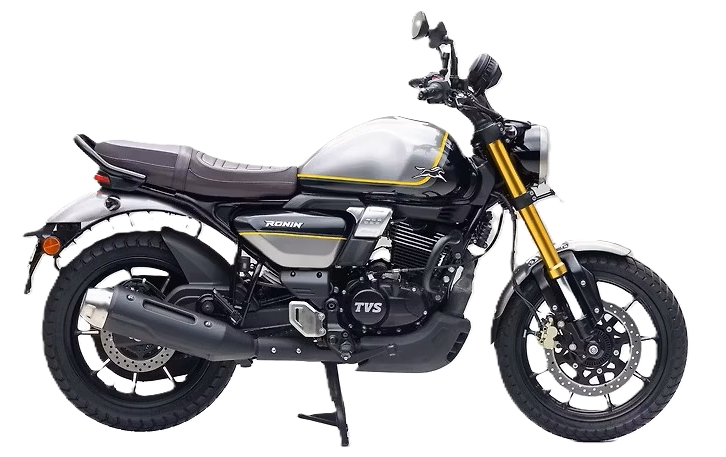
TVS Ronin 225
- 225.9 cc Oil-Cooled, 4-valve
- 20.4 PS @ 7750 rpm
- 42.95 km/l (ARAI)
- 14-litre tank
- 7 variants available
- Riding Modes: Urban & Rain
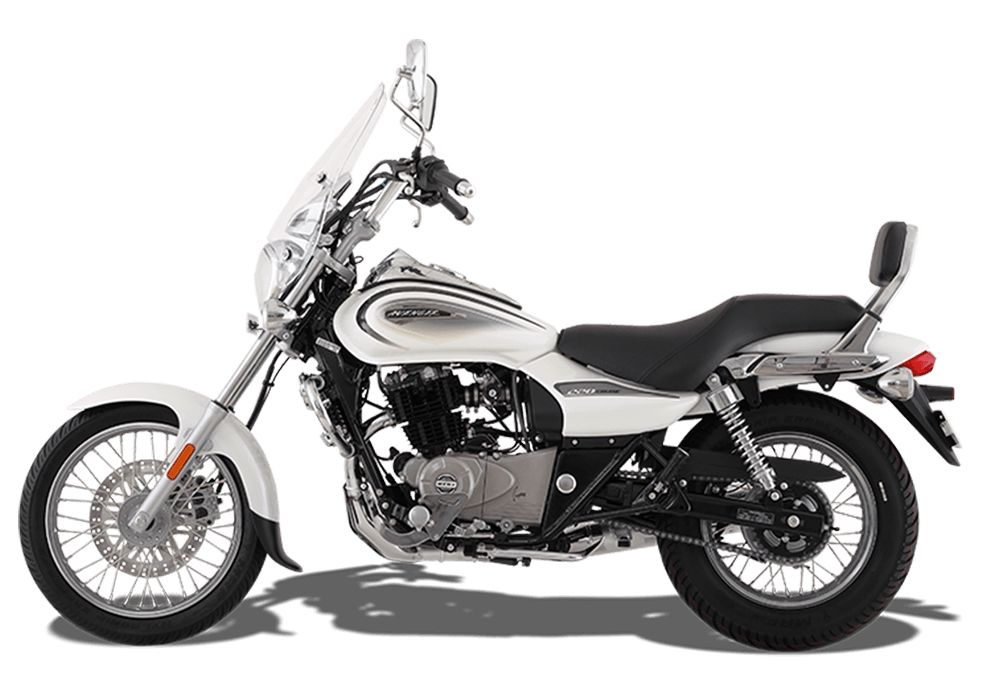
Bajaj Avenger Cruise 220
- 220 cc Oil-Cooled, 2-valve
- 19.03 PS @ 8500 rpm
- 40 km/l (ARAI)
- 13-litre tank
- 1 variant available
- Cruiser ergonomics & backrest
Full Specification Comparison
Every number that matters — side by side
| Specification | TVS Ronin 225 | Bajaj Avenger Cruise 220 |
|---|---|---|
| Engine & Performance | ||
| Displacement | 225.9 cc | 220 cc |
| Cooling System | Oil-Cooled | Oil-Cooled |
| Max Power | 20.4 PS @ 7750 rpm | 19.03 PS @ 8500 rpm |
| Max Torque | 19.93 Nm @ 3750 rpm | 17.55 Nm @ 7000 rpm |
| Valves per Cylinder | 4 | 2 |
| Bore × Stroke | 66 × 66 mm | 67 × 62.4 mm |
| Compression Ratio | 10.14 ± 0.5 : 1 | 9.8 : 1 |
| Emission Standard | BS6 Phase 2 | BS6 Phase 2 |
| Transmission | 5-Speed Manual | 5-Speed Manual |
| Clutch | Assist & Slipper | Wet Multiplate |
| Top Speed | ~120 km/h | ~120 km/h |
| Riding Modes | Urban, Rain | No |
| Traction Control | No | No |
| Fuel & Range | ||
| Mileage (ARAI) | 42.95 km/l | 40 km/l |
| Mileage (Real-world) | 38–42 km/l | ~39 km/l |
| Fuel Tank | 14 litres | 13 litres |
| Reserve Capacity | 2.8 litres | 3.8 litres |
| Riding Range | ~560 km | ~507 km |
| Brakes & Wheels | ||
| Braking System | Dual Channel ABS (mid/top) | Single Channel ABS |
| Front Brake | Disc – 300 mm | Disc – 280 mm |
| Rear Brake | Disc – 240 mm | Drum – 130 mm |
| Tyre Type | Tubeless | Tubed |
| Tyre Size (F / R) | 110/70-17 / 130/70-17 | 90/90-17 / 130/90-15 |
| Wheel Type | 9-Spoke Alloy | Spoke |
| Suspension & Chassis | ||
| Front Suspension | 41 mm USD Fork | Telescopic (anti-friction bush) |
| Rear Suspension | Monoshock (7-step preload) | Twin shock (5-step preload) |
| Chassis | Double Cradle Split Synchro Stiff Frame | Tubular Double Cradle |
| Rear Preload Adjuster | Yes | Yes |
| Dimensions & Weight | ||
| Kerb Weight | 160 kg | 163 kg |
| Seat Height | 795 mm | 737 mm |
| Ground Clearance | 181 mm | 169 mm |
| Wheelbase | 1357 mm | 1490 mm |
| Overall L × W × H | 2040 × 805 × 1170 mm | 2210 × 806 × 1321 mm |
| Features & Electronics | ||
| Instrument Console | Fully Digital | Semi-Digital |
| Headlight | LED | Halogen |
| DRLs | Yes | Yes |
| Turn Signals | LED | LED |
| Hazard Warning Lights | Yes | No |
| Riding Modes | Urban / Rain | No |
| Bluetooth Connectivity | Yes (top variants) | No |
| Navigation | Yes (top variants) | No |
| Call & SMS Alerts | Yes (top variants) | No |
| USB Charging Port | Yes | No |
| Distance to Empty | Yes | No |
| Gear Indicator | Yes | No |
| Tachometer | Digital | No |
| Pillion Backrest | No | Yes |
| Keyless Ignition | No | No |
| Price & Warranty | ||
| Starting Price (ex-showroom) | ₹1,26,690 | ₹1,26,620 |
| Top Variant Price | ₹1,60,140 | ₹1,26,620 |
| Number of Variants | 7 | 1 |
| Standard Warranty | 5 Years / 60,000 km | 5 Years / 75,000 km |
★ Green highlights indicate the stronger value in each row. Prices are ex-showroom India averages and may vary by city.
Variant-wise Price Comparison
All variants laid out — find the right one for your budget
TVS Ronin 225 Variants
Avenger Cruise 220 Variants
Pros & Cons
Honest strengths and weaknesses of each bike
Pros
- More powerful engine – 20.4 PS with higher torque (19.93 Nm)
- Torque available very low at 3750 rpm — strong city pull
- 4-valve oil-cooled engine with slipper clutch
- Dual-channel ABS on mid and top variants
- Larger 300 mm front disc + 240 mm rear disc
- Alloy wheels with tubeless tyres
- USD front forks for superior stability
- Riding modes: Urban & Rain
- Better ARAI mileage (42.95 km/l) and larger fuel tank
- Fully digital instrument console
- LED headlight, hazard lights, gear indicator
- USB charging port standard across all variants
- Bluetooth & navigation on top variants
- 7 variants — wide choice across budgets
- Superior ground clearance (181 mm)
Cons
- No pillion backrest
- Higher seat height (795 mm) — less accessible for shorter riders
- No traction control on any variant
- Top variant significantly pricier at ₹1,60,140
- Shorter warranty km coverage (60,000 km vs 75,000 km)
- Bluetooth and navigation only on top-tier variants
- Not designed for aggressive highway touring
Pros
- Very low seat height (737 mm) — accessible for all riders
- Dedicated cruiser ergonomics with pillion backrest
- Long wheelbase (1490 mm) for superior highway stability
- Comfortable wide seat for long-distance touring
- Simple single-variant lineup — no decision fatigue
- Starting price almost identical to Ronin base
- Superior warranty km coverage (5 years / 75,000 km)
- Relaxed cruiser styling with spoke wheels
- Proven 220cc engine with long-term reliability
- Lower maintenance cost profile
Cons
- Lower power (19.03 PS) and torque (17.55 Nm)
- Torque arrives late at 7000 rpm — less city-friendly
- Only single-channel ABS — no dual-channel option
- Rear drum brake — no disc option
- No riding modes
- No Bluetooth, navigation, or USB charging
- Halogen headlight instead of LED
- Semi-digital console — no gear indicator or tachometer
- Tubed tyres — puncture repair more cumbersome
- Less ground clearance (169 mm)
- Heavier at 163 kg vs 160 kg
Key Differences Explained
What really sets these two bikes apart
Engine Character
The Ronin 225 uses a 225.9 cc oil-cooled 4-valve engine with an assist & slipper clutch, making 20.4 PS and 19.93 Nm — its torque peak arrives very early at 3750 rpm, delivering a strong, tractable pull for city riding. The Avenger Cruise 220's 220 cc oil-cooled 2-valve motor produces 19.03 PS and 17.55 Nm, with a torque peak at 7000 rpm — tuned for steady cruising rather than low-RPM punch. Both engines are oil-cooled and reliable, but the Ronin's architecture is more modern.
Riding Comfort & Ergonomics
This is where the Avenger wins decisively. Its 737 mm seat height is one of the lowest in its segment, forward-set footpegs, wide handlebar, and a dedicated pillion backrest create a true cruiser posture built for long highway rides. The Ronin at 795 mm has upright neo-retro ergonomics — comfortable for city use and moderate touring, but not as relaxed over extended distances as the Avenger.
Braking & Safety
The Ronin holds a significant advantage here. Its 300 mm front disc and 240 mm rear disc with dual-channel ABS (on mid/top variants) are far superior to the Avenger's 280 mm front disc, rear drum, and single-channel ABS only setup. The Ronin also adds riding modes (including Rain) that adjust ABS behaviour for wet conditions — a meaningful safety feature the Avenger completely lacks. Tubeless tyres on the Ronin further aid safety with slower deflation on punctures.
Technology & Features
The Ronin is a generation ahead in technology. All variants get a fully digital console, gear indicator, USB charging, LED headlight, hazard warning lights, distance-to-empty, and riding modes. Top variants add Bluetooth connectivity with turn-by-turn navigation. The Avenger, by contrast, offers a semi-digital console with no gear indicator, tachometer, Bluetooth, USB port, or LED headlight — a basic feature set by modern standards.
Highway Stability
The Avenger Cruise 220's 1490 mm wheelbase — 133 mm longer than the Ronin's 1357 mm — is its headline highway advantage. A longer wheelbase means inherently better straight-line stability at speed, a trait cruiser riders value above all. The Ronin's USD front forks, monoshock rear, and 181 mm ground clearance partially compensate with better suspension quality, but the Avenger's geometry is purpose-built for relaxed highway miles.
Warranty & Ownership
Both bikes offer a 5-year warranty, but the Avenger Cruise 220 covers 75,000 km while the Ronin 225 covers 60,000 km. For daily commuters covering 15,000+ km per year, the Avenger's extra 15,000 km of warranty protection is a genuine advantage. The Avenger also benefits from a simpler, proven 2-valve engine that has demonstrated long-term reliability and low maintenance costs over many years.
Expert Verdict
Which one should you actually buy?
Buy the TVS Ronin 225 if…
- You want modern tech: Bluetooth, navigation, riding modes
- City commuting is your primary use and low-end torque matters
- You value better braking with disc brakes front and rear
- LED lighting, hazard lights, and USB charging are important
- You want a fully digital console with gear indicator
- Ground clearance on rough city roads is a concern
- Variety of variants helps you balance budget vs features
- A neo-retro aesthetic appeals more than a classic cruiser look
Buy the Avenger Cruise 220 if…
- Long highway rides and touring are your primary use case
- Very low seat height (737 mm) is essential for your comfort
- Classic cruiser ergonomics with a pillion backrest matter
- You want the longest warranty km coverage (75,000 km)
- Simplicity and proven long-term reliability appeal to you
- You prefer a single straightforward variant with no confusion
- Classic spoke-wheel cruiser styling suits your taste
- You don't need Bluetooth or advanced connectivity features
Overall Winner for Most Riders: TVS Ronin 225. More power, better low-end torque, superior braking (disc-disc with dual-channel ABS), modern features like riding modes, USB charging, fully digital console and LED lighting, better fuel efficiency, more ground clearance, and a wider variant range make the Ronin 225 the more well-rounded and future-proof choice for the majority of Indian buyers. Choose the Bajaj Avenger Cruise 220 only if pure cruiser comfort, an exceptionally low seat height, long highway touring ergonomics, or the classic spoke-wheel cruiser character are your absolute top priorities.
Frequently Asked Questions
Common questions answered by our experts
The TVS Ronin 225 is better for most buyers who want modern technology (riding modes, Bluetooth, dual-channel ABS), more power (20.4 PS), disc brakes all round, better fuel efficiency (42.95 km/l), and a wider range of variants. The Bajaj Avenger Cruise 220 is better for riders who prioritise pure cruiser comfort, a very low 737 mm seat height, a dedicated pillion backrest, long wheelbase stability, and the superior 5-year / 75,000 km warranty.
At the base level, the difference is negligible — the Avenger Cruise 220 starts at ₹1,26,620 and the Ronin 225 starts at ₹1,26,690, a difference of just ₹70. However, the Ronin's range extends to ₹1,60,140 for its connected top variant, while the Avenger is available in only a single standard variant at ₹1,26,620. Both prices are ex-showroom India and may vary by city.
The TVS Ronin 225 delivers better ARAI-certified mileage at 42.95 km/l compared to the Avenger Cruise 220's 40 km/l. The Ronin also has a larger 14-litre tank versus the Avenger's 13 litres, giving it a longer theoretical riding range of ~560 km against ~507 km. Real-world figures are 38–42 km/l for the Ronin and approximately 39 km/l for the Avenger.
The TVS Ronin 225 makes more power at 20.4 PS @ 7750 rpm compared to the Bajaj Avenger Cruise 220's 19.03 PS @ 8500 rpm. More importantly, the Ronin's torque of 19.93 Nm arrives very early at 3750 rpm — far lower than the Avenger's 17.55 Nm at 7000 rpm. This makes the Ronin feel considerably stronger in real-world city riding where low-rpm pull matters most.
Yes, the TVS Ronin 225 offers two riding modes — Urban and Rain — across most of its variants, adjusting power delivery and ABS sensitivity for different road conditions. The Bajaj Avenger Cruise 220 does not offer any riding modes.
The Bajaj Avenger Cruise 220 is specifically designed for long-distance touring. Its 737 mm seat height, forward-set footpegs, wide handlebar, long 1490 mm wheelbase, and pillion backrest create a relaxed, fatigue-free posture for extended highway rides. The TVS Ronin 225 is comfortable for daily commuting and moderate touring with upright ergonomics, but its shorter wheelbase and streetfighter stance are less optimised for pure highway cruising.
Both bikes offer a 5-year warranty, but they differ in kilometre coverage: the Bajaj Avenger Cruise 220 covers 75,000 km while the TVS Ronin 225 covers 60,000 km. For high-mileage commuters and tourers who clock 15,000–20,000 km per year, the Avenger's additional 15,000 km of warranty coverage provides meaningful protection against potential out-of-warranty repair costs.