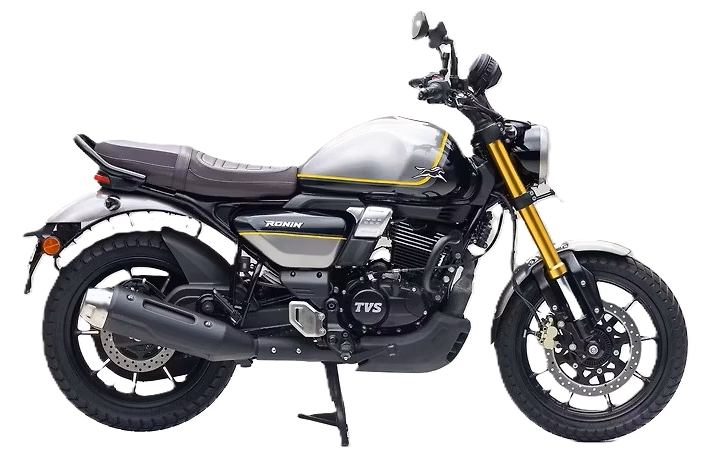
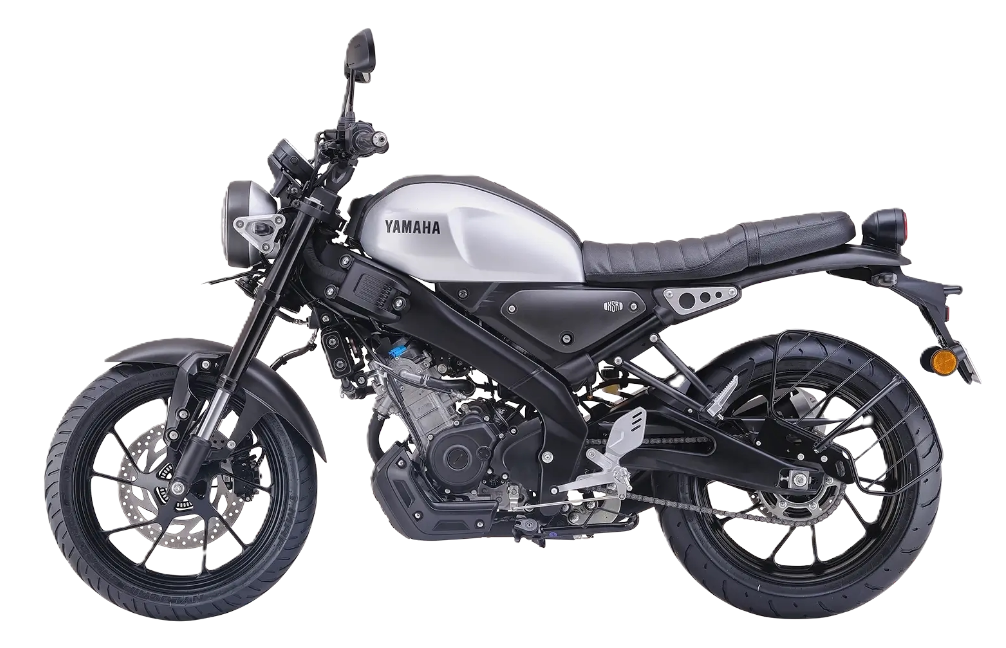
At a Glance
Key differences that define each motorcycle
TVS Ronin 225
- 225.9 cc Oil-Cooled, 4-valve
- 20.4 PS @ 7750 rpm
- 42.95 km/l (ARAI)
- 14-litre tank
- 7 variants available
- Ride modes: Urban, Rain
Yamaha XSR 155
- 155 cc Liquid-Cooled, 4-valve VVA
- 18.4 PS @ 10000 rpm
- 46 km/l (Claimed)
- 10-litre tank
- 1 variant (5 colours)
- Traction control standard
Full Specification Comparison
Every number that matters — side by side
| Specification | TVS Ronin 225 | Yamaha XSR 155 |
|---|---|---|
| Engine & Performance | ||
| Displacement | 225.9 cc | 155 cc |
| Cooling System | Oil-Cooled | Liquid-Cooled |
| Max Power | 20.4 PS @ 7750 rpm | 18.4 PS @ 10000 rpm |
| Max Torque | 19.93 Nm @ 3750 rpm | 14.2 Nm @ 7500 rpm |
| Valves per Cylinder | 4 | 4 |
| Engine Technology | Standard FI | VVA (Variable Valve Actuation) |
| Compression Ratio | 10.14 ± 0.5 : 1 | 11.6 : 1 |
| Bore × Stroke | 66 × 66 mm | 58.0 × 58.7 mm |
| Emission Standard | BS6 Phase 2 | BS6 Phase 2 |
| Transmission | 5-Speed Manual | 6-Speed Manual |
| Clutch | Assist & Slipper | Assist & Slipper |
| Top Speed | ~120 km/h | ~130 km/h |
| Riding Modes | Urban, Rain | No |
| Traction Control | No | Yes (standard) |
| Fuel & Range | ||
| Mileage (Claimed) | 42.95 km/l (ARAI) | 46 km/l |
| Fuel Tank | 14 litres | 10 litres |
| Reserve Capacity | 2.8 litres | 1.6 litres |
| Riding Range | ~560 km | ~460 km |
| Brakes & Wheels | ||
| Braking System | Dual Channel ABS (mid & top variants) | Dual Channel ABS (standard) |
| Front Brake | Disc – 300 mm | Disc – 282 mm |
| Rear Brake | Disc – 240 mm | Disc – 220 mm |
| Tyre Type | Tubeless | Tubeless |
| Tyre Size (F / R) | 110/70-17 / 130/70-17 | 100/80-17 / 140/70-17 |
| Wheel Type | 9-Spoke Alloy | Alloy |
| Suspension & Chassis | ||
| Front Suspension | 41 mm USD Fork | USD Fork |
| Rear Suspension | Monoshock (7-step adjustable) | Monoshock |
| Chassis | Double Cradle Split Synchro Stiff Frame | Deltabox Frame |
| Rear Preload Adjuster | Yes (7-step) | Yes |
| Dimensions & Weight | ||
| Kerb Weight | 160 kg | 137 kg |
| Seat Height | 795 mm | 810 mm |
| Ground Clearance | 181 mm | 170 mm |
| Wheelbase | 1357 mm | 1330 mm |
| Overall L × W × H | 2040 × 805 × 1170 mm | 2007 × 804 × 1080 mm |
| Features & Electronics | ||
| Instrument Console | Fully Digital | Fully Digital LCD |
| Headlight | LED | LED |
| DRLs | Yes | Yes |
| Turn Signals | LED | LED |
| Hazard Warning Lights | Yes | No |
| Riding Modes | Urban / Rain | No |
| Traction Control | No | Yes |
| Bluetooth Connectivity | Yes (top variants) | Yes (standard, Y-Connect) |
| Call & SMS Alerts | Yes (top variants) | Yes |
| USB Charging Port | Yes | No |
| Distance to Empty | Yes | No |
| Navigation | Yes (top variants) | No |
| Gear Indicator | Yes | Yes |
| Tachometer | Digital | Digital |
| Keyless Ignition | No | No |
| Price & Warranty | ||
| Starting Price (ex-showroom) | ₹1,26,690 | ₹1,49,990 |
| Top Variant Price | ₹1,60,140 | ₹1,58,990 |
| Number of Variants | 7 | 1 (5 colour options) |
| Standard Warranty | 5 Years / 60,000 km | 2 Years / 30,000 km |
★ Green highlights indicate the stronger value in each row. Prices are ex-showroom India averages and may vary by city.
Variant-wise Price Comparison
All variants laid out — find the right one for your budget
TVS Ronin 225 Variants
Yamaha XSR 155 Variants
Pros & Cons
Honest strengths and weaknesses of each bike
Pros
- Larger 225.9 cc engine with massive torque (19.93 Nm)
- Much lower starting price (₹1,26,690 vs ₹1,49,990)
- Large 14-litre tank for longer riding range (~560 km)
- Bigger 300 mm front disc and 240 mm rear disc
- Riding modes: Urban and Rain
- USB charging port standard across all variants
- Distance to empty indicator
- Hazard warning lights standard
- Navigation on top variants
- 7 variants — widest choice
- Excellent 5-year / 60,000 km warranty
- Excellent ground clearance (181 mm)
Cons
- No traction control on any variant
- Base variants only have single-channel ABS
- Heavier at 160 kg vs 137 kg
- Bluetooth only on top two variants
- Lower top speed (~120 km/h vs ~130 km/h)
- Lower mileage (42.95 km/l vs 46 km/l)
- Only 5-speed gearbox vs 6-speed
Pros
- Traction control standard on every colour variant
- Liquid-cooled VVA engine — highest-revving in class
- Dual-channel ABS standard across all variants
- Lighter at just 137 kg for sharper handling
- 6-speed gearbox for better highway cruising
- Higher top speed (~130 km/h)
- Better mileage (46 km/l)
- Bluetooth Y-Connect standard on all colours
- Wider rear tyre (140/70-17) for better grip
- Premium Yamaha build quality and finish
Cons
- Significantly higher starting price (₹1,49,990)
- Tiny 10-litre fuel tank — short ~460 km range
- No ride modes on any variant
- No USB charging port
- No hazard warning lights
- No navigation features
- Very weak 2-year / 30,000 km warranty
- No colour/mechanical variants — less choice
- Smaller engine — less low-end torque
Key Differences Explained
What really sets these two bikes apart
Engine Character
The TVS Ronin 225 uses a 225.9 cc oil-cooled, 4-valve engine producing 20.4 PS but, crucially, a massive 19.93 Nm of torque at just 3750 rpm — nearly 40% more torque than the XSR 155's 14.2 Nm. This makes the Ronin feel effortlessly tractable in traffic. The Yamaha XSR 155 uses a 155 cc liquid-cooled, VVA 4-valve unit making 18.4 PS at 10,000 rpm. Its liquid cooling and Variable Valve Actuation deliver a more free-revving, sporty character with stronger high-rpm performance — but everyday rideability strongly favours the Ronin's torquey delivery.
Fuel Efficiency & Range
The XSR 155 claims better mileage at 46 km/l against the Ronin's ARAI-certified 42.95 km/l. However, the Ronin's 14-litre tank completely overturns the range comparison — it delivers approximately 560 km per fill versus just 460 km for the XSR 155's 10-litre tank. That is a 100 km range advantage despite lower efficiency. The Ronin's larger reserve capacity (2.8 litres vs 1.6 litres) also reduces range anxiety.
Braking & Safety
The Yamaha XSR 155 has a notable safety advantage — dual-channel ABS is standard on every variant, and it also includes traction control, a feature absent on the Ronin. The Ronin's base three variants use single-channel ABS; dual-channel only arrives from ₹1,48,040 (Mid variant). However, the Ronin has larger discs — 300 mm front (vs 282 mm) and 240 mm rear (vs 220 mm) — giving better raw stopping power on the mid and top variants.
Ride Modes & Technology
The TVS Ronin 225 has an edge in ride-mode technology with Urban and Rain modes on mid and top variants. The Yamaha XSR 155 has no ride modes at all, but compensates with traction control and Bluetooth Y-Connect as standard. The Ronin also offers USB charging, distance to empty, navigation (top variants) and hazard warning lights — a richer feature list. The XSR's Bluetooth is standard across all five colours, whereas the Ronin restricts it to the two most expensive variants.
Warranty & Ownership
The TVS Ronin 225 offers a decisively better 5-year / 60,000 km warranty against the Yamaha XSR 155's 2-year / 30,000 km warranty. For a rider averaging 12,000 km per year, the XSR 155's warranty could expire in under three years, while the Ronin's coverage lasts over five. This is a major long-term ownership advantage for the Ronin that can translate to significant savings on repair costs.
Price & Value
The Ronin's base starts ₹23,300 cheaper (₹1,26,690 vs ₹1,49,990). At comparable price points — the Ronin's Mid variants at ₹1,48,040–₹1,49,340 vs the XSR's cheapest at ₹1,49,990 — the Ronin delivers a larger engine, more torque, dual-channel ABS, ride modes and a bigger tank for roughly the same money. The only serious advantage the XSR offers at this price is traction control, VVA engine technology and the Yamaha brand premium.
Expert Verdict
Which one should you actually buy?
Buy the TVS Ronin 225 if…
- A larger, torquier engine for everyday riding is a priority
- Long riding range and a big 14-litre tank matter to you
- You want the lowest starting price in this comparison
- USB charging, ride modes and navigation are important
- The superior 5-year / 60,000 km warranty gives you confidence
- You want multiple variant options to match your budget
- Ground clearance (181 mm) for rough roads is important
Buy the Yamaha XSR 155 if…
- Traction control as standard is non-negotiable for you
- Dual-channel ABS from the base price matters
- The VVA liquid-cooled engine character excites you
- A lighter 137 kg chassis for agile city handling appeals
- Yamaha's premium build quality and brand heritage count
- Higher top speed (~130 km/h) for highway riding is needed
- Bluetooth Y-Connect from base without paying extra is key
Overall Winner for Most Riders: TVS Ronin 225. A larger and torquier engine, a significantly lower starting price, a 14-litre fuel tank delivering far greater range, bigger disc brakes, ride modes, USB charging, navigation, hazard lights and an outstanding 5-year / 60,000 km warranty give the Ronin a commanding overall package. The Yamaha XSR 155 wins on traction control, liquid-cooled VVA engine sophistication, lighter weight and the Yamaha premium — choose it if those specific qualities justify the higher price and weaker warranty for you.
Frequently Asked Questions
Common questions answered by our experts
The TVS Ronin 225 is better for most buyers due to its larger 225.9 cc engine, massively more torque (19.93 Nm vs 14.2 Nm), significantly lower starting price (₹1,26,690 vs ₹1,49,990), a 14-litre tank for longer range (~560 km), USB charging, ride modes and a far superior 5-year / 60,000 km warranty. The Yamaha XSR 155 is better if traction control, Yamaha's VVA liquid-cooled engine, a lighter chassis and the brand premium are your top priorities.
The TVS Ronin 225 starts at ₹1,26,690 (Base Lightning Black) and goes up to ₹1,60,140 for top variants. The Yamaha XSR 155 is priced from ₹1,49,990 (Metallic Blue) to ₹1,58,990 for its most expensive colour options. At base level, the Ronin is ₹23,300 cheaper. However, at the mid variants (₹1,48,040– ₹1,49,340), the Ronin competes almost at par with the XSR's starting price while offering dual-channel ABS, ride modes and a larger engine. Prices are ex-showroom India and may vary by city.
The Yamaha XSR 155 claims better mileage at 46 km/l compared to the TVS Ronin 225's ARAI-certified 42.95 km/l. However, in terms of riding range, the Ronin wins convincingly — its 14-litre tank provides approximately 560 km per fill versus just 460 km for the XSR 155's 10-litre tank. Despite lower efficiency, the Ronin goes 100 km further before needing to refuel, which matters far more for practical daily riding.
The TVS Ronin 225 makes more peak power at 20.4 PS @ 7750 rpm compared to the Yamaha XSR 155's 18.4 PS @ 10000 rpm. The Ronin also produces significantly more torque at 19.93 Nm vs 14.2 Nm, available much lower in the rev range (3750 rpm vs 7500 rpm). While the Yamaha's VVA engine revs higher and delivers more top-end excitement, the Ronin's torque advantage makes it noticeably stronger and more effortless for everyday city riding and overtaking.
No, the TVS Ronin 225 does not offer traction control on any of its seven variants. The Yamaha XSR 155 comes with traction control as standard across all its five colour options — making this a significant advantage for the Yamaha from a safety and electronics standpoint. The Ronin partially offsets this with Urban and Rain ride modes on its mid and top variants, which adjust throttle response for different conditions.
The TVS Ronin 225 offers a vastly superior 5-year / 60,000 km warranty compared to the Yamaha XSR 155's 2-year / 30,000 km warranty. This is one of the most significant practical differences between the two bikes. A typical rider clocking 10,000–12,000 km annually would exhaust the XSR's warranty in under three years, while the Ronin's warranty would still have years remaining. This translates to meaningfully lower risk of out-of-warranty repair costs for Ronin owners.