At a Glance
Key differences that define each motorcycle
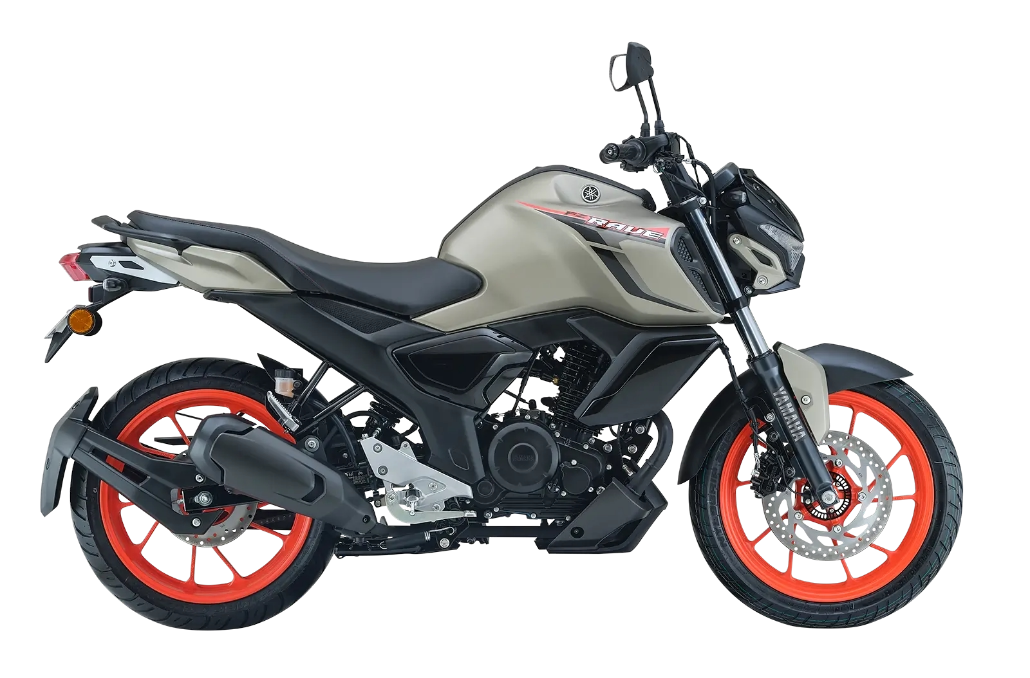
Yamaha FZ Rave
- 149cc Air-Cooled, 2-valve
- 12.4 PS @ 7250 rpm
- Mileage Not Claimed
- 13-litre tank (~663 km range)
- 1 variant available
- Single-Ch ABS, LED Projector
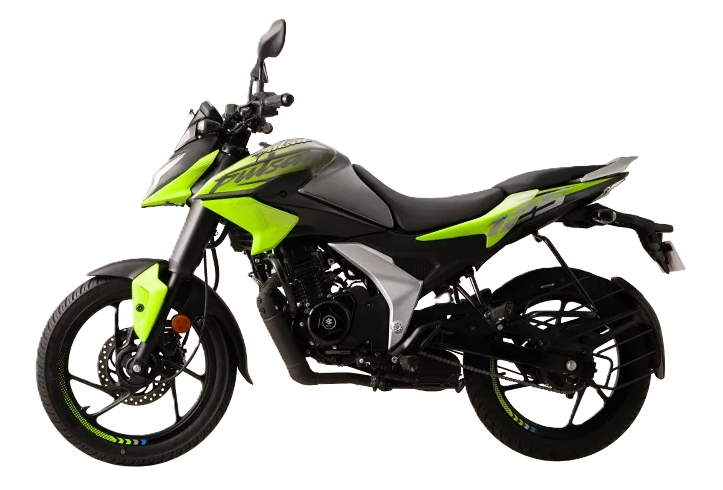
Bajaj Pulsar N125
- 124.58cc Air-Cooled, 2-valve
- 12 PS @ 8500 rpm
- 60 km/l (ARAI)
- 9.5-litre tank (~570 km range)
- 2 variants available
- 5-year / 75,000 km warranty
Full Specification Comparison
Every number that matters — side by side
| Specification | Yamaha FZ Rave | Bajaj Pulsar N125 |
|---|---|---|
| Engine & Performance | ||
| Displacement | 149 cc | 124.58 cc |
| Cooling System | Air-Cooled | Air-Cooled |
| Max Power | 12.4 PS @ 7250 rpm | 12 PS @ 8500 rpm |
| Max Torque | 13.3 Nm @ 5500 rpm | 11 Nm @ 6000 rpm |
| Valves per Cylinder | 2 | 2 |
| Compression Ratio | 9.6 : 1 | 10.05 ± 0.3 : 1 |
| Bore × Stroke | 57.3 × 57.9 mm | 54 × 54.4 mm |
| Emission Standard | BS6 Phase 2 | BS6 Phase 2 |
| Transmission | 5-Speed Manual | 5-Speed Manual |
| Top Speed | ~115 km/h | ~100 km/h |
| Riding Modes | No | No |
| Traction Control | No | No |
| Fuel & Range | ||
| Mileage (Claimed) | Not Claimed | 60 km/l (ARAI) |
| Fuel Tank | 13 litres | 9.5 litres |
| Reserve Capacity | 1.7 litres | 1.5 litres |
| Riding Range | ~663 km (estimated) | ~570 km (ARAI based) |
| Brakes & Wheels | ||
| Braking System | Single Channel ABS | CBS |
| Front Brake | Disc – 282 mm | Disc – 240 mm |
| Rear Brake | Disc – 220 mm | Drum – 130 mm |
| Tyre Type | Tubeless | Tubeless |
| Tyre Size (F / R) | 100/80-17 / 140/60R-17 | 80/100-17 / 110/80-17 |
| Wheel Type | Alloy | Alloy |
| Suspension & Chassis | ||
| Front Suspension | Telescopic Fork | Telescopic Fork |
| Rear Suspension | Swingarm | Mono-shock |
| Chassis | Diamond Frame | Diamond Frame |
| Rear Preload Adjuster | No | Yes |
| Dimensions & Weight | ||
| Kerb Weight | 136 kg | 125 kg |
| Seat Height | 790 mm | 795 mm |
| Ground Clearance | 165 mm | 198 mm |
| Wheelbase | 1330 mm | 1295 mm |
| Overall L × W × H | 1990 × 780 × 1080 mm | 2018 × 810 × 1078 mm |
| Features & Electronics | ||
| Instrument Console | Fully Digital LCD | Fully Digital LCD |
| Headlight | LED Projector | LED |
| DRLs | Yes | Yes |
| Turn Signals | LED | LED |
| Hazard Warning Lights | Yes | Yes |
| Bluetooth Connectivity | Yes | Yes (BT variant only) |
| Call & SMS Alerts | Yes | Yes (BT variant only) |
| USB Charging Port | No | Yes |
| Distance to Empty | No | Yes |
| Gear Indicator | No | Yes |
| Service Reminder | Yes | Yes |
| Side Stand Engine Cut-off | Yes | Yes |
| Keyless Ignition | No | No |
| Price & Warranty | ||
| Starting Price (ex-showroom) | ₹1,20,060 | ₹93,668 |
| Top Variant Price | ₹1,20,060 (single variant) | ₹94,661 (LED Disc BT) |
| Number of Variants | 1 | 2 |
| Standard Warranty | 2 Years / 30,000 km | 5 Years / 75,000 km |
★ Green highlights indicate the stronger value in each row. Prices are ex-showroom India averages and may vary by city.
Variant-wise Price Comparison
All variants laid out — find the right one for your budget
Yamaha FZ Rave Variants
Pulsar N125 Variants
Pros & Cons
Honest strengths and weaknesses of each bike
Pros
- Larger 149cc engine with more power (12.4 PS) and torque (13.3 Nm)
- Single-channel ABS standard for superior braking safety
- Larger 282 mm front disc and 220 mm rear disc brakes
- LED projector headlamp for better road illumination
- Wider rear tyre (140/60R-17) for more grip
- Higher top speed (~115 km/h vs ~100 km/h)
- Longer wheelbase (1330 mm) for better highway stability
- Bluetooth connectivity standard across the single variant
- Yamaha's proven engine refinement and low vibrations
- Larger 13-litre fuel tank for extended range
Cons
- Significantly higher price (₹1,20,060 vs ₹93,668)
- No official ARAI mileage figure claimed
- Only single variant — no choice of spec level
- Weaker warranty (2 years / 30,000 km)
- No USB charging port
- No gear indicator on display
- No distance to empty readout
- Less ground clearance (165 mm vs 198 mm)
- Heavier at 136 kg vs 125 kg
- No rear preload adjuster on suspension
Pros
- Lower starting price (₹93,668 vs ₹1,20,060) — saves ₹26,392
- ARAI-certified 60 km/l mileage for lower running costs
- Outstanding 5-year / 75,000 km warranty
- Superior ground clearance (198 mm vs 165 mm)
- Lighter at just 125 kg for better city agility
- Monoshock rear suspension for better ride quality
- Rear preload adjuster available
- USB charging port standard on both variants
- Gear indicator and distance to empty on display
- LED turn signals and hazard warning lights
- Bluetooth available in BT variant (₹94,661)
Cons
- No ABS — only CBS (no front wheel lock-up prevention)
- Rear drum brake instead of disc
- Smaller 124.58cc engine, less power and torque
- Lower top speed (~100 km/h)
- Smaller front disc (240 mm vs 282 mm)
- Narrower rear tyre (110/80-17 vs 140/60R-17)
- Bluetooth only on BT variant, not base model
- Less highway cruising ability
Key Differences Explained
What really sets these two bikes apart
Price & Segment
The Pulsar N125 starts at just ₹93,668 while the FZ Rave is priced at ₹1,20,060 — a gap of ₹26,392. Even the Pulsar's fully equipped BT variant at ₹94,661 is over ₹25,000 cheaper. These bikes sit in different price and engine segments: the N125 is a premium 125cc commuter; the FZ Rave competes in the 150cc space. Buyers with a budget under ₹1 lakh will naturally gravitate to the Pulsar, while those with ₹1.2 lakh get a meaningfully larger engine.
Engine & Performance
The FZ Rave's 149cc engine delivers 12.4 PS and 13.3 Nm — about 3.3% more power and 21% more torque than the Pulsar N125's 124.58cc unit. The Yamaha also reaches ~115 km/h versus the Bajaj's ~100 km/h. In real riding, the FZ Rave feels noticeably more capable at highway speeds and during overtakes. The Pulsar N125 compensates with revvier high-rpm character for city sprinting, but the FZ Rave dominates for all-round performance.
Braking & Safety
The FZ Rave has a decisive advantage here. It offers single-channel ABS with a 282 mm front disc and 220 mm rear disc — both significantly larger than the Pulsar N125's 240 mm front disc and 130 mm rear drum brake. The Pulsar uses CBS without ABS, meaning there is no electronic protection against front wheel lock-up under hard braking. ABS is a meaningful real-world safety advantage, especially in emergency stops on wet roads.
Fuel Efficiency & Range
The Pulsar N125 declares an ARAI-certified 60 km/l — Yamaha has not claimed a figure for the FZ Rave. The Pulsar's smaller 124.58cc engine and 125 kg kerb weight give it a natural efficiency advantage. However, the FZ Rave's larger 13-litre tank versus the N125's 9.5 litres means the Yamaha offers a longer estimated range of ~663 km against ~570 km. For daily fuel cost savings, the Pulsar N125 wins; for fewer refuelling stops, the FZ Rave wins.
Warranty & Ownership
The Pulsar N125 holds a commanding warranty advantage: 5 years or 75,000 km versus the FZ Rave's 2 years or 30,000 km. The Bajaj offers 2.5 times longer coverage and 2.5 times more kilometre protection. For a daily commuter clocking 15,000–20,000 km per year, this is a significant financial safety net that can avoid expensive post-warranty repairs. Both bikes use Bajaj and Yamaha's widespread India service networks.
Features & Practicality
Both bikes offer LED lighting and digital consoles, but differ in key areas. The FZ Rave has a LED projector headlamp, ABS, wider tyres, and Bluetooth standard. The Pulsar N125 counters with a USB charging port on both variants, gear indicator, distance to empty display, rear preload adjuster, and class-leading 198 mm ground clearance. The Pulsar N125 BT also adds Bluetooth for just ₹993 more over base. On everyday utility, the Pulsar edges ahead.
Expert Verdict
Which one should you actually buy?
Buy the Yamaha FZ Rave if…
- You have a ₹1.2 lakh budget and want a 150cc commuter
- ABS for front wheel safety is a non-negotiable requirement
- You ride on highways and need top speed beyond 100 km/h
- An LED projector headlamp for better night visibility matters
- Wider rear tyre grip and larger disc brakes appeal to you
- Yamaha engine refinement and smooth power delivery are priorities
- You want Bluetooth connectivity available from the base variant
Buy the Bajaj Pulsar N125 if…
- Budget is the priority — starts ₹26,392 cheaper at ₹93,668
- The exceptional 5-year / 75,000 km warranty gives long-term peace of mind
- You clock 15,000+ km/year and want lower fuel running costs
- 198 mm ground clearance matters for rough Indian roads
- You want a USB charging port standard from the base variant
- Sporty Pulsar styling with N-series DNA appeals to you
- City commuting is your primary use and highway speed is not critical
Overall Winner for Most Riders: Bajaj Pulsar N125. Despite a smaller 124.58cc engine and the absence of ABS, the Pulsar N125 wins this comparison on the metrics that matter most to budget-conscious Indian commuters: a ₹26,392 lower price, ARAI-certified 60 km/l mileage, an outstanding 5-year / 75,000 km warranty, superior 198 mm ground clearance, a USB charging port standard, and a gear indicator — all at under ₹95,000. Choose the Yamaha FZ Rave if you specifically need ABS braking safety, a 149cc engine with higher top speed, an LED projector headlamp, and wider tyres, and are comfortable spending ₹1.2 lakh.
Frequently Asked Questions
Common questions answered by our experts
For most budget-conscious buyers, the Bajaj Pulsar N125 wins on value with a ₹26,392 lower price, ARAI-certified 60 km/l mileage, an exceptional 5-year / 75,000 km warranty, 198 mm ground clearance, and a USB charging port. The Yamaha FZ Rave is the better pick if you need ABS braking safety, a larger 149cc engine with higher top speed (~115 km/h), an LED projector headlamp, and wider tyres — and are willing to pay ₹1.2 lakh.
The Bajaj Pulsar N125 starts at ₹93,668 while the Yamaha FZ Rave is priced at ₹1,20,060 ex-showroom — a base difference of ₹26,392. Even the Pulsar N125's top BT variant at ₹94,661 remains over ₹25,000 cheaper than the FZ Rave's single variant. Both prices are approximate India averages and may vary by city.
The Bajaj Pulsar N125 has an ARAI-certified mileage of 60 km/l. Yamaha has not officially claimed any ARAI mileage figure for the FZ Rave. Given the FZ Rave's larger 149cc engine and heavier 136 kg body versus the Pulsar N125's 125 kg, the Pulsar N125 will generally deliver better real-world fuel economy, making it cheaper to run on a daily basis.
The Yamaha FZ Rave makes more power at 12.4 PS @ 7250 rpm and 13.3 Nm torque from its 149cc engine compared to the Bajaj Pulsar N125's 12 PS @ 8500 rpm and 11 Nm from its 124.58cc engine. The FZ Rave also achieves a higher top speed of ~115 km/h versus ~100 km/h for the Pulsar N125, making it the stronger performer especially at highway speeds.
Yes, the Yamaha FZ Rave comes with single-channel ABS as standard. The Bajaj Pulsar N125 uses CBS (Combined Braking System) on both its variants — this synchronises front and rear braking but does not prevent front wheel lock-up the way ABS does. For riders who prioritise braking safety, especially in emergency stops or wet conditions, the FZ Rave's ABS is a meaningful advantage.
The Bajaj Pulsar N125 offers a significantly better warranty of 5 years or 75,000 km compared to the Yamaha FZ Rave's 2 years or 30,000 km. The Pulsar's warranty is 2.5 times longer in duration and covers 2.5 times more kilometres. For riders clocking 15,000–20,000 km per year, the Pulsar N125 offers protection for 4–5 years of typical riding, making it a far safer long-term ownership proposition.