At a Glance
Key differences that define each motorcycle
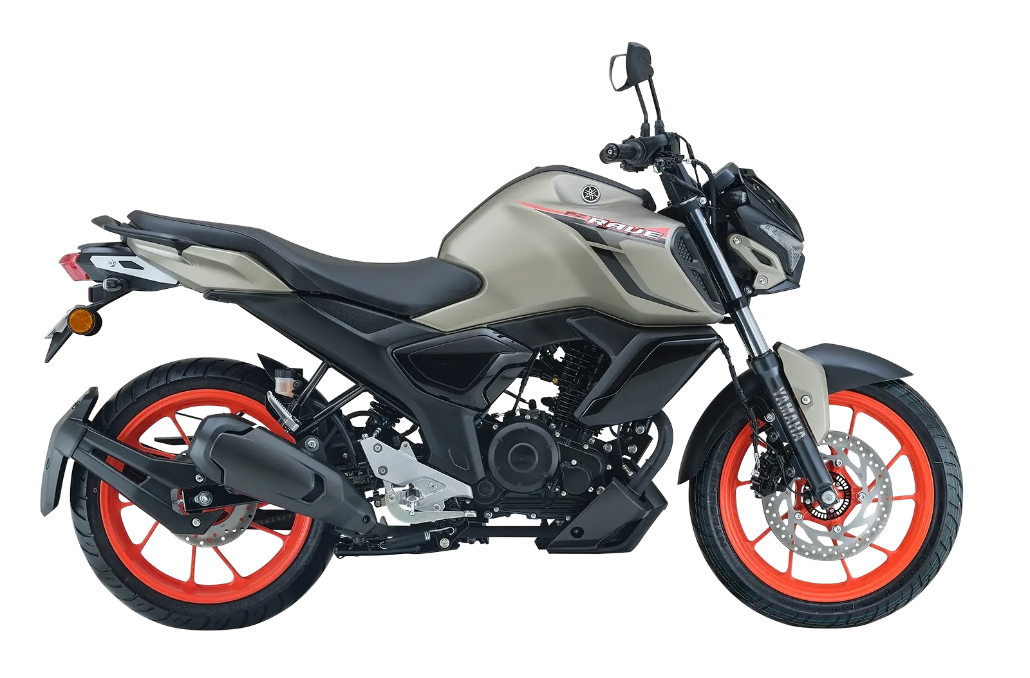
Yamaha FZ Rave
- 149 cc Air-Cooled, 2-valve
- 12.4 PS @ 7,250 rpm
- Not Claimed (ARAI)
- 13-litre tank
- 1 variant available
- Single-channel ABS, Rear Disc
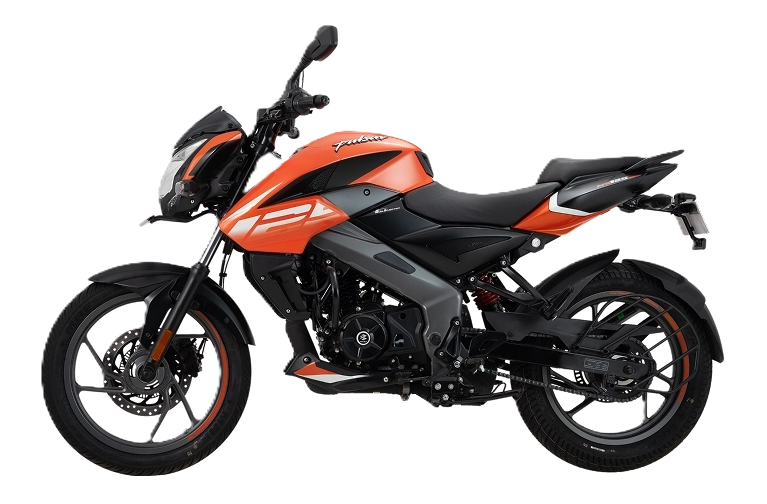
Bajaj Pulsar NS125
- 124.45 cc Air-Cooled, 4-valve DTS-i
- 12 PS @ 8,500 rpm
- 46.9 km/l (ARAI)
- 12-litre tank
- 3 variants available
- Perimeter Frame, 5-yr Warranty
Full Specification Comparison
Every number that matters — side by side
| Specification | Yamaha FZ Rave | Bajaj Pulsar NS125 |
|---|---|---|
| Engine & Performance | ||
| Displacement | 149 cc | 124.45 cc |
| Cooling System | Air-Cooled | Air-Cooled |
| Max Power | 12.4 PS @ 7,250 rpm | 12 PS @ 8,500 rpm |
| Max Torque | 13.3 Nm @ 5,500 rpm | 11 Nm @ 7,000 rpm |
| Valves per Cylinder | 2 | 4 (DTS-i) |
| Bore × Stroke | 57.3 × 57.9 mm | 52 × 58.6 mm |
| Compression Ratio | 9.6 : 1 | 10 ± 0.5 : 1 |
| Emission Standard | BS6 Phase 2 | BS6 / OBD2 |
| Transmission | 5-Speed Manual | 5-Speed Manual |
| Clutch | Wet, Multi-disc | Wet Multi-Plate |
| Top Speed | ~115 km/h | ~103 km/h |
| Riding Modes | No | No |
| Traction Control | No | No |
| Fuel & Range | ||
| Mileage (ARAI) | Not Claimed | 46.9 km/l |
| Fuel Tank | 13 litres | 12 litres |
| Reserve Capacity | 1.7 litres | 2.6 litres |
| Riding Range | ~663 km (est.) | ~560 km (ARAI-based) |
| Brakes & Wheels | ||
| Braking System | Single Channel ABS | CBS / Single Channel ABS (top variant) |
| Front Brake | Disc – 282 mm | Disc – 240 mm |
| Rear Brake | Disc – 220 mm | Drum – 130 mm |
| Tyre Type | Tubeless | Tubeless |
| Front Tyre Size | 100/80-17 | 90/90-17 |
| Rear Tyre Size | 140/60R-17 | 120/80-17 |
| Wheel Type | Alloy | Alloy |
| Suspension & Chassis | ||
| Front Suspension | Telescopic Fork | Telescopic Fork |
| Rear Suspension | Swingarm | Nitrox Mono Shock |
| Chassis | Diamond | Perimeter Frame |
| Rear Preload Adjuster | No | Yes |
| Dimensions & Weight | ||
| Kerb Weight | 136 kg | 144 kg |
| Seat Height | 790 mm | 805 mm |
| Ground Clearance | 165 mm | 178 mm |
| Wheelbase | 1330 mm | 1352 mm |
| Overall L × W × H | 1990 × 780 × 1080 mm | 2012 × 810 × 1078 mm |
| Features & Electronics | ||
| Instrument Console | Fully Digital LCD | Semi-Digital (Digital on LED BT variants) |
| Headlight | LED Projector | Halogen (LED on LED BT variants) |
| DRLs | Yes | Yes |
| Turn Signals | LED | Halogen |
| Hazard Warning Lights | Yes | No |
| Bluetooth Connectivity | Yes (standard) | Yes (LED BT variants only) |
| Call & SMS Alerts | Yes | No |
| USB Charging Port | No | Yes (LED BT variants) |
| Gear Indicator | No | No |
| Tachometer | Digital | Digital |
| Service Reminder | Yes | Yes |
| Keyless Ignition | No | No |
| Side Stand Engine Cut-off | Yes | Yes |
| Price & Warranty | ||
| Starting Price (ex-showroom) | ₹1,20,060 | ₹92,671 |
| Top Variant Price | ₹1,20,060 | ₹1,01,934 |
| Number of Variants | 1 | 3 |
| Standard Warranty | 2 Years / 30,000 km | 5 Years / 75,000 km |
★ Green highlights indicate the stronger value in each row. Prices are ex-showroom India averages and may vary by city.
Variant-wise Price Comparison
All variants laid out — find the right one for your budget
FZ Rave Variants
Pulsar NS125 Variants
Pros & Cons
Honest strengths and weaknesses of each bike
Pros
- Larger 149 cc engine with more power (12.4 PS) and torque (13.3 Nm)
- Higher top speed (~115 km/h vs ~103 km/h)
- Wider rear tyre (140/60R-17) for a more planted, confident ride
- Bigger front disc (282 mm) and rear disc brake vs rear drum
- Single-channel ABS standard on all variants
- LED Projector headlamp as standard
- LED turn signals and hazard warning lights
- Bluetooth and call/SMS alerts on base variant
- Lighter kerb weight (136 kg vs 144 kg)
- Yamaha's refined, smooth engine character
Cons
- Significantly more expensive — ₹27,389 pricier at base
- No official ARAI mileage claimed
- Only 1 variant — no choice to upgrade features
- Conventional diamond frame vs sporty perimeter frame
- No USB charging port
- Much shorter warranty — 2 years / 30,000 km
- Less ground clearance (165 mm vs 178 mm)
Pros
- Starting price ₹27,389 cheaper (₹92,671 vs ₹1,20,060)
- Outstanding 5-year / 75,000 km warranty
- Sporty perimeter frame for sharper handling and rigidity
- ARAI-certified 46.9 km/l mileage figure
- 3 variants to suit different budgets and feature needs
- Higher ground clearance (178 mm vs 165 mm)
- Nitrox monoshock rear suspension with preload adjuster
- 4-valve DTS-i engine for better breathing at higher rpm
- USB charging port on LED BT variants
- Bajaj's widespread and affordable service network
Cons
- Smaller 124.45 cc engine — less power and torque
- Lower top speed (~103 km/h)
- Rear drum brake on all variants
- Smaller front disc (240 mm vs 282 mm)
- ABS only on top variant; base uses CBS
- Bluetooth only from 2nd variant (NS125 LED BT)
- Halogen headlight on base variant
- Heavier at 144 kg vs 136 kg
- No hazard warning lights or LED turn signals
Key Differences Explained
What really sets these two bikes apart
Engine & Performance
The FZ Rave runs a 149 cc air-cooled, 2-valve engine tuned for smooth low-to-mid range delivery, producing 12.4 PS and 13.3 Nm — both figures higher than the NS125. The Pulsar NS125 uses a 124.45 cc air-cooled, 4-valve DTS-i engine making 12 PS and 11 Nm. While the 4-valve setup allows the NS125 to rev more freely and feel more energetic near its peak, the FZ Rave's larger displacement gives it meaningfully stronger torque, a higher top speed and a more relaxed highway cruise.
Fuel Efficiency & Range
Bajaj claims an ARAI-certified 46.9 km/l for the NS125, giving buyers a reliable benchmark for running cost planning. Yamaha has not published any ARAI mileage for the FZ Rave. Given its larger 149 cc displacement, real-world efficiency is generally expected to be lower than the NS125. The FZ Rave's 13-litre tank edges the NS125's 12-litre unit in capacity, but the NS125's certified figure gives it a verifiable edge in fuel economy.
Braking & Safety
The FZ Rave wins comfortably here. Its 282 mm front disc is 42 mm larger than the NS125's 240 mm unit, and it runs a rear disc (220 mm) where all three NS125 variants use a rear drum. Single-channel ABS is standard across the FZ Rave's sole variant, while on the NS125 it is available only on the top ₹1,01,934 ABS variant — lower variants use CBS, not ABS. Wider 140-section rear tyres also improve braking stability on the FZ Rave.
Chassis & Handling
The NS125 holds a structural advantage with its perimeter frame — a design typically reserved for larger performance motorcycles. It provides greater rigidity, better load distribution and improved cornering stability compared to the FZ Rave's conventional diamond frame. The NS125 also benefits from a preload-adjustable Nitrox monoshock, 178 mm ground clearance (vs 165 mm) and a longer 1,352 mm wheelbase for a more stable, sportier ride character.
Features & Technology
The FZ Rave has an edge in lighting and connectivity on its single variant — LED projector headlamp, LED turn signals, hazard warning lights and Bluetooth with call/SMS alerts are all standard. The NS125's base variant ships with halogen lighting and no Bluetooth; these are unlocked only from the ₹97,904 LED BT variant onwards. However, the NS125 LED BT variants add a USB charging port that the FZ Rave lacks entirely.
Price, Value & Warranty
The price gap here is exceptional. The NS125 starts at ₹92,671 — a full ₹27,389 less than the FZ Rave's ₹1,20,060. Even the ABS-equipped top NS125 variant at ₹1,01,934 is ₹18,126 cheaper. Add Bajaj's industry-leading 5-year / 75,000 km warranty versus Yamaha's 2-year / 30,000 km, and the NS125 offers extraordinary long-term value — especially for high-mileage daily commuters.
Expert Verdict
Which one should you actually buy?
Buy the Yamaha FZ Rave if…
- You want a larger 149 cc engine with more low-end torque
- A rear disc brake and bigger 282 mm front disc are important
- LED projector headlamp and full LED lighting are a priority
- You want ABS and Bluetooth standard without paying extra
- Wider tyres for a more planted, confidence-inspiring feel appeal to you
- Smooth Yamaha refinement and highway composure matter
- Budget is not a primary concern
Buy the Pulsar NS125 if…
- You want a sportier perimeter frame chassis at a much lower price
- Saving ₹18,000–₹27,000 over the FZ Rave matters to your budget
- The outstanding 5-year / 75,000 km warranty is a priority
- A certified ARAI mileage figure for fuel cost planning is important
- Higher ground clearance (178 mm) suits your daily roads
- You want variant flexibility — from entry CBS to ABS-equipped
- Bajaj's widespread and affordable service network is a factor
Overall Winner for Most Riders: Bajaj Pulsar NS125. A starting price that is ₹27,389 lower, an exceptional 5-year / 75,000 km warranty, a sportier perimeter frame, an ARAI-certified mileage figure, higher ground clearance, a preload-adjustable monoshock and three variant choices make the Pulsar NS125 outstanding value in the 125cc segment. Choose the Yamaha FZ Rave only if the larger 149 cc engine, rear disc brake, wider tyres, standard ABS, full LED lighting and Yamaha's refined engine character are non-negotiable priorities — and you are comfortable paying a substantial premium for them.
Frequently Asked Questions
Common questions answered by our experts
The Bajaj Pulsar NS125 is better value for most buyers — it is substantially cheaper, has a sporty perimeter frame, an ARAI-certified mileage figure and an outstanding 5-year / 75,000 km warranty. The Yamaha FZ Rave is the better choice if you want a larger 149 cc engine, rear disc brake, wider tyres, full LED lighting standard from the base and Yamaha's smooth engine refinement.
The Bajaj Pulsar NS125 starts at ₹92,671 while the Yamaha FZ Rave starts at ₹1,20,060 ex-showroom — a base difference of ₹27,389. Even the top NS125 ABS variant at ₹1,01,934 is ₹18,126 cheaper than the single FZ Rave variant. Prices may vary by city.
The Bajaj Pulsar NS125 has an ARAI-certified mileage of 46.9 km/l. Yamaha has not officially published any ARAI mileage figure for the FZ Rave. Given the FZ Rave's larger 149 cc engine, the NS125 is expected to deliver better real-world fuel efficiency, making it the more economical choice for daily commuters concerned about running costs.
The Yamaha FZ Rave makes slightly more power at 12.4 PS @ 7,250 rpm compared to the Bajaj Pulsar NS125's 12 PS @ 8,500 rpm. More notably, the FZ Rave produces significantly more torque at 13.3 Nm versus 11 Nm for the NS125, owing to its larger 149 cc displacement. This translates to stronger low-to-mid range pull and a higher top speed of ~115 km/h versus ~103 km/h for the NS125.
Yes, the Bajaj Pulsar NS125 uses a perimeter frame — a chassis design typically found on larger, more premium motorcycles. It provides better torsional rigidity, improved handling stability and sharper cornering dynamics compared to the conventional diamond frame used on the Yamaha FZ Rave. This is one of the NS125's standout features in the 125cc segment.
The Bajaj Pulsar NS125 offers an exceptional 5-year / 75,000 km warranty — one of the best in its class. The Yamaha FZ Rave offers a 2-year / 30,000 km warranty. The NS125's warranty covers 2.5 times more years and 2.5 times more kilometres, making it significantly more reassuring for high-mileage daily commuters.