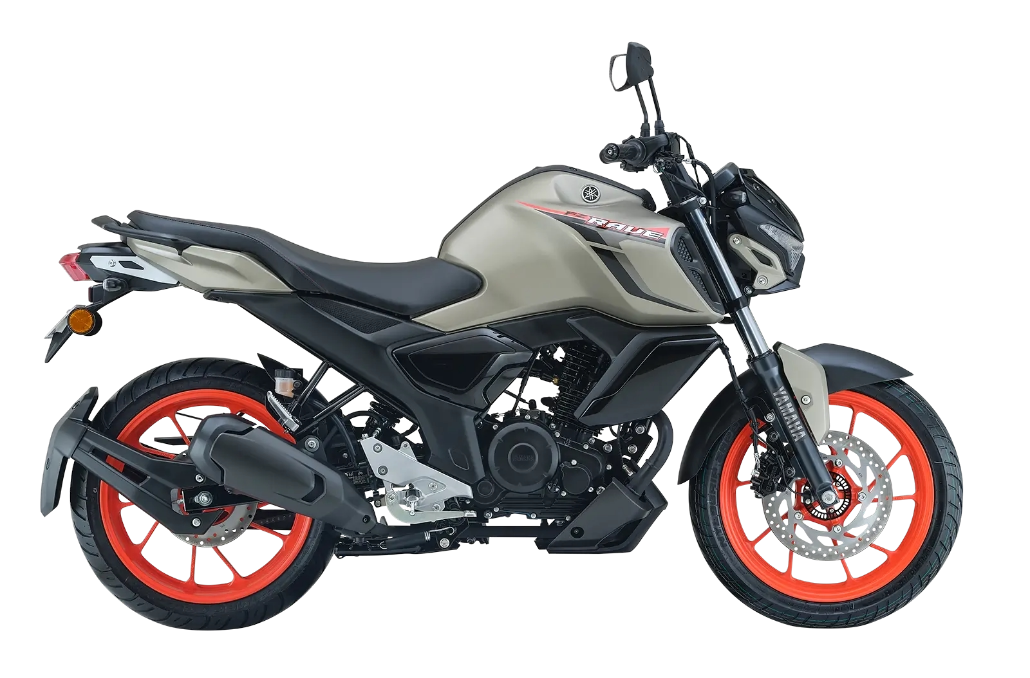
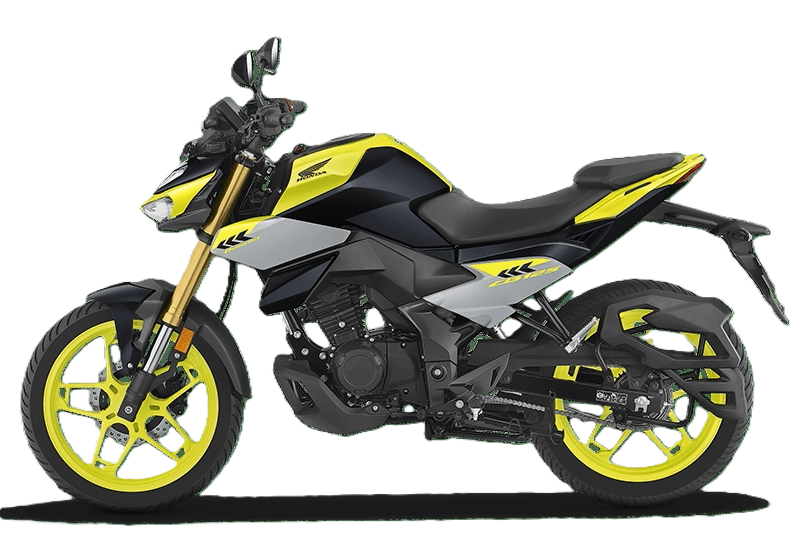
At a Glance
Key differences that define each motorcycle
Yamaha FZ Rave
- 149 cc Air-Cooled, 2-valve
- 12.4 PS @ 7,250 rpm
- Not Claimed (ARAI)
- 13-litre tank
- 1 variant available
- Single-channel ABS
Honda CB 125 Hornet
- 123.94 cc Air-Cooled, 2-valve
- 11.14 PS @ 7,500 rpm
- 48 km/l (Claimed)
- 12-litre tank
- 1 variant available
- USD Forks + TFT Display
Full Specification Comparison
Every number that matters — side by side
| Specification | Yamaha FZ Rave | Honda CB 125 Hornet |
|---|---|---|
| Engine & Performance | ||
| Displacement | 149 cc | 123.94 cc |
| Cooling System | Air-Cooled | Air-Cooled |
| Max Power | 12.4 PS @ 7,250 rpm | 11.14 PS @ 7,500 rpm |
| Max Torque | 13.3 Nm @ 5,500 rpm | 11.2 Nm @ 6,000 rpm |
| Valves per Cylinder | 2 | 2 |
| Bore × Stroke | 57.3 × 57.9 mm | 50.0 × 63.121 mm |
| Compression Ratio | 9.6 : 1 | 10.0 : 1 |
| Emission Standard | BS6 Phase 2 | BS6 Phase 2 |
| Transmission | 5-Speed Manual | 5-Speed Manual |
| Clutch | Wet, Multi-disc | Multiplate Wet Clutch |
| Top Speed | ~115 km/h | ~95 km/h |
| Riding Modes | No | No |
| Traction Control | No | No |
| Fuel & Range | ||
| Mileage (Claimed) | Not Claimed | 48 km/l |
| Fuel Tank | 13 litres | 12 litres |
| Reserve Capacity | 1.7 litres | 2.0 litres |
| Riding Range | ~663 km | ~660 km (est.) |
| Brakes & Wheels | ||
| Braking System | Single Channel ABS | Single Channel ABS |
| Front Brake | Disc – 282 mm | Disc – 240 mm |
| Rear Brake | Disc – 220 mm | Drum – 130 mm |
| Tyre Type | Tubeless | Tubeless |
| Front Tyre Size | 100/80-17 | 80/100-17 |
| Rear Tyre Size | 140/60R-17 | 110/80-17 |
| Wheel Type | Alloy | Alloy |
| Suspension & Chassis | ||
| Front Suspension | Telescopic Fork | Upside Down Fork (USD) |
| Rear Suspension | Swingarm | Monoshock |
| Chassis | Diamond | Diamond Type |
| Front Preload Adjuster | No | No |
| Rear Preload Adjuster | No | No |
| Dimensions & Weight | ||
| Kerb Weight | 136 kg | 124 kg |
| Seat Height | 790 mm | 796 mm |
| Ground Clearance | 165 mm | 166 mm |
| Wheelbase | 1330 mm | 1330 mm |
| Overall L × W × H | 1990 × 780 × 1080 mm | 2015 × 783 × 1087 mm |
| Features & Electronics | ||
| Instrument Console | Fully Digital LCD | 4.2-inch TFT Digital |
| Headlight | LED Projector | LED |
| DRLs | Yes | Yes |
| Turn Signals | LED | LED |
| Hazard Warning Lights | Yes | No |
| Gear Indicator | No | Yes |
| Distance to Empty | No | Yes |
| Bluetooth Connectivity | Yes | Yes |
| Call & SMS Alerts | Yes | Yes |
| USB Charging Port | No | Yes |
| Tachometer | Digital | Digital |
| Keyless Ignition | No | No |
| Side Stand Engine Cut-off | Yes | Yes |
| Service Reminder | Yes | Yes |
| Price & Warranty | ||
| Starting Price (ex-showroom) | ₹1,20,060 | ₹1,14,423 |
| Number of Variants | 1 | 1 |
| Standard Warranty | 2 Years / 30,000 km | 3 Years |
★ Green highlights indicate the stronger value in each row. Prices are ex-showroom India averages and may vary by city.
Variant-wise Price Comparison
All variants laid out — find the right one for your budget
FZ Rave Variants
CB 125 Hornet Variants
Pros & Cons
Honest strengths and weaknesses of each bike
Pros
- Larger 149 cc engine with more power (12.4 PS) and torque (13.3 Nm)
- Higher top speed (~115 km/h vs ~95 km/h)
- Wider rear tyre (140/60R-17) for a more planted feel
- Bigger front disc brake (282 mm vs 240 mm)
- Rear disc brake vs drum on the Honda
- Larger 13-litre fuel tank
- LED Projector headlamp
- Hazard warning lights standard
- Yamaha's renowned engine refinement and reliability
Cons
- Higher price (₹1,20,060 vs ₹1,14,423)
- No official ARAI mileage claimed
- Conventional telescopic forks vs USD on Honda
- No gear indicator on the console
- No USB charging port
- Basic LCD display vs Honda's TFT
- Shorter 2-year / 30,000 km warranty
Pros
- Segment-first USD (Upside-Down) front forks
- Premium 4.2-inch TFT display with Bluetooth
- Claimed mileage of 48 km/l
- Lighter at 124 kg vs 136 kg for easier maneuverability
- Lower starting price (₹1,14,423)
- Longer 3-year standard warranty
- Monoshock rear suspension
- USB charging port standard
- Gear indicator and distance-to-empty on console
- Honda's proven service network and reliability
Cons
- Smaller 123.94 cc engine — less power and torque
- Lower top speed (~95 km/h)
- Rear drum brake instead of disc
- Smaller front disc (240 mm vs 282 mm)
- Narrower tyres — less planted feel
- No hazard warning lights
Key Differences Explained
What really sets these two bikes apart
Engine & Performance
The FZ Rave runs a 149 cc air-cooled, 2-valve engine producing 12.4 PS and a healthy 13.3 Nm of torque, tuned for strong low-to-mid range pull typical of Yamaha's FZ lineage. The CB 125 Hornet uses a 123.94 cc air-cooled, 2-valve unit making 11.14 PS and 11.2 Nm. The FZ Rave's larger displacement gives it a meaningful edge in outright performance, a higher top speed, and a more confident highway presence.
Fuel Efficiency & Range
Yamaha has not officially published an ARAI mileage figure for the FZ Rave, making a direct certified comparison impossible. Honda claims 48 km/l for the CB 125 Hornet. Given the FZ Rave's larger displacement, real-world mileage for the Honda is likely superior. However, the FZ Rave's 13-litre tank slightly offsets this gap — both bikes offer a theoretical riding range of around 660 km.
Braking & Safety
The FZ Rave holds a clear edge in braking hardware. Its 282 mm front disc is 42 mm larger than the Honda's 240 mm unit, and it also runs a rear disc (220 mm) where the CB 125 Hornet uses a rear drum brake. Both bikes have single-channel ABS, but the FZ Rave's hardware provides stronger stopping power overall — particularly important on a bigger-displacement bike.
Suspension & Handling
The Honda CB 125 Hornet holds a significant edge here. It is the only bike in the 125cc segment to offer USD (Upside-Down) front forks, which deliver superior front-end stiffness, feedback, and handling precision compared to conventional telescopic forks. Combined with a monoshock rear and a lighter 124 kg kerb weight, the CB 125 Hornet is more agile and engaging to ride through corners than the FZ Rave.
Features & Technology
The CB 125 Hornet offers considerably more premium features for its price. Its 4.2-inch TFT display with Bluetooth, gear indicator, distance-to-empty, and a USB charging port put it ahead of the FZ Rave's conventional digital LCD screen which lacks a gear indicator and USB port. The FZ Rave counters with a projector headlamp and hazard warning lights — but overall the Honda wins in technology.
Price & Value
The CB 125 Hornet is ₹5,637 cheaper (₹1,14,423 vs ₹1,20,060) and includes more premium features — USD forks, TFT display, USB charging and a longer 3-year warranty. The FZ Rave commands a premium for its bigger engine, rear disc brake, and wider tyres. For pure value — features per rupee — the Honda has the upper hand, while the Yamaha is justified for buyers who specifically want a step up in performance.
Expert Verdict
Which one should you actually buy?
Buy the Yamaha FZ Rave if…
- You want a bigger 149 cc engine with more power and torque
- Higher top speed and highway performance matter to you
- You want rear disc brakes and a larger 282 mm front disc
- Wide tyres and a planted, sporty stance appeal to you
- You prefer Yamaha's smooth and refined FZ engine character
- An LED projector headlamp and hazard lights are important
- You're upgrading from a 125cc and want a real step up
Buy the Honda CB 125 Hornet if…
- You want segment-first USD forks for superior handling
- A premium TFT display and Bluetooth are on your wishlist
- Better fuel efficiency and a lower purchase price matter
- Lighter weight makes daily city riding more comfortable
- You want a longer 3-year warranty for peace of mind
- A USB charging port and gear indicator are daily essentials
- You value Honda's trusted service network and build quality
Overall Winner for Most Riders: Honda CB 125 Hornet. A lower starting price, segment-first USD front forks, a premium TFT display, Bluetooth connectivity, a USB charging port, better claimed mileage, a longer 3-year warranty and a lighter 124 kg kerb weight make the CB 125 Hornet an exceptional value proposition in this class. Choose the Yamaha FZ Rave only if a larger 149 cc engine, a rear disc brake, wider tyres and higher outright performance are your non-negotiable priorities.
Frequently Asked Questions
Common questions answered by our experts
The Honda CB 125 Hornet is better for most buyers who want premium features at a lower price — including USD forks, a TFT display, better mileage, and a longer warranty. The Yamaha FZ Rave is better if you want a larger 149 cc engine, more power, a rear disc brake, wider tyres, and a higher top speed.
The Honda CB 125 Hornet starts at ₹1,14,423 while the Yamaha FZ Rave starts at ₹1,20,060 ex-showroom — a difference of approximately ₹5,637. Both bikes are available in a single variant and prices may vary by city.
The Honda CB 125 Hornet has a claimed mileage of 48 km/l. Yamaha has not officially published an ARAI mileage figure for the FZ Rave, making a direct comparison difficult. However, owing to its smaller 123.94 cc engine, the CB 125 Hornet is expected to be more fuel-efficient in real-world riding.
The Yamaha FZ Rave makes more power at 12.4 PS @ 7,250 rpm compared to the Honda CB 125 Hornet's 11.14 PS @ 7,500 rpm. The FZ Rave also produces significantly more torque at 13.3 Nm vs 11.2 Nm, owing to its larger 149 cc displacement.
Yes, the Honda CB 125 Hornet features Upside-Down (USD) front forks, making it a segment-first in the 125cc class. USD forks provide superior front-end stiffness, better handling feedback, and improved braking performance compared to the conventional telescopic forks found on the Yamaha FZ Rave.
The Honda CB 125 Hornet offers a 3-year standard warranty, while the Yamaha FZ Rave offers 2 years / 30,000 km. The CB 125 Hornet's longer 3-year warranty provides greater peace of mind, especially for buyers who plan to hold onto the bike for an extended period.