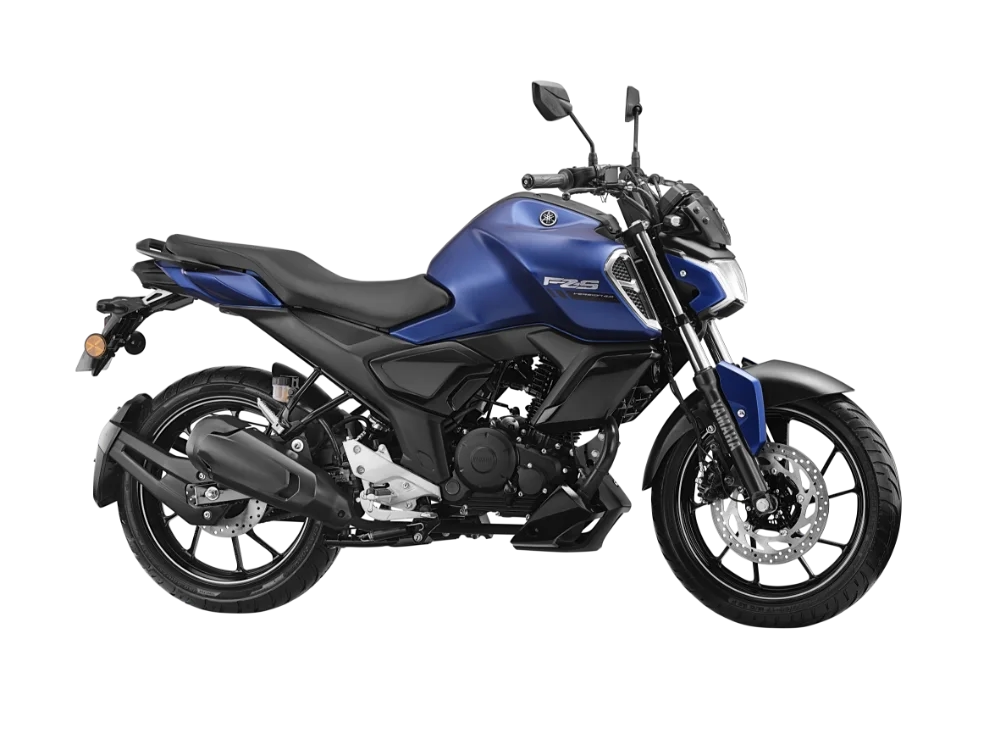
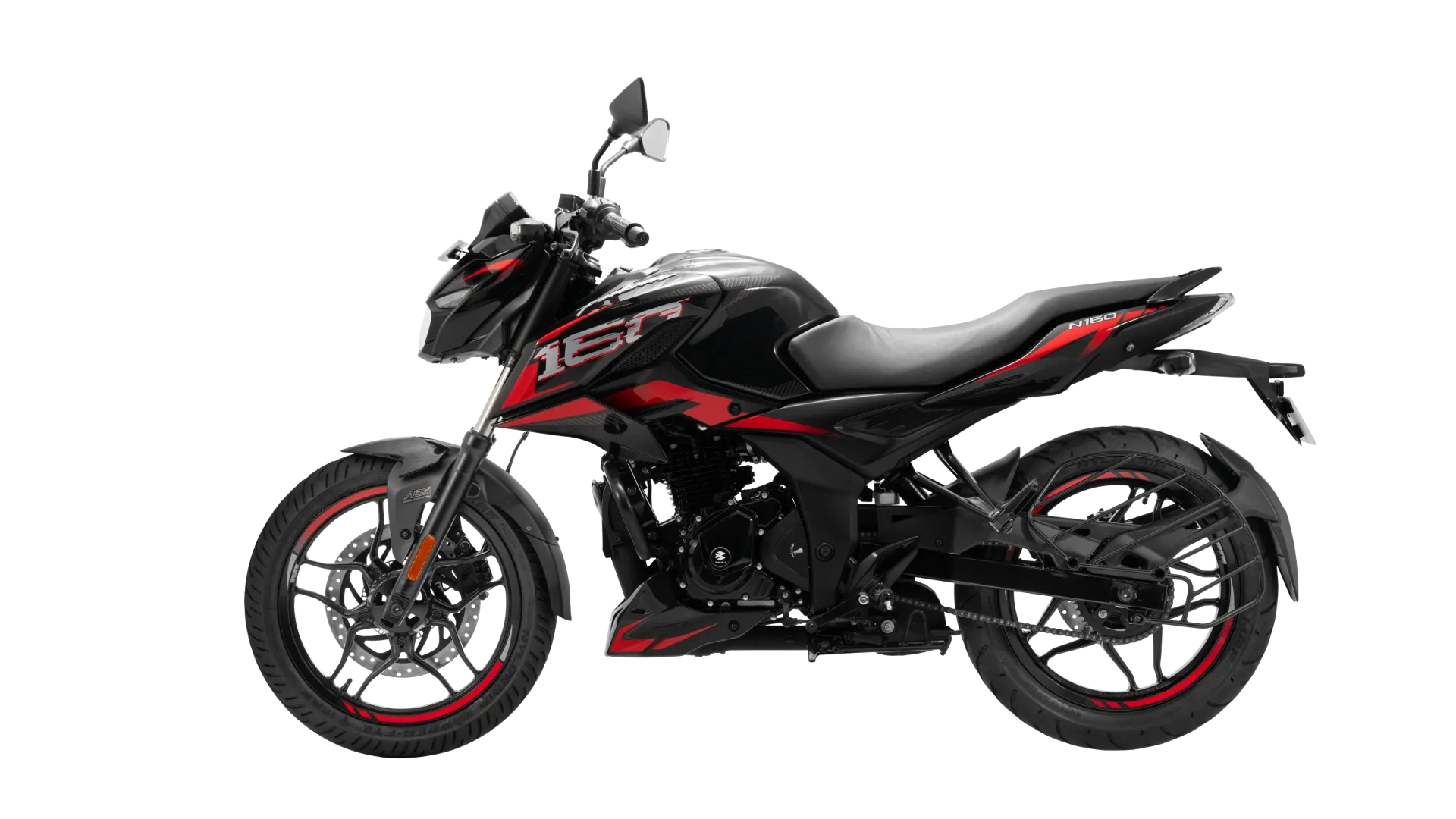
At a Glance
Key differences that define each motorcycle
Yamaha FZ-S Fi V4
- 149 cc Air-Cooled
- 12.4 PS @ 7250 rpm
- 60 km/l (ARAI)
- 13-litre tank
- 2 variants available
- Traction control (unique in segment)
Bajaj Pulsar N160
- 164.82 cc Air-Cooled
- 16 PS @ 8750 rpm
- 51.6 km/l (ARAI)
- 14-litre tank
- 4 variants available
- Dual-channel ABS (most variants)
Full Specification Comparison
Every number that matters — side by side
| Specification | Yamaha FZ-S Fi V4 | Bajaj Pulsar N160 |
|---|---|---|
| Engine & Performance | ||
| Displacement | 149 cc | 164.82 cc |
| Cooling System | Air-Cooled | Air-Cooled |
| Max Power | 12.4 PS @ 7250 rpm | 16 PS @ 8750 rpm |
| Max Torque | 13.3 Nm @ 5500 rpm | 14.65 Nm @ 6750 rpm |
| Valves per Cylinder | 2 | 2 |
| Compression Ratio | 9.6 : 1 | 10.3 ± 0.3 : 1 |
| Bore × Stroke | 57.3 × 57.9 mm | 58 × 62.38 mm |
| Emission Standard | BS6 Phase 2 (OBD2B) | BS6 Phase 2 |
| Transmission | 5-Speed Manual | 5-Speed Manual |
| Top Speed | ~115 km/h | ~120 km/h |
| Traction Control | Yes | No |
| Fuel & Range | ||
| Mileage (ARAI) | 60 km/l | 51.6 km/l |
| Mileage (Real-world) | 45–50 km/l | 45–50 km/l |
| Fuel Tank | 13 litres | 14 litres |
| Reserve Capacity | 2 litres | 2.8 litres |
| Riding Range | ~780 km | ~722 km (est.) |
| Brakes & Wheels | ||
| Braking System | Single Channel ABS | Single / Dual Channel ABS |
| Front Brake | Disc – 282 mm | Disc – 300 mm |
| Rear Brake | Disc – 220 mm | Disc – 230 mm |
| Tyre Type | Tubeless | Tubeless |
| Tyre Size (F / R) | 100/80-17 / 140/60-17 | 100/80-17 / 130/70-17 |
| Wheel Type | Alloy | Alloy |
| Suspension & Chassis | ||
| Front Suspension | Telescopic Fork | Telescopic / USD Fork (top variants) |
| Rear Suspension | 7-Step Adjustable Monoshock | Monoshock |
| Chassis | Diamond Frame | Perimeter Frame |
| Rear Preload Adjuster | Yes | Yes |
| Dimensions & Weight | ||
| Kerb Weight | 136 kg | 152–154 kg |
| Seat Height | 790 mm | 795 mm |
| Ground Clearance | 165 mm | 165 mm |
| Wheelbase | 1330 mm | 1358 mm |
| Overall L × W × H | 2000 × 780 × 1080 mm | 1989 × 743 × 1050 mm |
| Features & Electronics | ||
| Instrument Console | Fully Digital LCD | Digital |
| Headlight | LED | LED Projector |
| DRLs | Yes | Yes |
| Turn Signals | LED | LED |
| Hazard Warning Lights | Yes | Yes |
| Traction Control | Yes | No |
| Bluetooth Connectivity | Yes (Deluxe variant) | Yes (all variants) |
| Call & SMS Alerts | Yes (Deluxe variant) | Yes |
| USB Charging Port | No | Yes |
| Distance to Empty | Yes | Yes |
| Gear Indicator | Yes | Yes |
| Tachometer | Digital | Digital |
| Riding Modes | No | No (except split-seat variant) |
| Keyless Ignition | No | No |
| Price & Warranty | ||
| Starting Price (ex-showroom) | ₹1,20,409 | ₹1,14,840 |
| Top Variant Price | ₹1,20,866 | ₹1,27,333 |
| Number of Variants | 2 | 4 |
| Standard Warranty | 2 Years / 30,000 km | 5 Years / 75,000 km |
★ Green highlights indicate the stronger value in each row. Prices are ex-showroom India averages and may vary by city.
Variant-wise Price Comparison
All variants laid out — find the right one for your budget
Yamaha FZ-S Fi V4 Variants
Bajaj Pulsar N160 Variants
Pros & Cons
Honest strengths and weaknesses of each bike
Pros
- Superior ARAI-certified mileage of 60 km/l
- Traction control — a rare safety feature in segment
- Much lighter kerb weight at just 136 kg
- Highly refined, smooth and vibration-free engine
- 7-step adjustable rear monoshock
- Wider rear tyre (140/60-17) for better grip
- LED turn signals and hazard warning lights
- Bluetooth on Deluxe variant
Cons
- Significantly lower power (12.4 PS vs 16 PS)
- Only single-channel ABS across both variants
- Smaller front disc (282 mm vs 300 mm)
- No USB charging port
- Higher starting price (₹1,20,409)
- Short 2-year / 30,000 km warranty
- Only 2 variants available
Pros
- Higher peak power – 16 PS @ 8750 rpm
- Dual-channel ABS on most variants
- Larger 300 mm front disc for stronger braking
- Bigger 14-litre fuel tank for longer range
- 4 variant options for wider budget coverage
- USD forks on top variants
- Riding modes on top variant
- Outstanding 5-year / 75,000 km warranty
- Lower starting price (₹1,14,840)
- USB charging port on all variants
Cons
- No traction control
- Heavier at 152–154 kg vs 136 kg
- Lower ARAI mileage (51.6 km/l vs 60 km/l)
- More vibration than Yamaha's Blue Core engine
- Sporty posture may fatigue on long trips
Key Differences Explained
What really sets these two bikes apart
Engine Character
The FZ-S Fi V4 uses a 149 cc engine producing 12.4 PS and 13.3 Nm, tuned for smoothness, linear power delivery and fuel efficiency. Yamaha's Blue Core technology makes it one of the most refined engines in the 150cc segment. The Pulsar N160 uses a larger 164.82 cc motor making 16 PS and 14.65 Nm — 29% more power — tuned for stronger mid-range torque and better highway ability.
Fuel Efficiency & Range
The FZ-S Fi V4 leads on official mileage at 60 km/l (ARAI) versus the N160's 51.6 km/l, though real-world figures for both bikes are broadly similar at 45–50 km/l. The N160's 14-litre tank edges out the FZ-S's 13-litre unit, giving the Pulsar a larger potential range on a full fill despite lower official efficiency.
Braking & Safety
The Pulsar N160 holds a clear advantage here: dual-channel ABS is available from ₹1,17,619 (second variant onwards), combined with a larger 300 mm front disc. The FZ-S Fi V4 offers only single-channel ABS across both variants, with a smaller 282 mm disc — though it compensates with traction control, which the N160 completely lacks.
Weight & Agility
At just 136 kg, the FZ-S Fi V4 is a substantially lighter motorcycle than the Pulsar N160 at 152–154 kg — a difference of 16–18 kg. This makes the Yamaha feel noticeably more nimble and easier to manoeuvre in dense city traffic, while the heavier N160 feels more planted at higher speeds on the highway.
Warranty & Ownership
The Pulsar N160 comes with an outstanding 5-year / 75,000 km warranty compared to the FZ-S Fi V4's 2-year / 30,000 km coverage. This is one of the most significant ownership differences between the two bikes and reduces long-term risk substantially for N160 buyers.
Price & Value
The Pulsar N160 starts at ₹1,14,840 — about ₹5,569 less than the FZ-S Fi V4's ₹1,20,409 base price. Despite being cheaper, the N160 offers more power, dual-channel ABS (from variant 2), a larger tank, USB charging and four variants to choose from — making it significantly better value on a spec-per-rupee basis.
Expert Verdict
Which one should you actually buy?
Buy the Yamaha FZ-S Fi V4 if…
- Engine smoothness and refinement are your top priority
- You ride exclusively in city traffic and want a lighter bike
- Traction control matters for your riding style or conditions
- You cover shorter daily distances and want better ARAI efficiency
- Yamaha's brand reliability and dealer experience are important
- You prefer a lightweight, easy-to-manoeuvre motorcycle
Buy the Pulsar N160 if…
- You want the stronger-performing 160cc engine
- Dual-channel ABS braking safety is a priority
- Long-term warranty coverage matters to you
- You mix city and highway riding regularly
- Budget is a priority — starts ₹5,569 cheaper
- You want more variant choices and upgrade options
- A USB charging port is useful for your daily rides
Overall Winner for Most Riders: Bajaj Pulsar N160. More power, dual-channel ABS, a lower price, USB charging, four variants and an exceptional 5-year warranty make the Pulsar N160 the stronger all-round value proposition for the majority of Indian buyers. Choose the Yamaha FZ-S Fi V4 only if you specifically value engine refinement, lightweight agility and the unique addition of traction control over outright performance and braking safety.
Frequently Asked Questions
Common questions answered by our experts
The Bajaj Pulsar N160 is better for most buyers who want stronger performance (16 PS vs 12.4 PS), dual-channel ABS, a lower price, more variant choice and a far superior 5-year / 75,000 km warranty. The Yamaha FZ-S Fi V4 is better if engine smoothness, light weight (136 kg vs 152–154 kg), higher ARAI mileage (60 km/l) and traction control are your priorities over outright power.
The Bajaj Pulsar N160 starts at ₹1,14,840 while the Yamaha FZ-S Fi V4 starts at ₹1,20,409 ex-showroom. The FZ-S Fi V4 is approximately ₹5,569 more expensive at the base variant level. Importantly, the Pulsar N160 offers four variants up to ₹1,27,333, while the FZ-S V4's two variants are tightly clustered at ₹1,20,409 and ₹1,20,866. Both prices are for India and may vary by city.
The Yamaha FZ-S Fi V4 has a better ARAI-certified mileage at 60 km/l compared to the Bajaj Pulsar N160's 51.6 km/l. However, real-world figures are similar for both bikes at around 45–50 km/l depending on riding style and traffic conditions. The Pulsar N160's larger 14-litre tank gives it a longer potential riding range per fill despite the lower official figure.
The Bajaj Pulsar N160 makes significantly more power at 16 PS @ 8750 rpm compared to the Yamaha FZ-S Fi V4's 12.4 PS @ 7250 rpm — about 29% more. The N160 also produces higher torque at 14.65 Nm versus 13.3 Nm for the FZ-S V4. For riders who want stronger acceleration and highway overtaking ability, the N160 is the clear winner.
Yes, the Yamaha FZ-S Fi V4 comes equipped with a traction control system on both its Standard and Deluxe variants. This is a rare safety feature in the 150–160cc segment that helps prevent rear wheel slip during hard acceleration, particularly on slippery surfaces. The Bajaj Pulsar N160 does not offer traction control on any of its four variants.
The Bajaj Pulsar N160 offers a significantly better warranty of 5 years or 75,000 km compared to the Yamaha FZ-S Fi V4's 2 years or 30,000 km. This is one of the most compelling ownership advantages of the N160 over the FZ-S V4, providing far greater protection against repair costs during the ownership period.