At a Glance
Key differences that define each motorcycle
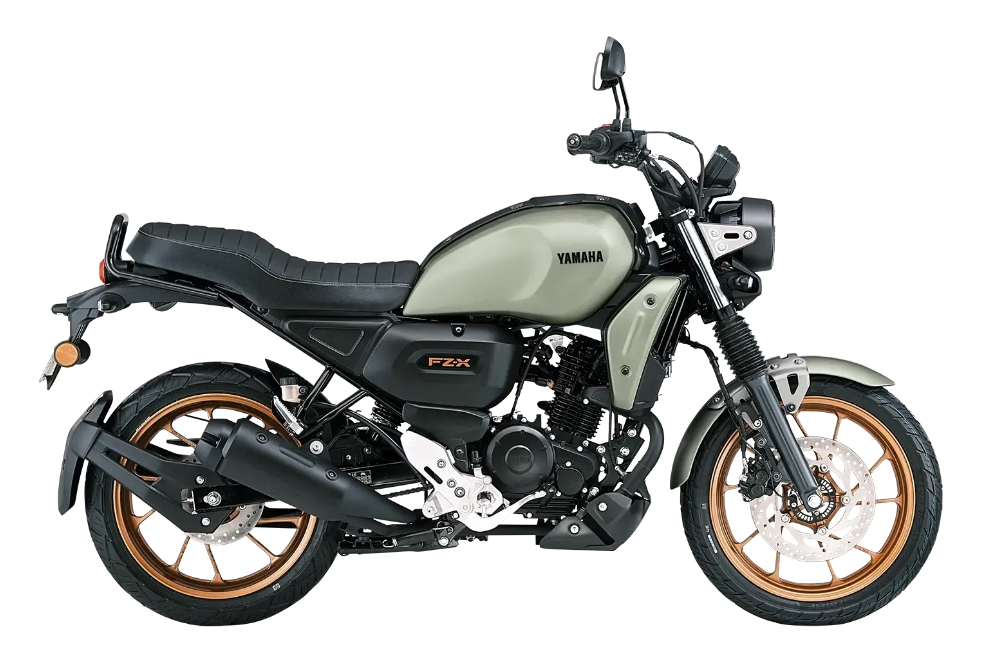
Yamaha FZ-X Hybrid
- 149 cc Air-Cooled + SMG Hybrid
- 12.4 PS @ 7250 rpm
- 53 km/l (ARAI)
- 10-litre tank
- 1 variant available
- Full-colour TFT display
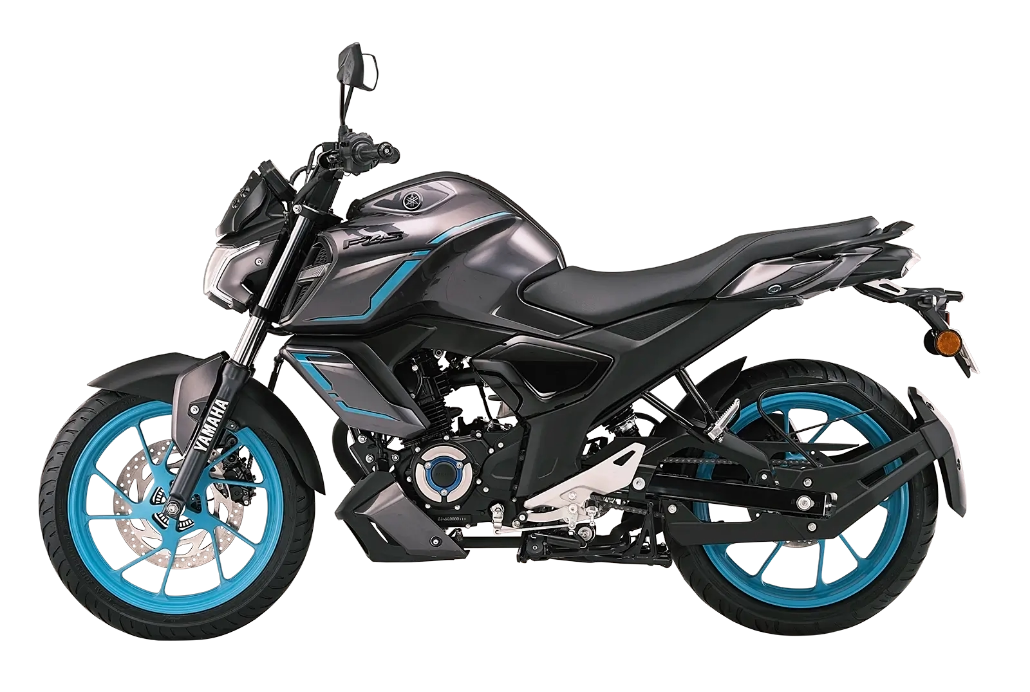
Yamaha FZS Fi Hybrid
- 149 cc Air-Cooled + SMG Hybrid
- 12.4 PS @ 7250 rpm
- 60 km/l (ARAI)
- 13-litre tank
- 1 variant, 3 colours
- ~780 km range + LED indicators
Full Specification Comparison
Every number that matters — side by side
| Specification | Yamaha FZ-X Hybrid | Yamaha FZS Fi Hybrid |
|---|---|---|
| Engine & Performance | ||
| Displacement | 149 cc | 149 cc |
| Cooling System | Air-Cooled | Air-Cooled |
| Max Power | 12.4 PS @ 7250 rpm | 12.4 PS @ 7250 rpm |
| Max Torque | 13.3 Nm @ 5500 rpm | 13.3 Nm @ 5500 rpm |
| Hybrid System | Smart Motor Generator (SMG) | Smart Motor Generator (SMG) |
| Valves per Cylinder | 2 | 2 |
| Compression Ratio | 9.6 : 1 | 9.6 : 1 |
| Bore × Stroke | 57.3 × 57.9 mm | 57.3 × 57.9 mm |
| Emission Standard | BS6 Phase 2 | BS6 Phase 2 / OBD-2B |
| Transmission | 5-Speed Manual | 5-Speed Manual |
| Clutch | Wet Multiplate | Wet Multi-Plate |
| Top Speed | ~115 km/h | ~115 km/h |
| Idle Stop-Start | Yes | Yes |
| Silent Start | Yes | Yes |
| Traction Control | Yes | Yes |
| Fuel & Range | ||
| Mileage (Claimed) | 53 km/l (ARAI) | 60 km/l (ARAI) |
| Mileage (Real-world) | 45–50 km/l | 50–55 km/l |
| Fuel Tank | 10 litres | 13 litres |
| Reserve Capacity | 1.6 litres | 2 litres |
| Riding Range | ~530 km | ~780 km |
| Brakes & Wheels | ||
| Braking System | Single Channel ABS | Single Channel ABS |
| Front Brake | Disc – 282 mm | Disc – 282 mm |
| Rear Brake | Disc – 220 mm | Disc – 220 mm |
| Tyre Type | Tubeless | Tubeless |
| Tyre Size (F / R) | 100/80-17 / 140/60-17 | 100/80-17 / 140/60-17 |
| Wheel Type | Alloy | Alloy |
| Suspension & Chassis | ||
| Front Suspension | Telescopic Fork | Telescopic Fork |
| Rear Suspension | 7-Step Adjustable Monocross | 7-Step Adjustable Monocross |
| Chassis | Diamond Frame | Diamond Frame |
| Rear Preload Adjuster | Yes | Yes |
| Dimensions & Weight | ||
| Kerb Weight | 141 kg | 138 kg |
| Seat Height | 810 mm | 790 mm |
| Ground Clearance | 165 mm | 165 mm |
| Wheelbase | 1330 mm | 1330 mm |
| Overall L × W × H | 2020 × 785 × 1100 mm | 2000 × 780 × 1080 mm |
| Features & Electronics | ||
| Instrument Console | Fully Digital TFT | Fully Digital LCD |
| Headlight | LED | LED |
| DRLs | Yes | Yes |
| Turn Signals | Bulb | LED |
| Hazard Warning Lights | Yes | Yes |
| Bluetooth Connectivity | Yes | Yes |
| Call & SMS Alerts | Yes | Yes |
| USB Charging Port | Yes | No |
| Distance to Empty | Yes | Yes |
| Tachometer | Digital | Digital |
| Gear Indicator | Yes | Yes |
| Colour Options | 1 (Matte Titan) | 3 (Racing Blue, Cyan Metallic Grey, Matte Black) |
| Price & Warranty | ||
| Starting Price (ex-showroom) | ₹1,39,969 | ₹1,35,174 |
| Top Variant Price | ₹1,39,969 | ₹1,35,174 |
| Number of Variants | 1 | 1 |
| Standard Warranty | 2 Years / 30,000 km | 2 Years / 30,000 km |
★ Green highlights indicate the stronger value in each row. Prices are ex-showroom India averages and may vary by city.
Variant-wise Price Comparison
All variants laid out — find the right one for your budget
FZ-X Hybrid Variants
FZS Fi Hybrid Variants
Pros & Cons
Honest strengths and weaknesses of each bike
Pros
- Premium full-colour TFT instrument cluster
- USB charging port as standard
- Distinctive neo-retro scrambler styling
- SMG hybrid system with idle stop-start and silent start
- Traction control and Bluetooth on all variants
- Distance-to-empty display
- Hazard warning lights
- 53 km/l ARAI mileage
Cons
- Lower ARAI mileage (53 km/l vs 60 km/l)
- Smaller 10-litre fuel tank — less range (~530 km)
- Higher price (₹1,39,969 vs ₹1,35,174)
- Only 1 colour option (Matte Titan)
- Bulb turn signals instead of LED
- Heavier at 141 kg vs 138 kg
Pros
- Best ARAI mileage among Yamaha 150cc hybrids — 60 km/l
- Larger 13-litre tank for ~780 km range
- Lower price at ₹1,35,174
- LED turn signals standard
- 3 colour choices (Racing Blue, Cyan Metallic Grey, Matte Black)
- Lighter at 138 kg
- SMG hybrid with idle stop-start and silent start
- Hazard warning lights and traction control
- Lower seat height (790 mm) — more accessible
Cons
- Standard LCD display — no TFT colour screen
- No USB charging port
- Conventional street naked styling — less distinctive
- Single variant — no mechanical differentiation
Key Differences Explained
What really sets these two bikes apart
Engine & Hybrid System
Both bikes share exactly the same powerplant: a 149 cc air-cooled, 2-valve engine producing 12.4 PS and 13.3 Nm, paired with Yamaha's Smart Motor Generator (SMG) hybrid system. Both get idle stop-start, silent start and traction control. The mechanical difference between these two is genuinely zero — the distinction lies entirely in design, tank size, display and feature set.
Fuel Efficiency & Range
Despite sharing the same engine, the FZS Fi Hybrid achieves a significantly better ARAI mileage of 60 km/l versus the FZ-X Hybrid's 53 km/l — a 13% gap. This is partly attributable to the FZS Fi's more aerodynamically efficient upright street-naked form. More crucially, the FZS Fi Hybrid's 13-litre tank versus the FZ-X Hybrid's 10 litres delivers a theoretical range of ~780 km versus ~530 km — a massive 250 km advantage per fill-up.
Display & Daily Features
The FZ-X Hybrid gets a decisive edge here with its full-colour TFT display — a premium feature the FZS Fi Hybrid lacks, making do with a standard LCD cluster instead. The FZ-X Hybrid also includes a USB charging port, absent on the FZS Fi. Both show distance-to-empty, both connect to the Yamaha Y-Connect app via Bluetooth. Riders who value a rich digital experience will strongly prefer the FZ-X Hybrid's cockpit.
Lighting & Safety Details
The FZS Fi Hybrid gets LED turn signals across all three colour options — the FZ-X Hybrid is fitted with bulb indicators instead. Both bikes come with LED headlights, DRLs, hazard warning lights and single-channel ABS. The braking hardware is identical: 282 mm front disc and 220 mm rear disc. The FZS Fi Hybrid's LED turn signals are a meaningful safety advantage in low-visibility conditions.
Design & Styling
The two bikes target distinctly different aesthetic audiences. The FZ-X Hybrid channels a neo-retro scrambler character with round LED headlamp, high mudguard, and rugged proportions — available only in Matte Titan. The FZS Fi Hybrid keeps the FZ series' muscular streetfighter look with a wider tank and aggressive lines — available in Racing Blue, Cyan Metallic Grey and Matte Black. Choice here is purely personal preference.
Price & Value
The FZS Fi Hybrid costs ₹4,795 less (₹1,35,174 vs ₹1,39,969) and delivers a larger tank, better mileage, LED indicators and 3 colour options for less money. The FZ-X Hybrid's premium is justified primarily by its TFT display and USB charging port. Both carry identical 2-year / 30,000 km warranties. For pure value, the FZS Fi Hybrid offers more per rupee — the FZ-X Hybrid charges a premium for its display and design.
Expert Verdict
Which one should you actually buy?
Buy the Yamaha FZ-X Hybrid if…
- A premium full-colour TFT display is important to you
- You use a USB charging port for your phone daily
- You love the neo-retro scrambler aesthetic of the FZ-X
- Style and premium cockpit feel matter more than range
- You ride mostly within the city and refuel frequently
- The Matte Titan colour suits your preference
Buy the Yamaha FZS Fi Hybrid if…
- Maximum fuel efficiency (60 km/l ARAI) is a priority
- You cover 30+ km daily and want a longer riding range
- The larger 13-litre tank reduces refuelling stops
- You want LED turn signals for better visibility
- Saving ₹4,795 and getting more range suits your needs
- You prefer multiple colour options over a single shade
- The classic FZ streetfighter design appeals to you
This is a uniquely close comparison — both bikes share the same engine, hybrid system, chassis, braking hardware and identical overall performance. The decision comes down to two trade-offs: the FZ-X Hybrid offers a premium TFT display and USB charging port at ₹4,795 more; the FZS Fi Hybrid gives you a larger 13-litre tank (~250 km more range per fill), better ARAI mileage (60 vs 53 km/l), LED turn signals, 3 colour choices, a lighter chassis and a lower price. For most daily commuters, the FZS Fi Hybrid is the stronger all-round buy. Choose the FZ-X Hybrid only if the TFT screen and scrambler design are non-negotiable for you.
Frequently Asked Questions
Common questions answered by our experts
For most buyers, the Yamaha FZS Fi Hybrid is the better choice — it delivers superior ARAI mileage (60 km/l vs 53 km/l), a larger 13-litre tank (~780 km range vs ~530 km), LED turn signals, 3 colour options, a lighter build and a lower price of ₹1,35,174. The Yamaha FZ-X Hybrid is worth the extra ₹4,795 only if you specifically want its full-colour TFT display, USB charging port or distinctive retro scrambler styling.
The Yamaha FZS Fi Hybrid is priced at ₹1,35,174 while the Yamaha FZ-X Hybrid is priced at ₹1,39,969 — both ex-showroom India. The FZS Fi Hybrid is ₹4,795 cheaper. Both are available in single mechanical variants, with the FZS Fi offering 3 colour choices at the same price point.
The Yamaha FZS Fi Hybrid has considerably better mileage at 60 km/l (ARAI certified) compared to the Yamaha FZ-X Hybrid's 53 km/l (ARAI). The FZS Fi Hybrid also has a larger 13-litre tank versus 10 litres, resulting in a theoretical riding range of ~780 km against ~530 km — a difference of approximately 250 km per tank in favour of the FZS Fi Hybrid.
Yes, both the Yamaha FZ-X Hybrid and Yamaha FZS Fi Hybrid use the identical 149cc air-cooled, 2-valve, fuel-injected engine producing 12.4 PS @ 7,250 rpm and 13.3 Nm @ 5,500 rpm. Both are paired with the same Smart Motor Generator (SMG) hybrid assist system enabling idle stop-start and silent start, and both use the same 5-speed manual gearbox. The performance gap between them is nil — differences are only in tank size, display, features and styling.
Yes. The Yamaha FZ-X Hybrid features a full-colour TFT digital instrument cluster, which is a significant upgrade over the Yamaha FZS Fi Hybrid's standard full-digital LCD display. Both connect to the Yamaha Y-Connect smartphone app via Bluetooth and display gear indicators, distance-to-empty and trip data, but the TFT on the FZ-X Hybrid offers a richer, more vivid visual experience.
Both the Yamaha FZ-X Hybrid and Yamaha FZS Fi Hybrid offer identical warranty coverage: 2 years or 30,000 km, whichever comes first. Neither bike has any advantage in warranty terms. Both follow the same service schedule — first service at 1,000 km / 1 month, second at 5,000 km / 6 months, and third at 9,000 km / 12 months.