At a Glance
Key differences that define each motorcycle
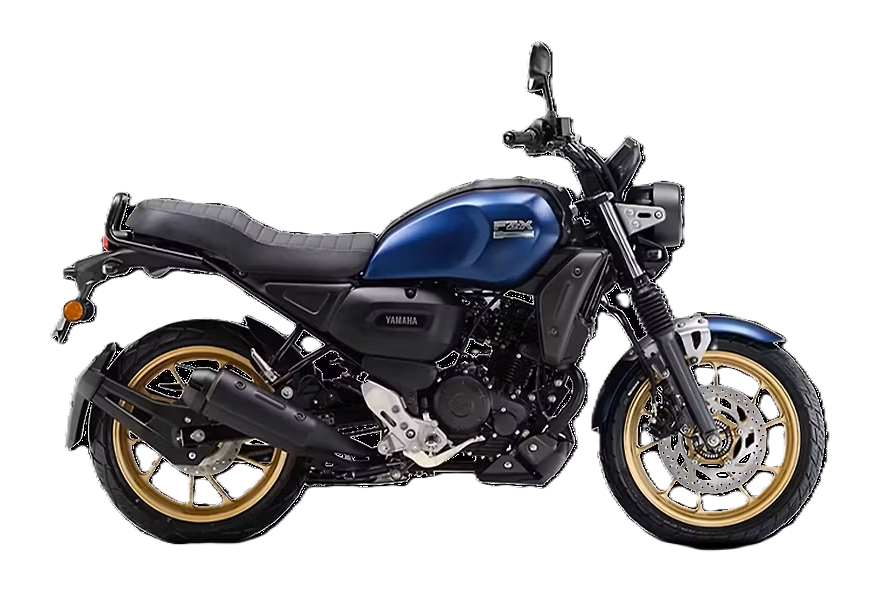
Yamaha FZ-X
- 149 cc Air-Cooled, 2-valve FI
- 12.4 PS @ 7,250 rpm
- 55.11 km/l (ARAI)
- 10-litre tank
- 2 variants available
- Traction control + Bluetooth
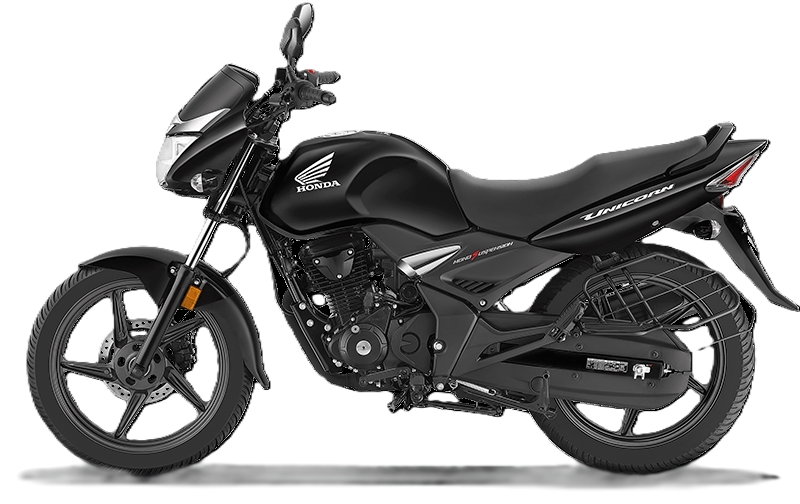
Honda Unicorn
- 162.71 cc Air-Cooled, 2-valve
- 13.18 PS @ 7,500 rpm
- 50 km/l (ARAI)
- 13-litre tank
- 1 variant available
- 187 mm ground clearance
Full Specification Comparison
Every number that matters — side by side
| Specification | Yamaha FZ-X | Honda Unicorn |
|---|---|---|
| Engine & Performance | ||
| Displacement | 149 cc | 162.71 cc |
| Cooling System | Air-Cooled | Air-Cooled |
| Max Power | 12.4 PS @ 7,250 rpm | 13.18 PS @ 7,500 rpm |
| Max Torque | 13.3 Nm @ 5,500 rpm | 14.8 Nm @ 5,250 rpm |
| Valves per Cylinder | 2 | 2 |
| Compression Ratio | 9.6 : 1 | 10 ± 0.2 : 1 |
| Bore × Stroke | 57.3 × 57.9 mm | 57.3 × 63.1 mm |
| Emission Standard | BS6 Phase 2 | BS6 Phase 2 (OBD2) |
| Transmission | 5-Speed Manual | 5-Speed Manual |
| Top Speed | ~115 km/h | ~106 km/h |
| Riding Modes | No | No |
| Traction Control | Yes | No |
| Fuel & Range | ||
| Mileage (ARAI) | 55.11 km/l (ARAI) | 50 km/l (ARAI) |
| Fuel Tank | 10 litres | 13 litres |
| Reserve Capacity | 1.6 litres | 2 litres |
| Riding Range | ~551 km | ~650 km |
| Brakes & Wheels | ||
| Braking System | Single Channel ABS | Single Channel ABS |
| Front Brake | Disc – 282 mm | Disc – 240 mm |
| Rear Brake | Disc – 220 mm | Drum – 130 mm |
| Tyre Type | Tubeless | Tubeless |
| Tyre Size (F / R) | 100/80-17 / 140/60-17 | 80/100-18 / 100/90-18 |
| Wheel Type | Alloy | Alloy |
| Suspension & Chassis | ||
| Front Suspension | Telescopic Fork | Telescopic |
| Rear Suspension | 7-Step Adjustable Monocross | Monoshock |
| Chassis | Diamond Frame | Diamond Type |
| Rear Preload Adjuster | Yes | No |
| Dimensions & Weight | ||
| Kerb Weight | 139 kg | 139 kg |
| Seat Height | 810 mm | 798 mm |
| Ground Clearance | 165 mm | 187 mm |
| Wheelbase | 1330 mm | 1335 mm |
| Overall L × W × H | 2020 × 785 × 1115 mm | 2081 × 756 × 1103 mm |
| Features & Electronics | ||
| Instrument Console | Fully Digital LCD | Digi-Analog |
| Headlight | LED Projector | Halogen |
| DRLs | Yes | No |
| Turn Signals | Bulb | – |
| Hazard Warning Lights | No | No |
| Traction Control | Yes | No |
| Bluetooth Connectivity | Yes (Y-Connect) | No |
| Call & SMS Alerts | Yes | No |
| USB Charging Port | Yes | Yes (Type-C) |
| Distance to Empty | Yes | No |
| Gear Indicator | Yes | No |
| Tachometer | No | Yes |
| Service Reminder | Yes | No |
| Keyless Ignition | No | No |
| Price & Warranty | ||
| Starting Price (ex-showroom) | ₹1,21,667 | ₹1,12,898 |
| Top Variant Price | ₹1,30,054 | ₹1,12,898 |
| Number of Variants | 2 | 1 |
| Standard Warranty | 2 Years / 30,000 km | 3 Years / 42,000 km |
★ Green highlights indicate the stronger value in each row. Prices are ex-showroom India averages and may vary by city.
Variant-wise Price Comparison
All variants laid out — find the right one for your budget
FZ-X Variants
Unicorn Variants
Pros & Cons
Honest strengths and weaknesses of each bike
Pros
- Distinctive neo-retro scrambler design — unique in segment
- Higher ARAI-certified mileage of 55.11 km/l
- Traction control system — unique safety advantage
- Bluetooth connectivity via Yamaha Y-Connect app
- LED projector headlamp with DRLs
- USB charging port standard
- Full digital LCD cluster with distance to empty and gear indicator
- Larger front disc (282 mm) and rear disc setup
- 7-step adjustable rear preload
- 2 variant/colour options
Cons
- Smaller 149cc engine — less power (12.4 PS) and torque (13.3 Nm)
- Smaller 10-litre fuel tank, shorter range (~551 km)
- Higher starting price (₹1,21,667 vs ₹1,12,898)
- Shorter warranty — 2 years / 30,000 km
- Less ground clearance (165 mm vs 187 mm)
- Higher seat height (810 mm vs 798 mm)
- Halogen-quality bulb turn indicators
Pros
- Larger 162.71cc engine — more power (13.18 PS) and torque (14.8 Nm)
- Bigger 13-litre fuel tank, longer range (~650 km)
- Significantly lower price — ₹8,769 cheaper at base
- Superior 3-year / 42,000 km warranty
- Excellent ground clearance of 187 mm
- Lower, more accessible seat height (798 mm)
- USB Type-C charging port
- Honda's proven long-term reliability
- ARAI-certified 50 km/l mileage
Cons
- No traction control
- No Bluetooth connectivity or smartphone integration
- Halogen headlamp — no LED or projector
- No DRLs
- Rear drum brake instead of disc
- Conservative, traditional styling
- Digi-Analog cluster lacks digital features
- No gear indicator or distance to empty
- Only one variant available
Key Differences Explained
What really sets these two bikes apart
Engine & Performance
The Honda Unicorn has a meaningful performance edge with its 162.71cc engine producing 13.18 PS and 14.8 Nm of torque — 6.3% more power and 11.3% more torque than the FZ-X's 149cc unit (12.4 PS / 13.3 Nm). The Unicorn's longer stroke (63.1 mm vs 57.9 mm) delivers stronger low and mid-range pull, making it noticeably more capable with a pillion or on inclines. The FZ-X's engine is smoother and more refined for solo city use, but the Unicorn has the real-world grunt advantage.
Fuel Efficiency & Range
The FZ-X has a higher ARAI-certified mileage figure of 55.11 km/l versus the Unicorn's 50 km/l — a 10% gap on paper. However, the Unicorn's significantly larger 13-litre tank gives it a real-world riding range of approximately 650 km, compared to just ~551 km from the FZ-X's 10-litre tank. For riders who hate fuel stops, the Unicorn wins despite lower per-litre efficiency.
Braking & Safety
The FZ-X has the stronger braking package: a larger 282 mm front disc (vs Unicorn's 240 mm), a rear disc (vs the Unicorn's rear drum), and critically, traction control — a feature entirely absent from the Unicorn. Both bikes have single-channel ABS. The FZ-X's traction control adds genuine wet-road confidence that the Unicorn, for all its other strengths, simply cannot match.
Technology & Features
The FZ-X leads comprehensively on modern tech. It offers Bluetooth connectivity via Yamaha Y-Connect, call and SMS alerts, a full digital LCD cluster with gear indicator and distance to empty, an LED projector headlamp with DRLs, and a service reminder. The Unicorn counters with a USB Type-C charging port and an analogue tachometer, but has no smartphone connectivity, no LED headlamp, no DRLs, and a basic Digi-Analog console. For tech-forward buyers, the FZ-X is the clear winner.
Warranty & Reliability
The Honda Unicorn offers a significantly better warranty — 3 years / 42,000 km versus the FZ-X's 2 years / 30,000 km. That's 50% more time and 40% more kilometres of factory coverage. Honda's brand reputation for exceptional long-term durability further strengthens the Unicorn's ownership case. For buyers planning to keep their bike for many years, this is a meaningful difference.
Price & Value
The Honda Unicorn starts at ₹1,12,898 — ₹8,769 cheaper than the base FZ-X at ₹1,21,667. The Unicorn delivers more engine displacement, more power, a bigger tank, better ground clearance, and a longer warranty for substantially less money. The FZ-X justifies its premium through design, technology, and safety electronics. Value depends on priorities: the Unicorn is better value for pure commuting; the FZ-X for features and style.
Expert Verdict
Which one should you actually buy?
Buy the Yamaha FZ-X if…
- You want a motorcycle that genuinely stands out in a crowd
- Traction control for wet-road safety is important to you
- Bluetooth connectivity and smartphone alerts are a priority
- An LED projector headlamp matters for night riding
- Better certified mileage per litre (55.11 km/l) is a consideration
- Disc brakes at both ends give you braking confidence
- You value a full digital cluster with gear indicator and distance to empty
Buy the Honda Unicorn if…
- Budget matters — starts ₹8,769 cheaper
- You want more engine power and torque for daily use
- A larger 13-litre tank and ~650 km range suits your riding pattern
- Ground clearance (187 mm) is critical for your daily roads
- The superior 3-year / 42,000 km warranty gives you peace of mind
- Honda's long-term reliability record is a priority
- You prefer a practical, no-compromise commuter over a lifestyle bike
Overall Winner for Most Riders: Honda Unicorn. At ₹8,769 less, the Unicorn delivers more engine displacement, higher power and torque, a larger 13-litre fuel tank, a longer ~650 km riding range, superior 187 mm ground clearance, and a better 3-year / 42,000 km warranty — making it the stronger practical choice for the majority of Indian buyers. Choose the Yamaha FZ-X if you place a premium on distinctive neo-retro styling, traction control, Bluetooth connectivity, LED lighting, and a feature-rich digital console that the Unicorn simply does not offer.
Frequently Asked Questions
Common questions answered by our experts
The Honda Unicorn is better for most buyers who prioritise lower price, more engine power and torque, a larger fuel tank, longer riding range, better ground clearance, and a superior 3-year / 42,000 km warranty. The Yamaha FZ-X is better if you value distinctive neo-retro styling, traction control, Bluetooth connectivity, an LED projector headlamp, and a richer digital feature set.
The Honda Unicorn starts at ₹1,12,898 while the Yamaha FZ-X Standard starts at ₹1,21,667 ex-showroom — the Unicorn is ₹8,769 cheaper at base. The FZ-X's premium Dark Matte Blue Purple variant reaches ₹1,30,054, widening the gap to ₹17,156. The Unicorn is available in only one variant, while the FZ-X offers two. Prices are ex-showroom India averages and may vary by city.
The Yamaha FZ-X has a higher ARAI-certified mileage of 55.11 km/l versus the Honda Unicorn's ARAI-certified 50 km/l. However, the Unicorn's larger 13-litre tank delivers an estimated riding range of ~650 km versus ~551 km for the FZ-X's 10-litre tank. The FZ-X wins on fuel efficiency per litre, while the Unicorn wins on overall riding range between fill-ups.
The Honda Unicorn makes more power at 13.18 PS @ 7,500 rpm compared to the Yamaha FZ-X's 12.4 PS @ 7,250 rpm. The Unicorn also produces significantly more torque at 14.8 Nm @ 5,250 rpm versus 13.3 Nm @ 5,500 rpm. This is largely down to the Unicorn's larger 162.71cc engine versus the FZ-X's 149cc unit, giving the Unicorn noticeably stronger real-world performance especially with a pillion passenger.
Yes, the Yamaha FZ-X comes with traction control as standard on all variants. This is a significant safety advantage over the Honda Unicorn, which does not offer traction control. The FZ-X's traction control system helps prevent rear wheel slip on wet, sandy, or loose road surfaces — particularly useful during Mumbai monsoons or on potholed Indian roads.
The Honda Unicorn offers a significantly better warranty at 3 years / 42,000 km compared to the Yamaha FZ-X's 2 years / 30,000 km. The Unicorn provides 50% more time and 40% more kilometres of factory warranty coverage. Combined with Honda's well-established reputation for long-term reliability, the Unicorn offers stronger ownership peace of mind for buyers planning to keep their bike for multiple years.