At a Glance
Key differences that define each motorcycle
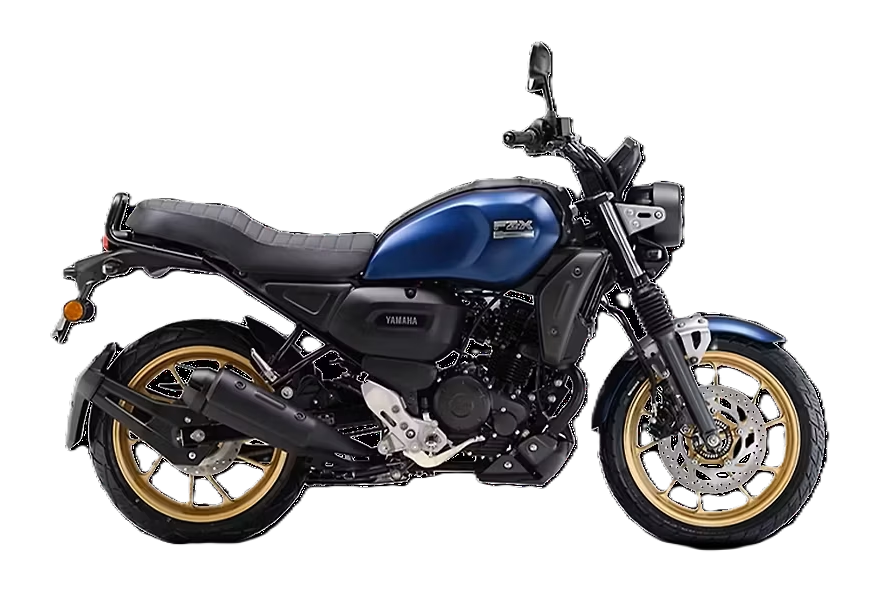
Yamaha FZ-X
- 149 cc Air-Cooled, 2-valve
- 12.4 PS @ 7250 rpm
- 55.11 km/l (ARAI)
- 10-litre tank
- 2 variants available
- Bluetooth on all variants
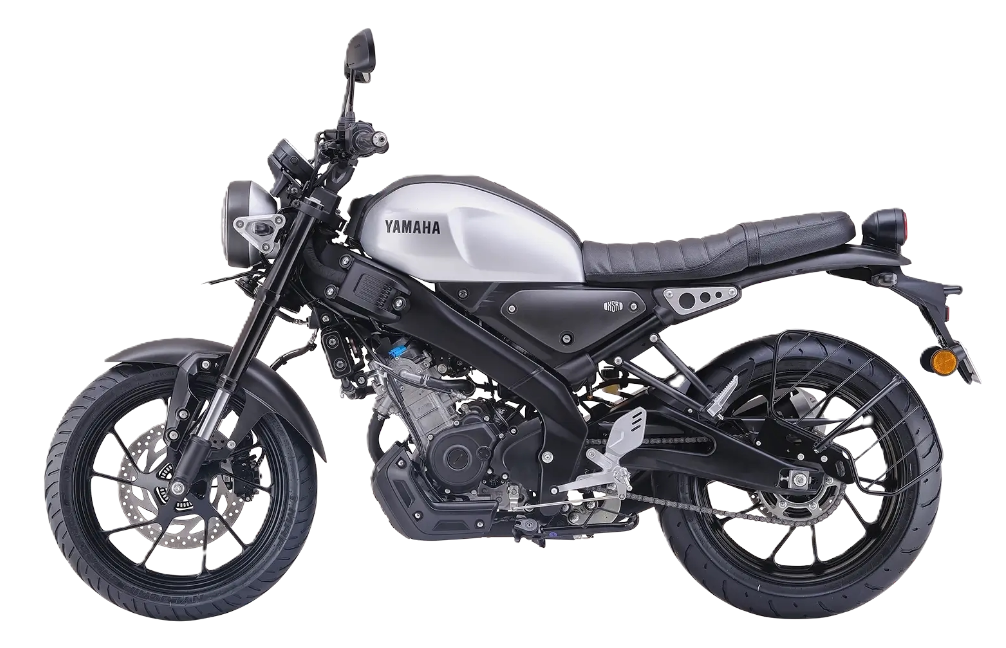
Yamaha XSR 155
- 155 cc Liquid-Cooled, 4-valve VVA
- 18.4 PS @ 10000 rpm
- 46 km/l (Claimed)
- 10-litre tank
- 5 colour variants
- Dual-channel ABS + USD Forks
Full Specification Comparison
Every number that matters — side by side
| Specification | Yamaha FZ-X | Yamaha XSR 155 |
|---|---|---|
| Engine & Performance | ||
| Displacement | 149 cc | 155 cc |
| Cooling System | Air-Cooled | Liquid-Cooled |
| Max Power | 12.4 PS @ 7250 rpm | 18.4 PS @ 10000 rpm |
| Max Torque | 13.3 Nm @ 5500 rpm | 14.2 Nm @ 7500 rpm |
| Valves per Cylinder | 2 | 4 (VVA) |
| Compression Ratio | 9.6 : 1 | 11.6 : 1 |
| Bore × Stroke | 57.3 × 57.9 mm | 58.0 × 58.7 mm |
| Emission Standard | BS6 Phase 2 | BS6 Phase 2 |
| Transmission | 5-Speed Manual | 6-Speed Manual |
| Clutch | Wet Multiplate | Assist & Slipper Clutch |
| Top Speed | ~115 km/h | ~130 km/h |
| Riding Modes | No | No |
| Traction Control | Yes | Yes |
| Fuel & Range | ||
| Mileage (Claimed) | 55.11 km/l (ARAI) | 46 km/l |
| Mileage (Real-world) | 45–50 km/l | ~38–42 km/l |
| Fuel Tank | 10 litres | 10 litres |
| Reserve Capacity | 1.6 litres | 1.6 litres |
| Riding Range | ~551 km | ~460 km |
| Brakes & Wheels | ||
| Braking System | Single Channel ABS | Dual Channel ABS |
| Front Brake | Disc – 282 mm | Disc – 282 mm |
| Rear Brake | Disc – 220 mm | Disc – 220 mm |
| Tyre Type | Tubeless | Tubeless |
| Tyre Size (F / R) | 100/80-17 / 140/60-17 | 100/80-17 / 140/70-17 |
| Wheel Type | Alloy | Alloy |
| Suspension & Chassis | ||
| Front Suspension | Telescopic Fork | USD Fork |
| Rear Suspension | 7-Step Adjustable Monocross | Monoshock |
| Chassis | Diamond Frame | Deltabox Frame |
| Rear Preload Adjuster | Yes | Yes |
| Dimensions & Weight | ||
| Kerb Weight | 139 kg | 137 kg |
| Seat Height | 810 mm | 810 mm |
| Ground Clearance | 165 mm | 170 mm |
| Wheelbase | 1330 mm | 1330 mm |
| Overall L × W × H | 2020 × 785 × 1115 mm | 2007 × 804 × 1080 mm |
| Features & Electronics | ||
| Instrument Console | Fully Digital LCD | Fully Digital LCD |
| Headlight | LED | LED |
| DRLs | Yes | Yes |
| Turn Signals | Bulb | LED |
| Hazard Warning Lights | No | No |
| Traction Control | Yes | Yes |
| Bluetooth Connectivity | Yes (all variants) | Yes |
| Call & SMS Alerts | Yes | Yes |
| USB Charging Port | Yes | No |
| Distance to Empty | Yes | No |
| Gear Indicator | Yes | Yes |
| Tachometer | No | Digital |
| Keyless Ignition | No | No |
| Price & Warranty | ||
| Starting Price (ex-showroom) | ₹1,21,667 | ₹1,49,990 |
| Top Variant Price | ₹1,30,054 | ₹1,58,990 |
| Number of Variants | 2 | 5 (colour variants) |
| Standard Warranty | 2 Years / 30,000 km | 2 Years / 30,000 km |
★ Green highlights indicate the stronger value in each row. Prices are ex-showroom India averages and may vary by city.
Variant-wise Price Comparison
All variants laid out — find the right one for your budget
FZ-X Variants
XSR 155 Variants
Pros & Cons
Honest strengths and weaknesses of each bike
Pros
- Best-in-class ARAI-certified mileage of 55.11 km/l
- Significantly lower starting price (₹1,21,667 vs ₹1,49,990)
- Traction control and Bluetooth on all variants
- USB charging port as standard
- Distance to empty display
- Comfortable upright ergonomics for city commuting
- Lightweight 139 kg kerb weight
- Longer riding range (~551 km)
- 7-step adjustable rear suspension
Cons
- Significantly lower peak power (12.4 PS vs 18.4 PS)
- Air-cooled 2-valve engine — less sporty
- Only single-channel ABS
- Conventional telescopic forks
- 5-speed gearbox vs 6-speed on XSR 155
- No tachometer on instrument cluster
- Bulb turn signals (not LED)
Pros
- Higher peak power — 18.4 PS @ 10,000 rpm
- Liquid-cooled 4-valve VVA engine — premium character
- Dual-channel ABS as standard
- USD front forks for superior handling
- Deltabox frame for improved rigidity
- Assist & slipper clutch
- 6-speed gearbox for refined highway cruising
- LED turn signals
- Traction control standard
- R15-derived proven engine platform
Cons
- Lower claimed mileage (46 km/l vs 55.11 km/l)
- Higher starting price — ₹28,323 more than FZ-X
- No USB charging port
- No distance-to-empty display
- Only colour variants — no mechanical differentiation
- Limited service network in some areas
Key Differences Explained
What really sets these two bikes apart
Engine Character
The FZ-X uses a 149 cc air-cooled, 2-valve engine tuned for smooth mid-range torque and fuel efficiency — producing 12.4 PS. The XSR 155 uses a 155 cc liquid-cooled, 4-valve VVA unit producing 18.4 PS — nearly 48% more power — derived from the Yamaha R15 with Variable Valve Actuation for strong low-end torque and an exciting top-end charge. The XSR 155's liquid cooling also manages engine temperatures more effectively in stop-and-go traffic.
Fuel Efficiency & Range
The FZ-X leads clearly with an ARAI-certified 55.11 km/l against the XSR 155's 46 km/l claimed figure. Despite both sharing the same 10-litre fuel tank, the FZ-X delivers a theoretical range of ~551 km versus ~460 km for the XSR 155 — a meaningful gap of around 90 km per tank for daily commuters. Real-world figures are 45–50 km/l for the FZ-X versus approximately 38–42 km/l for the XSR 155.
Braking & Safety
Both bikes share identical brake hardware — 282 mm front disc and 220 mm rear disc — but the XSR 155 carries a decisive safety advantage with dual-channel ABS as standard across all variants. The FZ-X is limited to single-channel ABS, which only controls the front wheel during ABS activation. Both bikes offer traction control, but for overall braking safety the XSR 155 holds the upper hand.
Suspension & Chassis
The XSR 155 wins clearly on chassis hardware. Its USD (upside-down) front forks offer greater rigidity and better feedback during cornering compared to the FZ-X's conventional telescopic setup. The XSR 155 also uses a Deltabox frame — the same platform as the R15 — providing superior torsional stiffness. The FZ-X partially compensates with a 7-step adjustable rear monocross suspension.
Features & Connectivity
The FZ-X edges ahead on everyday convenience features: it includes a USB charging port, a distance-to-empty display, and Bluetooth connectivity on all variants. The XSR 155 counters with LED turn indicators and a tachometer display, but lacks USB charging and the distance-to-empty feature. Both bikes support the Yamaha Y-Connect app for call alerts and ride data.
Price & Value
The FZ-X starts ₹28,323 cheaper (₹1,21,667 vs ₹1,49,990) and tops out at ₹1,30,054 — nearly ₹29,000 less than the XSR 155's most expensive colour. Both offer a 2-year / 30,000 km warranty. The FZ-X offers exceptional value for budget-conscious commuters, while the XSR 155 justifies its premium through a significantly more capable engine, dual-channel ABS, and USD forks.
Expert Verdict
Which one should you actually buy?
Buy the Yamaha FZ-X if…
- You want the best fuel economy in the 150cc retro segment
- Budget is the primary consideration — saves ~₹28,000
- Daily commuting of 30+ km and longer tank range matters
- USB charging and distance-to-empty are important daily features
- You prefer smooth, relaxed city riding over sporty performance
- You're a newer rider who wants a lighter, more forgiving motorcycle
- You want Bluetooth connectivity at a much lower price point
Buy the Yamaha XSR 155 if…
- You want significantly stronger outright performance (18.4 PS)
- Dual-channel ABS across all variants is a safety priority
- USD front forks and Deltabox frame appeal to you
- You enjoy spirited riding and want a premium engine character
- The VVA liquid-cooled engine's refinement matters to you
- You're upgrading from a 125cc and want real performance headroom
- Premium retro styling with race-derived hardware appeals to you
Overall Winner for Performance Riders: Yamaha XSR 155. Nearly 48% more power, a liquid-cooled 4-valve VVA engine, dual-channel ABS across all variants, USD front forks, a Deltabox chassis and an assist & slipper clutch make the XSR 155 the superior motorcycle for enthusiasts who want premium hardware and sporty performance. However, for riders who commute daily and prioritise fuel efficiency, affordability and everyday convenience features, the Yamaha FZ-X offers exceptional value at ₹28,000 less — particularly its best-in-class 55.11 km/l ARAI mileage and standard USB charging. Choose based on what matters most: the XSR 155 for performance, the FZ-X for economy and value.
Frequently Asked Questions
Common questions answered by our experts
The Yamaha XSR 155 is better for performance-focused riders who want a powerful liquid-cooled VVA engine (18.4 PS), dual-channel ABS, USD front forks, and a Deltabox chassis. The Yamaha FZ-X is better for budget commuters who prioritise best-in-class ARAI mileage (55.11 km/l), a lower starting price (₹1,21,667), USB charging, and a smooth everyday riding experience.
The Yamaha FZ-X starts at ₹1,21,667 while the Yamaha XSR 155 starts at ₹1,49,990 ex-showroom — a base difference of ₹28,323. The gap remains consistent at higher trims: the FZ-X tops out at ₹1,30,054, while the XSR 155's top colour variant reaches ₹1,58,990 — a difference of around ₹28,936. Both prices are for India and may vary by city.
The Yamaha FZ-X has significantly better mileage at 55.11 km/l (ARAI certified) compared to the Yamaha XSR 155's 46 km/l claimed figure. Both bikes share the same 10-litre fuel tank, but the FZ-X's superior efficiency gives it a longer theoretical range of ~551 km versus ~460 km for the XSR 155 — roughly 90 km more per tank.
The Yamaha XSR 155 makes considerably more power at 18.4 PS @ 10,000 rpm compared to the Yamaha FZ-X's 12.4 PS @ 7,250 rpm — nearly 48% more. The XSR 155 also produces higher torque (14.2 Nm vs 13.3 Nm), revs more freely thanks to its 4-valve VVA liquid-cooled engine, and uses a 6-speed gearbox versus the FZ-X's 5-speed.
Yes, the Yamaha XSR 155 comes equipped with dual-channel ABS as standard on all variants. This controls both front and rear wheel braking during ABS activation for maximum safety. The Yamaha FZ-X only offers single-channel ABS, which is limited to front wheel ABS intervention only.
Both the Yamaha FZ-X and Yamaha XSR 155 offer identical warranty coverage: 2 years or 30,000 km, whichever comes first. Neither bike has an advantage in warranty terms. Both are backed by Yamaha's established service network across India.