At a Glance
Key differences that define each motorcycle
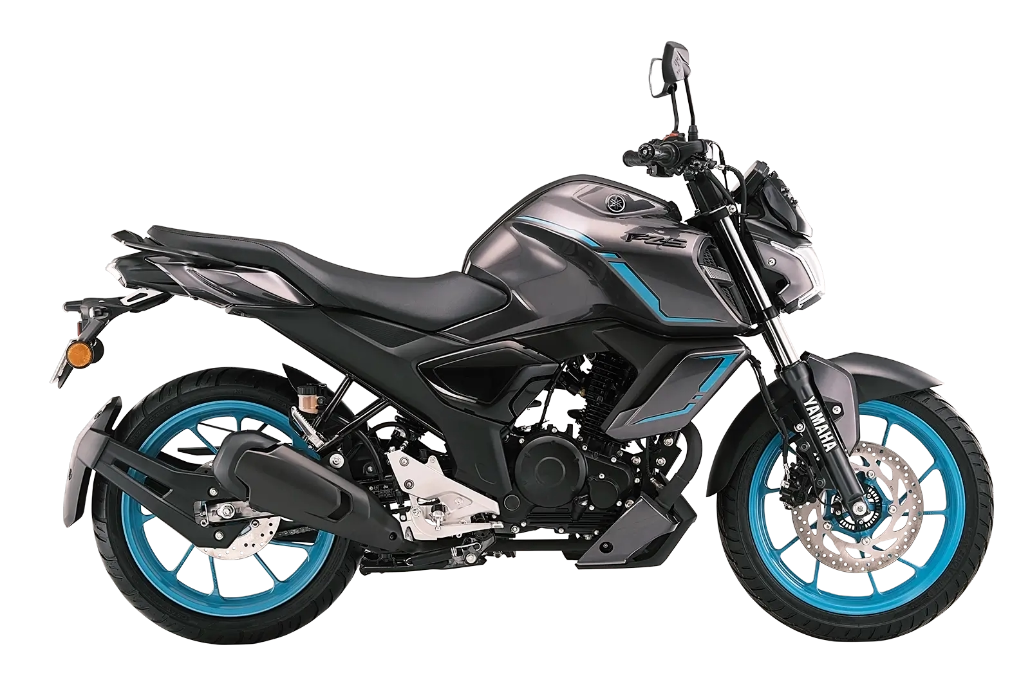
Yamaha FZS Fi Hybrid
- 149 cc Air-Cooled + SMG Hybrid
- 12.4 PS @ 7250 rpm
- 60 km/l (ARAI)
- 13-litre tank
- 1 variant, 3 colours
- Idle Stop-Start + Silent Start
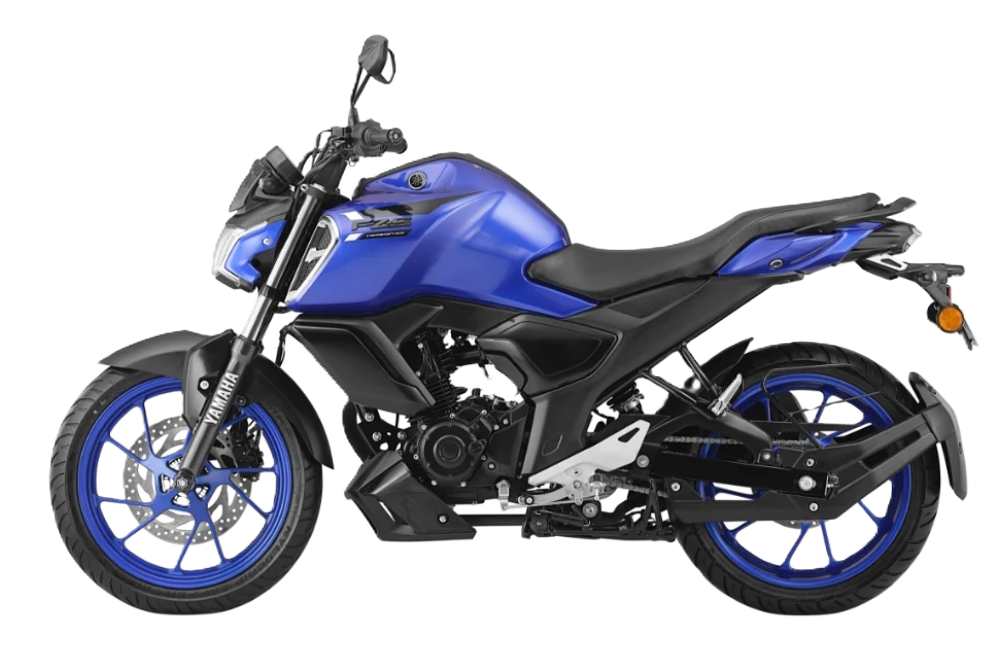
Yamaha FZ-S Fi V4
- 149 cc Air-Cooled, 2-valve FI
- 12.4 PS @ 7250 rpm
- 60 km/l (ARAI)
- 13-litre tank
- 2 variants, 8 colours
- Starting at ₹1,20,409
Full Specification Comparison
Every number that matters — side by side
| Specification | Yamaha FZS Fi Hybrid | Yamaha FZ-S Fi V4 |
|---|---|---|
| Engine & Performance | ||
| Displacement | 149 cc | 149 cc |
| Cooling System | Air-Cooled | Air-Cooled |
| Max Power | 12.4 PS @ 7250 rpm | 12.4 PS @ 7250 rpm |
| Max Torque | 13.3 Nm @ 5500 rpm | 13.3 Nm @ 5500 rpm |
| Hybrid System | Smart Motor Generator (SMG) | None |
| Valves per Cylinder | 2 | 2 |
| Compression Ratio | 9.6 : 1 | 9.6 : 1 |
| Bore × Stroke | 57.3 × 57.9 mm | 57.3 × 57.9 mm |
| Emission Standard | BS6 Phase 2 / OBD-2B | BS6 Phase 2 / OBD-2B |
| Transmission | 5-Speed Manual | 5-Speed Manual |
| Clutch | Wet Multi-Plate | Wet Multi-Plate |
| Top Speed | ~115 km/h | ~115 km/h |
| Idle Stop-Start | Yes | No |
| Silent Start | Yes | No |
| Traction Control | Yes | Yes |
| Riding Modes | No | No |
| Fuel & Range | ||
| Mileage (Claimed) | 60 km/l (ARAI) | 60 km/l (ARAI) |
| Mileage (Real-world) | 50–55 km/l | 45–50 km/l |
| Fuel Tank | 13 litres | 13 litres |
| Reserve Capacity | 2 litres | 2 litres |
| Riding Range | ~780 km | ~780 km |
| Brakes & Wheels | ||
| Braking System | Single Channel ABS | Single Channel ABS |
| Front Brake | Disc – 282 mm | Disc – 282 mm |
| Rear Brake | Disc – 220 mm | Disc – 220 mm |
| Tyre Type | Tubeless | Tubeless |
| Tyre Size (F / R) | 100/80-17 / 140/60-17 | 100/80-17 / 140/60-17 |
| Wheel Type | Alloy | Alloy |
| Suspension & Chassis | ||
| Front Suspension | Telescopic Fork | Telescopic Fork |
| Rear Suspension | 7-Step Adjustable Monocross | 7-Step Adjustable Monoshock |
| Chassis | Diamond Frame | Diamond Frame |
| Rear Preload Adjuster | Yes | Yes |
| Dimensions & Weight | ||
| Kerb Weight | 138 kg | 136 kg |
| Seat Height | 790 mm | 790 mm |
| Ground Clearance | 165 mm | 165 mm |
| Wheelbase | 1330 mm | 1330 mm |
| Overall L × W × H | 2000 × 780 × 1080 mm | 2000 × 780 × 1080 mm |
| Features & Electronics | ||
| Instrument Console | Fully Digital LCD | Fully Digital LCD |
| Headlight | LED | LED |
| DRLs | Yes | Yes |
| Turn Signals | LED | LED |
| Hazard Warning Lights | Yes | Yes |
| Traction Control | Yes | Yes |
| Bluetooth Connectivity | Yes (standard) | Yes (Deluxe variant only) |
| Call & SMS Alerts | Yes | Yes (Deluxe only) |
| USB Charging Port | No | No |
| Distance to Empty | Yes | Yes |
| Tachometer | Digital | Digital |
| Idle Stop-Start | Yes | No |
| Colour Options | 3 (Racing Blue, Cyan Metallic Grey, Matte Black) | 8 (across Standard & Deluxe) |
| Price & Warranty | ||
| Starting Price (ex-showroom) | ₹1,35,174 | ₹1,20,409 |
| Top Variant Price | ₹1,35,174 | ₹1,20,866 |
| Number of Variants | 1 | 2 (Standard + Deluxe) |
| Standard Warranty | 2 Years / 30,000 km | 2 Years / 30,000 km |
★ Green highlights indicate the stronger value in each row. Prices are ex-showroom India averages and may vary by city.
Variant-wise Price Comparison
All variants laid out — find the right one for your budget
FZS Fi Hybrid Variants
FZ-S Fi V4 Variants
Pros & Cons
Honest strengths and weaknesses of each bike
Pros
- SMG hybrid assist for smoother city acceleration
- Idle stop-start reduces fuel waste at traffic lights
- Silent start for a refined urban experience
- Better real-world mileage (50–55 km/l vs 45–50 km/l)
- Bluetooth connectivity standard on all colours
- Traction control, LED signals and hazard lights
- Distance-to-empty display
Cons
- Significantly more expensive — ₹14,765 premium over V4 Standard
- Only 3 colour options vs 8 on the V4
- Single variant — no Standard / Deluxe choice
- No USB charging port
- Slightly heavier at 138 kg vs 136 kg
Pros
- Significantly lower starting price (₹1,20,409)
- 8 colour options across Standard and Deluxe variants
- 2 variants — Standard and Deluxe with Bluetooth
- Same ARAI mileage claim (60 km/l) and 13-litre tank
- Traction control, LED signals and hazard lights
- Lightest in the FZ family at 136 kg
- Well-proven, reliable platform with wide service network
Cons
- No hybrid assist, idle stop-start or silent start
- Lower real-world mileage vs Hybrid (45–50 km/l)
- Bluetooth only on Deluxe variant — not standard
- Conventional commuter — no tech differentiation
- No USB charging port
Key Differences Explained
What really sets these two bikes apart
Hybrid Technology
The single biggest hardware difference: the FZS Fi Hybrid carries Yamaha's Smart Motor Generator (SMG) that assists the engine during acceleration, enables idle stop-start (engine cuts off at red lights automatically) and silent start (restarts without a loud crank). The FZ-S Fi V4 has none of this — it is a conventional fuel-injected motorcycle with the identical engine but no electrification. For heavy urban commuting, the Hybrid's stop-start alone can meaningfully improve real-world efficiency.
Fuel Efficiency & Range
Both bikes claim identical ARAI mileage of 60 km/l and share the same 13-litre tank, giving both a theoretical range of ~780 km. However, the Hybrid's idle stop-start system makes a real difference in stop-and-go city traffic — real-world figures run at 50–55 km/l for the Hybrid versus 45–50 km/l for the V4. For city commuters who regularly stop at traffic lights, the Hybrid's practical fuel savings add up meaningfully over time.
Price & Value
The FZ-S Fi V4 Standard costs ₹1,20,409 — ₹14,765 less than the FZS Fi Hybrid at ₹1,35,174. Even the Deluxe variant with Bluetooth is just ₹1,20,866. The Hybrid's premium buys the SMG system, idle stop-start and silent start; the V4 delivers the same engine, tank, brakes, and chassis for considerably less. For budget-conscious buyers, the V4 offers exceptional value. For tech-forward buyers who will recoup the premium through fuel savings, the Hybrid makes financial sense over time.
Connectivity & Features
The FZS Fi Hybrid includes Bluetooth connectivity as standard across all three colour options, enabling Y-Connect app integration with call and SMS alerts. The FZ-S Fi V4 only provides Bluetooth on the Deluxe variant (₹1,20,866) — the base Standard variant has no Bluetooth. Both bikes offer traction control, LED turn signals, hazard warning lights, distance-to-empty and a fully digital LCD cluster. Neither includes a USB charging port.
Variants & Colour Choice
The FZ-S Fi V4 wins convincingly with 8 colour options spread across two variants: the Standard (Dark Matte Blue, Matte Black) and the feature-rich Deluxe (Ice Fluo Vermillion, Cyber Green, Racing Blue, Metallic Grey, Majesty Red, Matte Black). The FZS Fi Hybrid offers just 3 colours — Racing Blue, Cyan Metallic Grey and Matte Black — in a single variant. Buyers with specific colour preferences will find far more choice in the V4's range.
Chassis, Braking & Warranty
Both bikes are mechanically near-identical outside the hybrid system — same diamond frame, same telescopic forks, same 7-step adjustable rear suspension, same 282 mm front and 220 mm rear disc setup with single-channel ABS, same 790 mm seat height, 165 mm ground clearance and 1330 mm wheelbase. The V4 is fractionally lighter at 136 kg versus 138 kg for the Hybrid. Both carry a 2-year / 30,000 km warranty and follow the same service schedule.
Expert Verdict
Which one should you actually buy?
Buy the Yamaha FZS Fi Hybrid if…
- You want hybrid assist and idle stop-start for city riding
- Reducing fuel consumption at traffic signals matters
- You want Bluetooth connectivity without paying extra for a Deluxe variant
- The silent start feature appeals for noise-sensitive environments
- You're willing to pay ₹14,765 more for future-facing hybrid tech
- You plan to keep the bike 3+ years and recoup the premium through fuel savings
Buy the Yamaha FZ-S Fi V4 if…
- You want the best value — ₹14,765 less for essentially the same bike
- You ride mostly on highways where idle stop-start has no benefit
- Colour choice matters — 8 options vs 3 on the Hybrid
- You want the Deluxe variant's Bluetooth at an even lower price
- A proven, conventional commuter with no new-tech risk suits you
- Budget is the primary consideration for your purchase
This comparison is essentially a question of whether the FZS Fi Hybrid's ₹14,765 premium is worth paying. For most buyers, the Yamaha FZ-S Fi V4 Deluxe is the smarter choice — it delivers the same engine, same 13-litre tank, same claimed mileage, same brakes, traction control, LED signals, hazard lights, Bluetooth connectivity and near-identical everything else for ₹14,308 less. The savings can fund 2–3 years of servicing. Choose the FZS Fi Hybrid only if you specifically commute through heavy stop-and-go city traffic and will genuinely benefit from idle stop-start on a daily basis — in that scenario, the Hybrid's real-world efficiency advantage and standard Bluetooth make the premium justifiable over a long ownership period.
Frequently Asked Questions
Common questions answered by our experts
For most buyers the Yamaha FZ-S Fi V4 Deluxe (₹1,20,866) is the better buy — it delivers an almost identical package with Bluetooth, traction control, LED lights and 60 km/l ARAI mileage for ₹14,308 less than the FZS Fi Hybrid. The FZS Fi Hybrid is better for riders who specifically commute in heavy stop-and-go city traffic and want idle stop-start, silent start and standard Bluetooth across all colours.
The Yamaha FZ-S Fi V4 Standard is priced at ₹1,20,409 and the Deluxe at ₹1,20,866, while the Yamaha FZS Fi Hybrid is priced at ₹1,35,174 — making the V4 Standard ₹14,765 cheaper and the V4 Deluxe ₹14,308 cheaper than the Hybrid. Both prices are ex-showroom India averages and may vary by city.
Yes, both the Yamaha FZS Fi Hybrid and FZ-S Fi V4 use the identical 149cc air-cooled, 2-valve, fuel-injected engine producing 12.4 PS @ 7,250 rpm and 13.3 Nm @ 5,500 rpm. The key difference is that the FZS Fi Hybrid adds a Smart Motor Generator (SMG) hybrid assist system with idle stop-start and silent start, which the FZ-S Fi V4 does not have. Both use the same 5-speed manual gearbox.
Both bikes claim the same ARAI-certified mileage of 60 km/l and share a 13-litre fuel tank. However, the FZS Fi Hybrid's idle stop-start system gives it a real-world advantage in city traffic — owners typically report 50–55 km/l versus 45–50 km/l for the V4. On highways where stop-start has no effect, the two bikes perform comparably.
No. The Yamaha FZ-S Fi V4 Standard variant does not include Bluetooth connectivity. Bluetooth is only available on the Deluxe variant at ₹1,20,866. In contrast, the Yamaha FZS Fi Hybrid includes Bluetooth as standard across all three colour options, making it a better choice for riders who want Y-Connect smartphone integration without paying a variant premium.
Both the Yamaha FZS Fi Hybrid and Yamaha FZ-S Fi V4 offer identical warranty coverage: 2 years or 30,000 km, whichever comes first. Neither has any advantage over the other in warranty terms. Both follow the same service schedule — first service at 1,000 km / 1 month, second at 5,000 km / 6 months and third at 9,000 km / 12 months.