At a Glance
Key differences that define each motorcycle
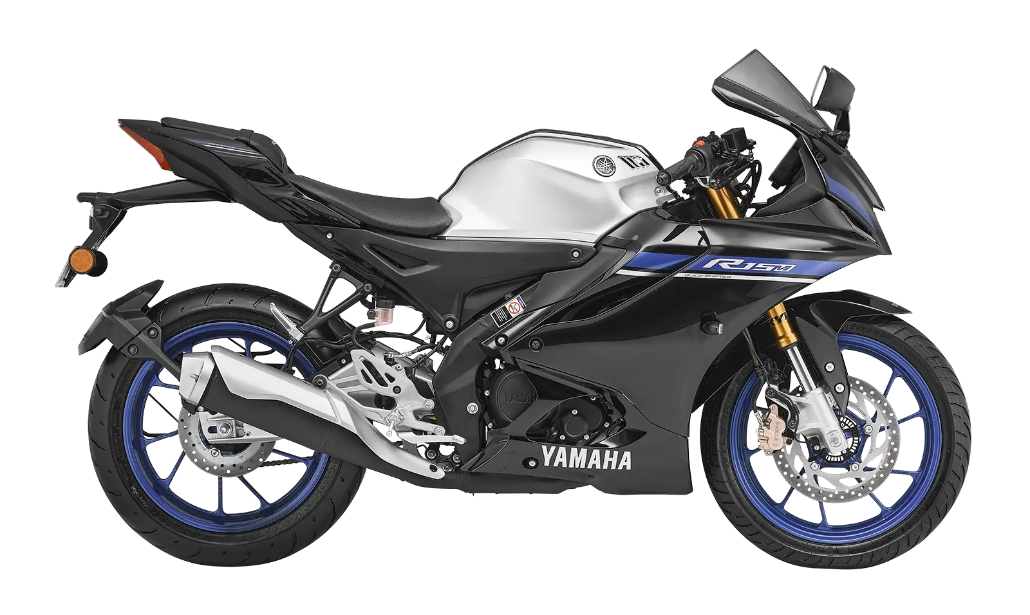
Yamaha R15 M
- 155 cc Liquid-Cooled, 4-valve, VVA
- 18.4 PS @ 10000 rpm
- 45 km/l (ARAI)
- 11-litre tank
- 3 variants available
- Traction control, quick shifter & TFT
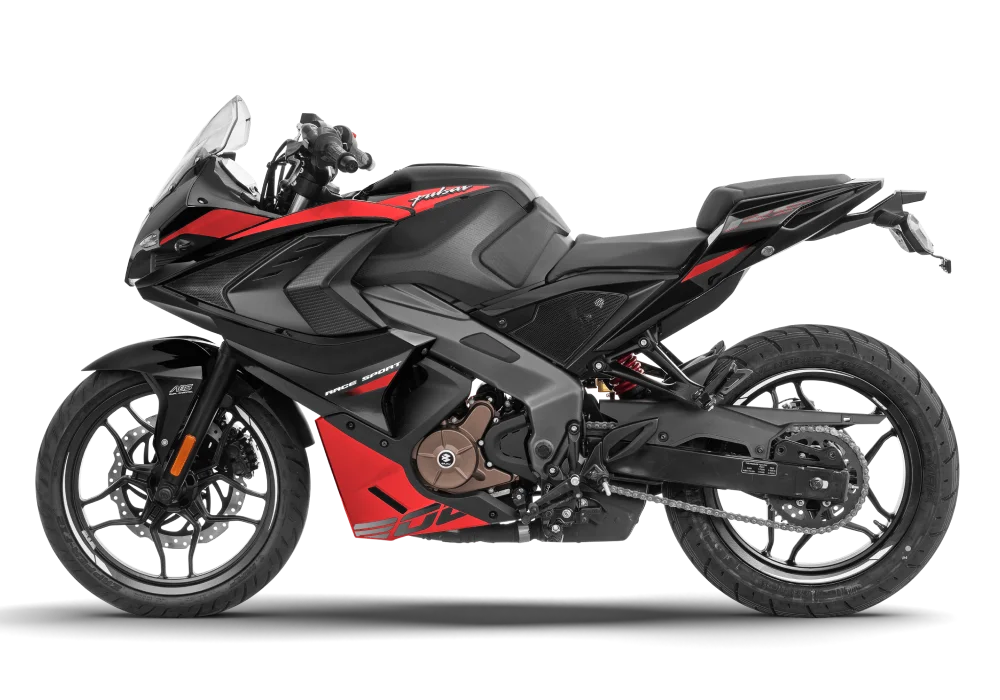
Bajaj Pulsar RS200
- 199.5 cc Liquid-Cooled, 4-valve
- 24.5 PS @ 9750 rpm
- 35 km/l (ARAI)
- 13-litre tank
- 1 variant available
- Dual-Ch ABS · 5 Yrs / 75,000 km warranty
Full Specification Comparison
Every number that matters — side by side
| Specification | Yamaha R15 M | Bajaj Pulsar RS200 |
|---|---|---|
| Engine & Performance | ||
| Displacement | 155 cc | 199.5 cc |
| Cooling System | Liquid-Cooled | Liquid-Cooled |
| Max Power | 18.4 PS @ 10000 rpm | 24.5 PS @ 9750 rpm |
| Max Torque | 14.2 Nm @ 7500 rpm | 18.74 Nm @ 8000 rpm |
| Valves per Cylinder | 4 | 4 |
| VVA Technology | Yes | No |
| Compression Ratio | 11.6 : 1 | 11 ± 0.5 : 1 |
| Bore × Stroke | 58.0 × 58.7 mm | 72 × 49 mm |
| Spark Plugs | 1 | 3 (Triple Spark) |
| Emission Standard | BS6 Phase 2 | BS6 |
| Transmission | 6-Speed Manual | 6-Speed Manual |
| Clutch | Assist & Slipper | Wet Multiplate |
| Top Speed | ~140 km/h | ~141 km/h |
| Traction Control | Yes | No |
| Quick Shifter | Yes (Up-Shift) | No |
| Riding Modes | Track, Street | Road, Rain, Off-Road |
| Fuel & Range | ||
| Mileage (ARAI) | 45 km/l (ARAI) | 35 km/l (ARAI) |
| Fuel Tank | 11 litres | 13 litres |
| Reserve Capacity | 1.76 litres | 2.6 litres |
| Riding Range | ~495 km | ~455 km |
| Brakes & Wheels | ||
| Braking System | Dual Channel ABS | Dual Channel ABS |
| Front Brake | Disc – 282 mm | Disc – 300 mm |
| Rear Brake | Disc – 220 mm | Disc – 230 mm |
| Tyre Type | Tubeless | Tubeless |
| Tyre Size (F / R) | 100/80-17 / 140/70R17 | 110/70-17 / 140/70-17 |
| Wheel Type | Alloy | Alloy |
| Suspension & Chassis | ||
| Front Suspension | USD Fork | Telescopic Fork with Anti-Friction Bush |
| Rear Suspension | Linked-Type Monocross | Nitrox Monoshock with Canister |
| Chassis | Deltabox Frame | Perimeter Frame |
| Rear Preload Adjuster | Yes | Yes |
| Dimensions & Weight | ||
| Kerb Weight | 141 kg | 167 kg |
| Seat Height | 815 mm | 810 mm |
| Ground Clearance | 170 mm | 157 mm |
| Wheelbase | 1325 mm | 1345 mm |
| Overall L × W × H | 1990 × 725 × 1135 mm | 1999 × 765 × 1114 mm |
| Features & Electronics | ||
| Instrument Console | Fully Digital TFT | Fully Digital LCD |
| Headlight | LED Projector | Halogen Projector (Twin) |
| DRLs | Yes | Yes |
| Turn Signals | LED | Bulb |
| Hazard Warning Lights | No | Yes |
| Traction Control | Yes | No |
| Quick Shifter | Yes | No |
| Bluetooth Connectivity | Yes (Y-Connect) | Yes |
| Turn-by-Turn Navigation | Yes | No |
| Call & SMS Alerts | Yes | Yes |
| USB Charging Port | Accessory only | No |
| Distance to Empty | Yes | Yes |
| Gear Indicator | Yes | Yes |
| Shift Timing Light | Yes | No |
| Side Stand Engine Cut-off | Yes | Yes |
| Keyless Ignition | No | No |
| Price & Warranty | ||
| Starting Price (ex-showroom) | ₹1,81,753 | ₹1,72,857 |
| Top Variant Price | ₹1,92,100 | ₹1,72,857 |
| Number of Variants | 3 | 1 |
| Standard Warranty | 2 Years / 30,000 km | 5 Years / 75,000 km |
★ Green highlights indicate the stronger value in each row. Prices are ex-showroom India averages and may vary by city.
Variant-wise Price Comparison
All variants laid out — find the right one for your budget
Yamaha R15 M Variants
Bajaj Pulsar RS200 Variants
Pros & Cons
Honest strengths and weaknesses of each bike
Pros
- Traction control as standard on all variants
- Quick shifter (upshift) for sportier gear changes
- Premium Bluetooth TFT display with navigation
- Dual riding modes: Track and Street
- USD front forks for superior front-end feel
- Lightweight at just 141 kg — best-in-class agility
- Assist and slipper clutch standard
- Better ARAI mileage (45 km/l vs 35 km/l)
- LED projector headlamp and LED turn signals
- VVA technology for strong top-end performance
- Higher ground clearance (170 mm vs 157 mm)
- 3 variants with MotoGP-inspired livery options
Cons
- Higher starting price (₹1,81,753 vs ₹1,72,857)
- Significantly less power (18.4 PS vs 24.5 PS)
- Smaller 155cc engine — less displacement
- Smaller 11-litre fuel tank
- Smaller front disc (282 mm vs 300 mm)
- No hazard warning lights
- Very short warranty — only 2 years / 30,000 km
- Aggressive posture may tire riders in daily commutes
- Heavier on pillion comfort
Pros
- Significantly more power — 24.5 PS @ 9750 rpm
- Larger 199.5cc liquid-cooled engine
- Triple spark technology for efficient combustion
- Larger 300 mm front disc and 230 mm rear disc
- Lower starting price (₹1,72,857)
- Outstanding 5-year / 75,000 km warranty
- Road, Rain and Off-Road riding modes
- Hazard warning lights standard
- Larger 13-litre fuel tank
- Fully-faired aerodynamic design with twin DRLs
- Nitrox monoshock with canister for premium rear feel
Cons
- No traction control
- No quick shifter
- Conventional telescopic forks instead of USD
- Halogen projector headlamp — not LED
- Bulb turn signals — not LED
- Heavier at 167 kg vs 141 kg
- Lower ARAI mileage (35 km/l vs 45 km/l)
- Single variant — no colour or spec choice
- Lower ground clearance (157 mm vs 170 mm)
- No shift timing light or TFT display
Key Differences Explained
What really sets these two bikes apart
Engine Performance
The RS200's 199.5cc engine produces 24.5 PS and 18.74 Nm — 33% more power and 32% more torque than the R15 M's 18.4 PS and 14.2 Nm from its 155cc unit. In practical terms, the RS200 pulls harder out of corners, overtakes more confidently on highways, and hits its top speed with more authority. For riders who prioritise straight-line punch and highway authority, the RS200's displacement advantage is felt every time the throttle opens wide.
Electronics & Technology
The R15 M carries a decisive electronics advantage. It offers traction control, a quick shifter (upshift), dual riding modes (Track and Street), a Bluetooth TFT display with turn-by-turn navigation, a shift timing indicator, and an assist and slipper clutch — features rarely seen at this price point. The RS200 counters with three riding modes (Road, Rain, Off-Road) and Bluetooth connectivity, but lacks traction control, quick shifter, and TFT display.
Handling & Chassis
The R15 M uses a Deltabox frame derived from Yamaha's superbikes, paired with USD forks — both typically found on more expensive motorcycles. At just 141 kg, it changes direction effortlessly and feels razor-sharp in corners. The RS200 uses a perimeter frame with conventional telescopic forks and weighs a heavier 167 kg. Both frames are sport-oriented, but the R15 M's hardware edges out the RS200 when riding enthusiastically on winding roads.
Fuel Efficiency & Range
The R15 M returns a significantly better 45 km/l ARAI versus the RS200's 35 km/l — a difference of 10 km/l. However, the RS200's larger 13-litre tank partially compensates, giving it ~455 km range vs ~495 km for the R15 M's 11-litre tank. The Yamaha's VVA technology is the key to its efficiency advantage. For daily city commuters, the R15 M will visit the fuel pump noticeably less often.
Warranty & Ownership
The RS200's warranty is exceptional: 5 years / 75,000 km versus the R15 M's 2 years / 30,000 km. This is a 2.5× advantage in both duration and kilometre coverage. For a rider clocking 12,000 km per year, the R15 M falls out of warranty by year two-and-a-half while the RS200 stays covered through year six. Additionally, the RS200 costs ₹8,896 less to start, making its overall ownership proposition considerably stronger for most practical buyers.
Price & Value
The RS200 starts at ₹1,72,857 — ₹8,896 less than the R15 M's base variant and ₹19,243 less than its top Icon Performance variant at ₹1,92,100. The RS200 delivers more power, a larger engine, bigger discs, a larger tank, riding modes, and an outstanding warranty at a lower entry price. The R15 M's premium pays for a superior electronics package and handling hardware. Which represents better value depends entirely on whether you prioritise track-derived technology or outright engine performance and long-term coverage.
Expert Verdict
Which one should you actually buy?
Buy the Yamaha R15 M if…
- Premium electronics — traction control, quick shifter and TFT — matter most
- You ride enthusiastically on twisty roads and value precise handling
- The lightweight 141 kg Deltabox chassis and USD forks appeal
- Better fuel efficiency (45 km/l) is important for daily use
- MotoGP-inspired styling and Y-Connect Bluetooth navigation appeal
- You want Track and Street riding modes for the sportiest experience
- The assist and slipper clutch makes a difference in your riding style
Buy the Bajaj Pulsar RS200 if…
- You want significantly more power (24.5 PS) for highways and overtaking
- The 5-year / 75,000 km warranty is a decisive ownership priority
- Budget is a factor — starts ₹8,896 cheaper
- Road, Rain and Off-Road riding modes suit your varied riding conditions
- Larger discs (300 mm front) and stronger braking hardware matter
- A 13-litre tank for fewer fuel stops appeals for highway touring
- You want the iconic fully-faired Pulsar RS200 design and road presence
Overall Verdict: Too Close to Call — Depends on Your Priority. This is one of the most evenly matched comparisons in the sport motorcycle segment. The Yamaha R15 M wins on handling precision, electronics richness (traction control, quick shifter, TFT), fuel efficiency, and lightweight agility. The Bajaj Pulsar RS200 wins on outright power (24.5 PS vs 18.4 PS), lower starting price, an exceptional 5-year / 75,000 km warranty, and bigger braking hardware. If you ride enthusiastically and value technology, the R15 M is the better machine. If you want more power for highway riding, long-term warranty coverage, and better ownership value, the RS200 is the stronger choice. Both earn a 4.5-star rating — your decision should come down to whether you value technology or displacement.
Frequently Asked Questions
Common questions answered by our experts
Both are excellent at their respective strengths. The Yamaha R15 M is better for riders who want traction control, a quick shifter, a premium TFT display, USD forks, and sharper handling with a lighter 141 kg chassis. The Bajaj Pulsar RS200 is better for riders who want more power (24.5 PS), a larger 199.5cc engine, an outstanding 5-year / 75,000 km warranty, a lower starting price (₹1,72,857), and stronger braking hardware.
The Bajaj Pulsar RS200 starts at ₹1,72,857 while the Yamaha R15 M starts at ₹1,81,753 — a base difference of ₹8,896 in the RS200's favour. The gap widens at the top end: the R15 M's Icon Performance variant at ₹1,92,100 is ₹19,243 more expensive than the single RS200 variant. Both prices are ex-showroom India averages and may vary by city.
The Yamaha R15 M has significantly better ARAI-certified mileage at 45 km/l compared to the Bajaj Pulsar RS200's 35 km/l. The R15 M's VVA technology and lighter 155cc engine are key to this 10 km/l advantage. However, the RS200's larger 13-litre tank partially narrows the range gap — ~495 km for the R15 M vs ~455 km for the RS200.
The Bajaj Pulsar RS200 makes significantly more power at 24.5 PS @ 9750 rpm compared to the Yamaha R15 M's 18.4 PS @ 10000 rpm — a difference of 33%. The RS200 also produces considerably more torque at 18.74 Nm vs 14.2 Nm. The RS200's 199.5cc engine gives it a clear advantage for highway riding, rapid overtaking, and top-end performance.
Yes, the Yamaha R15 M comes with traction control as standard on all three variants. It also includes a quick shifter (upshift), dual riding modes (Track and Street), a Bluetooth TFT display with turn-by-turn navigation, and an assist and slipper clutch. The Bajaj Pulsar RS200 does not offer traction control, though it does have Road, Rain and Off-Road riding modes.
The Bajaj Pulsar RS200 has a decisively better warranty at 5 years / 75,000 km compared to the Yamaha R15 M's 2 years / 30,000 km. The RS200's warranty is 2.5 times longer and covers 2.5 times more kilometres — a significant long-term ownership advantage, particularly for riders who clock 12,000–15,000 km per year.