At a Glance
Key differences that define each motorcycle
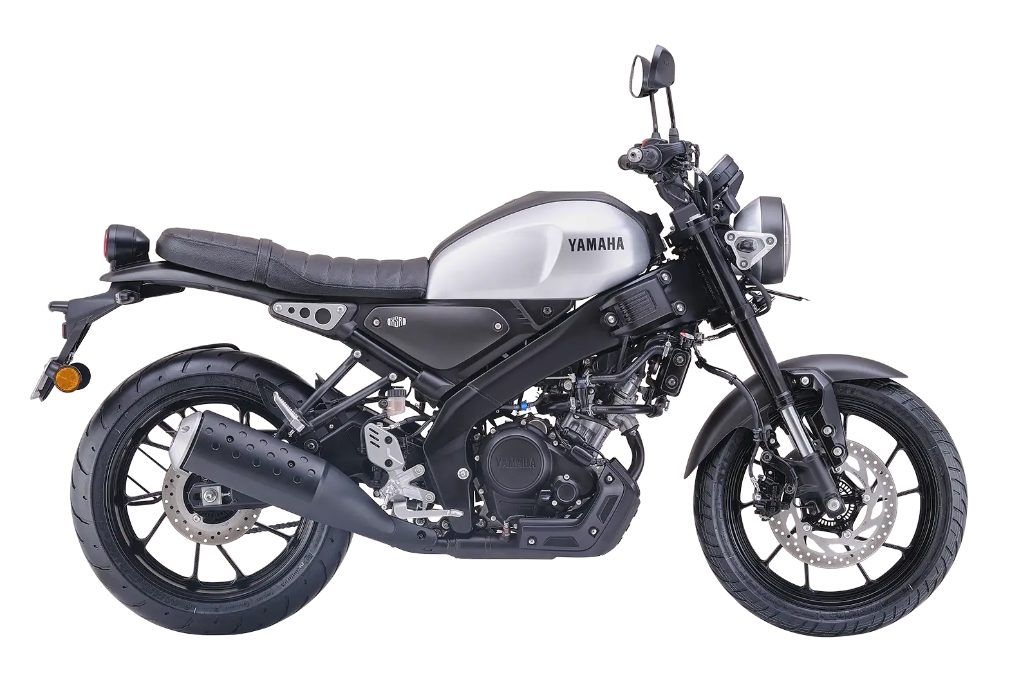
Yamaha XSR 155
- 155cc Liquid-Cooled, 4-valve, VVA
- 18.4 PS @ 10000 rpm
- 46 km/l (Claimed)
- 10-litre tank
- 5 colour options
- Dual-Ch ABS + Traction Control
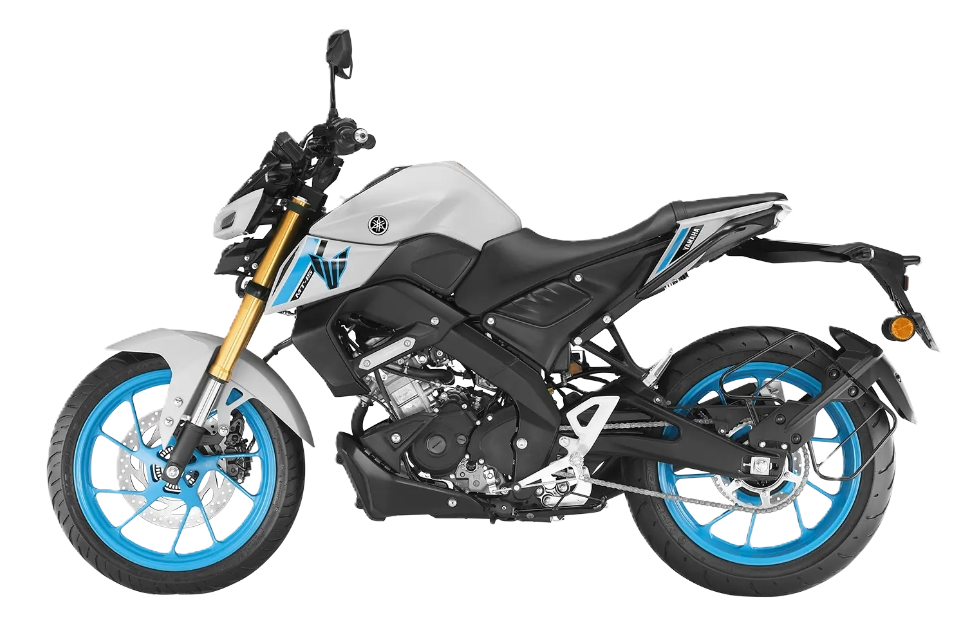
Yamaha MT-15 V2
- 155cc Liquid-Cooled, 4-valve, VVA
- 18.4 PS @ 10000 rpm
- 56.87 km/l (ARAI)
- 10-litre tank
- 2 mechanical variants
- Dual-Ch ABS + Traction Control
Full Specification Comparison
Every number that matters — side by side
| Specification | Yamaha XSR 155 | Yamaha MT-15 V2 |
|---|---|---|
| Engine & Performance | ||
| Displacement | 155 cc | 155 cc |
| Cooling System | Liquid-Cooled | Liquid-Cooled |
| Max Power | 18.4 PS @ 10000 rpm | 18.4 PS @ 10000 rpm |
| Max Torque | 14.2 Nm @ 7500 rpm | 14.1 Nm @ 7500 rpm |
| Valves per Cylinder | 4 | 4 |
| Compression Ratio | 11.6:1 | 11.6:1 |
| Bore × Stroke | 58.0 × 58.7 mm | 58.0 × 58.7 mm |
| Emission Standard | BS6 Phase 2 | BS6 OBD2 |
| Transmission | 6-Speed Manual | 6-Speed Manual |
| Clutch | Assist & Slipper Clutch | Assist & Slipper Clutch |
| Top Speed | ~130 km/h | ~122 km/h |
| Riding Modes | No | No |
| Traction Control | Yes (Standard) | Yes (Standard) |
| Fuel & Range | ||
| Mileage (Claimed / ARAI) | 46 km/l (Claimed) | 56.87 km/l (ARAI) |
| Mileage (Real-world) | ~40–46 km/l | 45–50 km/l |
| Fuel Tank | 10 litres | 10 litres |
| Reserve Capacity | 1.6 litres | 1.6 litres |
| Riding Range | ~460 km | ~568 km |
| Brakes & Wheels | ||
| Braking System | Dual Channel ABS | Dual Channel ABS |
| Front Brake | Disc – 282 mm | Disc – 282 mm |
| Rear Brake | Disc – 220 mm | Disc – 220 mm |
| Tyre Type | Tubeless | Tubeless |
| Tyre Size (F / R) | 100/80-17 / 140/70-17 | 100/80-17 / 140/70-17 |
| Wheel Type | Alloy | Alloy |
| Suspension & Chassis | ||
| Front Suspension | USD Fork | USD Fork |
| Rear Suspension | Monoshock | Linked-Type Monoshock |
| Chassis | Deltabox Frame | Deltabox Frame |
| Rear Preload Adjuster | Yes | Yes |
| Dimensions & Weight | ||
| Kerb Weight | 137 kg | 141 kg |
| Seat Height | 810 mm | 810 mm |
| Ground Clearance | 170 mm | 170 mm |
| Wheelbase | 1330 mm | 1325 mm |
| Overall L × W × H | 2007 × 804 × 1080 mm | 2015 × 800 × 1070 mm |
| Features & Electronics | ||
| Instrument Console | Fully Digital LCD | Fully Digital LCD |
| Headlight | LED | LED |
| DRLs | Yes | Yes |
| Turn Signals | LED | LED |
| Hazard Warning Lights | No | Yes (DLX variant) |
| Riding Modes | No | No |
| Traction Control | Yes | Yes |
| Bluetooth Connectivity | Yes (all colours) | Yes (DLX variant only) |
| Call & SMS Alerts | Yes | Yes (DLX variant only) |
| Navigation | No | Yes – Turn-by-Turn (DLX) |
| USB Charging Port | No | No |
| Distance to Empty | No | Yes |
| Gear Indicator | Yes | Yes |
| Tachometer | Digital | Digital |
| Keyless Ignition | No | No |
| Slipper Clutch | Yes | Yes |
| Price & Warranty | ||
| Starting Price (ex-showroom) | ₹1,49,990 | ₹1,60,096 |
| Top Variant Price | ₹1,58,990 | ₹1,68,507 |
| Number of Variants | 5 colour options (1 spec) | 2 (STD & DLX) |
| Standard Warranty | 2 Years / 30,000 km | 2 Years / 30,000 km |
★ Green highlights indicate the stronger value in each row. Prices are ex-showroom India averages and may vary by city.
Variant-wise Price Comparison
All variants laid out — find the right one for your budget
XSR 155 Colour Options
MT-15 V2 Variants
Pros & Cons
Honest strengths and weaknesses of each bike
Pros
- Lightest of the two at just 137 kg
- Unique retro-modern design that stands out on roads
- More upright, comfortable riding posture for daily use
- Bluetooth connectivity standard on all colour options
- Traction control as standard
- Lower starting price (₹1,49,990 vs ₹1,60,096)
- Lower top price (₹1,58,990 vs ₹1,68,507)
- Slightly higher torque (14.2 Nm vs 14.1 Nm)
- Higher claimed top speed (~130 km/h vs ~122 km/h)
Cons
- Significantly lower ARAI mileage (46 km/l claimed vs 56.87 km/l)
- Shorter riding range (~460 km vs ~568 km)
- No distance-to-empty display
- No hazard warning lights
- No turn-by-turn navigation
- Colour-only differentiation, no spec variants
- Less sporty streetfighter character
Pros
- Outstanding ARAI-certified mileage of 56.87 km/l
- Longer riding range (~568 km on same 10-litre tank)
- Turn-by-turn navigation on DLX variant
- Hazard warning lights on DLX variant
- Distance-to-empty display
- Aggressive MT streetfighter styling
- 2 mechanical variants (STD & DLX) for flexibility
- Traction control standard across both variants
Cons
- Higher starting price (₹1,60,096 vs ₹1,49,990)
- Bluetooth only on DLX variant (not STD)
- Slightly heavier at 141 kg vs 137 kg
- Lower claimed top speed (~122 km/h vs ~130 km/h)
- Aggressive posture less suited to long-distance riding
- Limited pillion comfort
Key Differences Explained
What really sets these two bikes apart
Design & Character
This is the most defining difference between the two. The XSR 155 draws from Yamaha's Sport Heritage DNA with a retro-modern neo-classic design — round headlamp, classic tank lines and a more upright cafe-racer inspired posture. The MT-15 V2 is pure streetfighter aggression — angular LED headlamp, sculpted tank, low handlebars and a sporting riding stance inspired by Yamaha's global MT lineup. Both bikes share the same engine and chassis but feel entirely different to look at and ride.
Fuel Efficiency & Range
Both bikes share the same 10-litre fuel tank, yet the MT-15 V2 delivers a dramatically better ARAI-certified figure of 56.87 km/l versus the XSR 155's claimed 46 km/l. This gap translates directly into range — the MT-15 V2 can theoretically travel ~568 km on a full tank versus ~460 km for the XSR 155, a difference of over 100 km. For daily commuters covering high distances, this efficiency gap has a real impact on running costs.
Engine & Performance
Both bikes are powered by the identical 155cc liquid-cooled, 4-valve VVA engine producing 18.4 PS @ 10,000 rpm with an assist & slipper clutch. The XSR 155 produces a marginally higher 14.2 Nm of torque (vs 14.1 Nm) and claims a higher top speed of ~130 km/h versus ~122 km/h for the MT-15 V2 — though real-world differences here are negligible. Power delivery character is essentially identical, with VVA technology ensuring strong performance across the rev range.
Technology & Features
Both bikes offer traction control and dual-channel ABS as standard. The XSR 155 includes Bluetooth connectivity on all colour options, giving it a slight edge at the base level. The MT-15 V2's DLX variant goes further with turn-by-turn navigation, hazard warning lights and a distance-to-empty readout — features unavailable on the XSR 155 entirely. The STD variant of the MT-15 V2, however, lacks Bluetooth altogether, making the XSR 155 better value for connectivity-focused buyers.
Ergonomics & Comfort
Despite identical seat heights of 810 mm, the riding experience differs meaningfully. The XSR 155's wide handlebars and more upright posture make it more comfortable for city commuting and everyday riding. The MT-15 V2's lower, sportier stance is more engaging on twisty roads but tiring over longer distances. At 137 kg, the XSR 155 is also 4 kg lighter than the MT-15 V2 (141 kg), adding to its nimble city feel.
Price & Value
The XSR 155 starts at ₹1,49,990 — ₹10,106 cheaper than the MT-15 V2 STD at ₹1,60,096 — and includes Bluetooth as standard. The MT-15 V2 DLX at ₹1,68,507 offers turn-by-turn navigation and hazard lights, making it genuinely more featured, but at a ₹18,517 premium over the cheapest XSR 155. For most buyers the XSR 155's lower price and standard Bluetooth represent better entry-level value; the MT-15 V2 DLX justifies its premium only if navigation and the streetfighter aesthetic are priorities.
Expert Verdict
Which one should you actually buy?
Buy the Yamaha XSR 155 if…
- You love the retro-modern lifestyle aesthetic
- A more upright, comfortable daily riding posture matters
- You want Bluetooth connectivity without paying a premium
- Budget is a priority — starts ₹10,106 cheaper
- You prefer the lightest possible bike (137 kg)
- Standing out from typical streetfighter bikes appeals to you
- You want traction control without spending extra
Buy the Yamaha MT-15 V2 if…
- Fuel efficiency is a top priority (56.87 km/l ARAI)
- Longer riding range (~568 km) matters for your commute
- Aggressive streetfighter styling is what you want
- Turn-by-turn navigation is important to you (DLX)
- You want the full Yamaha MT styling experience
- STD vs DLX variant flexibility helps your decision
- Spirited city and twisty road riding is your priority
A genuinely close call — both are excellent 155cc motorcycles from Yamaha's proven platform. The core engine, suspension, braking and chassis are near-identical between the two, making this primarily a choice of style, mileage and price. The MT-15 V2 wins on fuel efficiency (56.87 km/l ARAI vs 46 km/l) and range (~568 km), and the DLX variant adds navigation for tech-focused buyers. The XSR 155 wins on price (up to ₹10,106 cheaper), standard Bluetooth on every colour, lighter weight and its distinctive retro-modern design that is simply unavailable anywhere else in this segment. Daily commuters focused on efficiency should choose the MT-15 V2; lifestyle and value-focused buyers should choose the XSR 155.
Frequently Asked Questions
Common questions answered by our experts
Both are strong choices built on the same 155cc platform. The XSR 155 is better for riders who want a distinctive retro-modern lifestyle bike with a lower price and standard Bluetooth. The MT-15 V2 is better for riders who prioritise outstanding fuel efficiency (56.87 km/l ARAI), longer riding range (~568 km), aggressive streetfighter styling and optional turn-by-turn navigation on the DLX variant.
The XSR 155 starts at ₹1,49,990 (Metallic Blue) and goes up to ₹1,58,990 for premium colours. The MT-15 V2 starts at ₹1,60,096 (STD) and reaches ₹1,68,507 (DLX). At entry level the XSR 155 is approximately ₹10,106 cheaper. At the highest trim the XSR 155 is ₹9,517 cheaper than the MT-15 V2 DLX. All prices are ex-showroom India averages and may vary by city.
The Yamaha MT-15 V2 has significantly better ARAI-certified mileage at 56.87 km/l compared to the XSR 155's claimed 46 km/l. Both bikes share the same 10-litre tank, yet the MT-15 V2 achieves a theoretical riding range of ~568 km versus ~460 km for the XSR 155 — a difference of over 100 km per tank. This gap makes the MT-15 V2 the clear winner for fuel-efficiency focused buyers.
Yes, both the XSR 155 and MT-15 V2 use Yamaha's same 155cc liquid-cooled, 4-valve engine with VVA (Variable Valve Actuation) technology, producing 18.4 PS @ 10,000 rpm with an assist & slipper clutch. The XSR 155 produces a marginally higher 14.2 Nm of torque versus 14.1 Nm for the MT-15 V2, but this difference is barely perceptible in real-world riding.
Yes, the Yamaha XSR 155 comes with traction control as standard. The Yamaha MT-15 V2 also offers traction control as standard on both its STD and DLX variants. Both bikes are therefore equal on this front, which is a notable feature for the 155cc segment.
The Yamaha XSR 155 includes Bluetooth connectivity (via Y-Connect) on all its colour options as standard. The Yamaha MT-15 V2 offers Bluetooth only on the DLX variant (₹1,68,507), while the STD variant (₹1,60,096) does not include it. For buyers who want Bluetooth at the lowest possible price, the XSR 155 has a clear advantage — its most affordable colour at ₹1,49,990 includes Bluetooth.