Bajaj Pulsar 150 Price in India 2026 – Mileage, Specs, Colours, Images & Review

4.5 ★
✔ Updated: March 2026 ✔ Price Verified ✔ Reviewed by Auto Experts
Bajaj Pulsar 150
Images Colors 360° View
  • The Bajaj Pulsar 150 continues the iconic Pulsar legacy with muscular styling and proven 150cc performance.
  • Powered by a 149.50 cc engine delivering strong mid-range torque and everyday rideability.
  • Available in Single Disc and Twin Disc configurations for different braking preferences.

₹ 1,10,120

View Variant-wise Prices

Ex-Showroom Price (Selected City)

EMI ₹ 0

* EMI calculated on estimated on-road price

Who Should Buy Bajaj Pulsar 150?

Who Should Avoid Bajaj Pulsar 150?

Key Specs & Features of Bajaj Pulsar 150

Our Opinion On Specifications

The Pulsar 150 remains one of the most balanced motorcycles in the 150cc segment. With a 149.50 cc engine producing 14 PS of power and 13.4 Nm of torque, it delivers strong mid-range acceleration without compromising everyday usability. The 5-speed gearbox ensures relaxed cruising, while the perimeter frame enhances stability at higher speeds.

Key Specs Top Features Stand Out Features
⚙️ Engine 149.50 cc
Power 14 PS
🔁 Torque 13.4 Nm
Mileage 47.5 km/l (Claimed)
⚖️ Kerb Weight 148–150 kg
🛢️ Fuel Tank 15 litres
  • Single Channel ABS across all variants
  • Fully digital LCD console with Bluetooth connectivity
  • USB charging port for everyday convenience
  • Perimeter frame for improved stability
  • Iconic Pulsar muscular tank design
  • Twin Disc UG variant with rear disc brake
  • Proven 150cc engine tuned for strong mid-range performance

Bajaj Pulsar 150 Expert Review

The Bajaj Pulsar 150 continues to hold a strong position in India’s 150cc commuter-sport segment because it delivers something many motorcycles fail to balance: usable performance without unnecessary complexity.

The 149.50 cc single-cylinder engine produces 14 PS at 8500 rpm and 13.4 Nm at 6500 rpm. While these numbers may look modest on paper, the power delivery is tuned for everyday usability. The engine feels strongest in the mid-range — between 4,000 and 7,000 rpm — which is exactly where most urban riders operate. Overtakes require minimal downshifts and throttle response remains predictable rather than aggressive.

Engine & Refinement

At lower RPMs, the motor feels smooth and tractable. Mild vibrations begin to appear beyond 90–95 km/h, but they are not intrusive. Riders upgrading from 125cc motorcycles will immediately notice the stronger torque, especially while riding with a pillion or climbing flyovers.

The 5-speed gearbox complements the engine’s torque characteristics. First gear is short enough for traffic, while fifth gear allows comfortable cruising at 85–95 km/h without excessive engine strain.

Ride & Handling

The perimeter frame enhances structural rigidity and improves high-speed stability. The bike feels planted on highways and predictable in sweeping corners. While it is not a track-focused machine, it offers confidence and composure for daily and weekend riding.

Kerb weight ranges between 148 kg and 150 kg depending on the variant. Although slightly heavier than some rivals, the added weight improves highway stability and reduces nervousness at higher speeds.

Braking Performance

Single Disc variants equipped with 260 mm front disc with rear drum brake, whereas Twin Disc UG is equipped with 280 mm front disc with rear disc brake.

Single Channel ABS standard across all variantsIn real-world conditions, braking performance is adequate for city commuting and moderate highway riding. The Twin Disc variant provides better braking feel and confidence during repeated or emergency stops.

Fuel Efficiency & Range

The claimed mileage is 47.5 km/l. In mixed riding conditions (city and occasional highway), riders can realistically expect around 42–45 km/l depending on riding style and traffic conditions.

With a 15-litre fuel tank, the theoretical riding range exceeds 700 km. Practical range before refueling typically falls between 600–650 km, making it suitable for longer intercity rides.

Comfort & Ergonomics

The upright riding posture makes daily commuting comfortable. A seat height of 785 mm ensures accessibility for most Indian riders. Suspension tuning is slightly firm, which improves stability at speed but can feel stiff over sharp potholes.

Overall, the Pulsar 150 remains a well-balanced motorcycle that prioritizes mechanical reliability, usable performance, and everyday practicality.
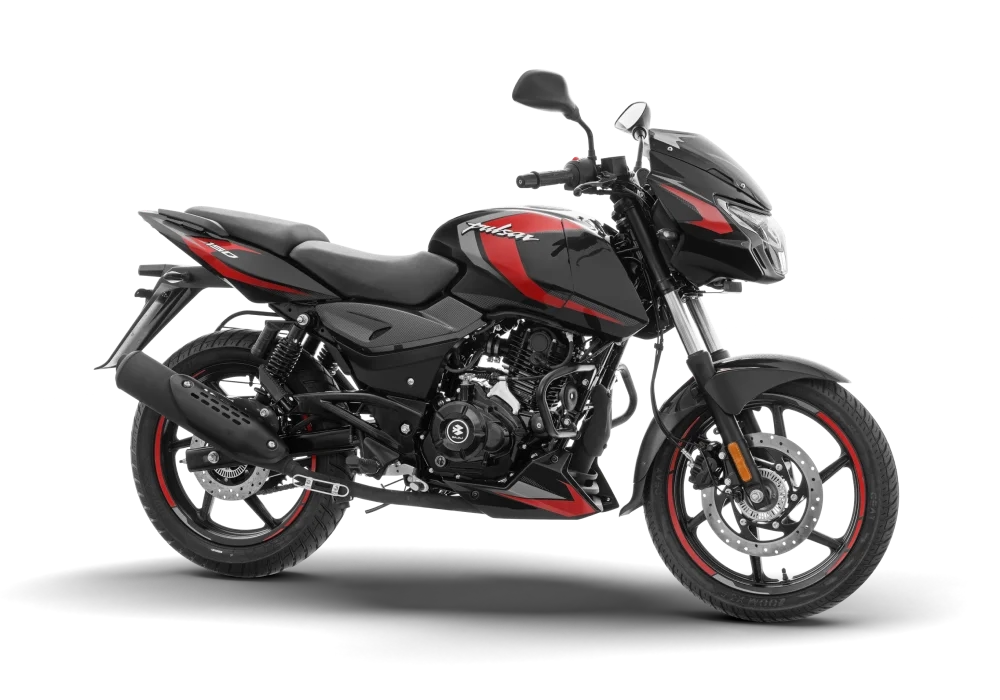
Bajaj Pulsar 150 Pros & Cons

Pros

  • Strong mid-range performance
  • Single Channel ABS standard across variants
  • Digital console with Bluetooth and USB charging
  • Proven reliability and wide service network

Cons

  • No dual-channel ABS option
  • Slightly heavier than some rivals
  • No i3S or advanced riding modes

What Owners Like & Dislike About Bajaj Pulsar 150

What Owners Like

What Owners Dislike

Bajaj Pulsar 150 Price

The Bajaj Pulsar 150 is positioned as a premium 150cc commuter-sport motorcycle. Pricing varies depending on braking configuration and cosmetic updates.

Single Disc

Approximately 115 kmph · 47.5 km/l (Claimed) · 149.50 cc

₹ 1,10,120 Get On-Road Price

Single Disc UG

Approximately 115 kmph · 47.5 km/l (Claimed) · 149.50 cc

₹ 1,13,143 Get On-Road Price

Twin Disc UG

Approximately 115 kmph · 47.5 km/l (Claimed) · 149.50 cc

₹ 1,16,916 Get On-Road Price

Bajaj Pulsar 150 vs Similar Bikes

The Pulsar 150 competes in the 150–160cc commuter-sport segment, offering a balance of performance, practicality, and affordability.

Bike Engine Claimed Mileage Ex-Showroom Price*
Bajaj Pulsar 150 149.5 cc 47.5 km/l ₹ 1,10,120
TVS Apache RTR 160 4V 159.7 cc 45 km/l ₹ 1,16,491
Honda Unicorn 162.7 cc 50 km/l ₹ 1,12,898
Hero Xtreme 160R 4V 163.2 cc 48 km/l ₹ 1,31,755

*Prices are approximate ex-showroom India averages and may vary by city.

Bike Colours

This bike is available in the following colour options in India.

Bike Colour Image

Bajaj Pulsar 150 Mileage

The claimed mileage of Bajaj Pulsar 150 is 47.5 km/l. Actual mileage may vary depending on riding style, traffic conditions, and maintenance.

Bajaj Pulsar 150 – City vs Highway Usage

City Riding

In city traffic, the Pulsar 150 offers smooth throttle response and strong mid-range torque, making overtakes easy. The upright riding posture supports daily commuting comfort.

Highway Riding

On highways, the 149.50 cc engine feels stable at cruising speeds. The perimeter frame and wider tyres contribute to confident handling, especially at moderate highway speeds.

Bajaj Pulsar 150 Maintenance & Ownership Experience

One of the strongest advantages of the Bajaj Pulsar 150 is its predictable ownership cost. The engine platform has been in production for years, making it mechanically mature and well-understood by service centers across India.

Official Service Schedule

Routine service costs typically range between ₹1,200 and ₹1,800 depending on parts replaced and location. Bajaj’s widespread dealership network ensures easy availability of spare parts and quick turnaround times.

Long-Term Reliability

The 149.50 cc engine is known for consistent performance even after high mileage, provided maintenance schedules are followed. Common wear items such as chain sets, brake pads, and clutch plates remain affordable compared to higher-capacity motorcycles.

For riders looking for a motorcycle that balances performance and manageable long-term ownership expenses, the Pulsar 150 continues to be a dependable choice.

Bajaj Pulsar 150 – Full Specifications & Features

Displacement149.50 cc
Max Power14 PS @ 8500 rpm
Max Torque13.4 Nm @ 6500 rpm
Top SpeedApproximately 115 kmph
Mileage (ARAI)47.5 km/l (Claimed)
Transmission5 Speed Manual
Transmission TypeChain Drive
Gear Shifting Pattern1 down, 4 up
ClutchWet Multiplate
Riding RangeApproximately 700+ km
Riding ModesNo
Cylinders1
Valves Per Cylinder2
Cooling SystemAir Cooled
Bore x Stroke56 mm x 60.7 mm
Compression Ratio9.5 : 1
Spark Plugs2 Per Cylinder
Battery12V
Emission StandardBS6 Phase 2
Fuel TypePetrol
Braking SystemSingle Channel ABS
Front Brake TypeDisc
Front Brake Size260 mm / 280 mm (variant dependent)
Rear Brake TypeDrum / Disc (variant dependent)
Rear Brake Size130 mm Drum / 230 mm Disc
Wheel TypeAlloy
Front Wheel Size17-inch
Rear Wheel Size17-inch
Tyre SizeFront: 80/100-17, Rear: 100/90-17
Tyre TypeTubeless
Tyre Pressure (Rider)Front - 25 psi, Rear - 28 psi
Tyre Pressure (Rider & Pillion)Front - 25 psi, Rear - 32 psi
Front SuspensionTelescopic
Rear SuspensionTwin Gas Shock
Front Suspension Preload AdjusterNo
Rear Suspension Preload AdjusterYes
Chassis TypePerimeter Frame
Kerb Weight148–150 kg (variant dependent)
Seat Height785 mm
Ground Clearance165 mm
Fuel Tank Capacity15 litres
Reserve Fuel Capacity2.4 litres
Overall Dimensions (L x W x H)2055 mm x 755 mm x 1060 mm
Wheelbase1320 mm / 1345 mm (variant dependent)
Instrument ConsoleFully Digital LCD
Touch Screen DisplayNo
Mobile ConnectivityBluetooth
SpeedometerDigital
OdometerDigital
Fuel GaugeDigital
Distance to EmptyYes
Voice AssistNo
TripmeterDigital
TachometerNo
Gear IndicatorYes
Low Fuel IndicatorYes
Service ReminderYes
ClockYes
Call & SMS AlertsYes (Bluetooth)
USB Charging PortYes
Keyless IgnitionNo
Traction ControlNo
Cruise ControlNo
Start TypeSelf Start / Kick (variant dependent)
Idle Stop-StartNo
Silent StartNo
Side Stand Engine Cut-offYes
Kill SwitchYes
Headlight TypeLED
Projector HeadlampNo
DRLs (Daytime Running Lights)No
Brake / Tail LightLED
Turn SignalLED
Hazard Warning LightsNo
Pass LightYes
Under Seat StorageNo
Pillion SeatYes
Pillion BackrestNo
Pillion FootrestYes
Grab RailYes
Standard Warranty5 Years or 75,000 km
1st Service500-750 Kms or 30-45 Days
2nd Service4500-5000 Kms or 240 Days
3rd Service9500-10000 Kms or 360 Days

Is Bajaj Pulsar 150 Worth the Price in 2026?

The Bajaj Pulsar 150 remains one of the most balanced motorcycles in the 150cc segment. It may not lead the class in outright performance or advanced features, but it delivers a dependable combination of mid-range torque, highway stability, manageable maintenance costs, and practical fuel efficiency.

For riders who want a motorcycle capable of handling daily commuting during the week and comfortable highway runs on weekends, the Pulsar 150 continues to make logical sense. The platform’s long-standing reliability and widespread service network add to its ownership confidence.

If your priority is usable real-world performance rather than aggressive acceleration or feature-heavy electronics, the Pulsar 150 remains a sensible and well-rounded choice in 2026.

In short, the Bajaj Pulsar 150 is not about extremes — it is about balance, predictability, and long-term practicality.

Bajaj Pulsar 150 – Frequently Asked Questions

What is the mileage of Bajaj Pulsar 150?

The claimed mileage of Bajaj Pulsar 150 is 47.5 km/l.

Does Pulsar 150 have ABS?

Yes, it comes with Single Channel ABS.

How many variants are available?

Single Disc, Single Disc UG, and Twin Disc UG variants are available.

Is i3S available?

No, Idle Stop-Start (i3S) is not available on Pulsar 150.

Get On-Road Price – Bajaj Pulsar 150

Variant:

Ex-Showroom₹ 0
RTO Charges₹ 0
Insurance₹ 0
Other Charges₹ 0
On-Road Price₹ 0

*Indicative price for select cities. Final on-road price may vary by dealer.

Calculate EMI

Monthly EMI: ₹0/month