At a Glance
Key differences that define each motorcycle
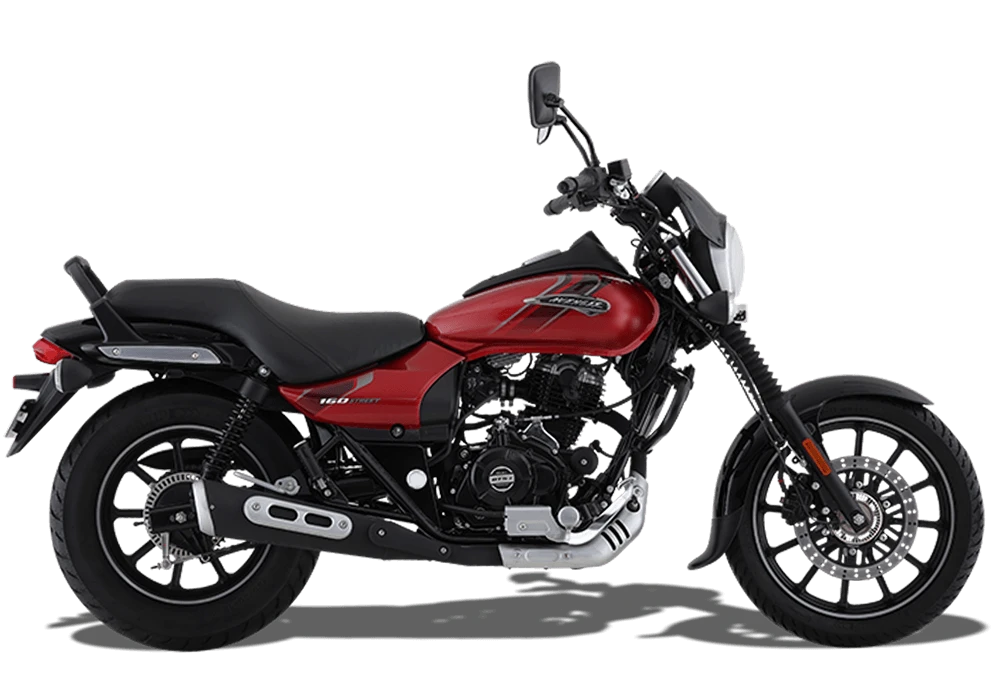
Bajaj Avenger Street 160
- 160 cc Air-Cooled DTS-i, 2-valve
- 15 PS @ 8500 rpm
- 45 km/l (ARAI)
- 13-litre tank
- 1 variant available
- Cruiser ergonomics, 737 mm seat
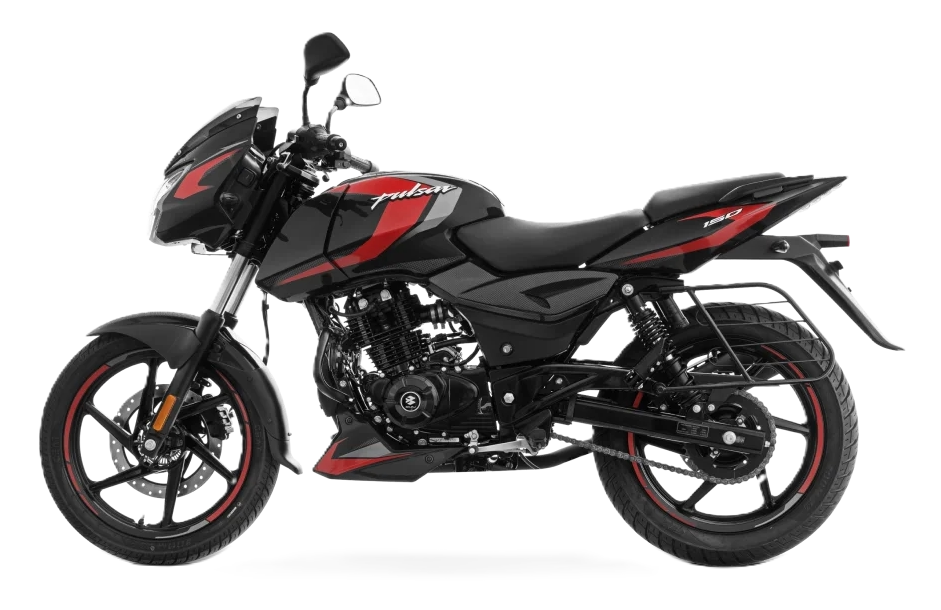
Bajaj Pulsar 150
- 149.50 cc Air-Cooled DTS-i, 2-valve
- 14 PS @ 8500 rpm
- 47.5 km/l (Claimed)
- 15-litre tank
- 3 variants available
- Bluetooth, USB charging & LED lights
Full Specification Comparison
Every number that matters — side by side
| Specification | Bajaj Avenger Street 160 | Bajaj Pulsar 150 |
|---|---|---|
| Engine & Performance | ||
| Displacement | 160 cc | 149.50 cc |
| Cooling System | Air-Cooled | Air-Cooled |
| Max Power | 15 PS @ 8500 rpm | 14 PS @ 8500 rpm |
| Max Torque | 13.7 Nm @ 7000 rpm | 13.4 Nm @ 6500 rpm |
| Valves per Cylinder | 2 | 2 |
| Compression Ratio | 9.8 ± 0.3 : 1 | 9.5 : 1 |
| Bore × Stroke | 58 × 60.7 mm | 56 × 60.7 mm |
| Emission Standard | BS6 | BS6 Phase 2 |
| Transmission | 5-Speed Manual | 5-Speed Manual |
| Spark Plugs | 2 | 2 (DTS-i) |
| Top Speed | ~105 km/h | ~115 km/h |
| Riding Modes | No | No |
| Traction Control | No | No |
| Fuel & Range | ||
| Mileage (Claimed) | 45 km/l (ARAI) | 47.5 km/l (Claimed) |
| Fuel Tank | 13 litres | 15 litres |
| Reserve Capacity | 3.8 litres | 2.4 litres |
| Riding Range | ~585 km | ~700+ km |
| Brakes & Wheels | ||
| Braking System | Single-Channel ABS | Single-Channel ABS |
| Front Brake | Disc – 280 mm | Disc – 260 / 280 mm (variant) |
| Rear Brake | Drum – 130 mm | Drum 130 mm / Disc 230 mm (Twin Disc) |
| Tyre Type | Tubeless | Tubeless |
| Tyre Size (F / R) | 90/90-17 / 130/90-15 | 80/100-17 / 100/90-17 |
| Rear Wheel Size | 15-inch | 17-inch |
| Wheel Type | Alloy | Alloy |
| Suspension & Chassis | ||
| Front Suspension | Telescopic Fork | Telescopic |
| Rear Suspension | Twin Shock Absorbers | Twin Gas Shock |
| Chassis | Tubular Double Cradle | Perimeter Frame |
| Rear Preload Adjuster | Yes | Yes |
| Dimensions & Weight | ||
| Kerb Weight | 156 kg | 148–150 kg |
| Seat Height | 737 mm | 785 mm |
| Ground Clearance | 169 mm | 165 mm |
| Wheelbase | 1490 mm | 1320–1345 mm (variant) |
| Overall L × W × H | 2210 × 806 × 1070 mm | 2055 × 755 × 1060 mm |
| Features & Electronics | ||
| Instrument Console | Semi-Digital | Fully Digital LCD |
| Headlight | Halogen | LED |
| DRLs | No | No |
| Turn Signals | Bulb | LED |
| Tail Light | LED | LED |
| Hazard Warning Lights | No | No |
| Bluetooth Connectivity | No | Yes |
| USB Charging Port | No | Yes |
| Distance to Empty | No | Yes |
| Tachometer | No | No |
| Gear Indicator | No | Yes |
| Service Reminder | Yes | Yes |
| Pillion Backrest | Yes | No |
| Keyless Ignition | No | No |
| Price & Warranty | ||
| Starting Price (ex-showroom) | ₹1,12,280 | ₹1,10,120 |
| Top Variant Price | ₹1,12,280 | ₹1,16,916 |
| Number of Variants | 1 | 3 |
| Standard Warranty | 5 Years / 75,000 km | 5 Years / 75,000 km |
★ Green highlights indicate the stronger value in each row. Prices are ex-showroom India averages and may vary by city.
Variant-wise Price Comparison
All variants laid out — find the right one for your budget
Avenger Street 160 Variants
Pulsar 150 Variants
Pros & Cons
Honest strengths and weaknesses of each bike
Pros
- Unique cruiser-style ergonomics — the only choice here
- Very low 737 mm seat height ideal for shorter riders
- Marginally more power (15 PS vs 14 PS)
- Larger 280 mm front disc on the single variant
- Very large 3.8-litre reserve fuel capacity (vs 2.4L)
- Pillion backrest for improved pillion comfort
- Longer wheelbase (1490 mm) for highway stability
- 5-year / 75,000 km warranty (same as Pulsar)
- LED tail light
Cons
- Higher starting price (₹2,160 more than Pulsar 150 base)
- Lower fuel efficiency (45 km/l vs 47.5 km/l)
- Smaller 13-litre tank — shorter riding range (~585 km)
- No Bluetooth connectivity
- No USB charging port
- Halogen headlight — not LED like the Pulsar
- Bulb turn signals — not LED
- No gear indicator on console
- No distance-to-empty display
- Only 1 variant — no choice
- 15-inch rear wheel — unusual tyre sizing
Pros
- Lower starting price (₹1,10,120 vs ₹1,12,280)
- Better fuel efficiency (47.5 km/l vs 45 km/l)
- Significantly larger 15-litre fuel tank
- Longer riding range (~700+ km vs ~585 km)
- Bluetooth connectivity with call & SMS alerts
- USB charging port standard
- LED headlight and LED turn signals
- Fully digital LCD console with gear indicator
- Distance-to-Empty display
- 3 variants — more choice for every budget
- Twin Disc UG offers rear disc brake option
- Perimeter frame — better high-speed stability
- Higher top speed (~115 km/h vs ~105 km/h)
- 5-year / 75,000 km warranty (same as Avenger)
Cons
- Sportier upright posture — not as relaxed as Avenger
- Higher 785 mm seat height — less accessible
- Less peak power (14 PS vs 15 PS)
- No pillion backrest
- Smaller 2.4-litre reserve fuel capacity
- No dual-channel ABS on any variant
- Base variant has smaller 260 mm front disc
Key Differences Explained
What really sets these two bikes apart
Style & Riding Character
This is the most fundamental split in the comparison. The Avenger Street 160 is a cruiser motorcycle — low seat (737 mm), forward-set pegs, wide bars, relaxed outstretched posture and even a pillion backrest. It's designed for comfort over long rides. The Pulsar 150 is a classic naked sports commuter — upright 785 mm seat, sportier riding posture, tighter handling and higher top speed. If the cruiser experience is your goal, only the Avenger delivers it in this price range.
Fuel Efficiency & Range
The Pulsar 150 wins decisively here. Its 47.5 km/l beats the Avenger's 45 km/l, but more significantly, its larger 15-litre tank (vs Avenger's 13 litres) delivers a theoretical range of 700+ km compared to ~585 km for the Avenger. For frequent long-distance riders, that is over 100 km more between fill-ups. The Avenger counters with a much larger 3.8-litre reserve (vs 2.4 litres), giving more buffer before running dry.
Features & Technology
The Pulsar 150 wins this category outright. It comes with Bluetooth connectivity, USB charging, a fully digital LCD console with gear indicator and distance-to-empty, LED headlight and LED turn signals. The Avenger Street 160 has none of these — it features a semi-digital console with an analogue speedometer, a halogen headlight and bulb turn signals. For tech-conscious buyers, the Pulsar 150 feels noticeably more modern.
Braking Options
The Avenger Street 160 comes with a 280 mm front disc and single-channel ABS as its only option. The Pulsar 150 starts with a 260 mm front disc on the base Single Disc variant, but the top Twin Disc UG variant (₹1,16,916) adds a 230 mm rear disc — making it the only bike in this comparison with both front and rear disc brakes. All variants of both bikes use single-channel ABS.
Performance & Top Speed
The Avenger Street 160 has 1 PS more peak power (15 PS vs 14 PS), but the Pulsar 150 reaches a higher top speed of ~115 km/h versus ~105 km/h for the Avenger. This is partly due to the Pulsar's more aerodynamic upright posture versus the cruiser's wind-catching stance. The Pulsar's perimeter frame also provides better high-speed stability. For highway riders who regularly cruise above 90 km/h, the Pulsar 150 is the more capable choice.
Price & Value
The Pulsar 150 starts at ₹1,10,120 — ₹2,160 less than the Avenger Street 160's ₹1,12,280. It also offers 3 variants spanning ₹1,10,120 to ₹1,16,916, giving buyers more flexibility. Crucially, for ₹2,160 more than the Avenger's single variant, the Pulsar 150 base variant delivers Bluetooth, USB charging, LED headlight, LED turn signals and a larger fuel tank. Both bikes share the same excellent 5-year / 75,000 km warranty.
Expert Verdict
Which one should you actually buy?
Buy the Avenger Street 160 if…
- You want the unique cruiser experience at this price point
- The very low 737 mm seat height is essential for you
- Relaxed, outstretched ergonomics suit your body and riding style
- You carry a pillion regularly and value the backrest
- The 3.8-litre reserve gives peace of mind on highway rides
- Distinctive cruiser styling is a priority over features
Buy the Pulsar 150 if…
- You want a sportier commuter with better highway capability
- Bluetooth, USB charging and modern features matter to you
- The larger 15-litre tank and 700+ km range suit your riding
- A lower starting price (₹1,10,120) is important
- LED headlight and LED turn signals are a must-have
- You want the option of a rear disc brake (Twin Disc UG)
- Three variant choices help you match your exact budget and needs
Overall Winner for Most Riders: Bajaj Pulsar 150. Despite being from the same brand, these two bikes serve very different riders. For the majority of buyers, the Pulsar 150 delivers a more complete package — a lower starting price, better fuel efficiency, a larger 15-litre tank with longer range, Bluetooth connectivity, USB charging, LED headlight and turn signals, a fully digital console with gear indicator, a higher top speed, 3 variant options and the same outstanding 5-year / 75,000 km warranty. The Bajaj Avenger Street 160 is the clear winner only for riders who specifically want cruiser-style ergonomics — it is India's most affordable cruiser motorcycle with a 737 mm seat height, pillion backrest and a large 3.8-litre reserve tank. If comfort and cruiser character are your priority, the Avenger wins on character alone.
Frequently Asked Questions
Common questions answered by our experts
The Bajaj Pulsar 150 is better for most buyers — it offers a lower starting price, better mileage (47.5 km/l), a larger 15-litre tank with 700+ km range, Bluetooth, USB charging, LED headlight, LED turn signals, a digital console with gear indicator, and the same 5-year / 75,000 km warranty. The Bajaj Avenger Street 160 is the better choice only for riders who specifically want cruiser-style ergonomics with a very low 737 mm seat height and a pillion backrest.
The Bajaj Pulsar 150 starts at ₹1,10,120 (Single Disc) while the Bajaj Avenger Street 160 starts at ₹1,12,280 — a difference of ₹2,160 at the base level. The Pulsar 150 tops out at ₹1,16,916 (Twin Disc UG) while the Avenger is available in only one standard variant. Both prices are ex-showroom India averages and may vary by city.
The Bajaj Pulsar 150 has better claimed mileage at 47.5 km/l compared to the Avenger Street 160's 45 km/l (both ARAI certified). More importantly, the Pulsar's larger 15-litre tank gives it a theoretical riding range of 700+ km versus ~585 km for the Avenger's 13-litre tank — over 100 km more range per fill-up. However, the Avenger has a much larger 3.8-litre reserve capacity versus only 2.4 litres on the Pulsar, which provides greater buffer when running low on fuel.
The Bajaj Avenger Street 160 makes marginally more peak power at 15 PS @ 8500 rpm compared to the Bajaj Pulsar 150's 14 PS @ 8500 rpm. The torque figures are also close — 13.7 Nm @ 7000 rpm for the Avenger versus 13.4 Nm @ 6500 rpm for the Pulsar. In real-world riding, this 1 PS difference is barely noticeable. The Pulsar 150 actually reaches a higher top speed (~115 km/h vs ~105 km/h) due to its more aerodynamic upright riding posture and sportier chassis setup.
The Avenger Street 160 has a 280 mm front disc — larger than the Pulsar 150 Single Disc variant's 260 mm unit, but identical to the Pulsar 150 Twin Disc UG variant. The key advantage of the Pulsar 150 is its top Twin Disc UG variant which adds a 230 mm rear disc brake — something not available on the Avenger. Both bikes use single-channel ABS (front wheel only). If rear disc braking safety matters, the Pulsar 150 Twin Disc UG at ₹1,16,916 is the only option in this comparison to offer it.
Both the Bajaj Avenger Street 160 and Bajaj Pulsar 150 offer an identical 5-year / 75,000 km standard warranty — Bajaj's excellent segment-leading warranty that applies across their range. This is a tie, and warranty should not be a deciding factor between these two bikes. Focus instead on riding style, ergonomic preferences, fuel tank size, and desired features to make the right choice.