At a Glance
Key differences that define each motorcycle
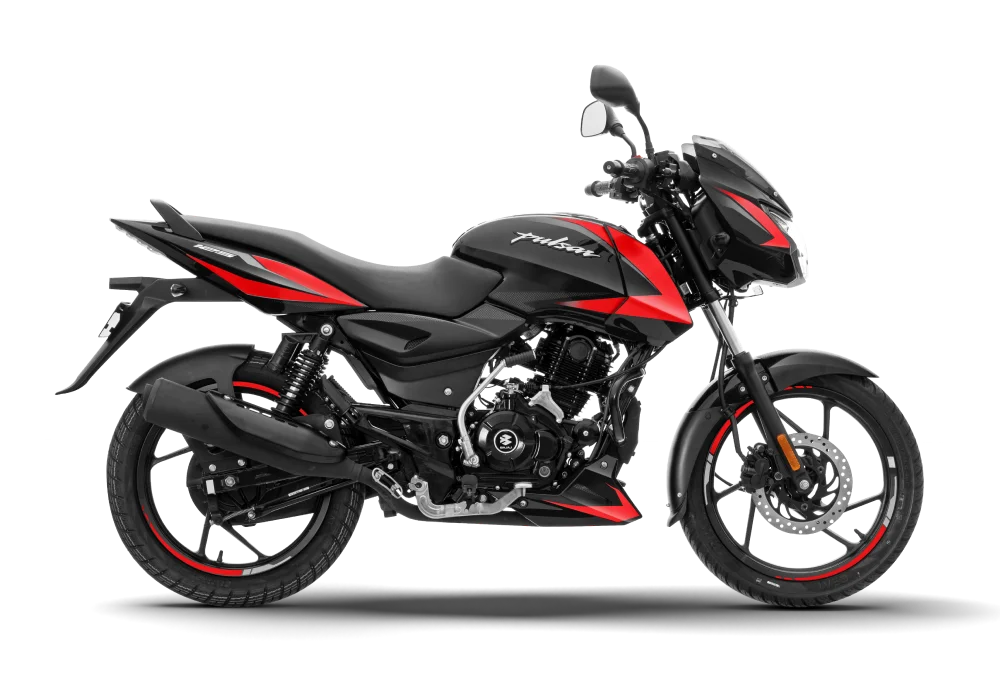
Bajaj Pulsar 125
- 124.38 cc Air-Cooled, 2-valve
- 11.8 PS @ 8500 rpm
- 57 kmpl (ARAI)
- 15-litre tank
- 3 variants available
- Front Disc + CBS
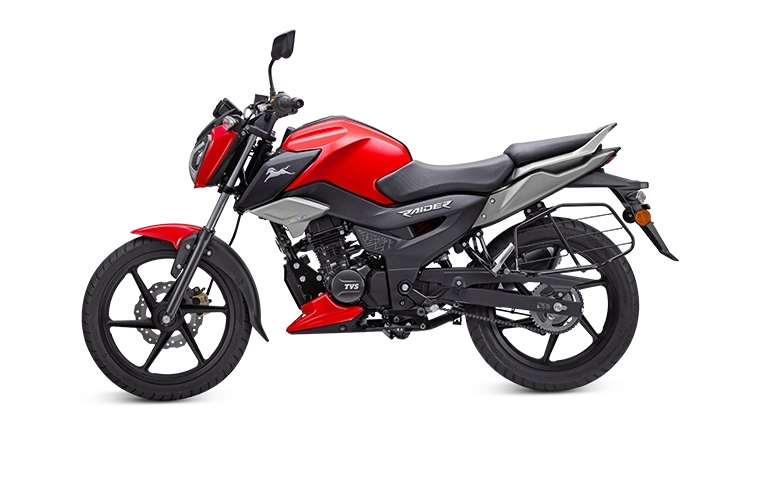
TVS Raider 125
- 124.8 cc Air & Oil-Cooled, 3-valve
- 11.38 PS @ 7500 rpm
- 71.94 kmpl (ARAI)
- 10-litre tank
- 7 variants available
- Ride modes: Eco & Power (select)
Full Specification Comparison
Every number that matters — side by side
| Specification | Bajaj Pulsar 125 | TVS Raider 125 |
|---|---|---|
| Engine & Performance | ||
| Displacement | 124.38 cc | 124.8 cc |
| Cooling System | Air-Cooled | Air & Oil-Cooled |
| Max Power | 11.8 PS @ 8500 rpm | 11.38 PS @ 7500 rpm |
| Max Torque | 10.8 Nm @ 6500 rpm | 11.75 Nm @ 6000 rpm |
| Valves per Cylinder | 2 | 3 |
| Compression Ratio | 10.05 ± 0.3 : 1 | 10.3 : 1 |
| Bore × Stroke | 52 × 58.6 mm | 53.5 × 55.5 mm |
| Emission Standard | BS6 Phase 2 | BS6 Phase 2 |
| Transmission | 5-Speed Manual | 5-Speed Manual |
| Top Speed | ~100 km/h | 99 km/h |
| Riding Modes | No | Eco & Power (select variants) |
| Idle Stop-Start | No | Yes (iGO variant) |
| Fuel & Range | ||
| Mileage (ARAI) | 57 kmpl | 71.94 kmpl |
| Mileage (Real-world) | 45–50 kmpl | ~58–65 kmpl |
| Fuel Tank | 15 litres | 10 litres |
| Reserve Capacity | 2.5 litres | 1.6 litres |
| Riding Range (ARAI based) | ~700+ km | ~650–700 km |
| Brakes & Wheels | ||
| Braking System | CBS | CBS (Synchronized Braking Technology) |
| Front Brake | Disc – 240 mm | Disc – 240 mm / Drum (base variant) |
| Rear Brake | Drum – 130 mm | Drum – 130 mm / Disc 200 mm (top variants) |
| Tyre Type | Tubeless | Tubeless |
| Tyre Size (F / R) | 80/100-17 / 100/90-17 | 80/100-17 / 100/90-17 |
| Wheel Type | Alloy | Alloy |
| Suspension & Chassis | ||
| Front Suspension | Telescopic Fork | Telescopic Fork |
| Rear Suspension | Twin Gas Shock | Mono-shock, 5-step adjustable |
| Chassis | Tubular Frame | Single Cradle Tubular Frame |
| Rear Preload Adjuster | Yes | Yes |
| Dimensions & Weight | ||
| Kerb Weight | 144–146 kg | 123–125 kg |
| Seat Height | 790 mm | 780 mm |
| Ground Clearance | 165 mm | 180 mm |
| Wheelbase | 1320 mm | 1326 mm |
| Overall L × W × H | 2055 × 755 × 1060 mm | 2070 × 785 × 1028 mm |
| Features & Electronics | ||
| Instrument Console | Digital (variant dependent) | Digital / TFT (top variant) |
| Headlight | Halogen / LED (variant dependent) | LED (all variants) |
| DRLs | No | Yes |
| Turn Signals | Bulb | Bulb |
| Hazard Warning Lights | No | Yes |
| Riding Modes | No | Eco & Power (select variants) |
| Tachometer | No | Yes |
| Bluetooth Connectivity | Yes (select variants) | Yes (select variants) |
| Call & SMS Alerts | Yes (Bluetooth) | Yes (Bluetooth variants) |
| USB Charging Port | Yes (variant dependent) | Yes (select variants) |
| Distance to Empty | Yes | Yes (TFT variant) |
| Gear Indicator | Yes | Yes |
| Service Reminder | Yes | Yes |
| Clock | Yes | Yes |
| Keyless Ignition | No | No |
| Price & Warranty | ||
| Starting Price (ex-showroom) | ₹82,420 | ₹84,490 |
| Top Variant Price | ₹92,691 | ₹97,719 |
| Number of Variants | 3 | 7 |
| Standard Warranty | 5 Years / 75,000 km | 5 Years / 60,000 km |
★ Green highlights indicate the stronger value in each row. Prices are ex-showroom India averages and may vary by city.
Variant-wise Price Comparison
All variants laid out — find the right one for your budget
Pulsar 125 Variants
Raider 125 Variants
Pros & Cons
Honest strengths and weaknesses of each bike
Pros
- Higher peak power — 11.8 PS vs 11.38 PS
- Larger 15-litre fuel tank — longest range in class
- Lower starting price (₹82,420 vs ₹84,490)
- Lower top variant price (₹92,691 vs ₹97,719)
- Wider rear tyre (100/90-17) for better grip
- Superior 5-year / 75,000 km warranty
- Sporty Pulsar muscular styling and tank design
- Twin gas shock rear suspension
- Distance to empty display standard
Cons
- Significantly lower ARAI mileage (57 vs 71.94 kmpl)
- 2-valve air-cooled engine vs 3-valve oil-cooled
- Less torque (10.8 Nm vs 11.75 Nm)
- No ride modes on any variant
- Heavier at 144–146 kg vs 123–125 kg
- Less ground clearance (165 mm vs 180 mm)
- Halogen headlight on base variant
- No DRLs or hazard warning lights
- Only 3 variants — limited choice
Pros
- Best-in-class ARAI mileage — 71.94 kmpl
- More torque — 11.75 Nm @ 6000 rpm
- 3-valve air & oil-cooled engine
- Significantly lighter at 123–125 kg
- Superior ground clearance (180 mm)
- LED headlight with DRLs standard across all variants
- Hazard warning lights standard
- 7 variants — widest choice in segment
- Ride modes (Eco & Power) on select variants
- TFT display with navigation on top variant
- Monoshock rear suspension (5-step adjustable)
- Dual disc brakes available on top variants
- Tachometer included
Cons
- Lower peak power (11.38 PS vs 11.8 PS)
- Smaller 10-litre tank
- Higher starting price (₹84,490 vs ₹82,420)
- Top TFT variant expensive at ₹97,719
- Drum brakes on base variant
Key Differences Explained
What really sets these two bikes apart
Engine Character
The Pulsar 125 uses a 124.38 cc air-cooled, 2-valve engine making 11.8 PS and 10.8 Nm — tuned for strong top-end power and Pulsar's sporty character. The Raider 125 uses a 124.8 cc air & oil-cooled, 3-valve unit producing 11.38 PS but a higher 11.75 Nm — meaning stronger mid-range pull that suits daily city riding more. The Raider's oil cooling also manages heat better in stop-and-go traffic, while its 3-valve design extracts more efficiency per cc.
Fuel Efficiency & Range
This is the Raider's most dominant advantage. Its ARAI-certified 71.94 kmpl dwarfs the Pulsar's 57 kmpl — a 26% gap. Real-world figures are approximately 58–65 kmpl for the Raider vs 45–50 kmpl for the Pulsar. The Pulsar fights back with a massive 15-litre tank (vs 10 litres) and a 2.5-litre reserve (vs 1.6 litres), giving both bikes a comparable ARAI-based range of around 700 km. In real-world use however, the Raider's superior efficiency will deliver a longer practical range despite the smaller tank.
Weight, Handling & Ground Clearance
The Raider 125 is a considerable 20–21 kg lighter at 123–125 kg versus the Pulsar's 144–146 kg, making it far more agile and easier to manoeuvre through city traffic. It also has a significant 15 mm advantage in ground clearance (180 mm vs 165 mm), which is practically useful on Indian roads. The Raider's 5-step adjustable monoshock rear suspension is also a step up from the Pulsar's twin gas shocks, offering better adjustability.
Lighting & Safety Features
The TVS Raider 125 carries a clear advantage in lighting and safety features. It comes with an LED headlight and DRLs standard across all variants, while the Pulsar 125 only gets an LED headlight on its two higher variants (₹90,670+) and lacks DRLs entirely. The Raider also includes hazard warning lights standard — absent on the Pulsar 125 in all variants. Both bikes offer CBS braking, but the Raider's top variants add a rear disc (200 mm) alongside the front disc.
Technology & Features
The Raider 125 leads in technology, offering ride modes (Eco and Power) on select variants, a 5-inch TFT display with Bluetooth navigation on the top variant, a tachometer, and an idle stop-start system on the iGO variant. The Pulsar 125 counters with Bluetooth and USB charging on its upper two variants, along with a distance-to-empty display and service reminder. The Raider's 7-variant lineup gives buyers far more choice versus the Pulsar's 3 variants.
Price & Warranty
The Pulsar 125 starts ₹2,070 cheaper (₹82,420 vs ₹84,490) and tops out at ₹92,691 — ₹5,028 less than the Raider's ₹97,719 TFT variant. The Pulsar's 5-year / 75,000 km warranty also beats the Raider's 5-year / 60,000 km coverage by 15,000 km. For budget-conscious buyers who don't need ride modes or TFT features, the Pulsar's base variant at ₹82,420 represents the better-priced entry point in this comparison.
Expert Verdict
Which one should you actually buy?
Buy the Bajaj Pulsar 125 if…
- You want the iconic Pulsar sporty styling and road presence
- A massive 15-litre tank for worry-free long rides matters
- Peak power (11.8 PS) is a priority over torque
- Budget is tight — starts ₹2,070 cheaper
- The 5-year / 75,000 km warranty coverage is important
- You rarely need the convenience of ride modes or TFT
- Bajaj's established service network is important to you
Buy the TVS Raider 125 if…
- Best-in-class ARAI mileage (71.94 kmpl) is a top priority
- A lighter, more agile motorcycle suits your city riding
- LED headlight with DRLs and hazard lights from base matter
- Higher ground clearance (180 mm) is needed for your roads
- You want more variant choices to match your budget
- Ride modes, TFT display or Bluetooth navigation appeal to you
- Higher torque (11.75 Nm) for smoother city acceleration
Overall Winner for Most Riders: TVS Raider 125. Significantly better ARAI mileage (71.94 vs 57 kmpl), more torque, a 3-valve oil-cooled engine, lighter and more agile chassis, higher ground clearance, LED lighting with DRLs standard on all variants, hazard lights, ride modes, and 7 variants to choose from make the Raider 125 the more modern, well-rounded choice for the majority of urban and suburban commuters. Choose the Bajaj Pulsar 125 if the iconic Pulsar design, a larger 15-litre fuel tank, a lower starting price, or the superior 75,000 km warranty are your primary buying criteria.
Frequently Asked Questions
Common questions answered by our experts
The TVS Raider 125 is better for most buyers thanks to its significantly higher ARAI mileage (71.94 vs 57 kmpl), more torque (11.75 Nm), lighter weight, greater ground clearance (180 mm), LED lighting with DRLs standard on all variants, hazard lights, ride modes, and 7 variants. The Bajaj Pulsar 125 is better if you want iconic Pulsar styling, a larger 15-litre tank, slightly more peak power (11.8 PS), a lower starting price (₹82,420), or the superior 5-year / 75,000 km warranty.
The Bajaj Pulsar 125 starts at ₹82,420 while the TVS Raider 125 starts at ₹84,490 — a base difference of ₹2,070 in favour of the Pulsar. At the top trim, the Pulsar's Carbon Fibre Split Seat LED is ₹92,691 against the Raider's TFT variant at ₹97,719 — a ₹5,028 gap. Both prices are ex-showroom India averages and may vary by city.
The TVS Raider 125 has considerably better ARAI-certified mileage at 71.94 kmpl compared to the Bajaj Pulsar 125's 57 kmpl — a 26% advantage. Real-world figures are approximately 45–50 kmpl for the Pulsar vs 58–65 kmpl for the Raider. The Pulsar's larger 15-litre tank partially compensates, giving both bikes a comparable ARAI-estimated range near 700 km. However, in real-world conditions the Raider's superior efficiency delivers longer practical range per fill-up.
The Bajaj Pulsar 125 makes marginally more peak power at 11.8 PS @ 8500 rpm compared to the TVS Raider 125's 11.38 PS @ 7500 rpm. However, the Raider produces more torque at 11.75 Nm @ 6000 rpm versus 10.8 Nm @ 6500 rpm for the Pulsar. In real-world riding, the Raider's higher torque and lower torque peak rpm make it feel punchier during city acceleration and overtaking manoeuvres.
Yes, select TVS Raider 125 variants offer two rider-selectable modes — Eco and Power. Eco mode optimises for fuel efficiency, while Power mode delivers the full engine performance. The Bajaj Pulsar 125 does not offer ride modes on any of its three variants.
Both bikes offer a 5-year warranty, but the Bajaj Pulsar 125 covers 75,000 km while the TVS Raider 125 covers 60,000 km. The Pulsar's 15,000 km additional warranty coverage is a meaningful advantage for high-mileage commuters who clock 15,000–20,000 km per year, offering extra protection from out-of-warranty repair costs.