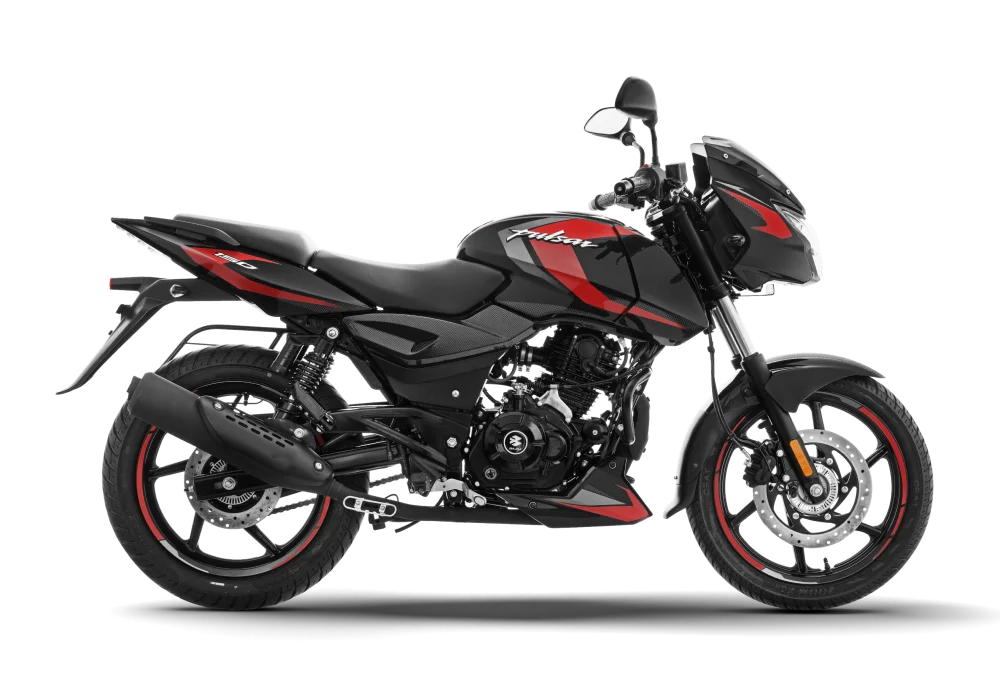
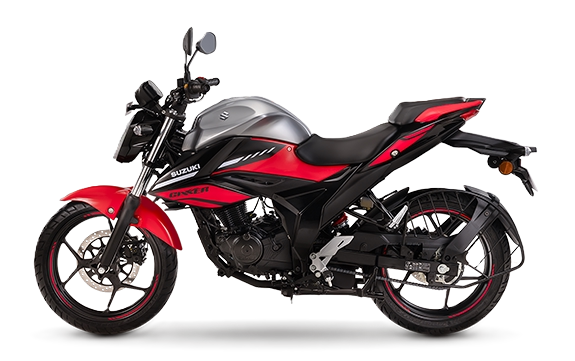
At a Glance
Key differences that define each motorcycle
Bajaj Pulsar 150
- 149.50 cc Air-Cooled, 2-valve
- 14 PS @ 8500 rpm
- 47.5 km/l (Claimed)
- 15-litre tank
- 3 variants available
- Single-channel ABS (all variants)
Suzuki Gixxer
- 155 cc Air-Cooled, 2-valve
- 13.6 PS @ 8000 rpm
- 45 km/l (Claimed)
- 12-litre tank
- 1 variant available
- Rear disc brake standard
Full Specification Comparison
Every number that matters — side by side
| Specification | Bajaj Pulsar 150 | Suzuki Gixxer |
|---|---|---|
| Engine & Performance | ||
| Displacement | 149.50 cc | 155 cc |
| Cooling System | Air-Cooled | Air-Cooled |
| Max Power | 14 PS @ 8500 rpm | 13.6 PS @ 8000 rpm |
| Max Torque | 13.4 Nm @ 6500 rpm | 13.8 Nm @ 6000 rpm |
| Valves per Cylinder | 2 | 2 |
| Compression Ratio | 9.5 : 1 | 9.8 : 1 |
| Bore × Stroke | 56 × 60.7 mm | 56 × 62.9 mm |
| Spark Plugs | 2 per cylinder | 1 |
| Emission Standard | BS6 Phase 2 | BS6 Phase 2 |
| Transmission | 5-Speed Manual | 5-Speed Manual |
| Top Speed | ~115 km/h | ~115 km/h |
| Riding Modes | No | No |
| Traction Control | No | No |
| Fuel & Range | ||
| Mileage (Claimed) | 47.5 km/l | 45 km/l |
| Fuel Tank | 15 litres | 12 litres |
| Reserve Capacity | 2.4 litres | 2.4 litres |
| Riding Range | ~700+ km | ~540 km |
| Brakes & Wheels | ||
| Braking System | Single Channel ABS | Single Channel ABS |
| Front Brake | Disc – 260 / 280 mm (variant) | Disc – 266 mm |
| Rear Brake | Drum / Disc (variant dependent) | Disc – 240 mm (standard) |
| Tyre Type | Tubeless | Tubeless |
| Tyre Size (F / R) | 80/100-17 / 100/90-17 | 100/80-17 / 140/60R17 |
| Wheel Type | Alloy | Alloy |
| Suspension & Chassis | ||
| Front Suspension | Telescopic | Telescopic |
| Rear Suspension | Twin Gas Shock | Monoshock |
| Chassis | Perimeter Frame | Diamond Frame |
| Rear Preload Adjuster | Yes | Yes |
| Dimensions & Weight | ||
| Kerb Weight | 148–150 kg | 141 kg |
| Seat Height | 785 mm | 795 mm |
| Ground Clearance | 165 mm | 160 mm |
| Wheelbase | 1320–1345 mm | 1335 mm |
| Overall L × W × H | 2055 × 755 × 1060 mm | 2020 × 800 × 1035 mm |
| Features & Electronics | ||
| Instrument Console | Fully Digital LCD | Fully Digital LCD |
| Headlight | LED | LED |
| DRLs | No | Yes |
| Turn Signals | LED | Halogen |
| Hazard Warning Lights | No | No |
| Bluetooth Connectivity | Yes | Yes |
| Call & SMS Alerts | Yes | Yes |
| USB Charging Port | Yes | No |
| Distance to Empty | Yes | No |
| Gear Indicator | Yes | Yes |
| Tachometer | No | Digital |
| Service Reminder | Yes | No |
| Keyless Ignition | No | No |
| Price & Warranty | ||
| Starting Price (ex-showroom) | ₹1,10,120 | ₹1,28,892 |
| Top Variant Price | ₹1,16,916 | ₹1,28,892 |
| Number of Variants | 3 | 1 |
| Standard Warranty | 5 Years / 75,000 km | 2 Years / 30,000 km |
★ Green highlights indicate the stronger value in each row. Prices are ex-showroom India averages and may vary by city.
Variant-wise Price Comparison
All variants laid out — find the right one for your budget
Pulsar 150 Variants
Suzuki Gixxer Variants
Pros & Cons
Honest strengths and weaknesses of each bike
Pros
- Higher claimed mileage (47.5 km/l vs 45 km/l)
- Larger 15-litre fuel tank for longer riding range (~700+ km)
- Lower starting price — ₹1,10,120 (saves ~₹18,000+)
- Outstanding 5-year / 75,000 km warranty
- Higher peak power (14 PS vs 13.6 PS)
- USB charging port standard
- Distance to empty indicator
- LED turn signals
- Service reminder on instrument cluster
- 3 variant choices to suit different budgets
Cons
- Rear drum brake on base variants
- Heavier at 148–150 kg vs 141 kg
- Less torque (13.4 Nm vs 13.8 Nm)
- No tachometer on instrument console
- No DRLs
- No monoshock — twin gas shock rear suspension
Pros
- Highly refined and smooth engine character
- Lighter at just 141 kg — easiest to handle
- Rear disc brake standard on the only variant
- Higher torque (13.8 Nm) for better mid-range pull
- Monoshock rear suspension for better comfort
- DRLs standard
- Wider rear tyre (140/60R17) for better grip
- Larger rear brake disc (240 mm)
- Digital tachometer on console
- Proven Suzuki reliability
Cons
- Significantly more expensive (₹1,28,892 vs ₹1,10,120)
- Much weaker warranty — only 2 years / 30,000 km
- Smaller 12-litre tank — less riding range (~540 km)
- Lower claimed mileage (45 km/l vs 47.5 km/l)
- No USB charging port
- No distance to empty indicator
- Only 1 variant — no budget-friendly entry option
- Halogen turn signals
Key Differences Explained
What really sets these two bikes apart
Engine Character
Both bikes use air-cooled, 2-valve, single-cylinder engines in the 150–155cc range. The Pulsar 150's 149.50 cc motor produces marginally more peak power at 14 PS, while the Gixxer's 155 cc engine delivers more torque at 13.8 Nm for a stronger mid-range pull. The key difference is character: the Gixxer is widely regarded as one of the smoothest and most refined engines in the segment, whereas the Pulsar 150's motor prioritises torque delivery and everyday usability over silkiness.
Fuel Efficiency & Range
The Pulsar 150 leads on both counts. Its claimed mileage of 47.5 km/l edges the Gixxer's 45 km/l, but the more decisive advantage is the fuel tank: 15 litres vs 12 litres. This gives the Pulsar a theoretical range of ~700+ km versus ~540 km for the Gixxer — a difference of over 160 km per tank. For daily commuters and intercity riders, the Pulsar's range advantage is a practical benefit that reduces the frequency of fuel stops.
Braking & Safety
The Suzuki Gixxer holds a clear edge here: rear disc brake is standard on its single variant, alongside a 266 mm front disc and a 240 mm rear disc. The Pulsar 150 only gets a rear disc on the top-spec Twin Disc UG variant (₹1,16,916); the base two variants use a rear drum. Both bikes are limited to single-channel ABS, so neither offers dual-channel ABS for enhanced rear-wheel braking safety. The Gixxer also benefits from a wider rear tyre (140/60R17 vs 100/90-17) for improved grip during braking.
Weight & Handling
The Gixxer is noticeably lighter at 141 kg versus 148–150 kg for the Pulsar 150 — a difference of 7–9 kg. Combined with a monoshock rear suspension (vs the Pulsar's twin gas shocks), the Gixxer feels more agile and easier to manoeuvre in tight city traffic. The Pulsar 150's perimeter frame and wider stance improve stability at highway speeds, but the Gixxer's overall lighter package makes it more nimble for urban riding.
Warranty & Ownership
This is where the Pulsar 150 wins decisively. It offers a 5-year / 75,000 km warranty — one of the best in any motorcycle segment — compared to the Gixxer's 2-year / 30,000 km coverage. The difference is enormous: 3 extra years and 45,000 additional kilometres of coverage. For a daily commuter riding 15,000–20,000 km per year, the Pulsar's warranty can save significantly on out-of-warranty repair costs. The Gixxer's ownership cost predictability is also aided by its reputation for low maintenance, but the warranty gap is hard to overlook.
Price & Value
The Pulsar 150 starts at ₹1,10,120 — a full ₹18,772 cheaper than the Gixxer's single variant at ₹1,28,892. Even the Pulsar's top Twin Disc UG variant at ₹1,16,916 is over ₹12,000 less than the Gixxer. The Pulsar 150 also gives buyers three variant choices to match their budget. Given the Gixxer's price premium, buyers must weigh whether the Gixxer's smoother engine, lighter weight, and standard rear disc justify spending nearly ₹19,000 more.
Expert Verdict
Which one should you actually buy?
Buy the Pulsar 150 if…
- Budget is a priority — you save nearly ₹19,000 over the Gixxer
- You do long daily commutes and need maximum riding range
- The superior 5-year / 75,000 km warranty gives you peace of mind
- USB charging and distance to empty are essential daily features
- You want 3 variant choices to fit your exact budget
- Proven platform reliability and wide Bajaj service network matter
- You ride occasionally on highways and want a larger fuel tank
Buy the Suzuki Gixxer if…
- Engine refinement and smoothness are your top priority
- Lightweight handling (141 kg) is important for city riding
- You want a rear disc brake standard without paying extra
- Monoshock suspension and sporty styling appeal to you
- You appreciate Suzuki's reputation for engine longevity
- DRLs and a digital tachometer are features you value
- Budget is less of a concern and you want a single complete package
Overall Winner for Most Riders: Bajaj Pulsar 150. A significantly lower starting price (saving up to ₹18,772), a larger 15-litre fuel tank for longer range, better claimed mileage, USB charging and distance to empty standard, plus an exceptional 5-year / 75,000 km warranty make the Pulsar 150 the more practical and better-value choice for the majority of Indian buyers. Choose the Suzuki Gixxer only if the silky-smooth engine character, lighter weight, standard rear disc brake, and monoshock suspension are worth the considerable price premium to you.
Frequently Asked Questions
Common questions answered by our experts
The Bajaj Pulsar 150 is better for most buyers who prioritise lower price (saves ~₹18,772), a larger 15-litre fuel tank, longer riding range (~700+ km), better claimed mileage (47.5 km/l) and a superior 5-year / 75,000 km warranty. The Suzuki Gixxer is better if you want a smoother and more refined engine, lighter weight (141 kg), a standard rear disc brake and a monoshock rear suspension without compromise.
The Bajaj Pulsar 150 starts at ₹1,10,120 while the Suzuki Gixxer is priced at ₹1,28,892 ex-showroom — a difference of approximately ₹18,772. Even the Pulsar 150's top Twin Disc UG variant at ₹1,16,916 remains over ₹12,000 cheaper than the Gixxer's single standard variant. Prices are approximate ex-showroom India averages and may vary by city.
The Bajaj Pulsar 150 has better claimed mileage at 47.5 km/l compared to the Suzuki Gixxer's 45 km/l. More significantly, the Pulsar 150 has a larger 15-litre fuel tank versus the Gixxer's 12-litre unit, giving it a considerably longer theoretical riding range of approximately 700+ km against around 540 km for the Gixxer. For long-distance or high-frequency commuters, the Pulsar's tank advantage is a practical everyday benefit.
The Bajaj Pulsar 150 makes marginally more peak power at 14 PS @ 8500 rpm compared to the Suzuki Gixxer's 13.6 PS @ 8000 rpm. However, the Suzuki Gixxer produces slightly more torque at 13.8 Nm @ 6000 rpm versus 13.4 Nm @ 6500 rpm for the Pulsar 150. In real-world riding, the performance difference is minimal — both bikes feel closely matched in everyday commuting. The Gixxer's advantage is its notably smoother and more refined power delivery.
No, the Suzuki Gixxer comes with single-channel ABS only. The Bajaj Pulsar 150 is also limited to single-channel ABS across all its variants. Neither motorcycle offers dual-channel ABS, which means the rear wheel is not assisted by ABS during emergency braking. Buyers seeking dual-channel ABS in this segment should consider the Bajaj Pulsar N160 (available from ₹1,17,619) instead.
The Bajaj Pulsar 150 has a vastly superior warranty at 5 years or 75,000 km compared to the Suzuki Gixxer's 2 years or 30,000 km. This is a difference of 3 additional years and 45,000 extra kilometres of coverage. For high-mileage daily commuters who clock 15,000–20,000 km per year, the Pulsar 150's warranty advantage translates into meaningful financial protection against unexpected repair costs for most of the bike's early ownership life.