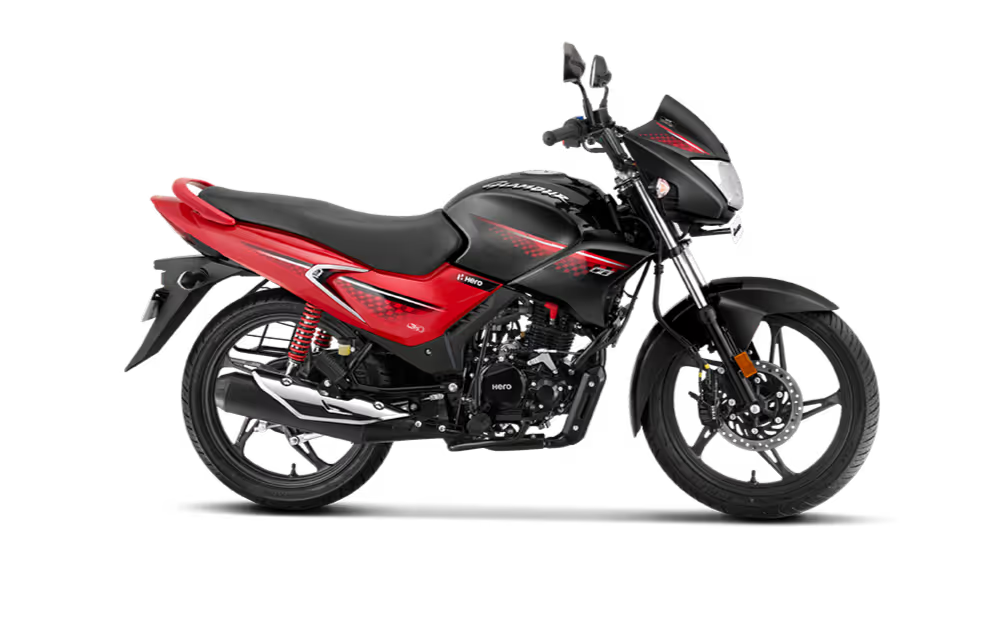
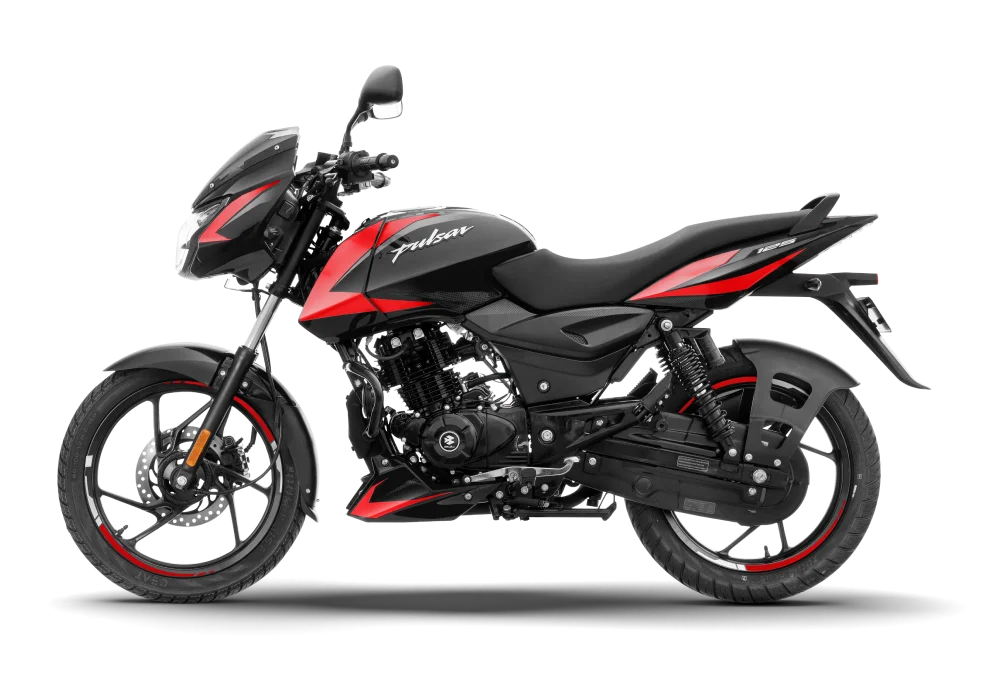
At a Glance
Key differences that define each motorcycle
Hero Glamour
- 124.7 cc Air-Cooled, 2-valve
- 10.84 PS @ 7500 rpm
- 65 km/l (ARAI)
- 10-litre tank
- 2 variants available
- CBS (Integrated Braking System)
Bajaj Pulsar 125
- 124.38 cc Air-Cooled, 2-valve
- 11.8 PS @ 8500 rpm
- 57 km/l (ARAI)
- 15-litre tank
- 3 variants available
- Sporty Pulsar DNA & styling
Full Specification Comparison
Every number that matters — side by side
| Specification | Hero Glamour | Bajaj Pulsar 125 |
|---|---|---|
| Engine & Performance | ||
| Displacement | 124.7 cc | 124.38 cc |
| Cooling System | Air-Cooled | Air-Cooled |
| Max Power | 10.84 PS @ 7500 rpm | 11.8 PS @ 8500 rpm |
| Max Torque | 10.6 Nm @ 6000 rpm | 10.8 Nm @ 6500 rpm |
| Valves per Cylinder | 2 | 2 |
| Compression Ratio | 10.0 : 1 | 10.05 ± 0.3 : 1 |
| Bore × Stroke | 52.4 × 57.8 mm | 52 × 58.6 mm |
| Emission Standard | BS6 Phase 2 (OBD2B) | BS6 Phase 2 |
| Transmission | 5-Speed Manual | 5-Speed Manual |
| Top Speed | 95 km/h | ~100 km/h |
| Riding Modes | No | No |
| Traction Control | No | No |
| Fuel & Range | ||
| Mileage (Claimed / ARAI) | 65 km/l (ARAI) | 57 km/l (ARAI) |
| Mileage (Real-world) | 55–60 km/l | ~45–50 km/l |
| Fuel Tank | 10 litres | 15 litres |
| Reserve Capacity | 1.4 litres | 2.5 litres |
| Riding Range | ~550–600 km | ~700+ km |
| Brakes & Wheels | ||
| Braking System | CBS (Integrated) | CBS (Combined) |
| Front Brake | Drum / Disc – 240 mm (variant) | Disc – 240 mm (all variants) |
| Rear Brake | Drum – 130 mm | Drum – 130 mm |
| Tyre Type | Tubeless | Tubeless |
| Tyre Size (F / R) | 80/100-18 / 100/80-18 | 80/100-17 / 100/90-17 |
| Wheel Type | Alloy | Alloy |
| Suspension & Chassis | ||
| Front Suspension | Telescopic Forks | Telescopic Forks |
| Rear Suspension | Hydraulic Shock Absorbers | Twin Gas Shock |
| Chassis | Diamond Frame | Tubular Frame |
| Rear Preload Adjuster | Yes | Yes |
| Dimensions & Weight | ||
| Kerb Weight | 121–123 kg | 144–146 kg |
| Seat Height | 793 mm | 790 mm |
| Ground Clearance | 170 mm | 165 mm |
| Wheelbase | 1267 mm | 1320 mm |
| Overall L × W × H | 2042 × 742 × 1090 mm | 2055 × 755 × 1060 mm |
| Features & Electronics | ||
| Instrument Console | Full Digital | Digital (variant dependent) |
| Headlight | Halogen | LED (select variants) |
| DRLs | No | No |
| Turn Signals | Bulb | Bulb |
| Hazard Warning Lights | No | No |
| Bluetooth Connectivity | No | Yes (select variants) |
| Call & SMS Alerts | No | Yes (Bluetooth variants) |
| USB Charging Port | Yes (all variants) | Yes (select variants) |
| Distance to Empty | Yes | Yes |
| Gear Indicator | Yes | Yes |
| Tachometer | Digital | No |
| Service Reminder | Yes | Yes |
| Keyless Ignition | No | No |
| Silent Start | Yes | No |
| Price & Warranty | ||
| Starting Price (ex-showroom) | ₹83,617 | ₹82,420 |
| Top Variant Price | ₹87,304 | ₹92,691 |
| Number of Variants | 2 | 3 |
| Standard Warranty | 5 Years / 70,000 km | 5 Years / 75,000 km |
★ Green highlights indicate the stronger value in each row. Prices are ex-showroom India averages and may vary by city.
Variant-wise Price Comparison
All variants laid out — find the right one for your budget
Hero Glamour Variants
Bajaj Pulsar 125 Variants
Pros & Cons
Honest strengths and weaknesses of each bike
Pros
- Exceptional ARAI-certified mileage of 65 km/l
- Significantly lighter at 121–123 kg vs 144–146 kg
- Full digital instrument console on all variants
- USB charging port on all variants
- Tachometer on instrument cluster
- Silent Start technology
- Smooth and refined engine for daily commuting
- Lower top variant price (₹87,304 vs ₹92,691)
- Higher ground clearance (170 mm vs 165 mm)
Cons
- Lower peak power (10.84 PS vs 11.8 PS)
- Smaller 10-litre tank, shorter range (~550–600 km)
- No Bluetooth connectivity on any variant
- Drum brake on base variant
- No DRLs, no LED headlight
- Only 2 variants — limited choice
- Lower top speed (~95 km/h)
Pros
- Higher peak power – 11.8 PS @ 8500 rpm
- Sporty Pulsar DNA and muscular styling
- Larger 15-litre fuel tank, longer range (~700+ km)
- Front disc brake standard across all variants
- Bluetooth on select variants for connectivity
- LED headlight on Carbon Fibre variants
- 3 variants — more choices for buyers
- Lower starting price (₹82,420)
- Better warranty at 5 years / 75,000 km
Cons
- Lower claimed mileage (57 km/l vs 65 km/l)
- Significantly heavier at 144–146 kg
- USB charging only on select variants
- No tachometer on instrument cluster
- Firmer ride quality on rough roads
- Top variant priced higher at ₹92,691
Key Differences Explained
What really sets these two bikes apart
Engine Character
Both bikes share a similar 124–125cc air-cooled, 2-valve architecture, but their tuning tells different stories. The Hero Glamour's 124.7cc engine is tuned for smooth, refined low-rpm performance — ideal for relaxed city commuting with minimal vibration. The Bajaj Pulsar 125's 124.38cc engine produces 11.8 PS — nearly 9% more power — and is tuned for a more energetic, performance-oriented character true to the Pulsar lineage. The Pulsar also revs higher and feels more exciting, though slightly less refined.
Fuel Efficiency & Range
The Glamour leads convincingly in efficiency with an ARAI-certified 65 km/l against the Pulsar 125's 57 km/l — an 8 km/l gap. Real-world riding only widens the gap: 55–60 km/l for the Glamour vs 45–50 km/l for the Pulsar. However, the Pulsar's massive 15-litre tank more than compensates, delivering a theoretical range of ~700+ km versus ~550–600 km for the Glamour's 10-litre tank. For city commuters, the Glamour is cheaper to run daily; for those who travel long distances, the Pulsar's greater range means fewer fuel stops.
Braking & Safety
The Pulsar 125 holds a clear edge: it offers a front disc brake as standard across all three variants, even the base ₹82,420 Neon. The Hero Glamour's base Drum variant (₹83,617) only gets a drum brake; the disc comes only with the ₹87,304 top variant — at a premium. Both bikes use CBS rather than ABS, so neither offers the more advanced braking safety system. For buyers prioritising braking confidence from the outset, the Pulsar 125 wins comfortably.
Weight & Rideability
The Hero Glamour is dramatically lighter at 121–123 kg versus the Pulsar 125's 144–146 kg — a difference of over 20 kg. This makes the Glamour noticeably more nimble, easier to manoeuvre in tight city traffic, and more comfortable to handle at low speeds or when parking. The Pulsar's extra weight comes from its larger tank and sportier build but can make it feel bulkier in dense urban conditions. Shorter riders or those in high-congestion areas will greatly appreciate the Glamour's lighter feel.
Features & Technology
The Glamour leads with a full digital console on all variants, a tachometer, Silent Start, and a USB charging port as standard equipment. The Pulsar 125 counters with Bluetooth connectivity and LED headlights on its upper two variants — features the Glamour lacks entirely. Neither bike offers ABS, riding modes, or a TFT display. For technology-forward commuters, the Pulsar 125's Bluetooth on the Carbon Fibre variants at ₹90,670 is a compelling advantage; for basic everyday utility, the Glamour's standard-fit USB charging wins.
Price & Value
The Pulsar 125 starts ₹1,197 cheaper (₹82,420 vs ₹83,617) and gives you a front disc brake immediately — strong value at entry level. However, the Glamour's top disc variant at ₹87,304 is ₹5,387 cheaper than the Pulsar 125's comparable Carbon Fibre LED variant at ₹90,670. The Glamour is the better value if you're willing to step to the disc variant. The Pulsar's top split-seat variant at ₹92,691 brings the range significantly higher. Overall, both bikes are closely priced, but the Glamour keeps costs tighter.
Expert Verdict
Which one should you actually buy?
Buy the Hero Glamour if…
- Maximum fuel economy (65 km/l) is your top priority
- You want a lighter, more nimble city commuter (121–123 kg)
- Full digital console and tachometer matter to you
- USB charging standard from base variant is important
- You prefer a smoother, more refined engine character
- Lower top variant price (₹87,304) suits your budget
- Silent Start and refined daily riding are your priority
Buy the Bajaj Pulsar 125 if…
- You want stronger outright performance (11.8 PS)
- Sporty Pulsar styling and muscular road presence appeal to you
- Front disc brake standard across all variants matters
- Long-range riding (~700+ km per tank) is important
- Bluetooth connectivity for a connected riding experience
- You're upgrading from a 100–110cc commuter
- The 5-year / 75,000 km warranty gives you confidence
Overall: Two very different bikes for two very different riders. The Hero Glamour is the smarter choice for pure city commuters who value fuel economy, lightweight handling, and a refined experience at a contained price. The Bajaj Pulsar 125 is the better pick for riders who want sporty character, stronger performance, disc brakes from the base variant, and a much larger fuel tank for longer rides. If mileage and low running costs are your deciding factor — go Glamour. If performance, looks, and riding confidence matter more — go Pulsar 125.
Frequently Asked Questions
Common questions answered by our experts
The Hero Glamour is better for most city commuters who prioritise fuel efficiency (65 km/l ARAI), a lighter weight (121–123 kg), a full digital console, and USB charging on all variants. The Bajaj Pulsar 125 is better if you want stronger performance (11.8 PS), sporty styling, a front disc brake from the base variant, a larger 15-litre fuel tank, and Bluetooth connectivity on select variants.
The Bajaj Pulsar 125 starts slightly cheaper at ₹82,420 versus the Hero Glamour's ₹83,617 — a base difference of ₹1,197. However, the Glamour's top variant (Disc, ₹87,304) is considerably less expensive than the Pulsar 125's top variant (Carbon Fibre Split Seat LED, ₹92,691) — a gap of ₹5,387. Prices are ex-showroom India and may vary by city.
The Hero Glamour has significantly better mileage at 65 km/l (ARAI certified) compared to the Bajaj Pulsar 125's 57 km/l (ARAI). Real-world figures also favour the Glamour at 55–60 km/l versus approximately 45–50 km/l for the Pulsar 125. However, the Pulsar's 15-litre tank (vs the Glamour's 10-litre) gives it a much longer riding range of ~700+ km versus ~550–600 km.
The Bajaj Pulsar 125 makes more power at 11.8 PS @ 8500 rpm compared to the Hero Glamour's 10.84 PS @ 7500 rpm. The Pulsar 125 also produces slightly more torque at 10.8 Nm vs 10.6 Nm and achieves a higher top speed of approximately 100 km/h versus 95 km/h for the Glamour. The Pulsar's engine has a more performance-oriented tuning suited for spirited riding.
No, the Hero Glamour does not offer ABS. It uses an Integrated Braking System (CBS) on all variants. Similarly, the Bajaj Pulsar 125 also uses a Combined Braking System (CBS) and does not offer ABS on any variant. Both bikes are compliant with BS6 Phase 2 safety standards, but neither offers ABS in the 125cc commuter segment.
The Bajaj Pulsar 125 offers a slightly better warranty at 5 years / 75,000 km compared to the Hero Glamour's 5 years / 70,000 km. Both cover 5 years, but the Pulsar 125 provides an additional 5,000 km of coverage. For high-mileage commuters clocking 15,000–20,000 km per year, the Pulsar's extra kilometre coverage can save on potential out-of-warranty repair costs.