At a Glance
Key differences that define each motorcycle
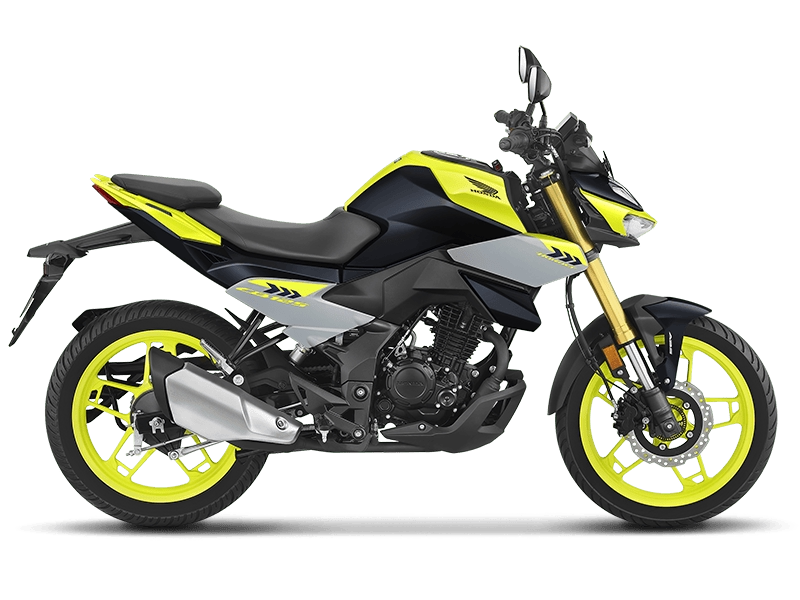
Honda CB 125 Hornet
- 123.94 cc Air-Cooled, 2-valve
- 11.14 PS @ 7500 rpm
- 48 km/l (Claimed)
- 12-litre tank
- 1 variant available
- TFT display + USD forks + ABS
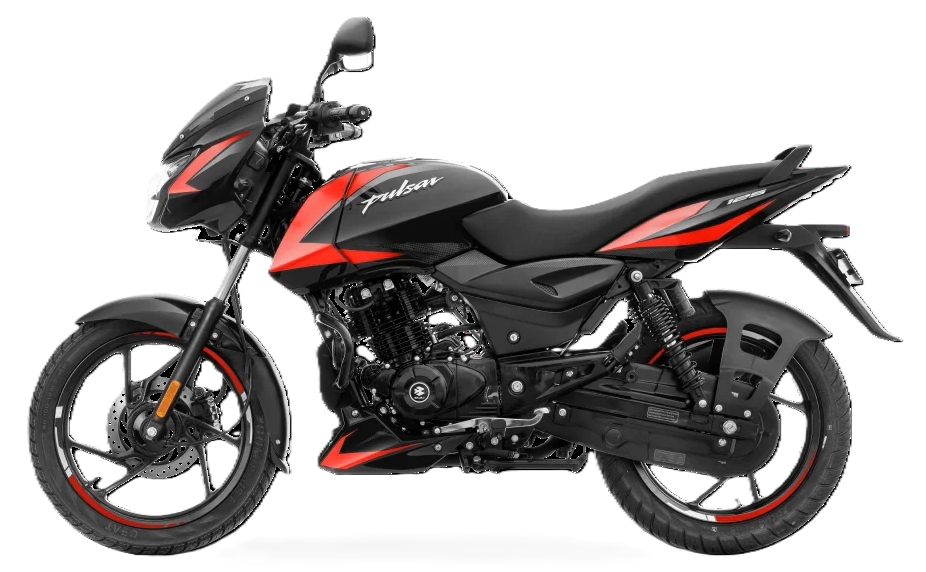
Bajaj Pulsar 125
- 124.38 cc Air-Cooled, 2-valve
- 11.8 PS @ 8500 rpm
- 57 km/l (ARAI)
- 15-litre tank
- 3 variants available
- 15L tank + 5yr warranty + wide tyres
Full Specification Comparison
Every number that matters — side by side
| Specification | Honda CB 125 Hornet | Bajaj Pulsar 125 |
|---|---|---|
| Engine & Performance | ||
| Displacement | 123.94 cc | 124.38 cc |
| Cooling System | Air-Cooled | Air-Cooled |
| Max Power | 11.14 PS @ 7500 rpm | 11.8 PS @ 8500 rpm |
| Max Torque | 11.2 Nm @ 6000 rpm | 10.8 Nm @ 6500 rpm |
| Valves per Cylinder | 2 | 2 |
| Compression Ratio | 10.0 : 1 | 10.05 ± 0.3 : 1 |
| Bore × Stroke | 50.0 × 63.121 mm | 52 × 58.6 mm |
| Spark Plugs | 1 Per Cylinder | 2 Per Cylinder |
| Emission Standard | BS6 Phase 2 | BS6 Phase 2 |
| Transmission | 5-Speed Manual | 5-Speed Manual |
| Top Speed | ~95 km/h | ~100 km/h |
| Start Type | Self Start (Silent) | Electric Start |
| Riding Modes | No | No |
| Traction Control | No | No |
| Fuel & Range | ||
| Mileage (Claimed / ARAI) | ~48 km/l (Claimed) | 57 km/l (ARAI) |
| Real-world Mileage | ~42–48 km/l | 45–50 km/l |
| Fuel Tank | 12 litres | 15 litres |
| Reserve Capacity | 2 litres | 2.5 litres |
| Riding Range (Estimated) | ~660 km | ~700+ km |
| Brakes & Wheels | ||
| Braking System | Single Channel ABS | CBS |
| Front Brake | Disc – 240 mm | Disc – 240 mm |
| Rear Brake | Drum – 130 mm | Drum – 130 mm |
| Tyre Type | Tubeless | Tubeless |
| Tyre Size (F / R) | 80/100-17 / 110/80-17 | 80/100-17 / 100/90-17 |
| Wheel Size | 17-inch | 17-inch |
| Wheel Type | Alloy | Alloy |
| Suspension & Chassis | ||
| Front Suspension | Upside Down Fork (USD) | Telescopic |
| Rear Suspension | Monoshock | Twin Gas Shock |
| Chassis | Diamond Type | Tubular Frame |
| Rear Preload Adjuster | No | Yes |
| Dimensions & Weight | ||
| Kerb Weight | 124 kg | 144–146 kg |
| Seat Height | 796 mm | 790 mm |
| Ground Clearance | 166 mm | 165 mm |
| Wheelbase | 1330 mm | 1320 mm |
| Overall L × W × H | 2015 × 783 × 1087 mm | 2055 × 755 × 1060 mm |
| Features & Electronics | ||
| Instrument Console | 4.2-inch TFT Digital | Digital (Semi-Digital on base variant) |
| Headlight | LED | Halogen / LED (variant dependent) |
| DRLs | Yes | No |
| Turn Signals | LED | Bulb |
| Tail Light | LED | LED |
| Hazard Warning Lights | No | No |
| Bluetooth Connectivity | Yes (all variants) | Yes (select variants) |
| Call & SMS Alerts | Yes | Yes (Bluetooth variants) |
| USB Charging Port | Yes | Yes (select variants) |
| Distance to Empty | Yes | Yes |
| Gear Indicator | Yes | Yes |
| Tachometer | Digital | No |
| Clock | Yes | Yes |
| Service Reminder | Yes | Yes |
| Silent Start | Yes | No |
| Side Stand Engine Cut-off | Yes | Yes |
| Keyless Ignition | No | No |
| Price & Warranty | ||
| Starting Price (ex-showroom) | ₹1,14,423 | ₹82,420 |
| Top Variant Price | ₹1,14,423 | ₹92,691 |
| Number of Variants | 1 | 3 |
| Standard Warranty | 3 Years | 5 Years / 75,000 km |
★ Green highlights indicate the stronger value in each row. Prices are ex-showroom India averages and may vary by city.
Variant-wise Price Comparison
All variants laid out — find the right one for your budget
Honda CB 125 Hornet Variants
Bajaj Pulsar 125 Variants
Pros & Cons
Honest strengths and weaknesses of each bike
Pros
- Premium 4.2-inch TFT display — best in 125cc class
- Bluetooth + call/SMS alerts as standard on all variants
- Segment-first USD front forks for superior handling
- Single-channel ABS for safer emergency braking
- Full LED lighting with DRLs, LED turn signals and tail light
- USB charging port and digital tachometer standard
- Silent ACG start for quieter ignition
- Significantly lighter at 124 kg vs 144–146 kg
- Higher torque — 11.2 Nm vs 10.8 Nm
Cons
- ₹32,003 more expensive than Pulsar 125 base
- Lower mileage — 48 km/l claimed vs 57 km/l ARAI
- Only 1 variant — no budget choice
- Smaller 12-litre fuel tank
- Shorter 3-year warranty vs 5-year on Pulsar 125
- Narrower rear tyre (110/80-17 vs 100/90-17)
- No rear preload adjuster
- No hazard warning lights
Pros
- More power — 11.8 PS @ 8500 rpm
- Better ARAI mileage — 57 km/l (vs 48 km/l claimed)
- ₹32,003 cheaper at base (₹82,420 vs ₹1,14,423)
- Excellent 5-year / 75,000 km warranty
- Significantly larger 15-litre fuel tank
- Wider rear tyre (100/90-17) for better road grip
- Rear preload adjuster on suspension
- 3 variant options including budget Neon variant
- Dual spark plug engine for smoother combustion
- LED tail light and classic Pulsar styling
Cons
- No ABS — only CBS braking system
- Conventional telescopic forks vs USD on CB Hornet
- Base variant has semi-digital console and halogen headlight
- Bluetooth only on Carbon Fibre variants
- Significantly heavier at 144–146 kg
- No full LED lighting (bulb turn signals)
- No DRLs on any variant
- No silent start, no tachometer
Key Differences Explained
What really sets these two bikes apart
Engine & Performance
Both bikes use 124cc air-cooled, 5-speed engines but with differing approaches. The Pulsar 125 produces 11.8 PS @ 8500 rpm with a dual-spark plug setup for more efficient combustion. The CB 125 Hornet produces 11.14 PS @ 7500 rpm but edges ahead with slightly more torque at 11.2 Nm vs 10.8 Nm — better for low-speed city pulling power. The CB Hornet's silent ACG start and refined Honda engine character add to its premium feel, while the Pulsar's higher redline delivers a sportier, more energetic character.
Fuel Efficiency & Range
The Pulsar 125 leads with an ARAI-certified 57 km/l versus the CB 125 Hornet's claimed 48 km/l — a substantial 19% difference. More critically, the Pulsar 125's 15-litre fuel tank is 3 litres larger than the CB Hornet's 12-litre unit, giving it an estimated range of 700+ km against the Hornet's ~660 km. For daily commuters focused on running costs and refuel frequency, the Pulsar 125 offers a compelling practical advantage.
Braking & Safety
Both bikes share identical 240 mm front disc and 130 mm rear drum brake hardware, but the braking system is decisively different. The CB 125 Hornet uses single-channel ABS, preventing front wheel lockup during emergency stops. The Pulsar 125 uses only CBS without ABS. For safety-focused riders — particularly new riders or those riding in wet conditions — ABS provides a meaningful real-world advantage. The Pulsar 125 counters with a wider 100/90-17 rear tyre, providing more contact patch and grip.
Features & Technology
The CB 125 Hornet dominates in features. Its 4.2-inch TFT display with Bluetooth, call/SMS alerts, digital tachometer, DRLs, full LED lighting (including turn signals), and silent start are all standard — features unavailable on any Pulsar 125 variant. The Pulsar 125's Carbon Fibre variants add Bluetooth and LED headlight but use bulb turn signals, no DRLs, no tachometer, and no USD forks. The CB Hornet also has significantly better suspension hardware with USD forks. The Pulsar 125's base Neon variant at ₹82,420 is the most basic of all, with a semi-digital console and halogen headlight.
Warranty & Ownership
The Pulsar 125 comprehensively wins on warranty: 5 years / 75,000 km versus the CB 125 Hornet's 3 years (no stated kilometre limit). The Pulsar 125 is also significantly lighter on the wallet — its annual service costs of ₹1,000–₹1,500 are comparable to the Hornet's ₹700–₹1,200 estimated costs. Bajaj's wide service network makes maintenance accessible nationwide. Honda's network is equally extensive but the Hornet's higher purchase cost increases the overall ownership investment considerably.
Price & Value
The Pulsar 125 starts at ₹82,420 — a massive ₹32,003 less than the CB 125 Hornet's ₹1,14,423. Even the top Pulsar 125 Carbon Fibre Split Seat at ₹92,691 is ₹21,732 cheaper. For that premium on the CB Hornet, buyers get ABS, USD forks, a TFT display, full LED lighting with DRLs, and Bluetooth standard. Whether that justifies a 39% higher purchase price is the key question each buyer must answer for themselves.
Expert Verdict
Which one should you actually buy?
Buy the Honda CB 125 Hornet if…
- A 4.2-inch TFT display with Bluetooth is non-negotiable
- ABS for safer braking — especially in wet or emergency situations
- USD front forks for superior handling and stability
- Full LED lighting with DRLs adds to your riding experience
- You want a significantly lighter bike (124 kg vs 144–146 kg)
- Silent ACG start appeals to you
- Budget is flexible and the ₹32,003 premium is acceptable
Buy the Bajaj Pulsar 125 if…
- Budget matters — starts ₹32,003 cheaper at base
- A 15-litre fuel tank for longer range between fill-ups
- Better ARAI mileage (57 km/l) for lower daily running costs
- 5-year / 75,000 km warranty for long-term peace of mind
- A wider rear tyre (100/90-17) for more road grip and stability
- Sporty muscular Pulsar styling appeals more than naked streetfighter design
- More power (11.8 PS) matters for spirited riding
Two bikes separated by ₹32,000 and a clear feature divide. The Honda CB 125 Hornet is the most premium 125cc motorcycle available, packing TFT display, ABS, USD forks and full LED lighting into a lightweight 124 kg package. But at ₹1,14,423, it costs nearly as much as entry-level 150–160cc streetfighters. The Bajaj Pulsar 125 at ₹82,420 offers more power, better mileage, a much larger fuel tank, wider rear tyre, and a class-leading 5-year / 75,000 km warranty — all at a price that undercuts the CB Hornet by ₹32,003. For most budget-conscious commuters, the Pulsar 125 is the smarter everyday buy. Choose the CB 125 Hornet only if ABS, TFT and premium hardware are genuinely worth the substantial premium for you.
Frequently Asked Questions
Common questions answered by our experts
The Honda CB 125 Hornet is better for riders who want TFT display, ABS, USD forks and full LED lighting as standard — all premium features at a ₹32,003 premium over the Pulsar 125. The Bajaj Pulsar 125 is better for riders who want more power (11.8 PS), better ARAI mileage (57 km/l), a lower price (₹82,420), a much larger 15-litre tank, a 5-year / 75,000 km warranty, and a wider rear tyre. The Pulsar 125 delivers better value on most practical metrics.
The Bajaj Pulsar 125 starts at ₹82,420 while the Honda CB 125 Hornet is priced at ₹1,14,423 — a base difference of ₹32,003. The top Pulsar 125 Carbon Fibre Split Seat variant at ₹92,691 is still ₹21,732 cheaper than the CB 125 Hornet's single variant. All prices are ex-showroom India averages and may vary by city.
The Bajaj Pulsar 125 has better mileage with an ARAI-certified 57 km/l compared to the Honda CB 125 Hornet's claimed 48 km/l. Real-world figures also favour the Pulsar 125 at 45–50 km/l. The Pulsar 125's much larger 15-litre tank (vs 12 litres) gives it a longer estimated riding range of 700+ km against the CB Hornet's ~660 km.
The Bajaj Pulsar 125 makes more peak power at 11.8 PS @ 8500 rpm compared to the Honda CB 125 Hornet's 11.14 PS @ 7500 rpm. However, the CB 125 Hornet produces more torque at 11.2 Nm vs 10.8 Nm. Both reach approximately 95–100 km/h top speed and are closely matched in real-world city performance.
Yes, the Honda CB 125 Hornet comes with single-channel ABS as standard on its single variant, offering a meaningful safety advantage during emergency braking. The Bajaj Pulsar 125 does not offer ABS on any of its three variants, instead using CBS (Combined Braking System) with a 240 mm front disc and 130 mm rear drum.
The Bajaj Pulsar 125 offers a significantly better warranty at 5 years / 75,000 km compared to the Honda CB 125 Hornet's 3-year warranty (with no stated kilometre limit). For high-mileage daily commuters, the Pulsar 125's extended coverage provides substantially more protection against out-of-warranty repair costs.